Posts Tagged ‘Art’

Well, not footloose really, as I had planned everything for the trip – cities to visit, what I would see, where to stay…and booked everything as well. You see, I am not the guy who would just pick up a backpack and figure out stuff as it comes. I have been told that the uncertainty is fun; perhaps it is. But to me, it is a bit stressful. So, I started out after charting out everything but with a willingness to change, if the need arose. 

The focus of the trip was to visit some cities in Eastern European countries that I had not visited in the past (Prague, Bratislava, Budapest, Zagreb, Split, Ljubljana, Cesky Krumlov, Tallinn, Riga and Vilnius) as well as some cities in Northern Europe (Helsinki and Copenhagen) and then end with a drive in the Scottish wilderness. The expected duration was six weeks, and this would be the longest solo trip I had been on, so far. Of course, about 10 days after I started, Sri joined for a few days and then she left. Then Jay and Sri joined me in the last few days at Scotland. That was welcome as it broke the “monotony” of the solo trip. 

I started my trip in Amsterdam as my SCHENGEN visa was issued by The Netherlands. A chance encounter in a tram sent me to the contemporary art museum there and that seemed to set the tone for the whole trip as I only visited contemporary art museums and photography museums in all the cities I visited and not a single museum that showed traditional or classical European art. In most museums I visited, I felt the art is evolving. To my untrained eye, it looks a bit behind the times, though each museum had some brilliant work or the other. Of course, the issues they are focused on, are different. In the countries that used to be within the Iron Curtain, they are coming to terms with freedom and the issues caused by Capitalism. In the Northern cities like Helsinki, climate change is a real existential issue. At the Helsinki Biennale, I watched a brilliant video titled “Teardrops of our grandmother” by Jenni Laiti & Carl-Johan Utsi, which clearly brings out the issue they face because of climate change and glaciers melting. A sentence from the film stuck with me – “we should not live at a pace faster than that of the land and the body”. 

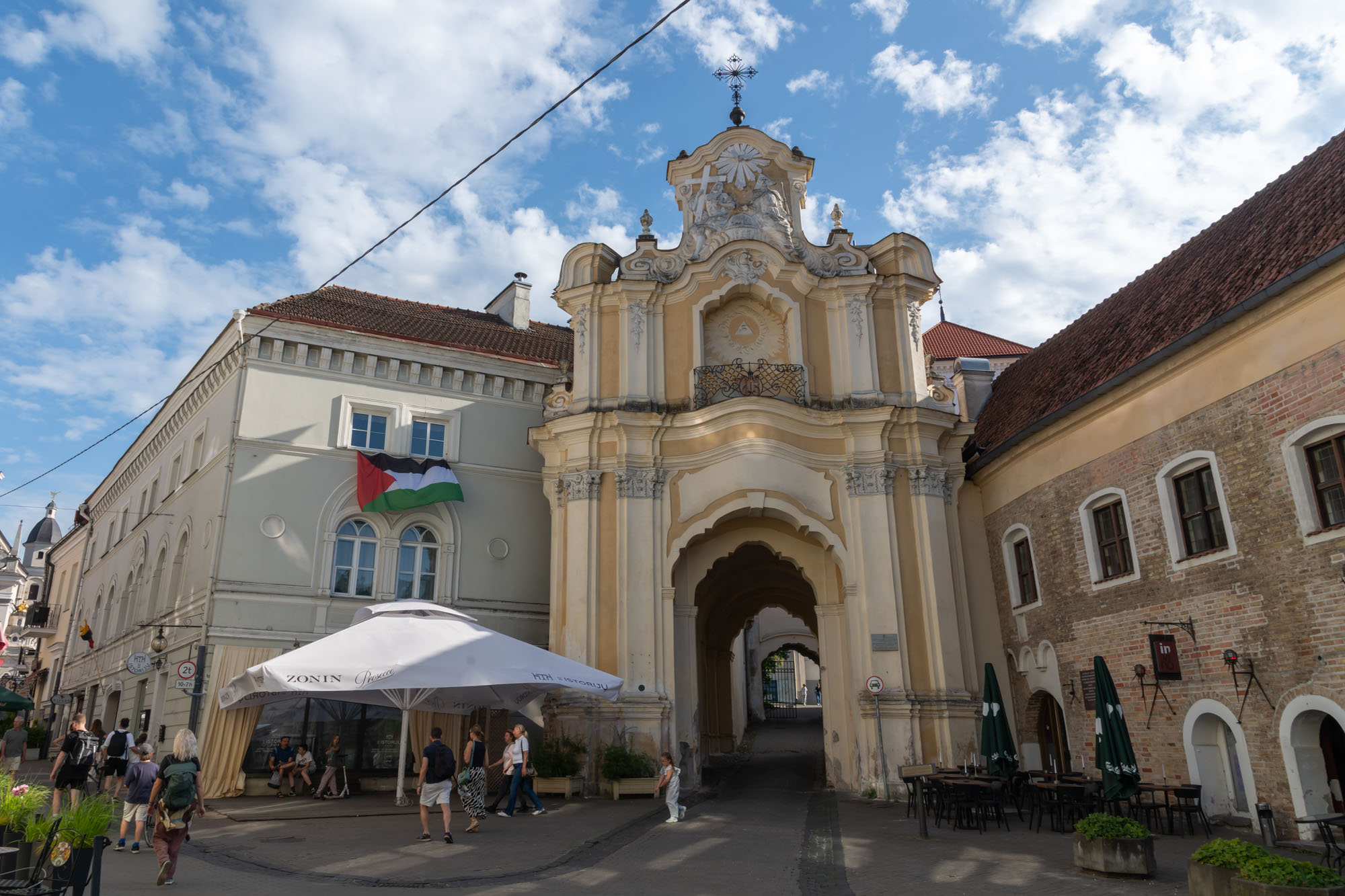
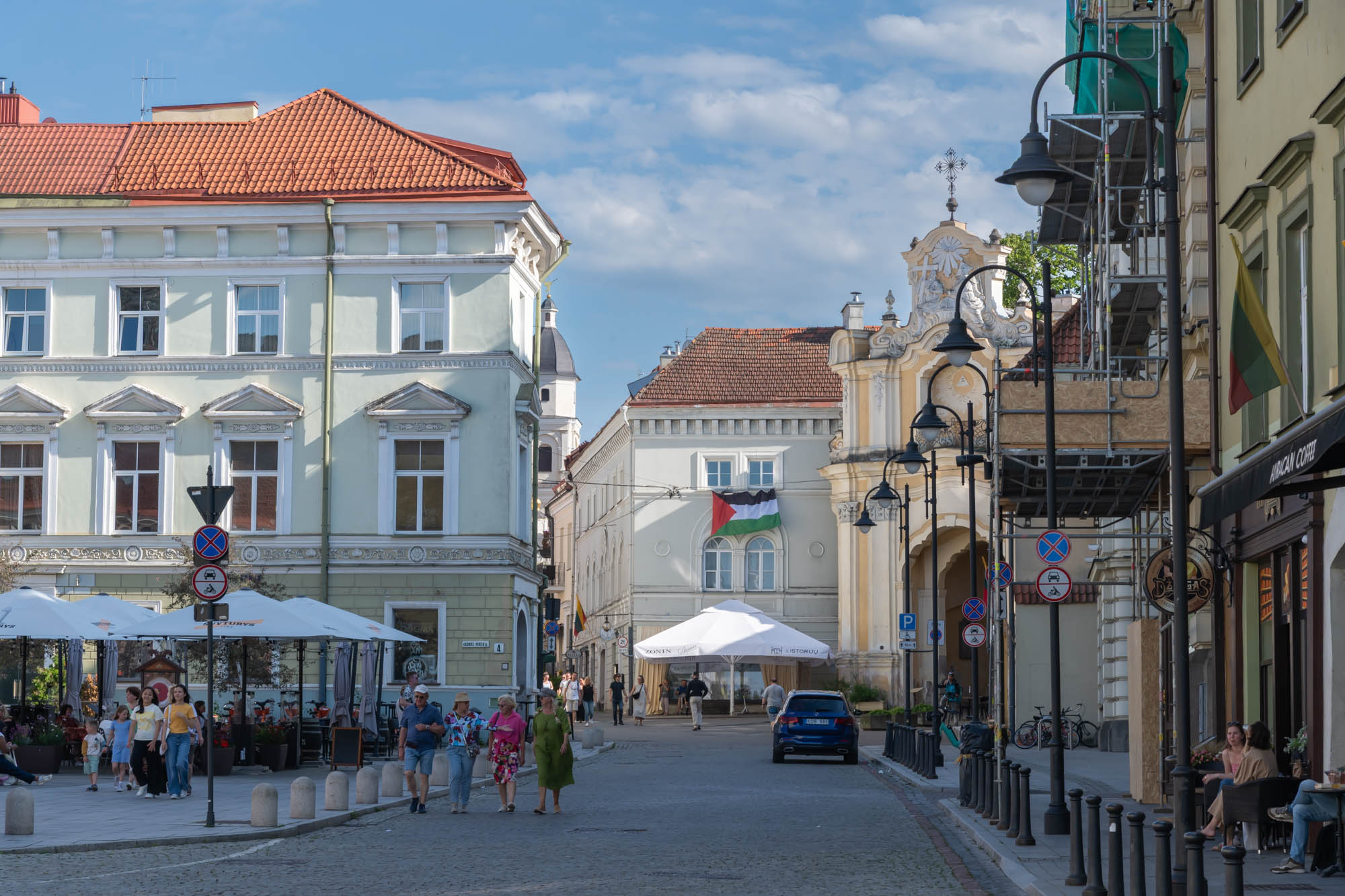
Europe’s official response to the Palestine issue has been downright deplorable and while you did find some instances of public support being displayed for the Palestinians (like the Ukranian church in Vilnius flying a Palestinian flag), the museums were noticeably silent on the issue, which is a shame. 
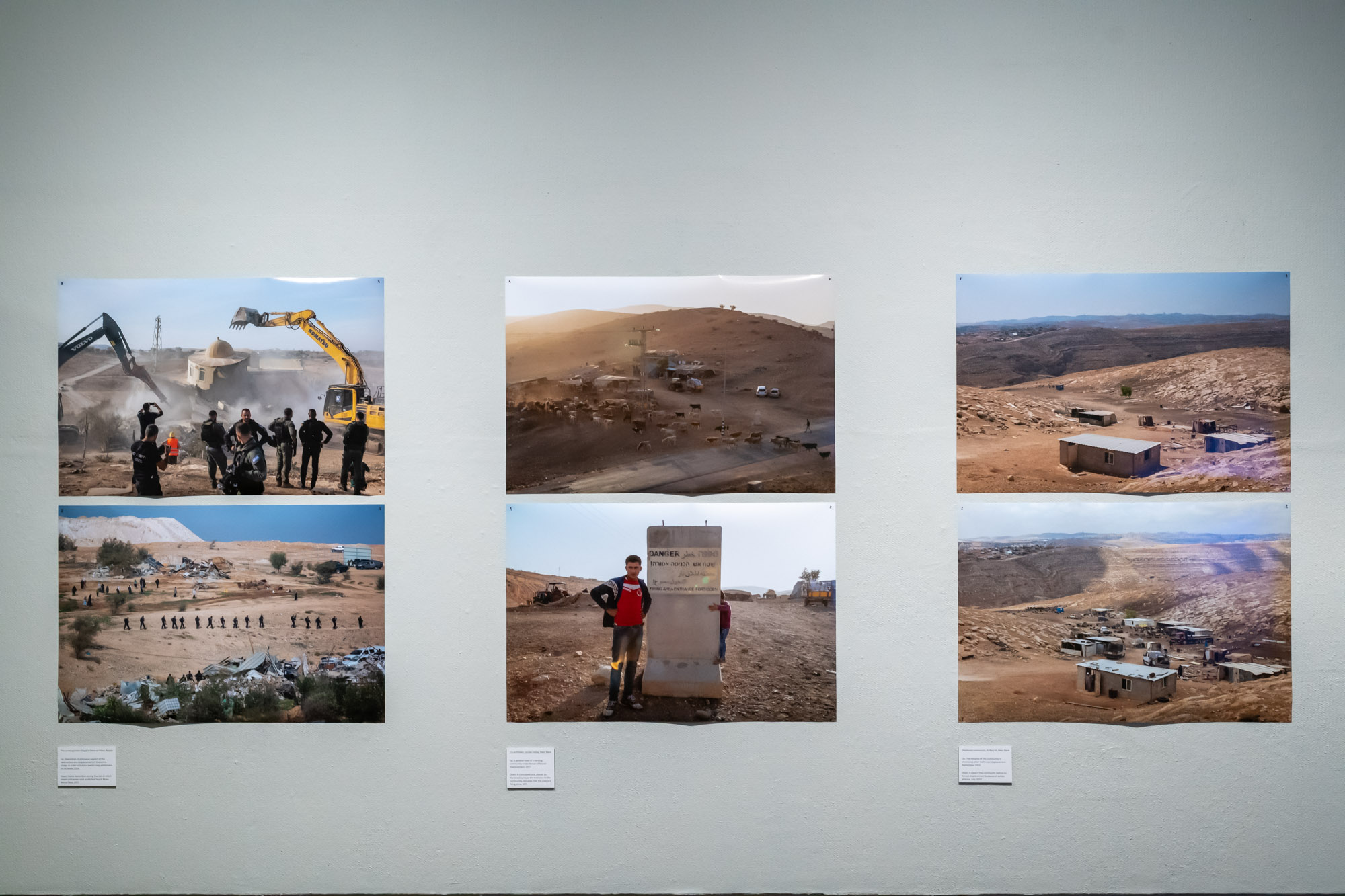
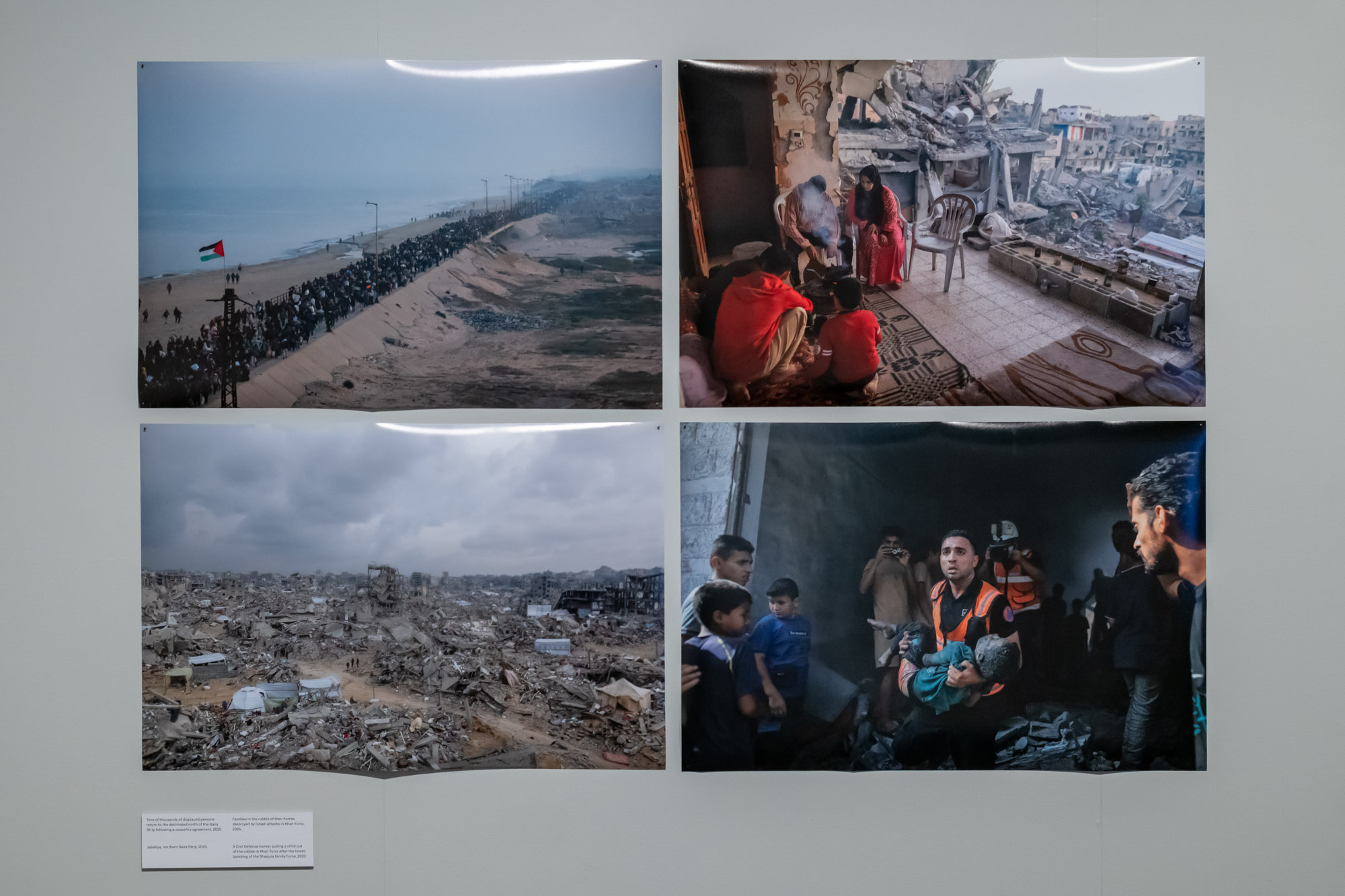
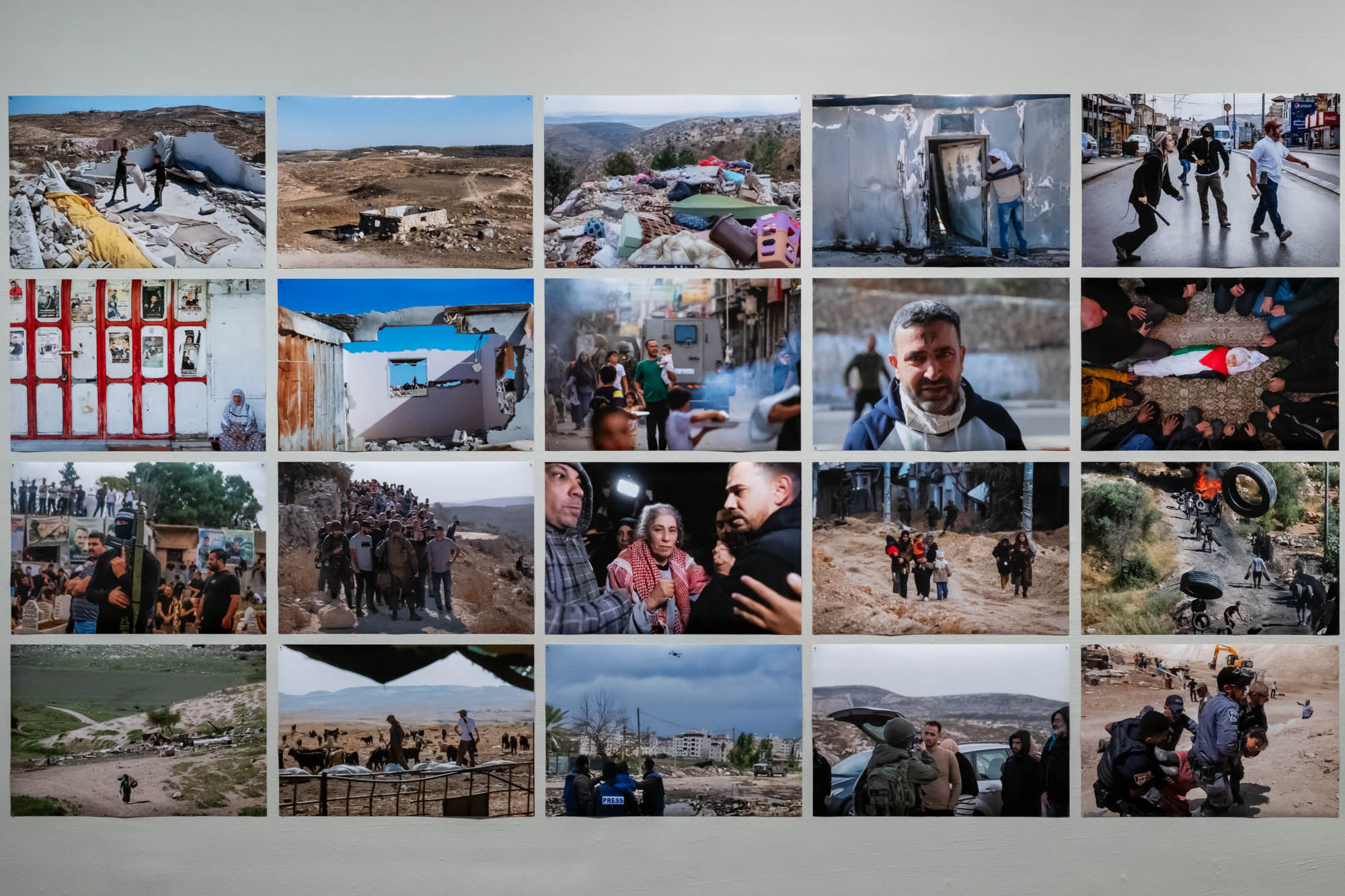
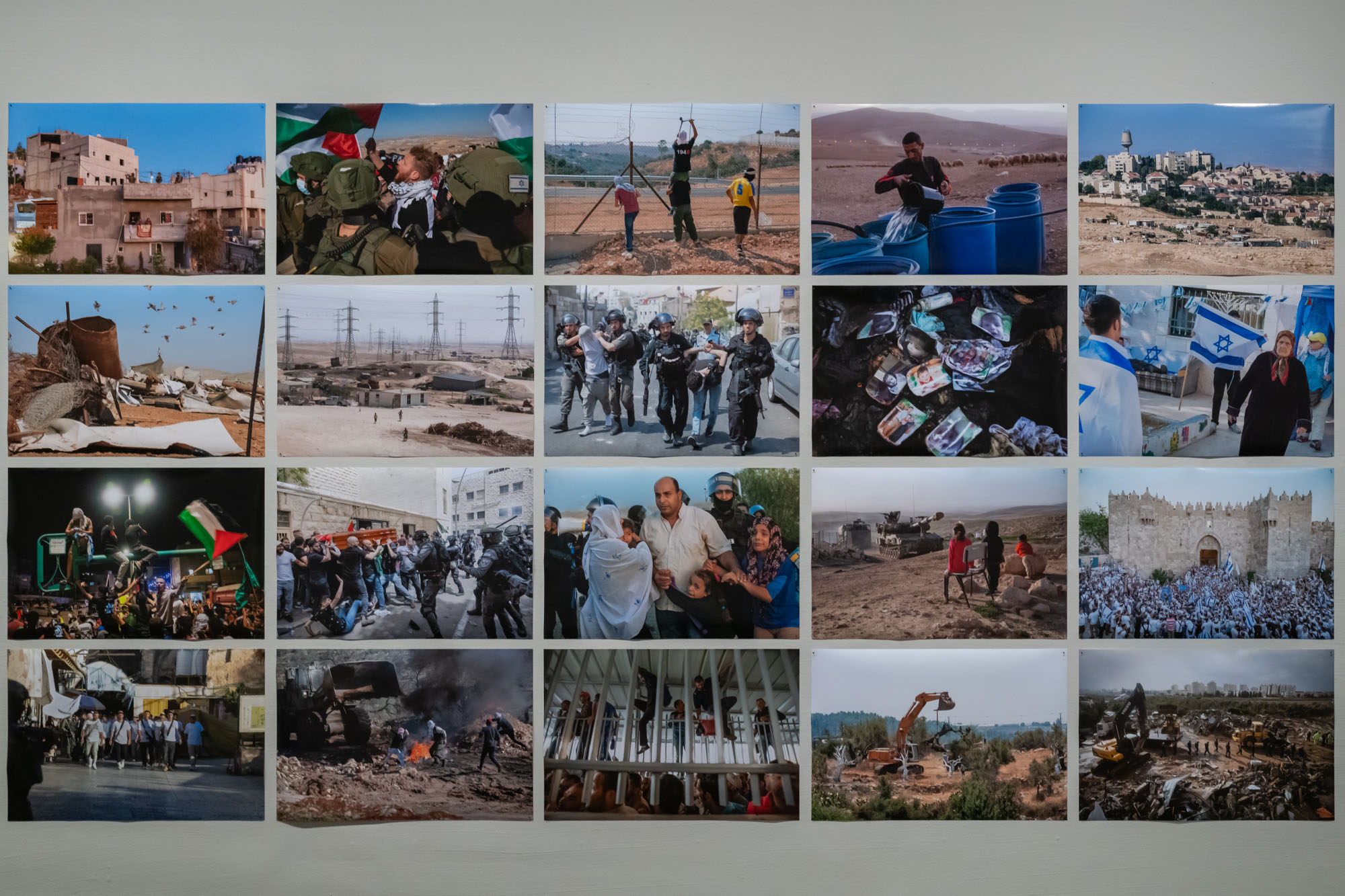
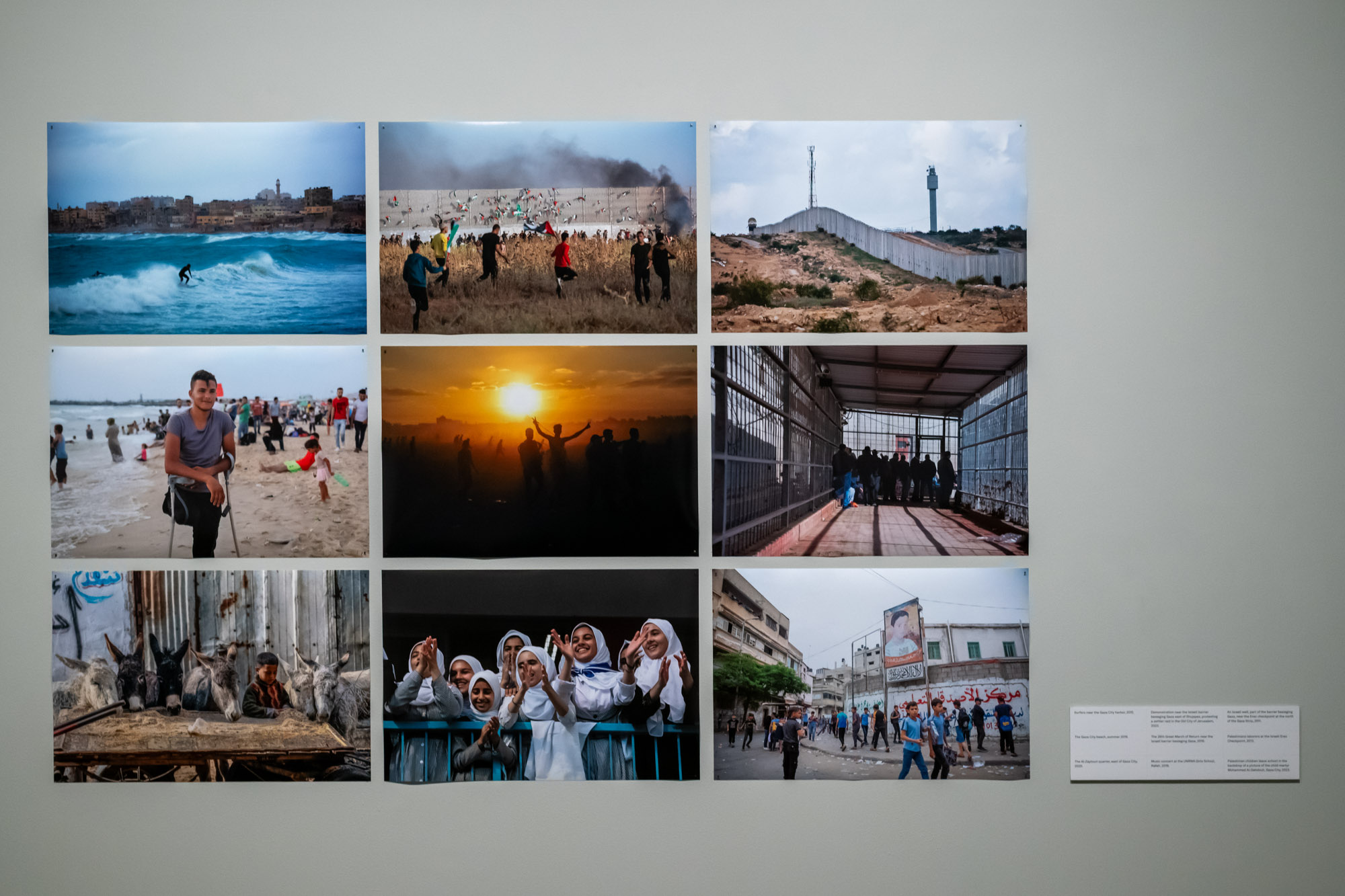
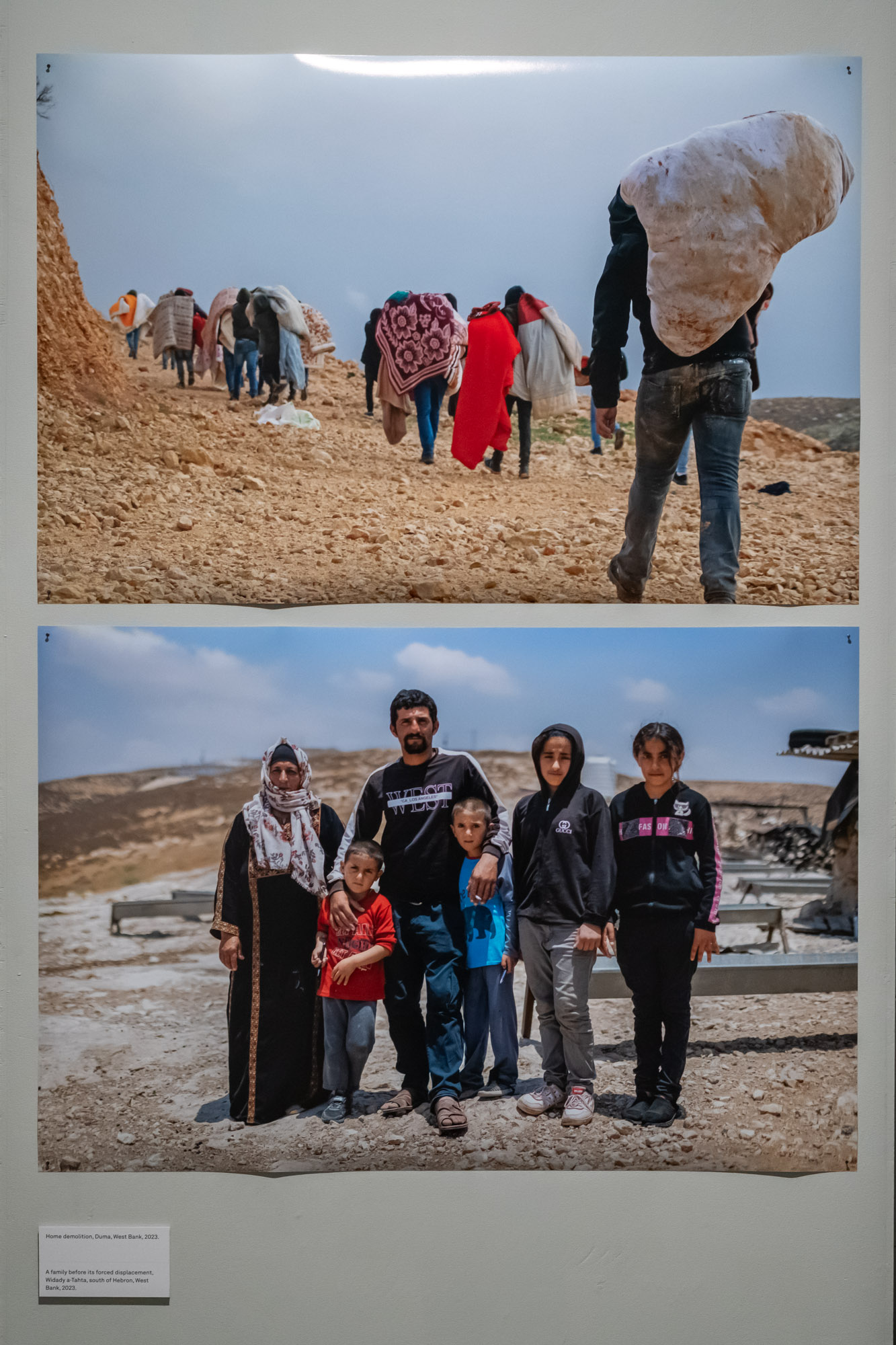
A welcome surprise was The Finnish Museum of Photography in Helsinki, which had organised an exhibition of photographs taken by a photography collective called “Activestills”. They have been documenting Israeli colonial violence and Palestinian resistance since 2005. 
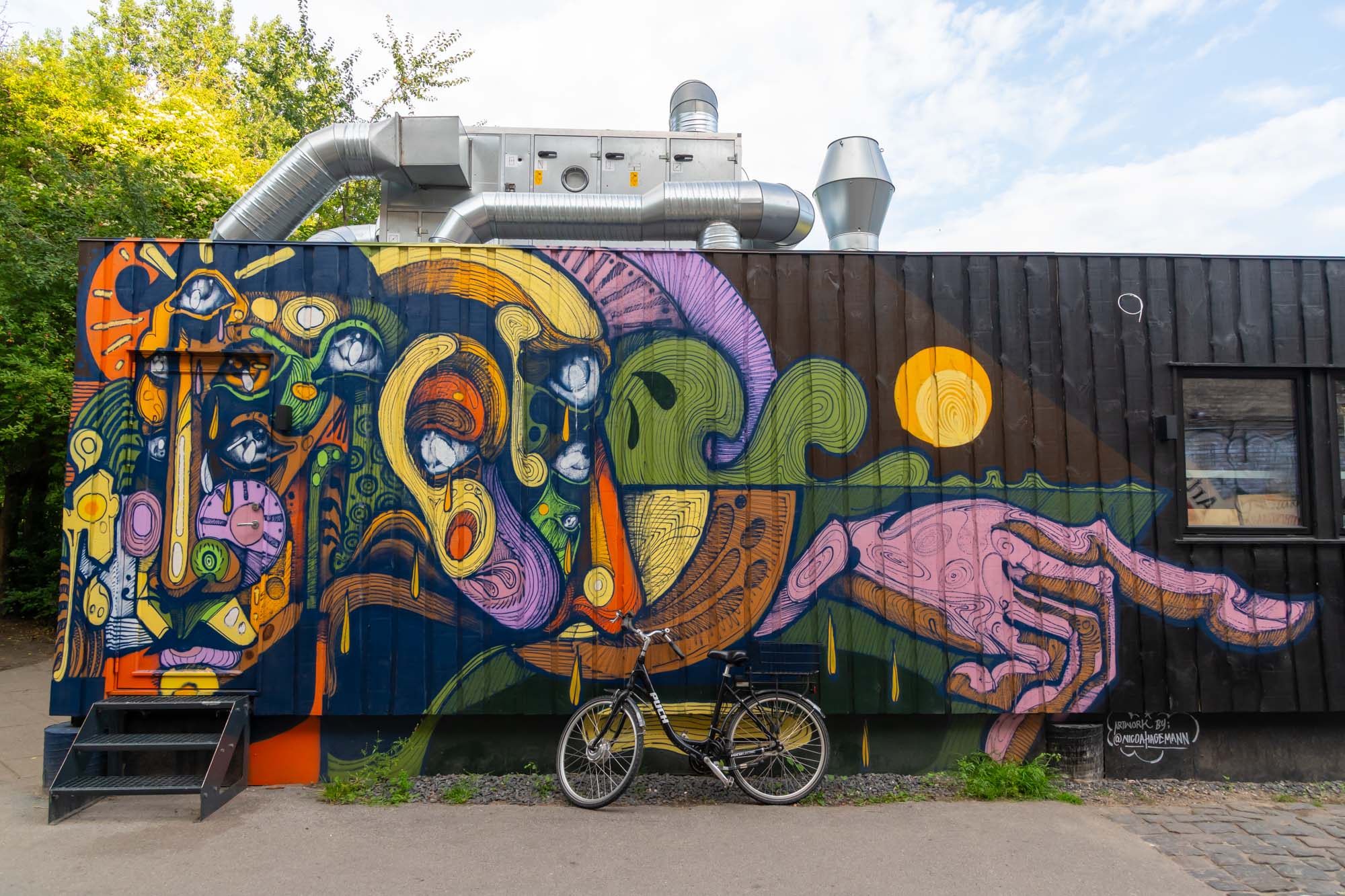
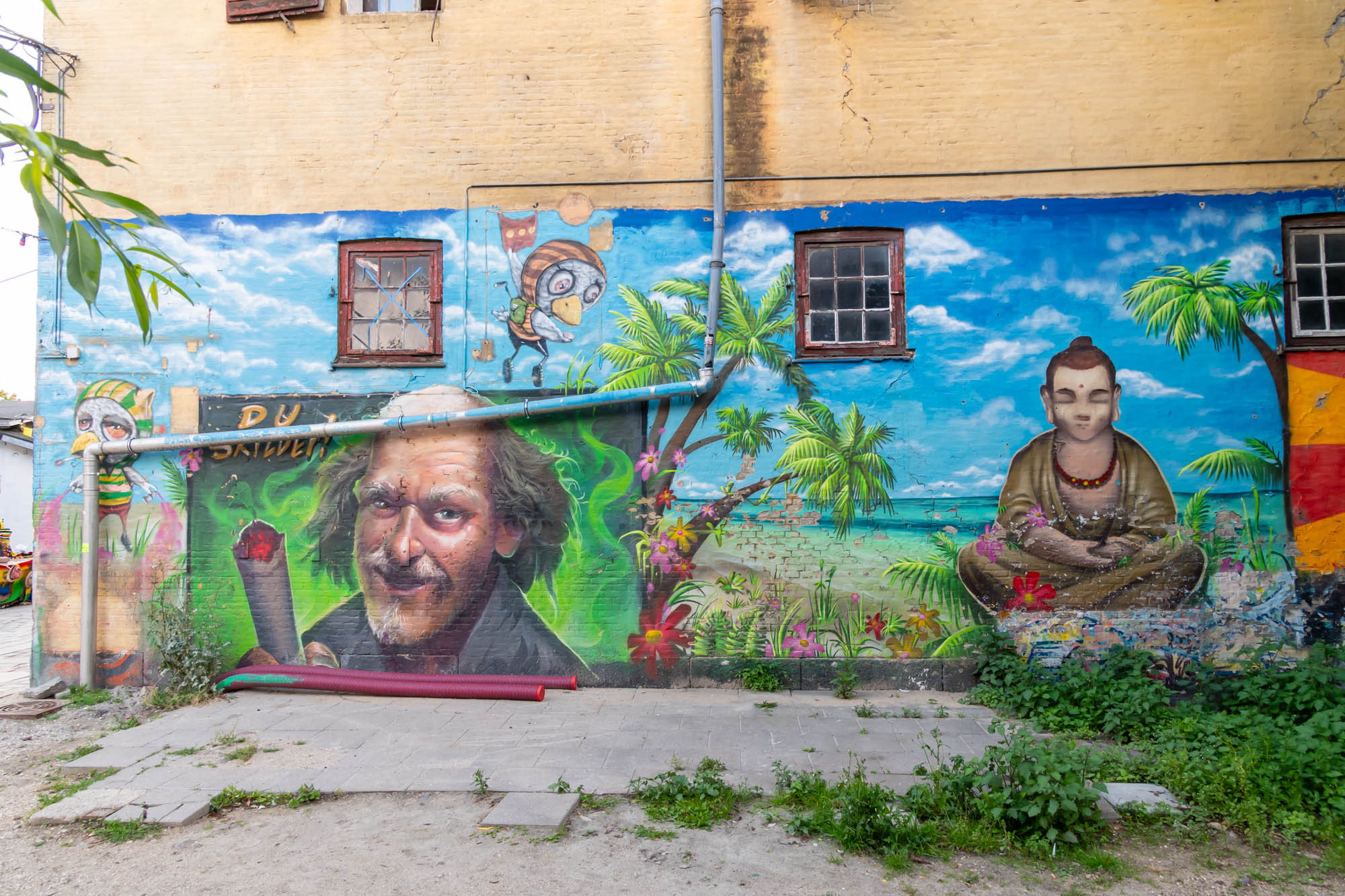
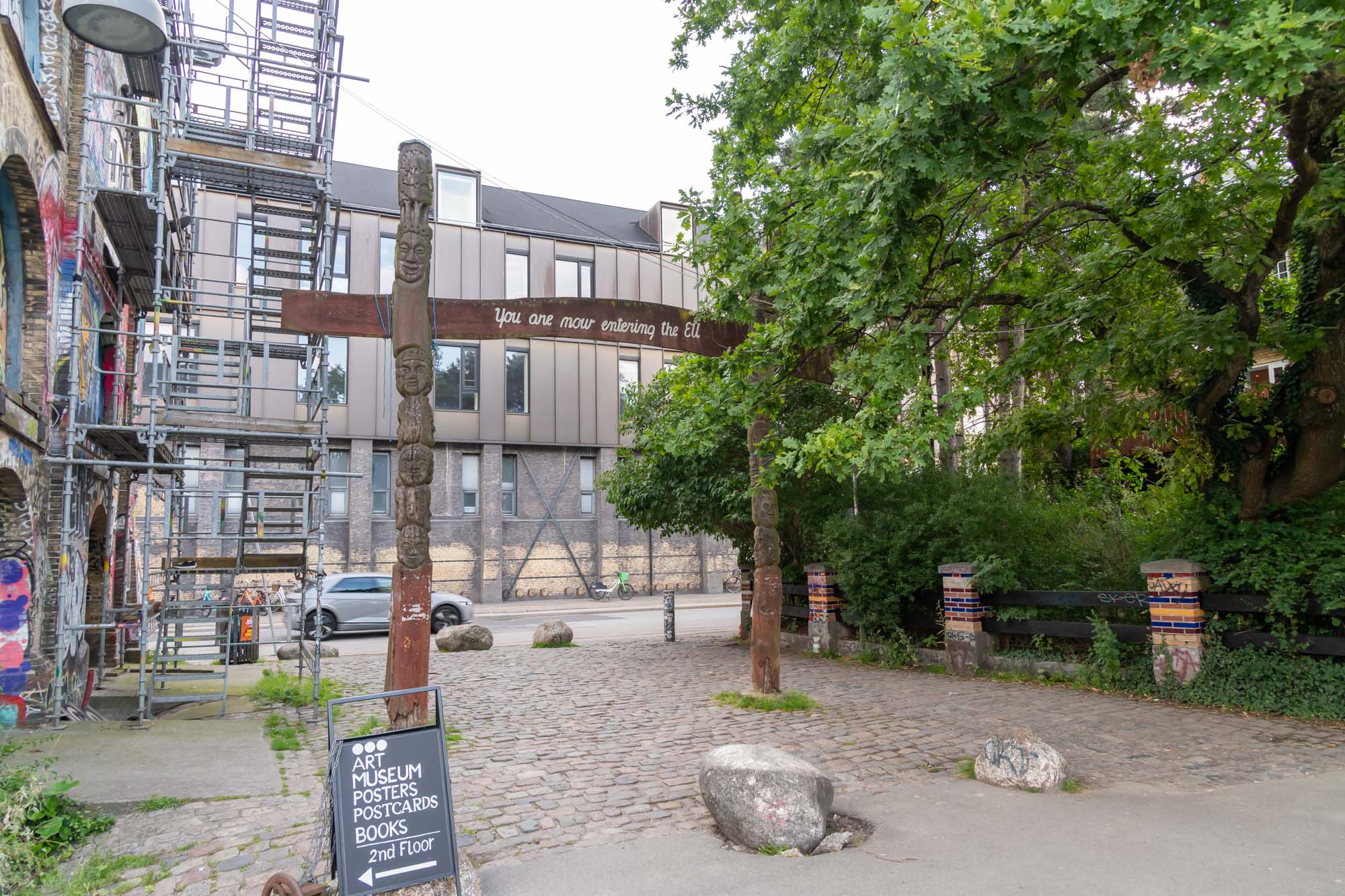
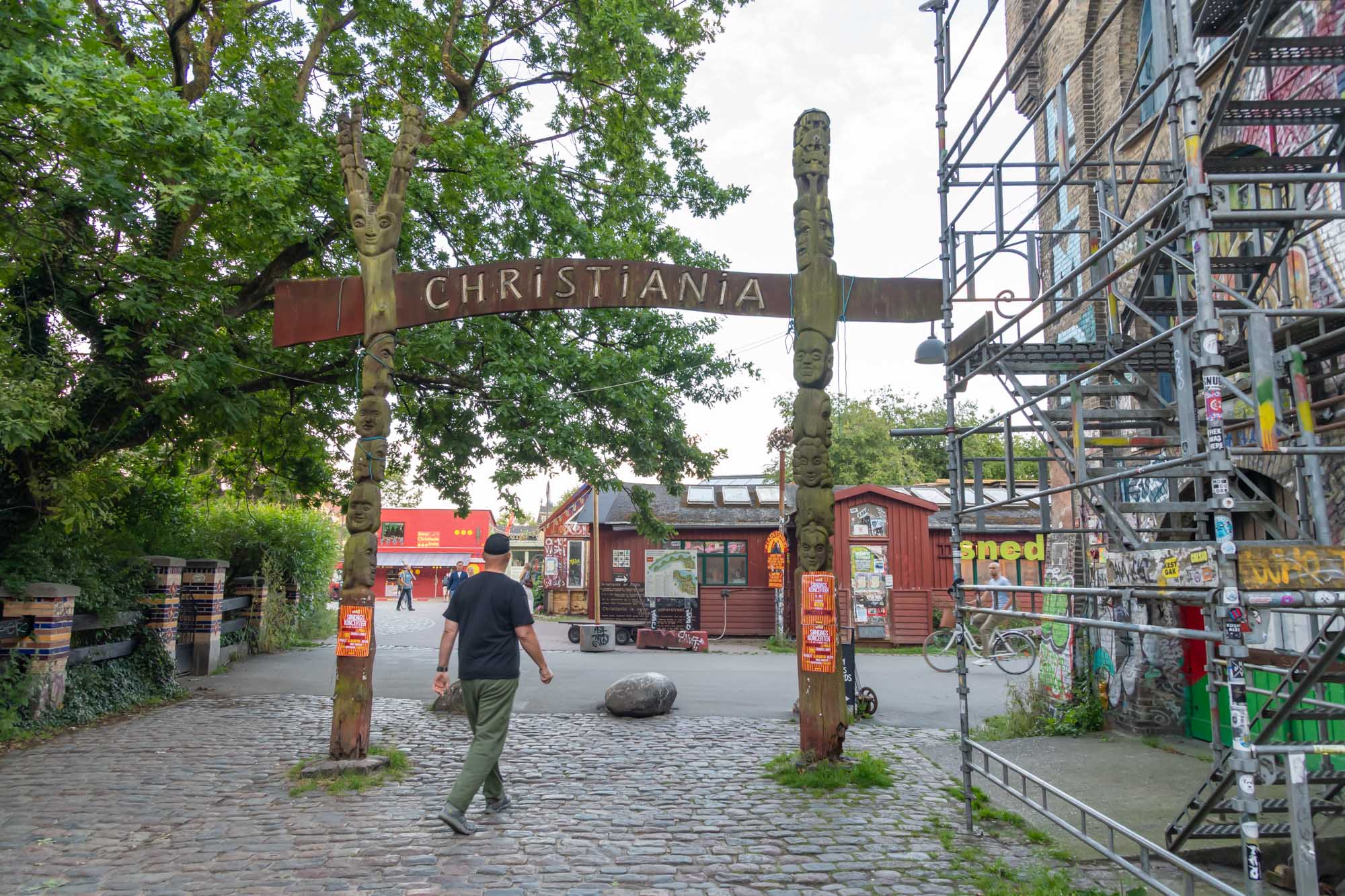
Later, when I was walking in the “independent region” of Christiania in Copenhagen, I met a gentleman with the Palestinian shawl Keffiyah draped around his shoulders. He said that he lives in Copenhagen and walks around like that quite often. It seems when he did that in Germany, he was warned by a friend to take it off as that could get him arrested. It seems he also got beaten by the police once during a protest, while he had the Keffiyah on him. He showed me various photos he had taken about protests in Denmark related to different issues. We talked a little bit about the rise of right-wing politics and such; two souls sharing their pain.

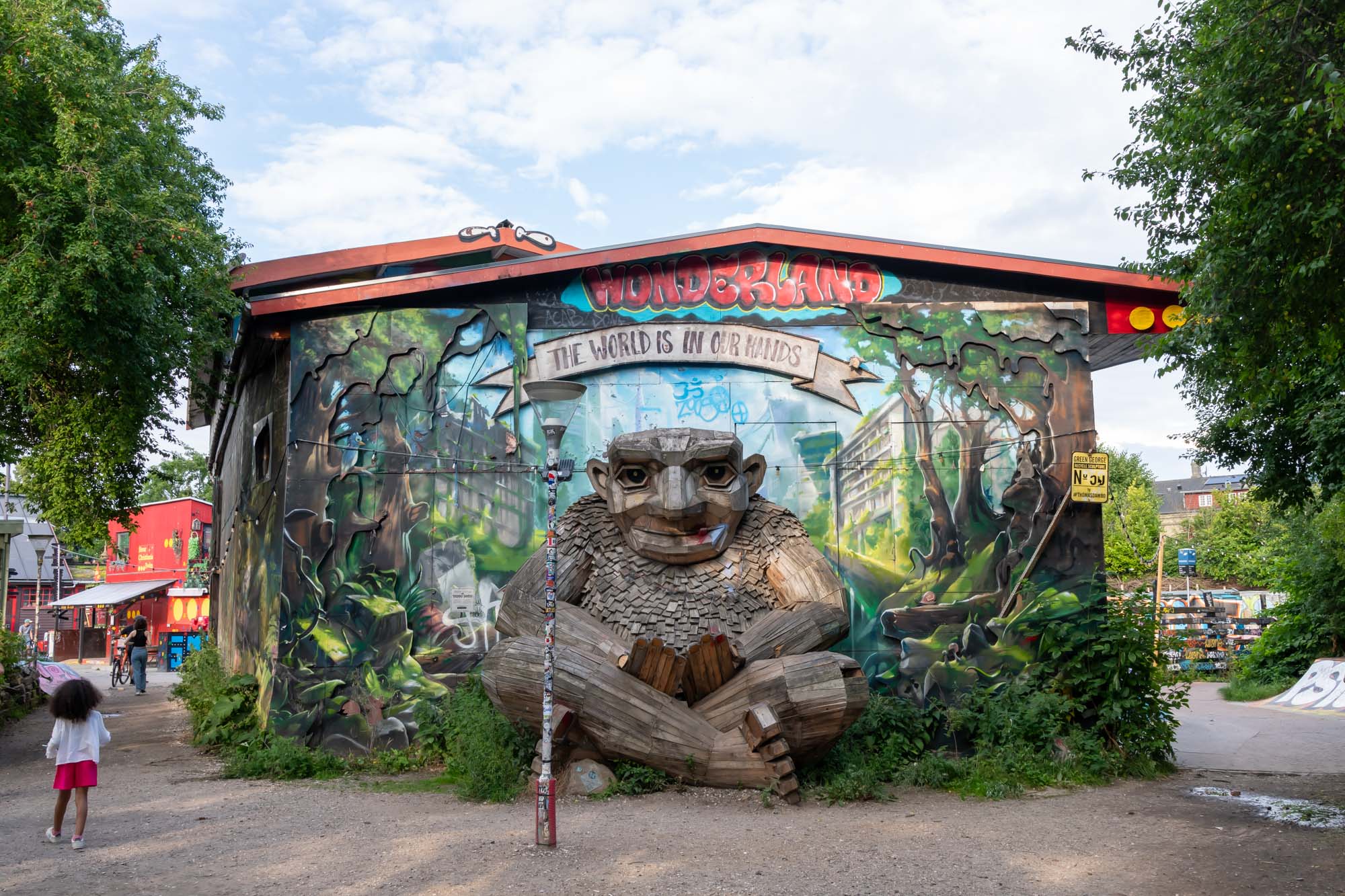
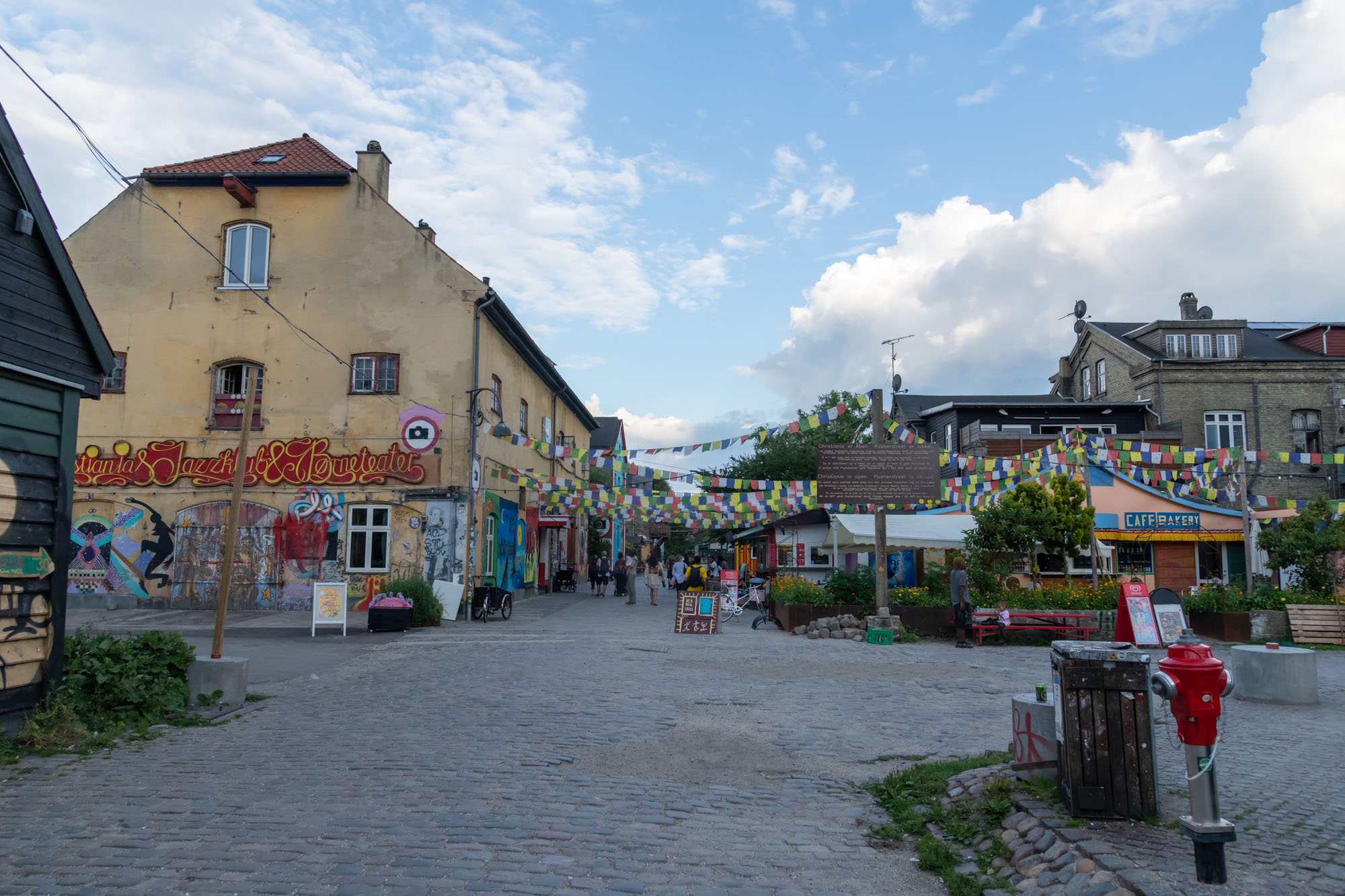
Christiania or Freetown Christiania is an anarchist commune that started in 1971, squatting on an old military base. It was a space for an alternate model of living and the place had its own currency and rules. The idea was to be a community that had space for all and be away from exploitation and discrimination. Over the years, some gangs started to dominate Christiania, and it became a paradise for drug peddlers with the main street being called Pusher Street. From the early 2000s the government started a push to bring Christiania under its control and now, it has more or less succeeded. Some of the erstwhile squatters in Christiania have bought their properties and now there is a move to evict all squatters. Cannabis and drug peddling is still going on, though much less visible now. There are about 800 to 1000 residents in Christiania now, spread over an area of about 19 acres. 

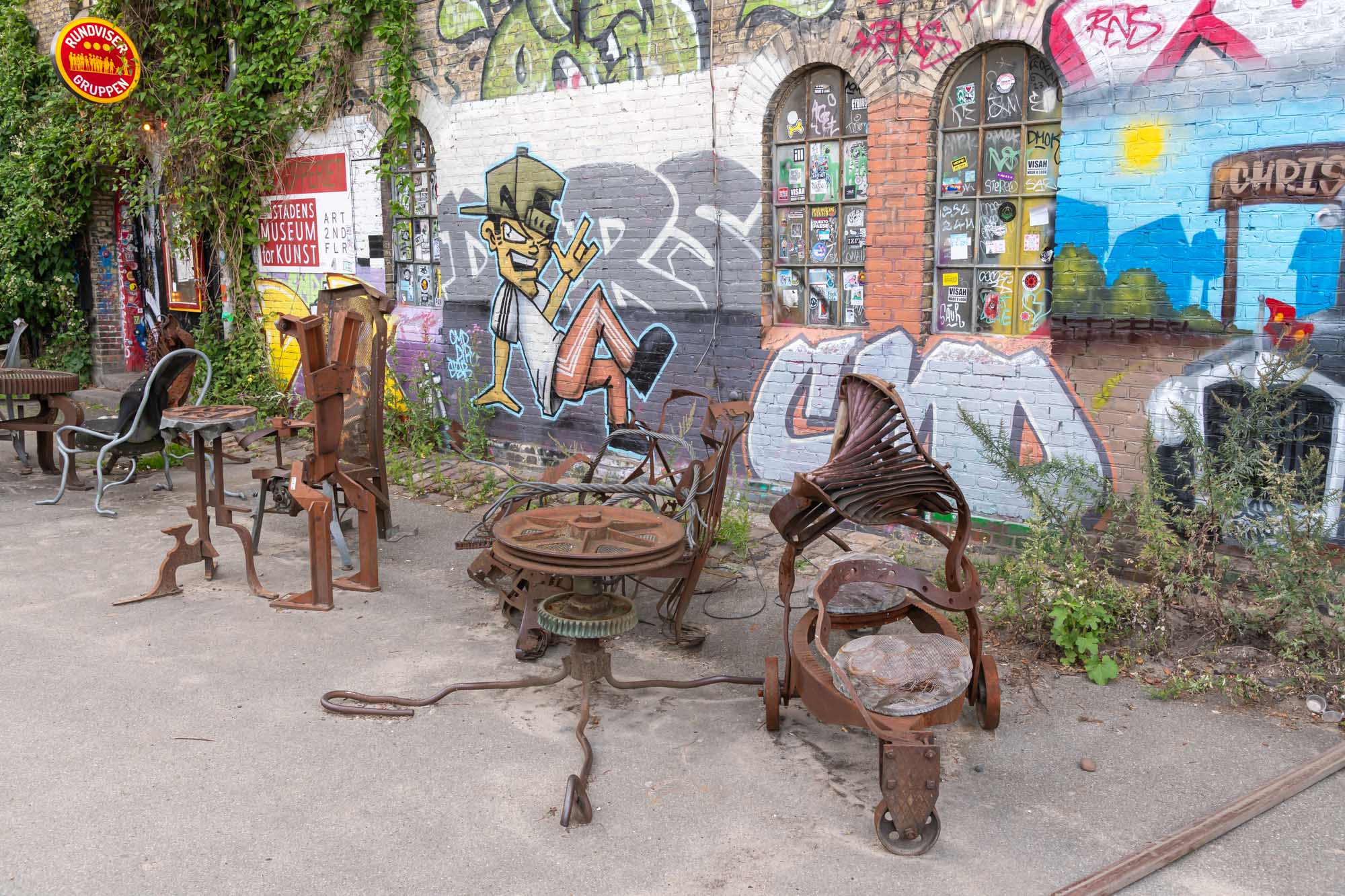
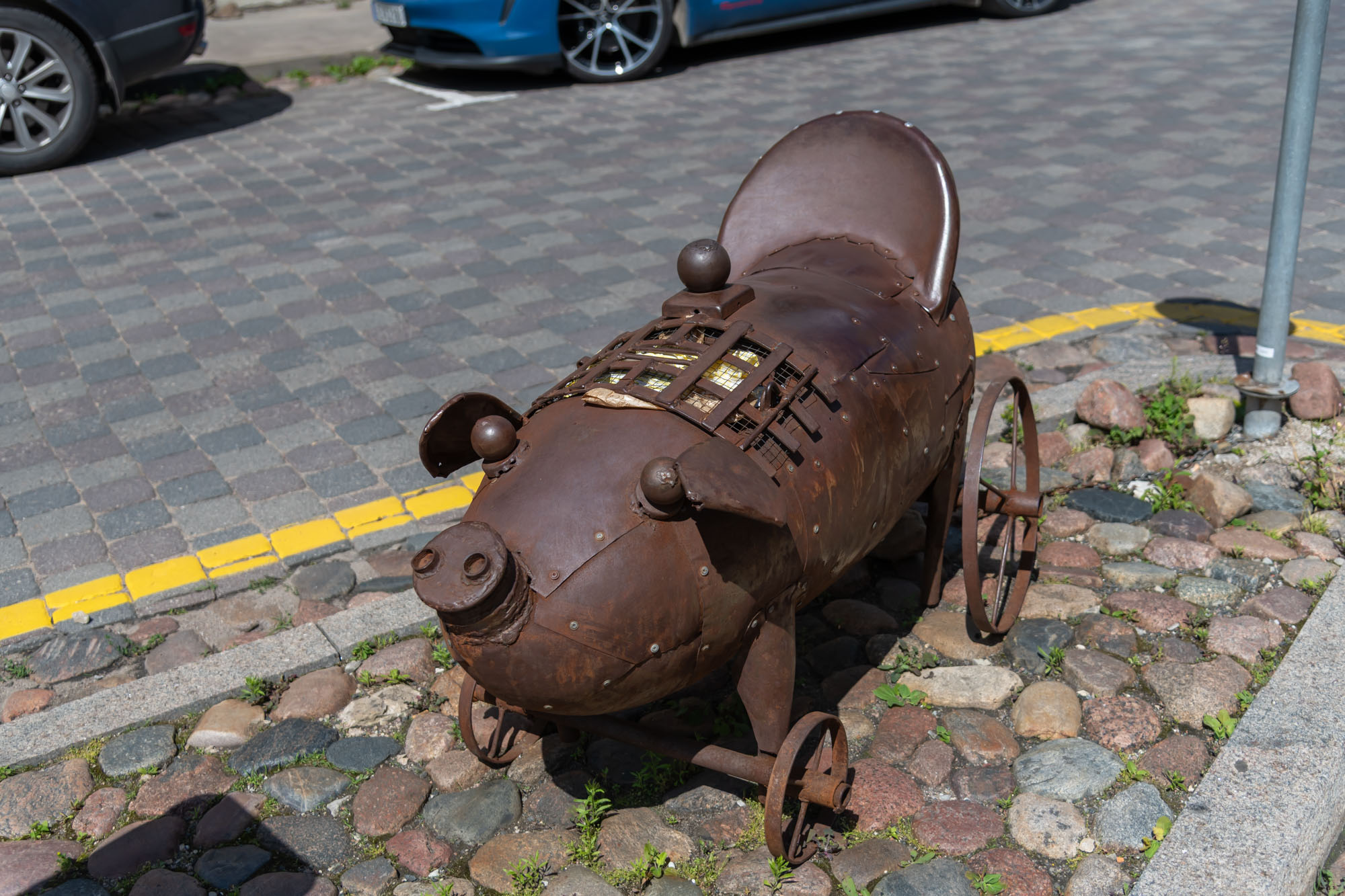
Today, Christiania has become a tourist attraction, and you find tourists walking around the place with little regard for the people that live there or their principles. These are people with an independent mindset and against the exploitative systems of capitalism and big corporations. Privacy is a very important concern for them. I had done my research before going there and so I was mindful that people would be wary of cameras there. I saw some furniture made of machine parts, which I wanted to photograph. There were a couple of people sitting near those and I asked one guy whether he was comfortable with me photographing the furniture. Something in the way I asked him, or my manner seemed to appeal to him, and he started talking to me. He told me that most of the tourists are a problem as they never spend anything in the place to support the local economy but were simply voyeuristic and looking at the residents as if they were some museum pieces. I agreed with him, and he told me he was speaking with me as he didn’t find that in me. Right then, an Indian family walked by with the man holding up a GoPro type camera and recording everything around him. Even I found it irritating and the gentleman I was speaking with (let us call him X), did not like it at all. However, he was polite in how he told the guy to not record. The man stopped his recording, but I found him doing it again later in another part of Christiania.

I spoke for quite some time with X and his friend, and he took me inside his workshop and showed me stuff he was working on. They told me that they are very sad at Christiania being gentrified and when I asked him whether the earlier model of a free town was workable, they were quite sure it was. They said the drug trade didn’t bother anybody, and people were using it on their freewill but then drugs weren’t the mainstay or the fundamental reason behind the commune. The idea was to have an alternate lifestyle, which was not dictated by the corporations. Christiania used to produce many goods that were consumed by the local people, and the economy was doing well. Sadly, corporations are taking over now and people who had been squatting there for 30-40 years are being kicked out. X himself has been staying there since the last forty years. 

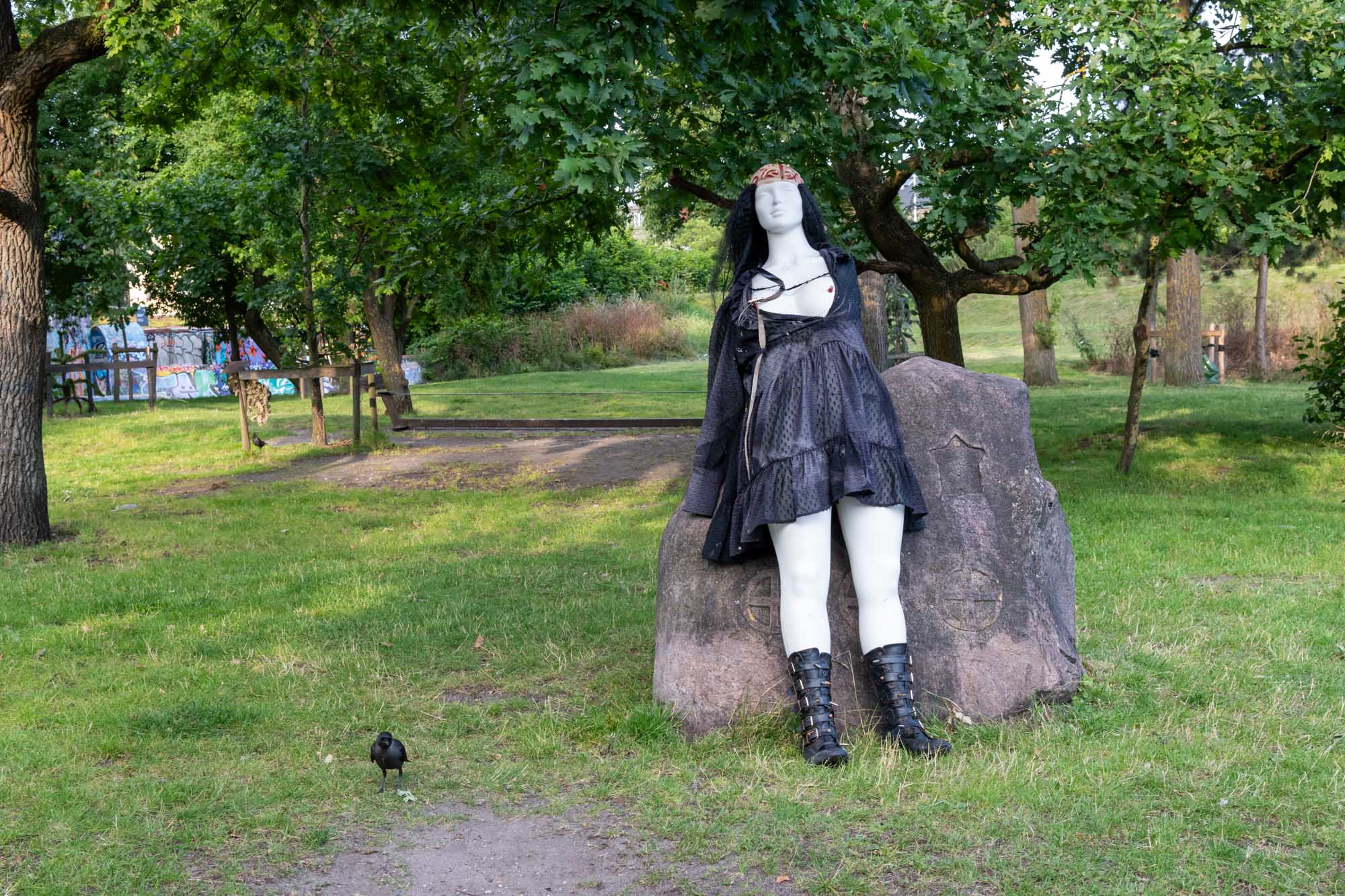
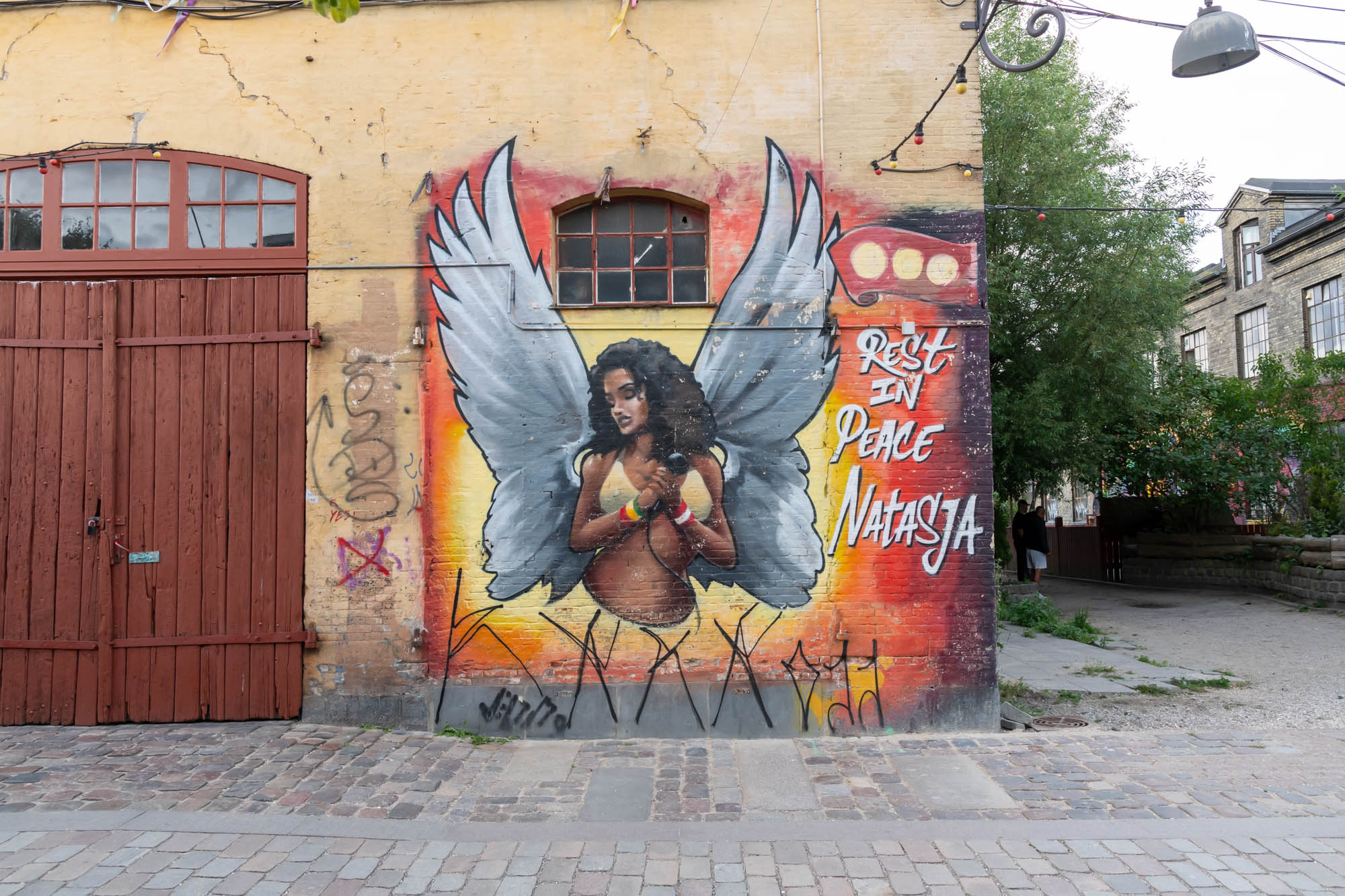
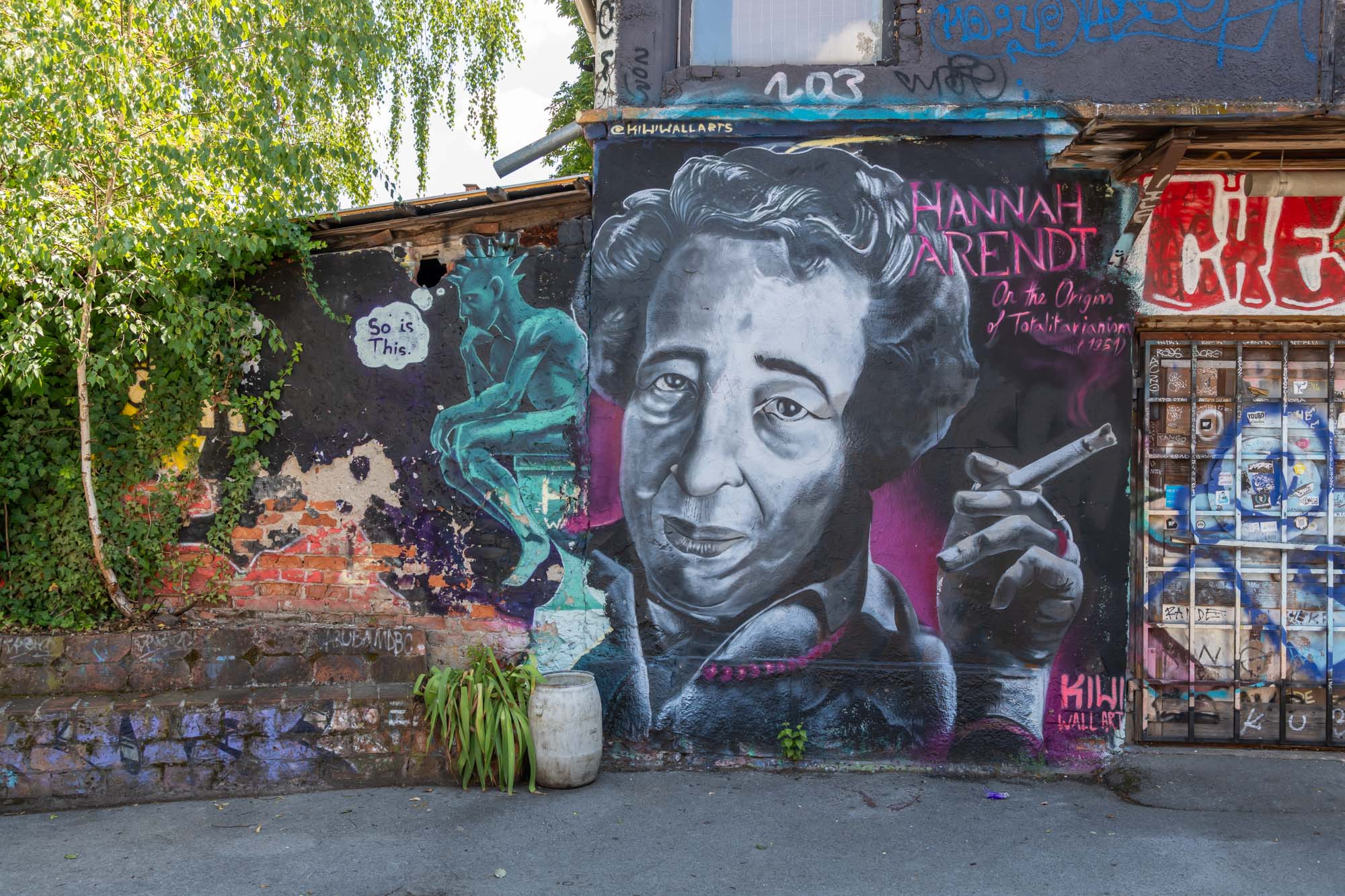
I had beer at their local brewery (yes, they brew their own, with hemp in it) and roamed around for a bit and left. As could be expected, there was a lot of graffiti and the whole place was interesting. I would have wanted to go back and spend more time there with more conversations, but I couldn’t find the time. Personally, my view is that communities like Christiania cannot hold on in these times. 
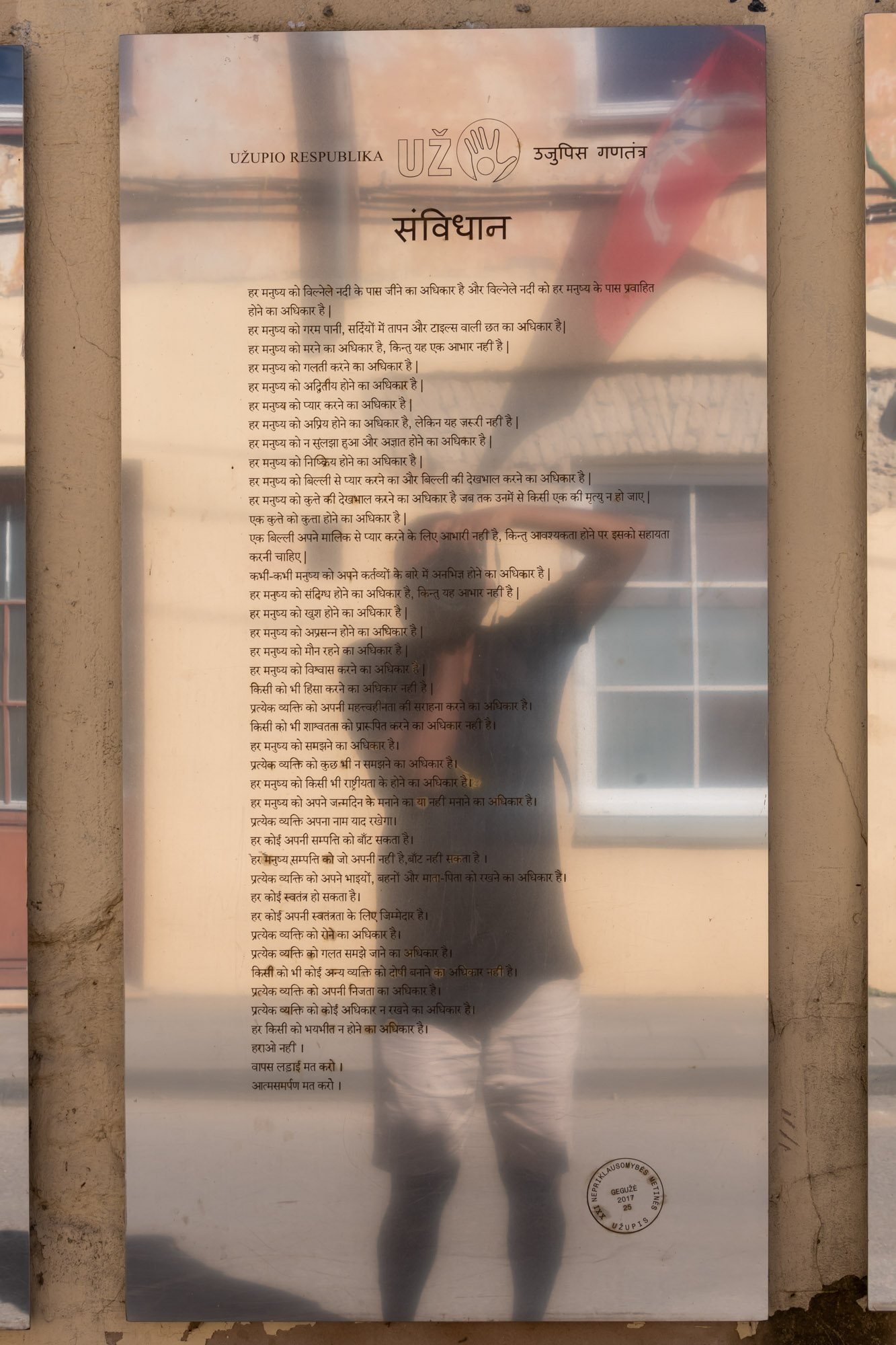
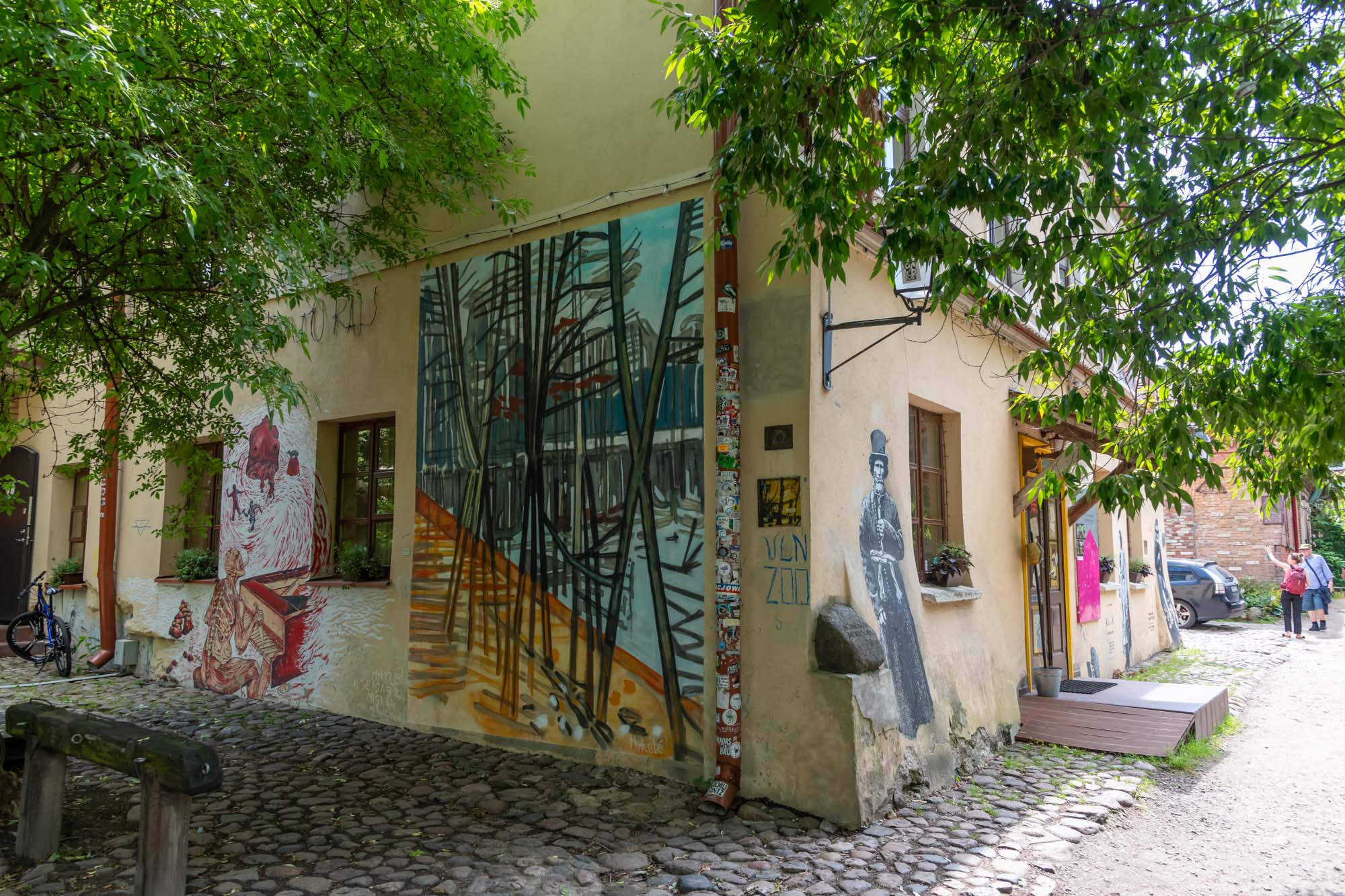
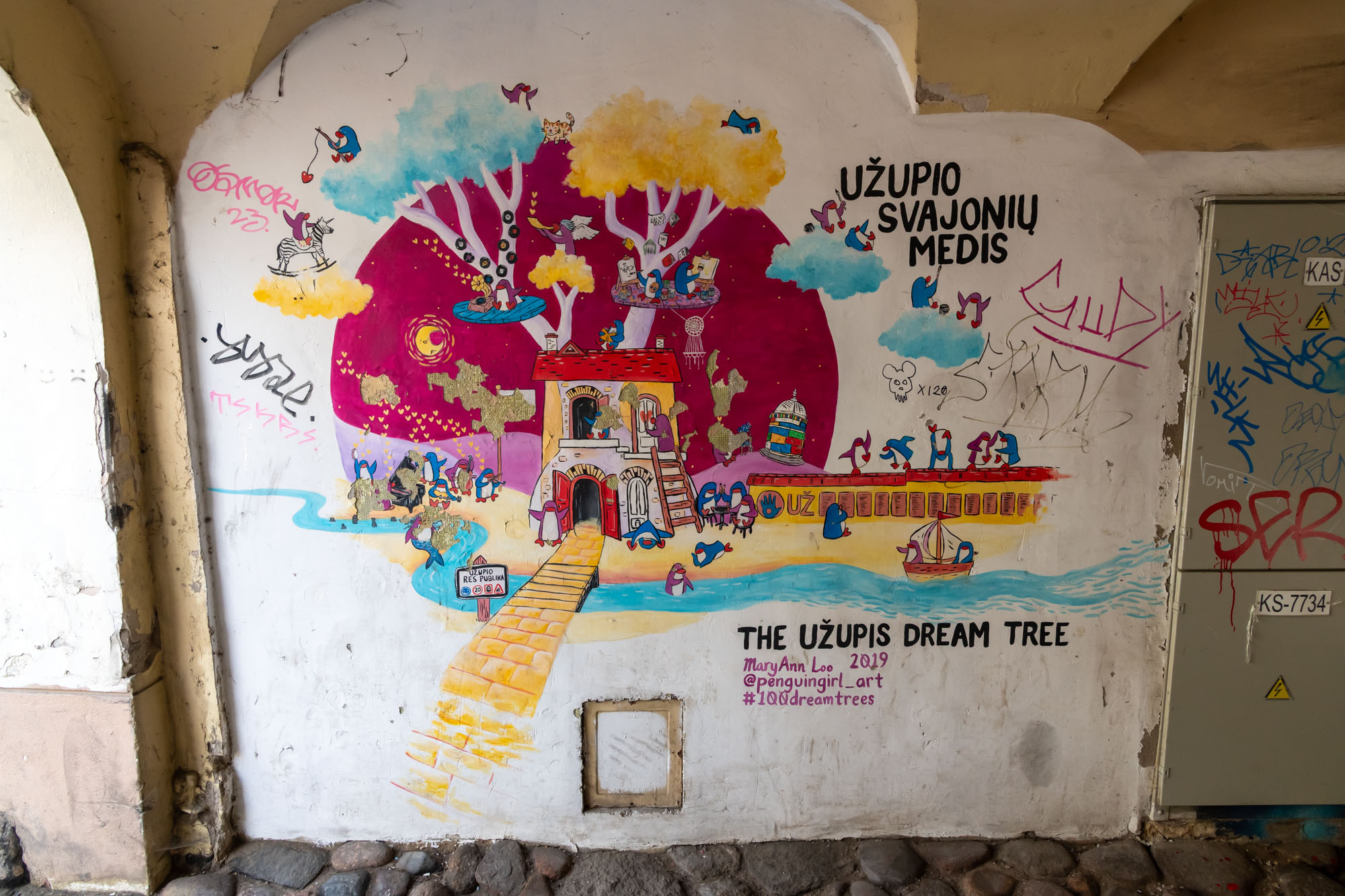
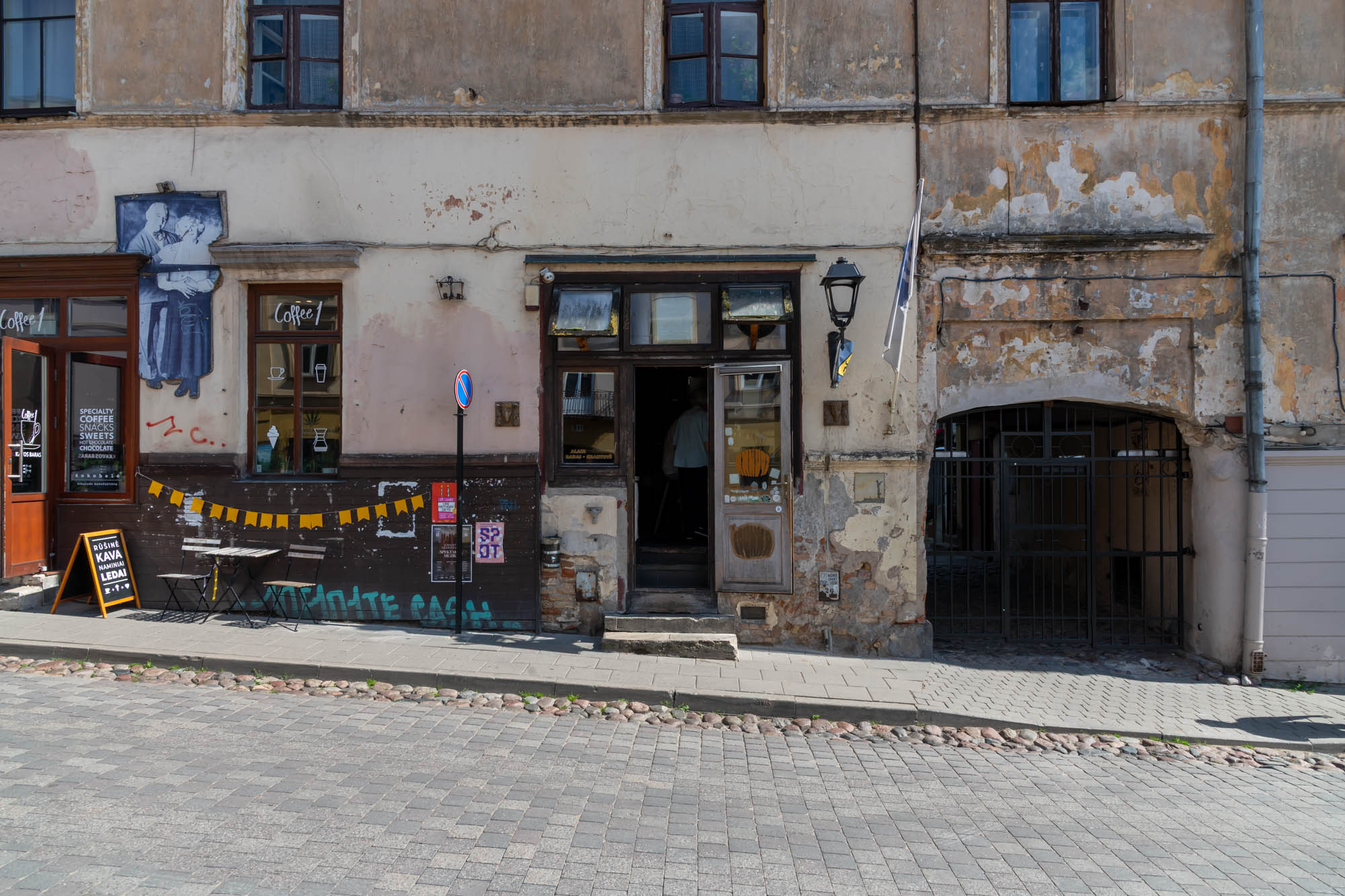
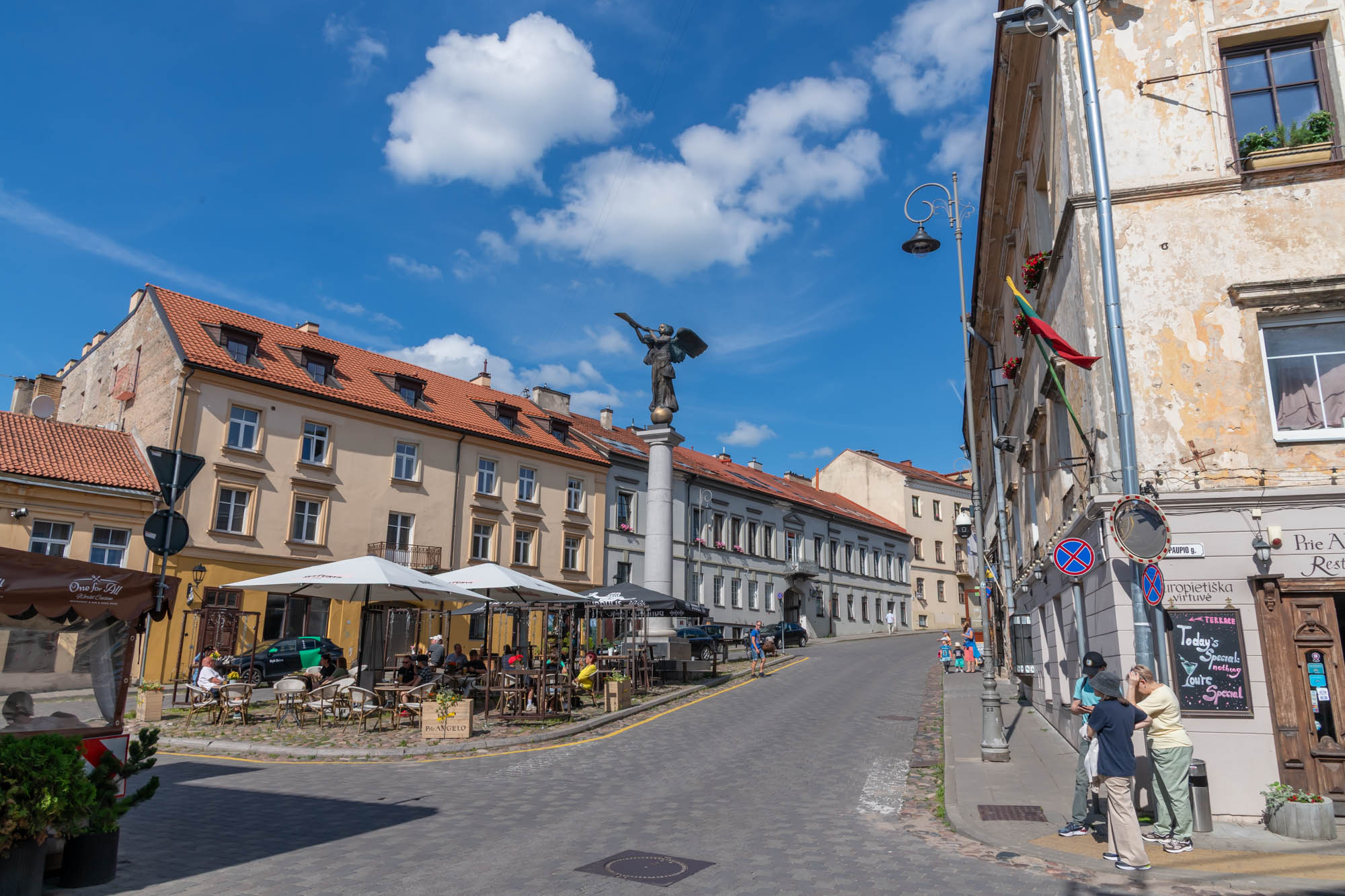
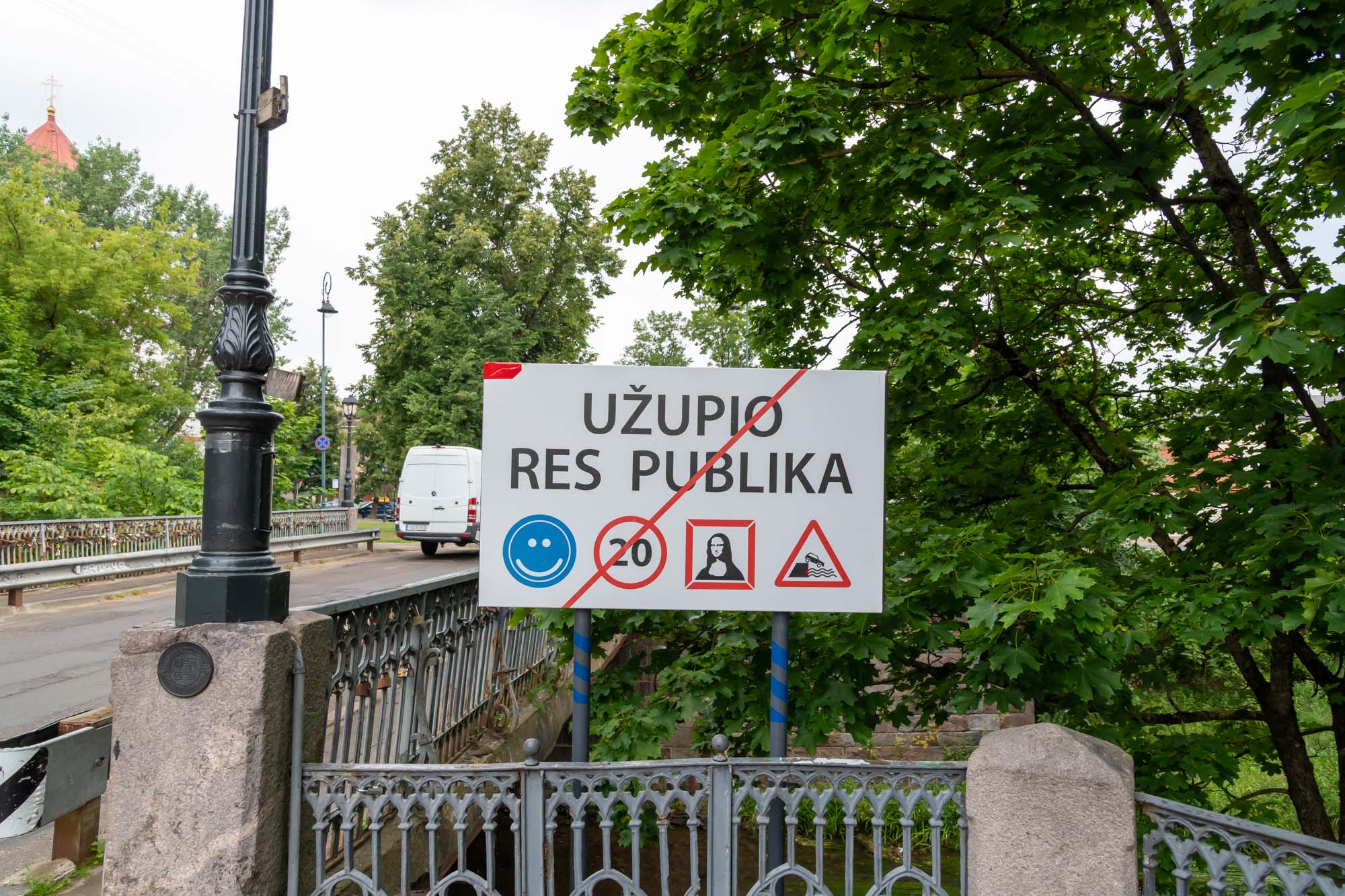
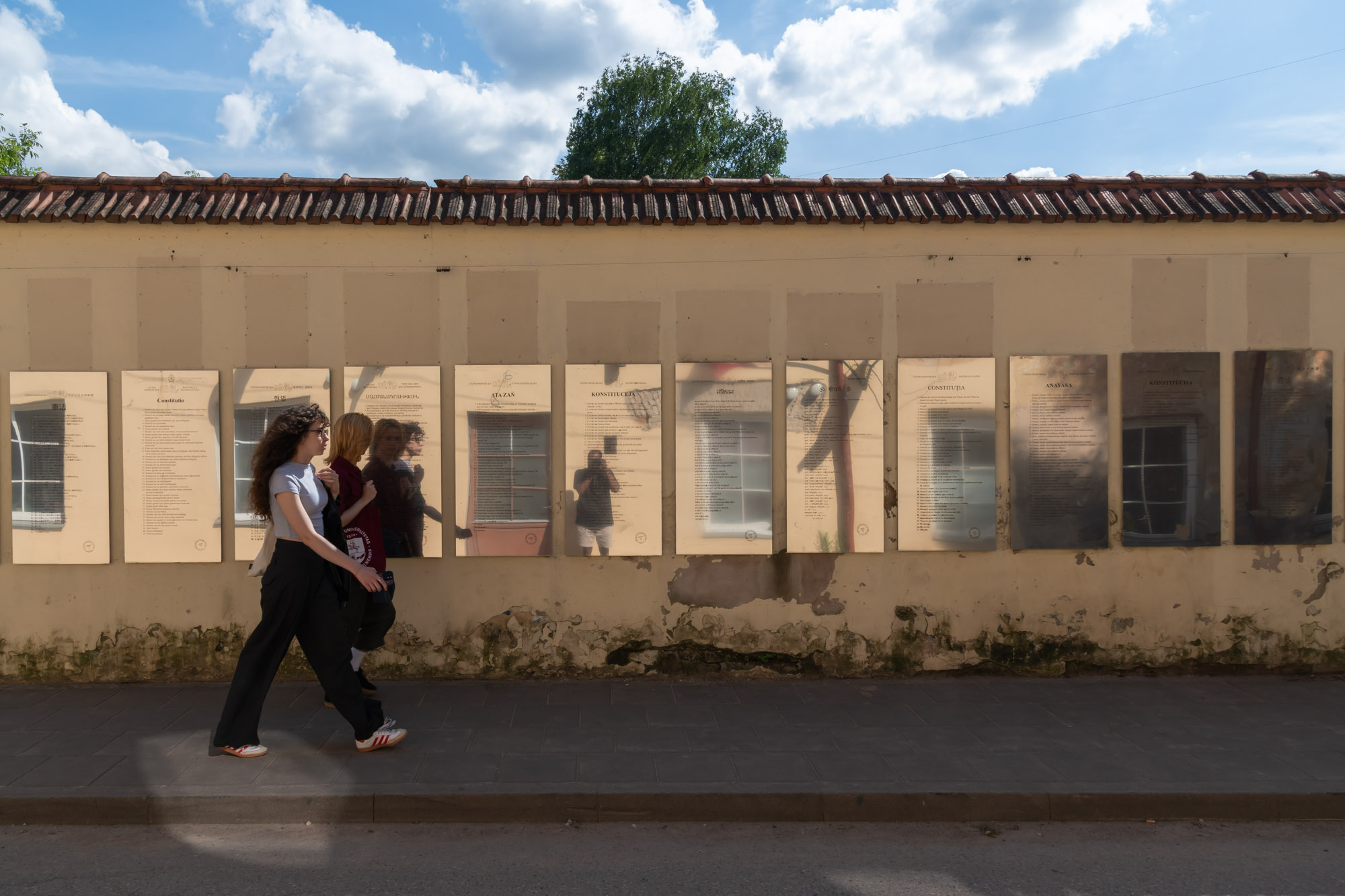
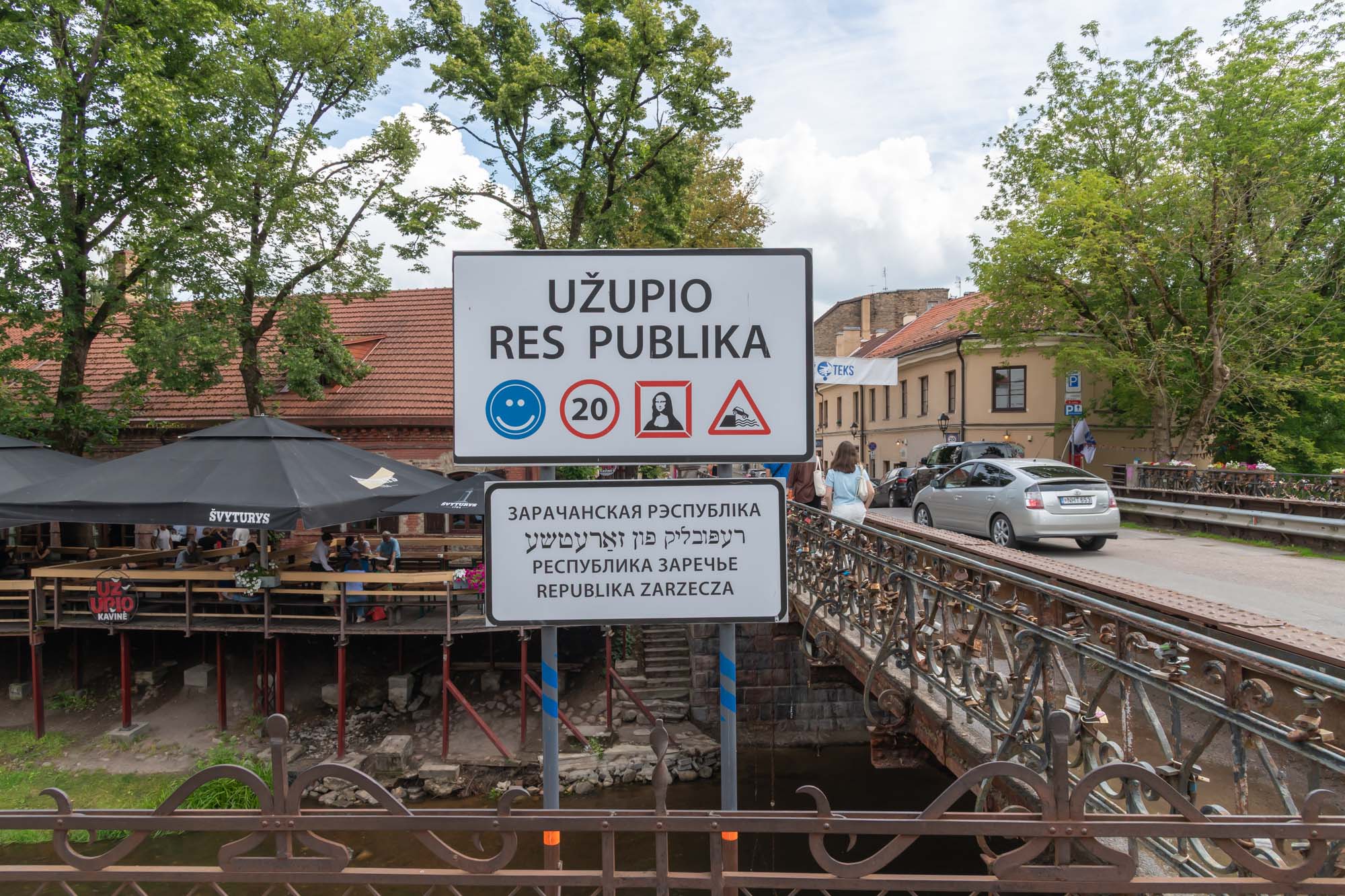
When I was in Christiania, I was reminded of the Republic of Uzupis, which I had visited just a week back. That was another free “country” with their own constitution and all, smack in the middle of Vilnius, the capital of Lithuania. The Constitution was displayed in many languages in a particular location, including in Hindi and Sanskrit! 
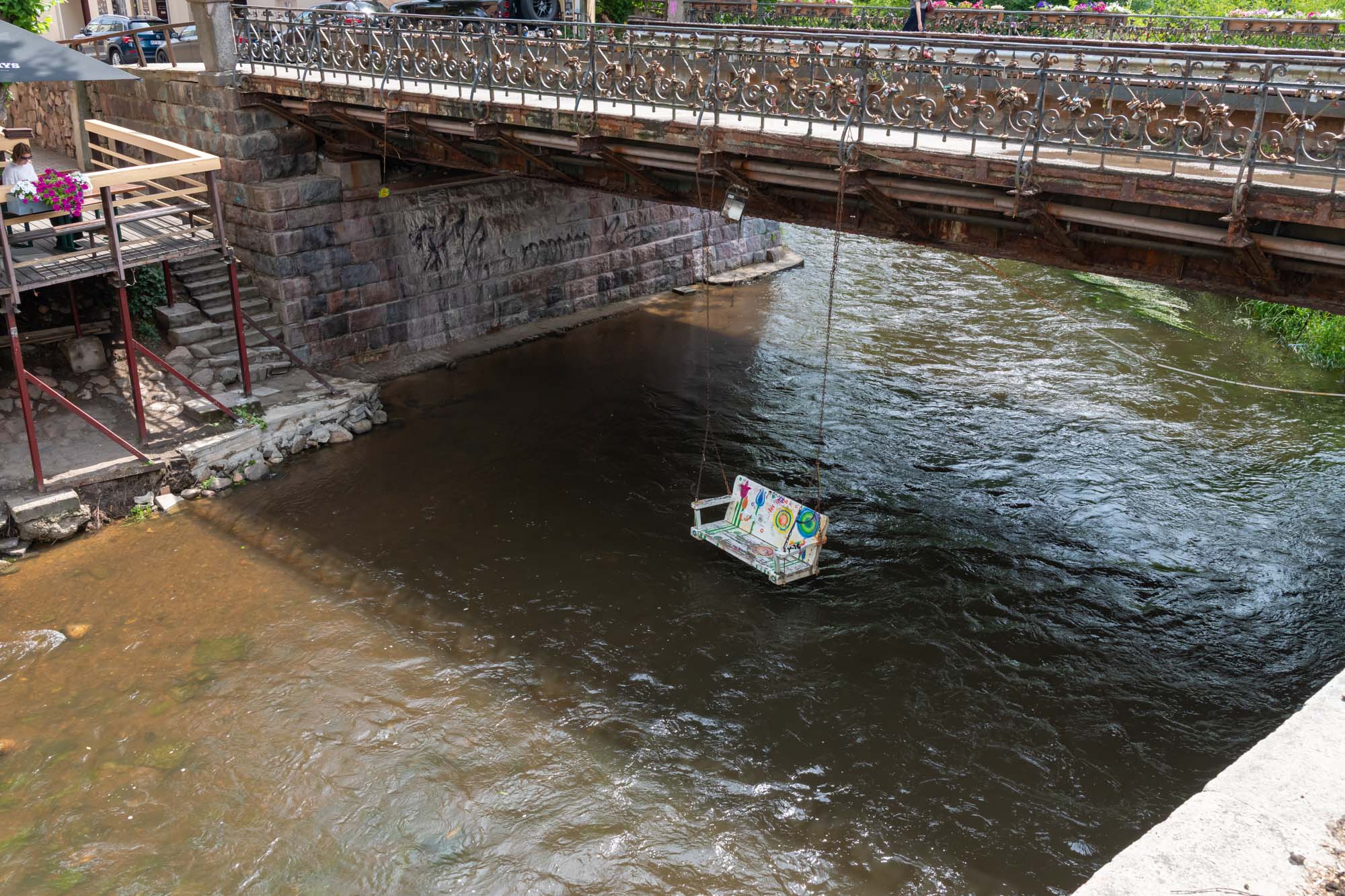
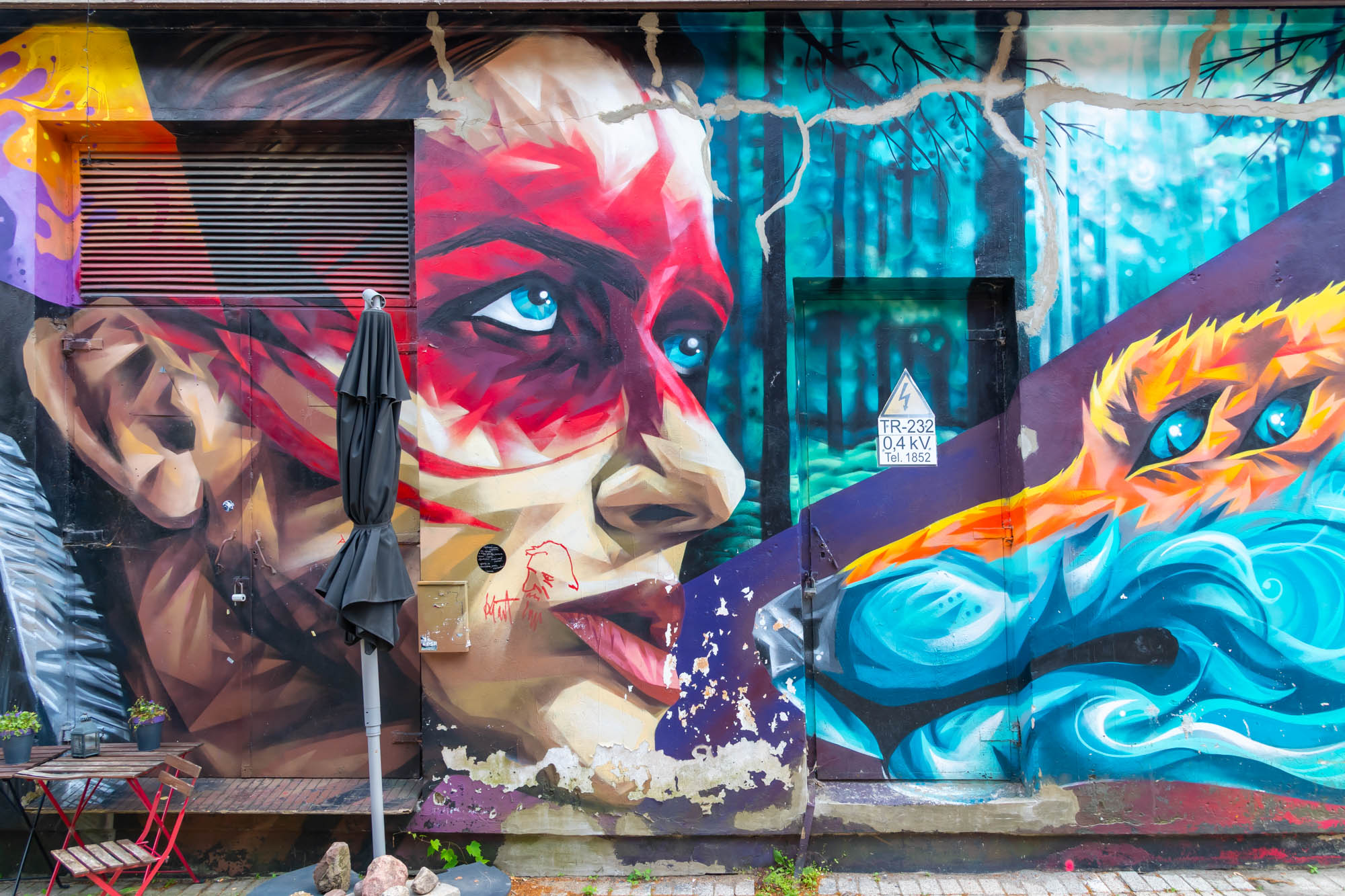
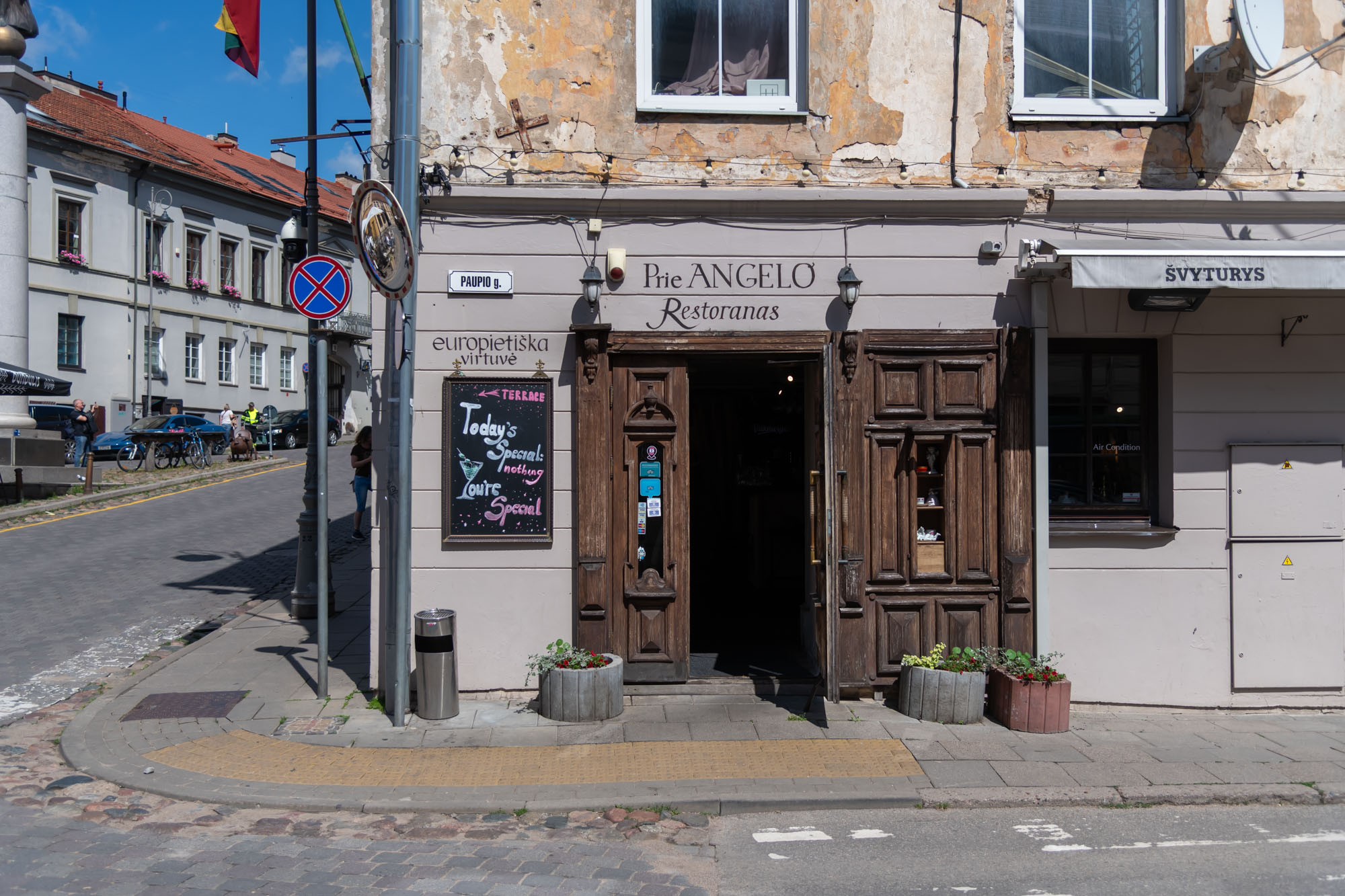
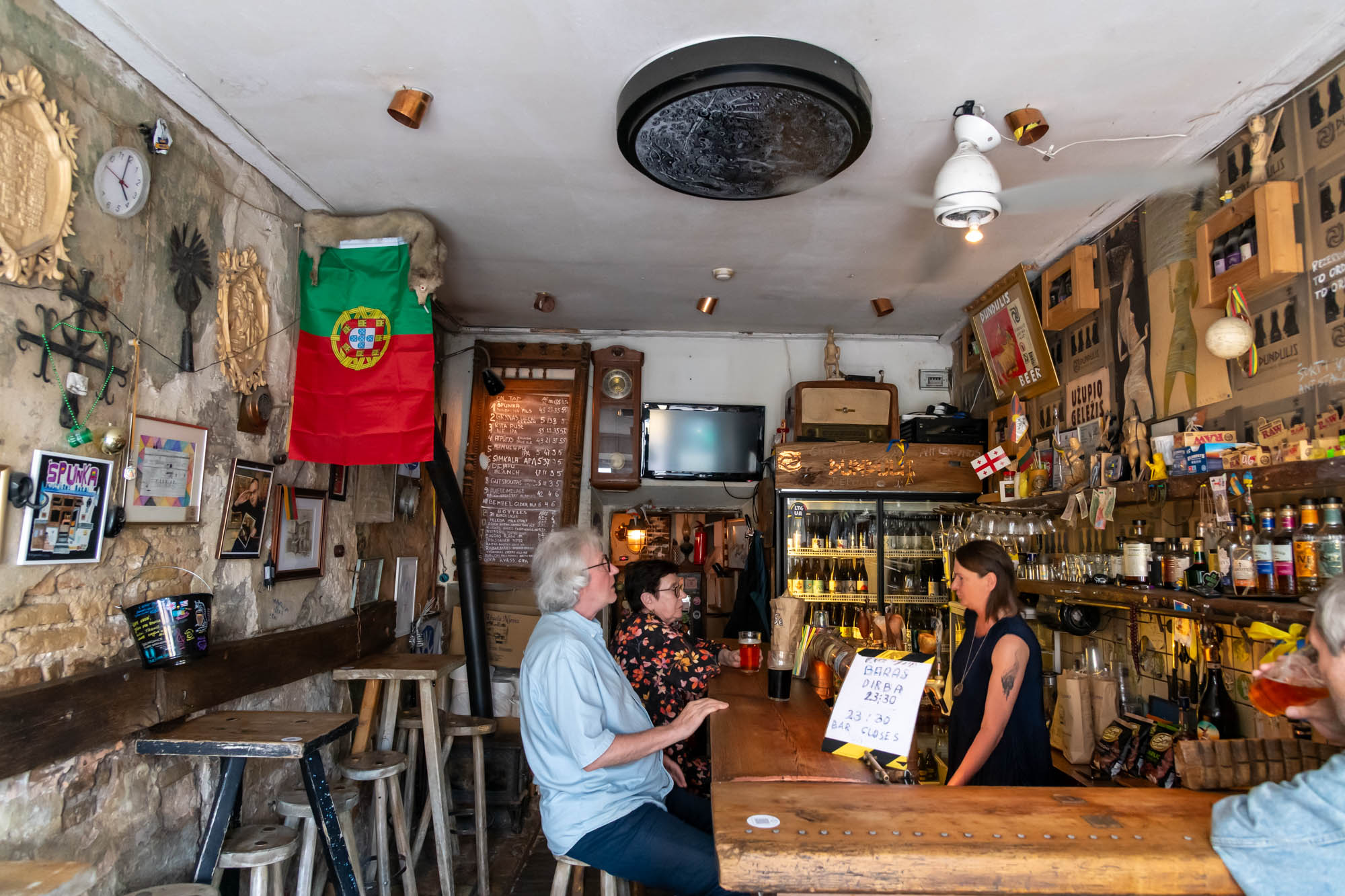
Uzupis too had its currency once and was an alternate community, mostly of artists. Nowadays, it is a proper touristy place, and I saw a lot of expensive cars around. It all looked very genteel and orderly – there was only one bar I found that looked like it was from the old times. That was a nice place and everyone who came there seemed to know each other. 
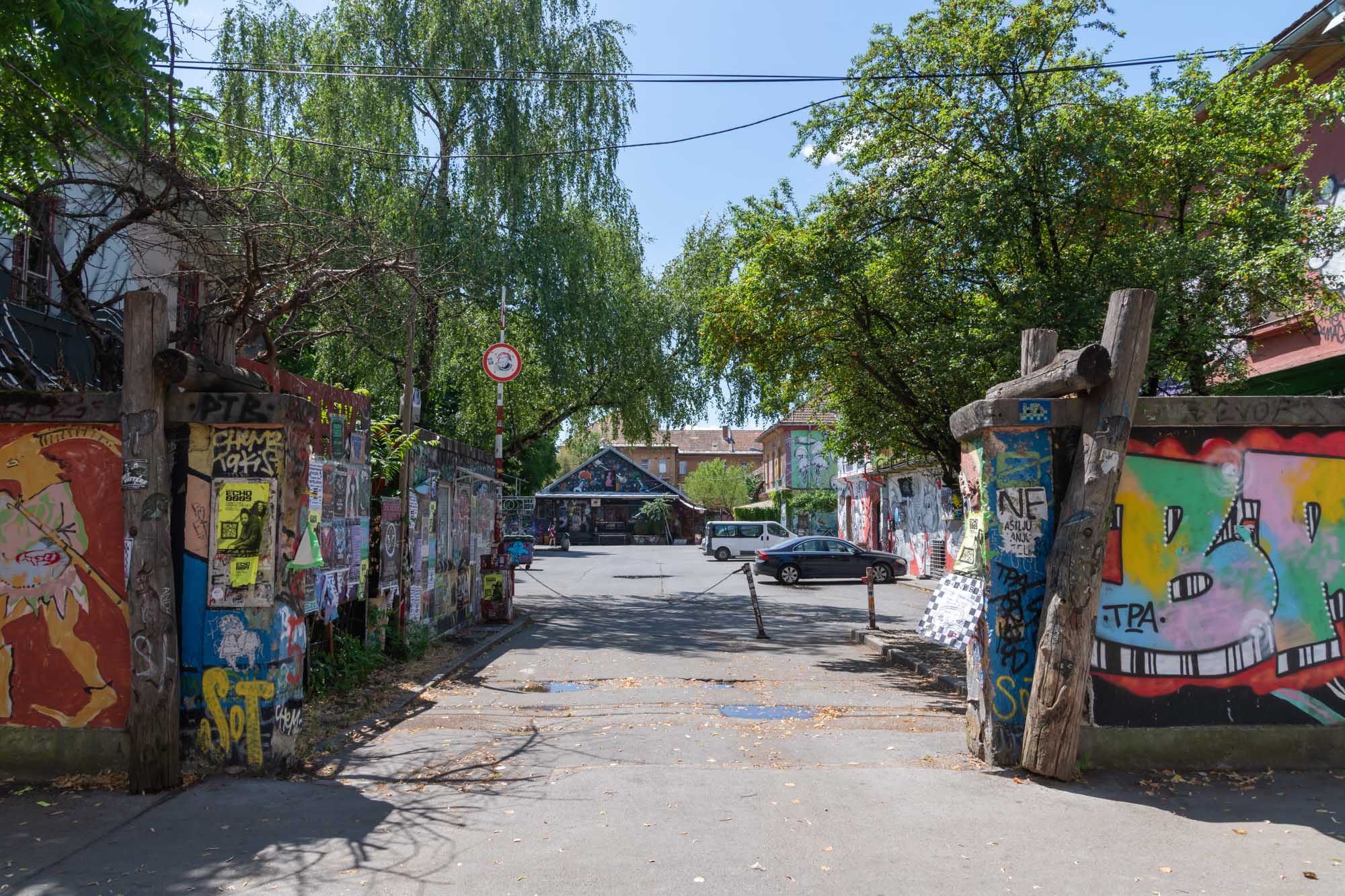
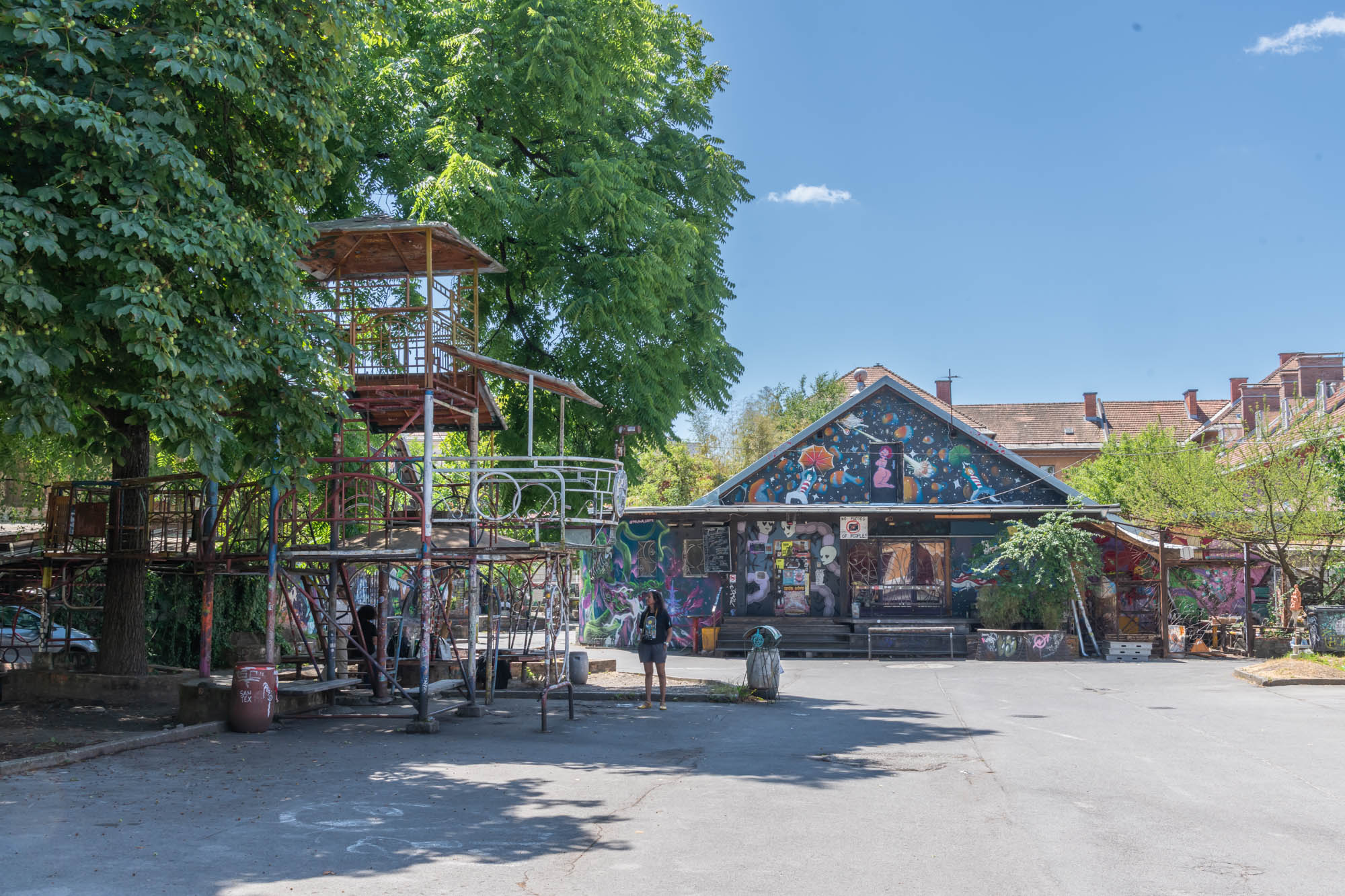
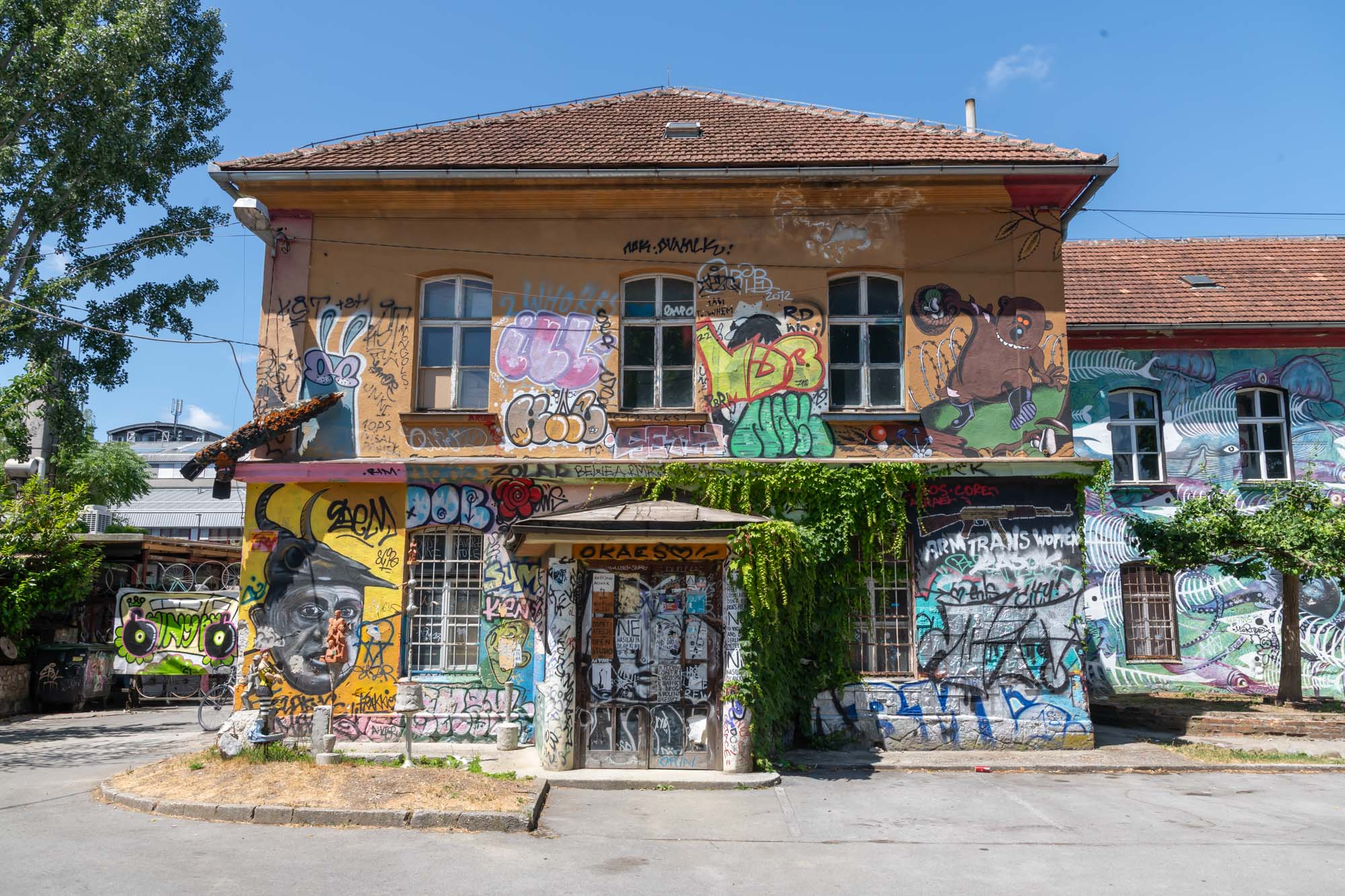
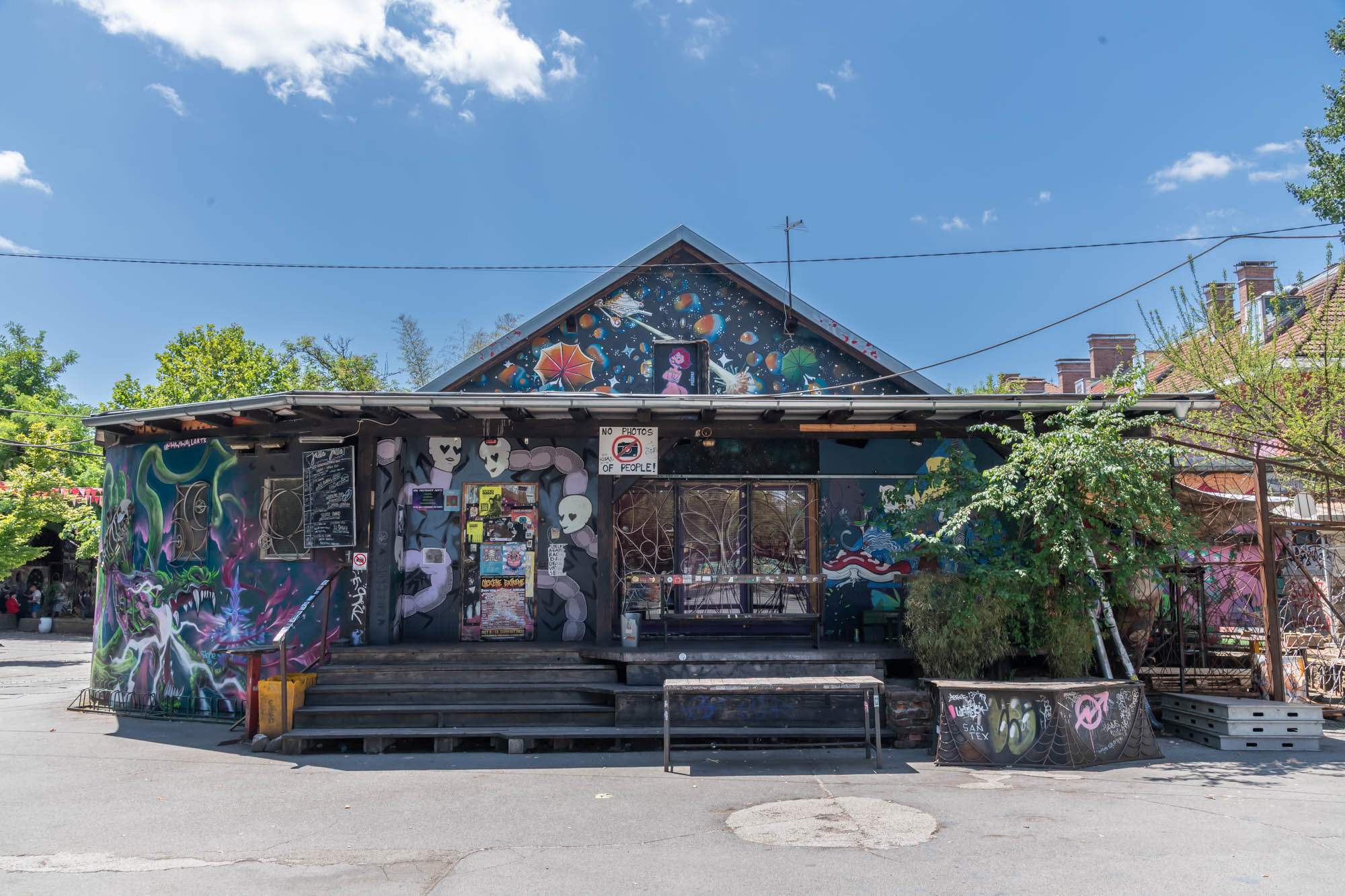
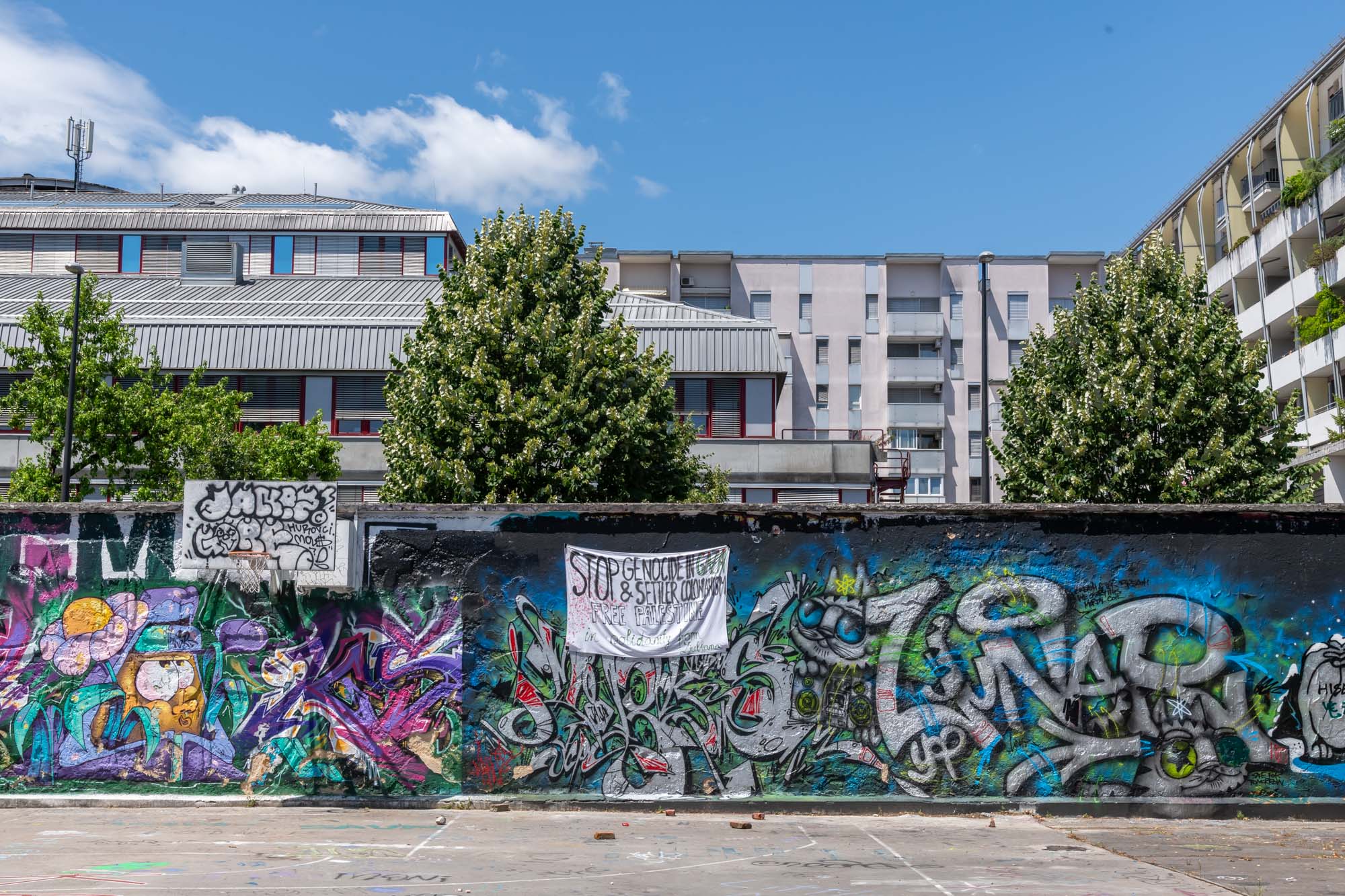
There is a similar, though much smaller, space in Ljubljana called AKC Metelkova mesto, which is an autonomous cultural centre. It is much smaller in size and is basically an old military site that squatters have taken over. It is still of dubious legal status though it has been recognised as a national heritage site since 2005. I spent some time there and the rebellious nature of the space is quite evident. 

I wasn’t aware of these kinds of spaces and alternate communities before this trip. The hollowness and exploitative nature of Capitalism have spawned these initiatives. Not everybody is willing to go along with the flow, and some show the mettle to be different.

I was looking forward to visiting the Baltics ever since I read about their independence movement. Estonia, Latvia and Lithuania had won their independence when the Soviet Union crumbled. One of the key activities in that movement was the “Baltic Way” which was a human chain that was formed on 23 August 1989, which stretched for 690 kilometres, from Tallinn to Vilnius. The total population of these three countries at that time was about 8 million and it is estimated that 2 million of those participated in this! It was held to mark the 50thanniversary of the Molotov-Ribbentrop Pact wherein Poland, Finland, Estonia, Lativa, Lithuania and Romania were divided (illegally) between the Soviet Union and Nazi Germany and occupied. 

In Tallinn, I met with a lady who had participated in the Baltic Way, as an eleven-year-old child. She remembers going on a bus with her parents and that there were big traffic jams and a lot of people. Estonia won its independence in a truly non-violent fashion with its Singing Revolution. People came together and sang songs and when I asked the lady why the Russians did not do anything violent, she said it was perhaps because the Soviet Union was crumbling and the Soviet soldiers in Estonia at that time were from places like Belarus, who had no particular affinity towards Russia or any stake in attacking Estonians fighting for their independence.

It seems matters got very tense just before the day independence was declared as Russian tanks moved into Tallinn and the borders that were open before were declared closed. There was much talk that the Soviet Union would regain control, and the situation would be back to what it was. So, there was much fear of retribution among those that were involved in the uprising. This lady’s brother had gone to Finland to take part in some competition and that was when the borders were closed, leaving him stranded. She said that was very traumatic and even now, tears started rolling down her cheeks when she narrated the story. She said she gets emotional every time she tells the story. Thankfully, the situation was resolved soon, and Estonia got its independence, and her brother was back home. I noticed that the family ties in Estonia are quite strong indeed and it can be understood from the story above. The weather was nice and there were a lot of people walking and relaxing in the gardens and most of them had kids around them. 

When I was talking to this lady, I realized that there was a lot of fear around Russia. The trauma of the days under Soviet Union seems to be so strong that those memories make them quite fearful again. I sensed this in Riga when I was talking to a guy who runs a café. During the conversation, he mentioned that the people in Baltics keep to themselves and don’t talk to strangers. I asked him why this was so, and he said perhaps it was a habit they developed during the Soviet days. In those days, it was best not to stand out or be noticed and you never knew whether any given person was a snitch or not. Hence, people pretty much kept to themselves and was apprehensive of speaking their mind, even amongst friends. 

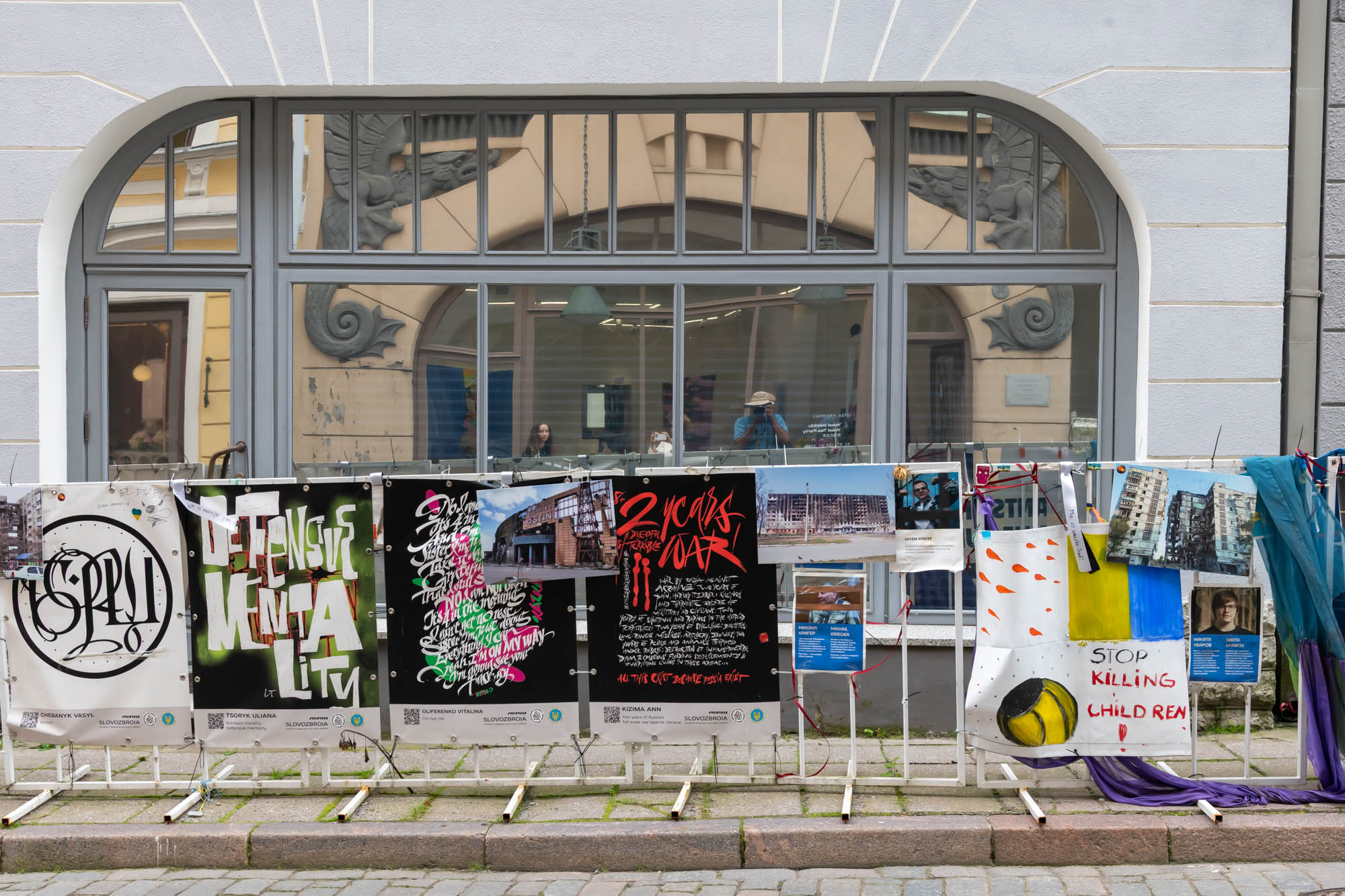
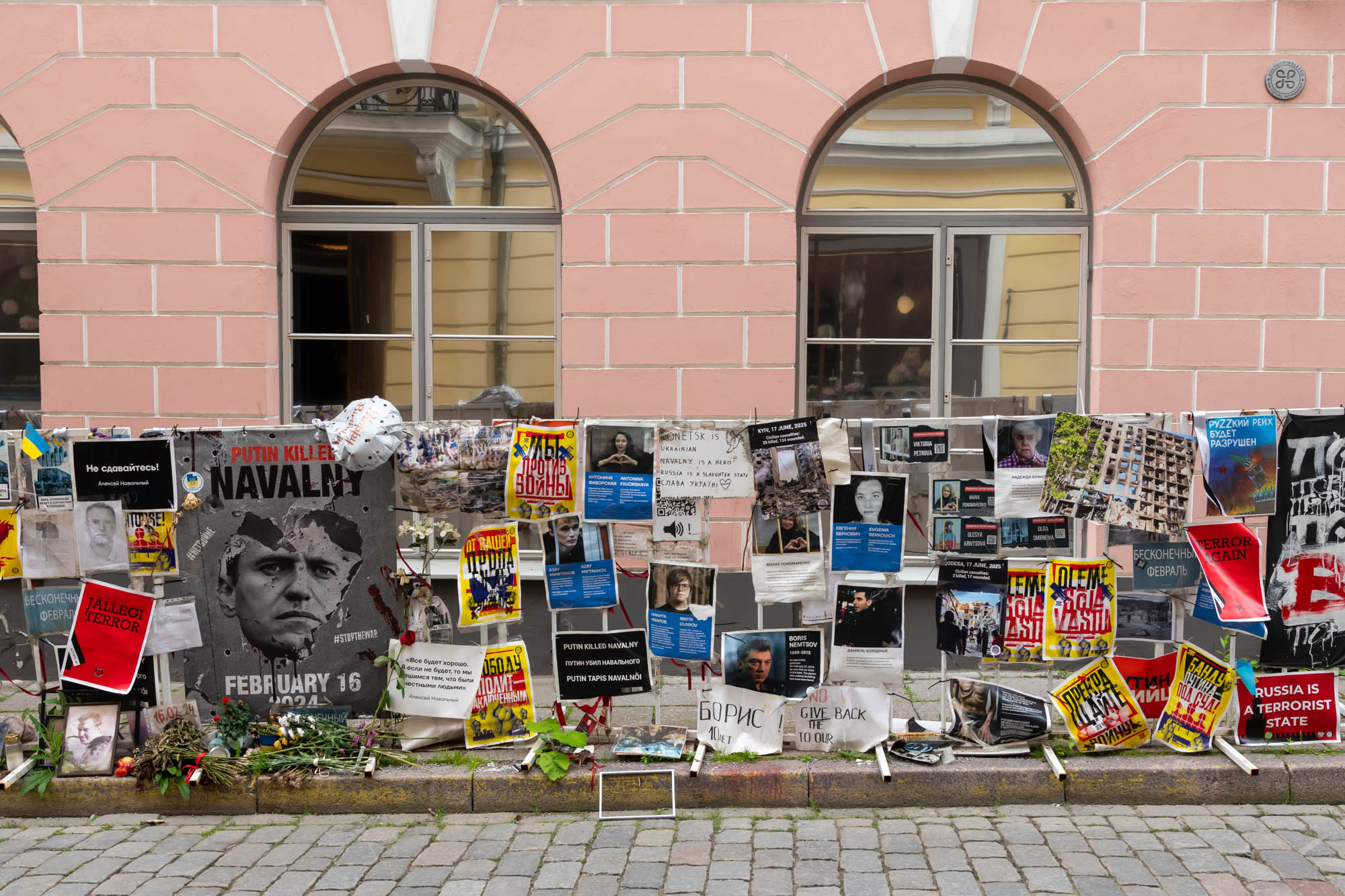
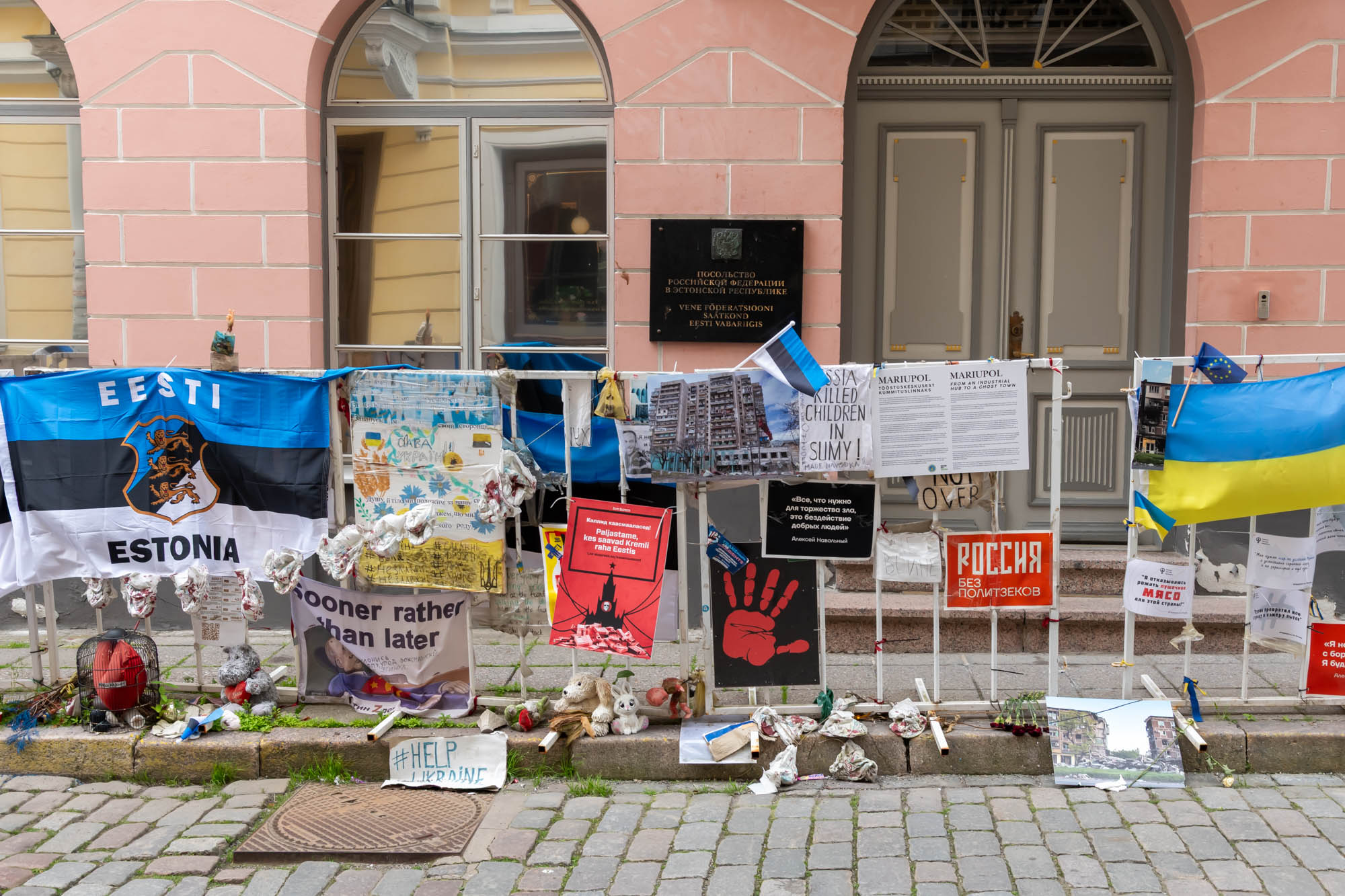
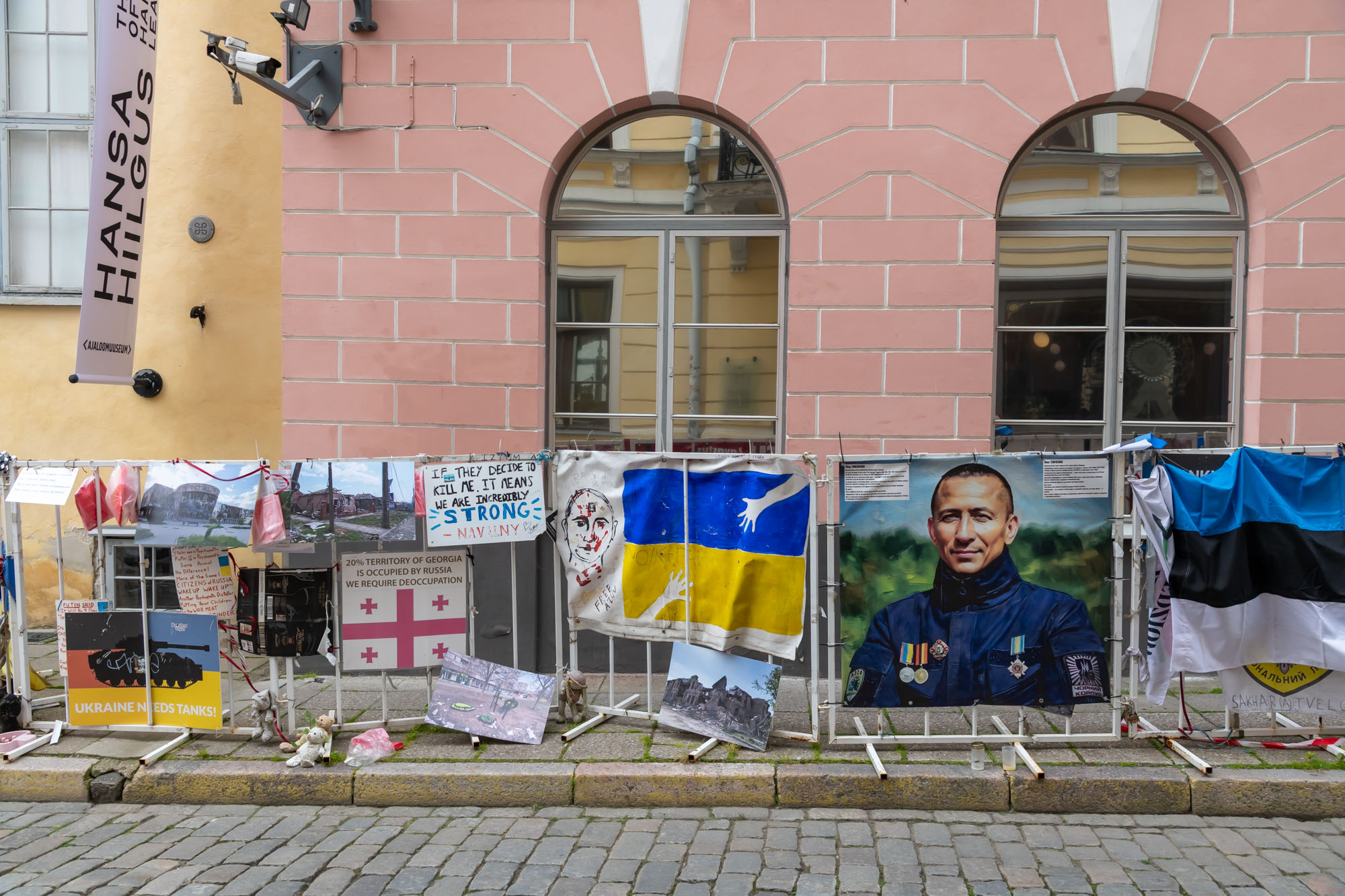
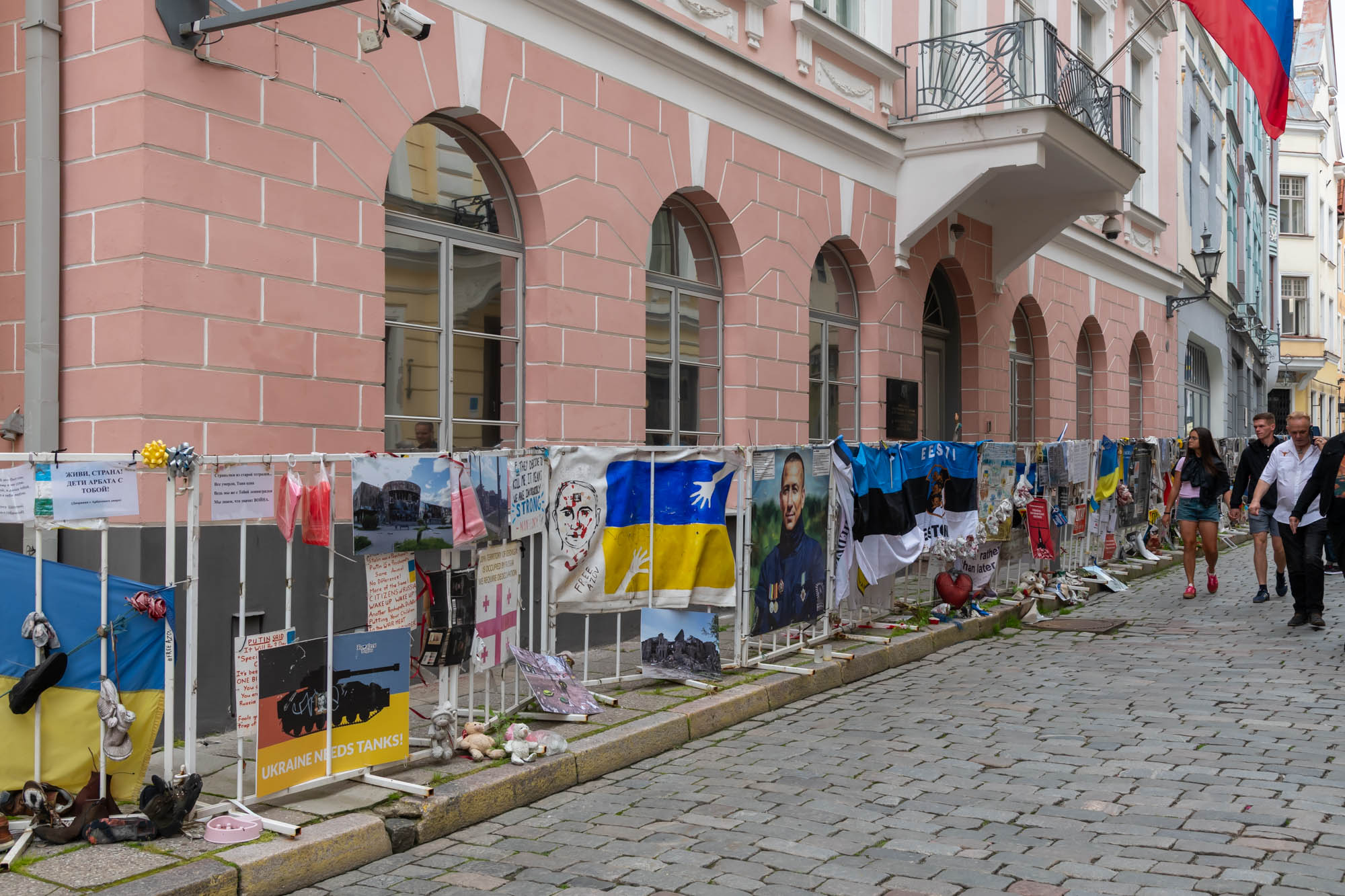
In Tallinn, I came across a protest against Russian aggression. This was a kind of exhibition just outside the Russian Embassy in the old town.
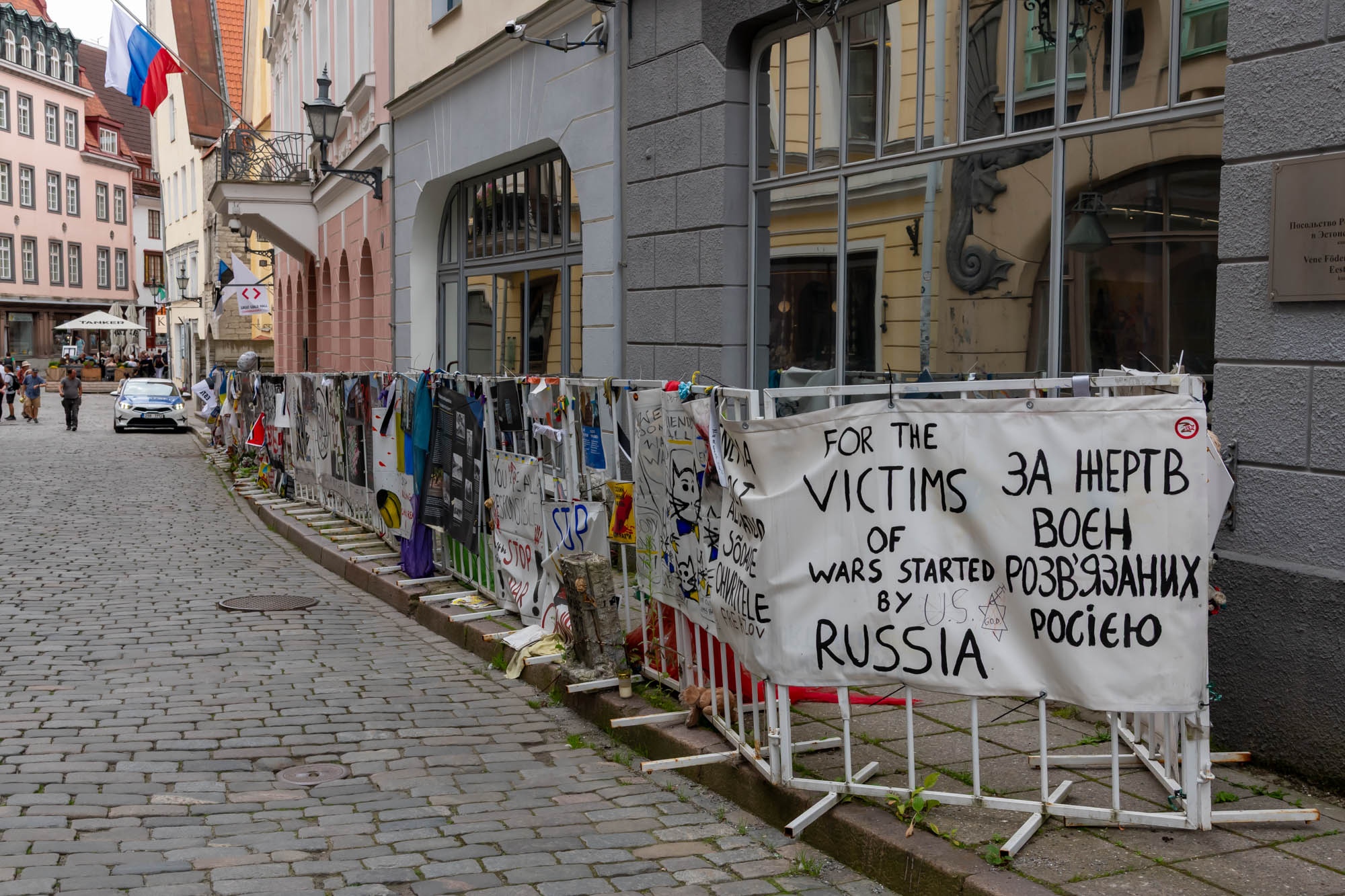
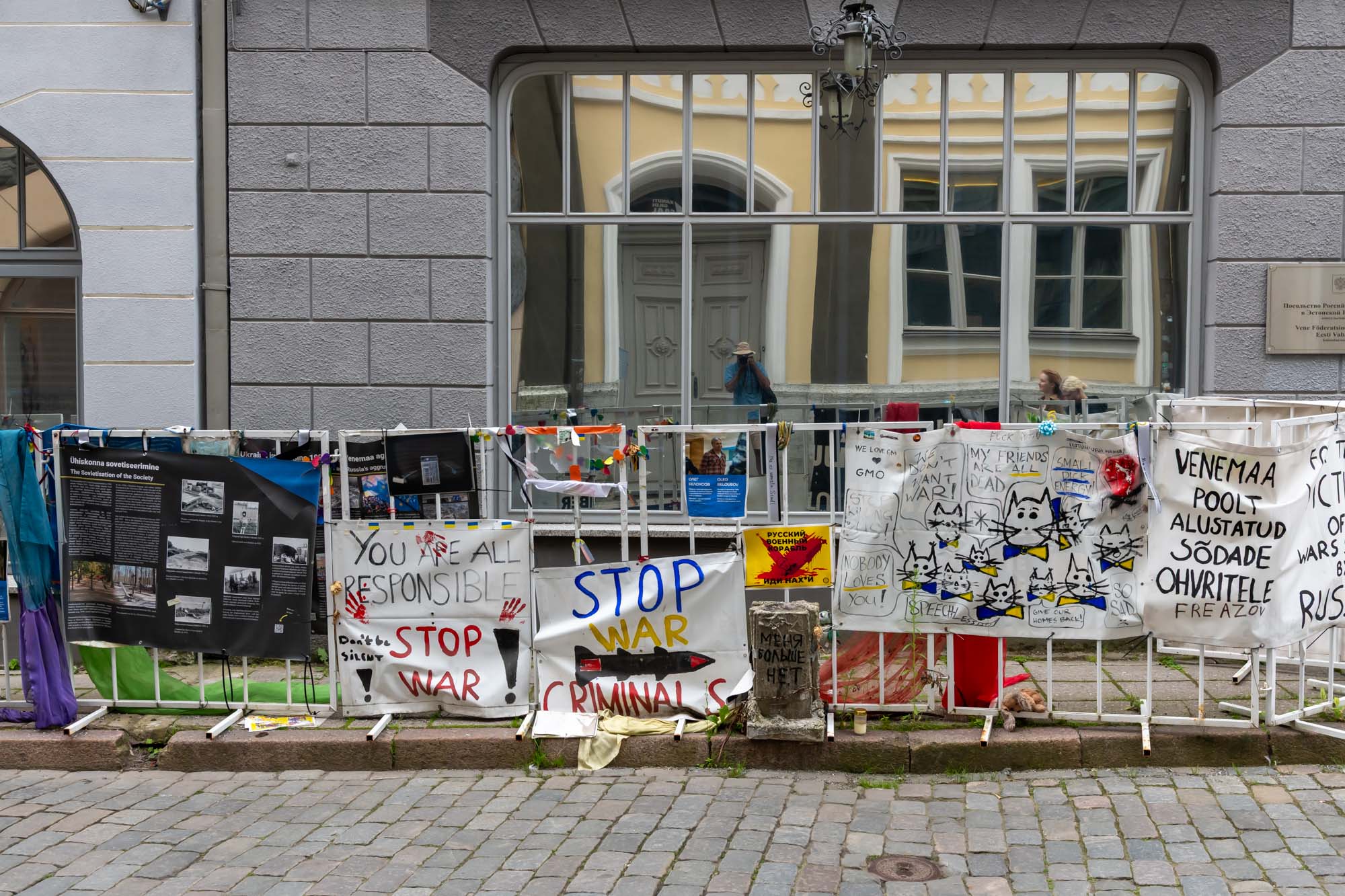
This fear seems to be burnt deeply into them and added to that, they say that the Russian psyche has always been an expansionist one, which believed in the superiority of Russia and everything Russian, right from the Czarist period. They view the current conflict in Ukraine as evidence of this expansionist mindset. When I was talking to a professor in the Czech Republic, she too expressed the same point, and she told me about how Finland was building a wall across the 2000 km long border with Russia. She was of the opinion that it was very likely that Russia would attack a small country like Estonia within a couple of years to see how far they could push NATO. The lady I met in Tallinn told me that investment into Estonia had slowed down because of this fear that Russia might attack them. I have no idea whether this was the opinion of just a few people but all the interactions I had with people seemed to support this view. This was kind of a surprise to me as I wasn’t aware that there was such a fear around current day Russia.

Music has been big in Estonia and as I mentioned before, even their independence movement was anchored on singing. They have a big music festival that is held in Tallinn every two or three years; unfortunately, I missed it by three or four days. The festival is held in the same ground where the Singing Revolution began and since there was tight security in place for the festival, I couldn’t get to see the ground. Musicians come from all over Estonia and a hundred thousand people were expected to come to watch them play – this is almost ten percent of the country’s population! In preparation for the festival some bands were performing in the main square in Tallinn’s old town. Their music was quite wonderful, and people were enjoying themselves. 

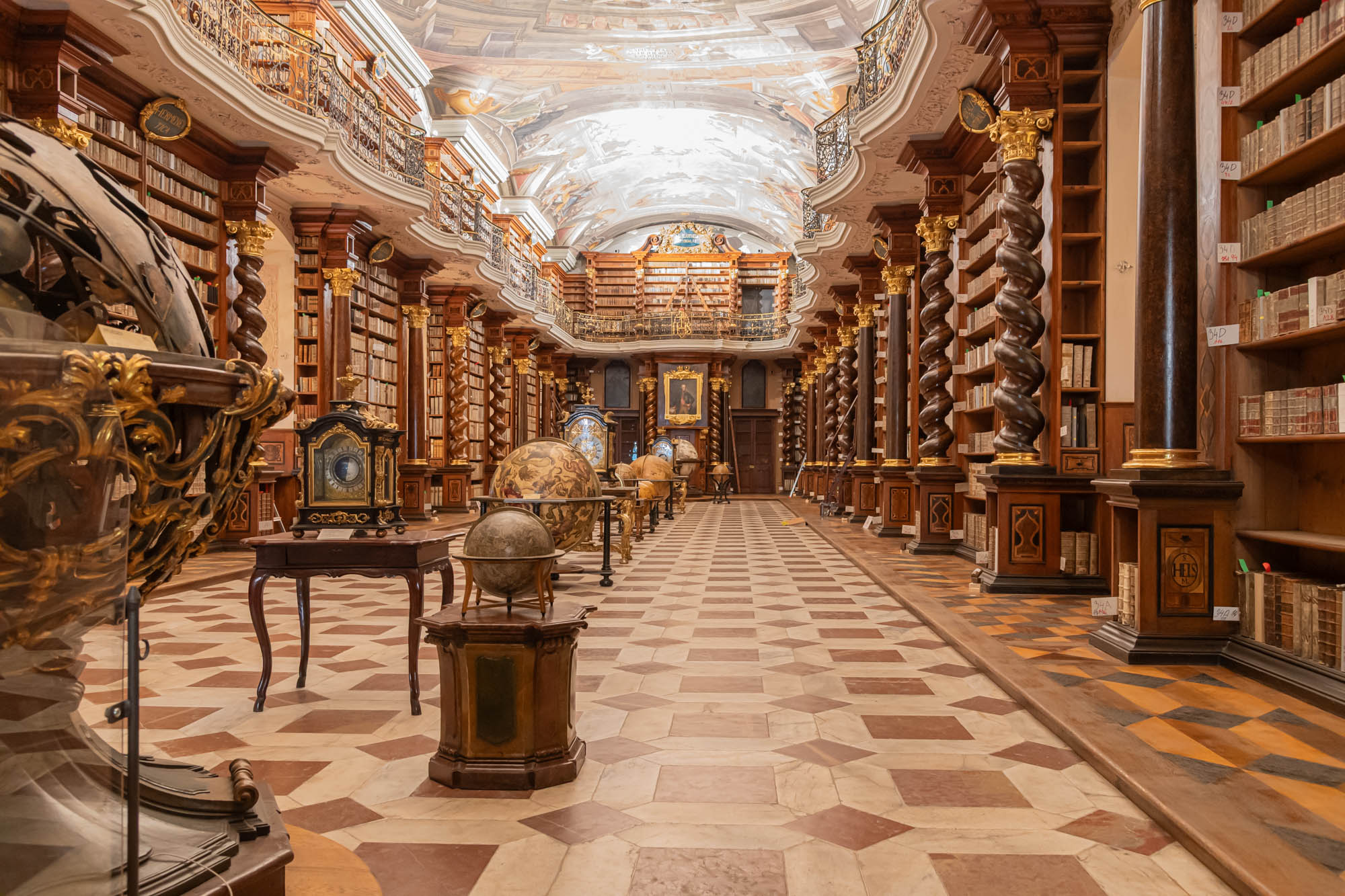
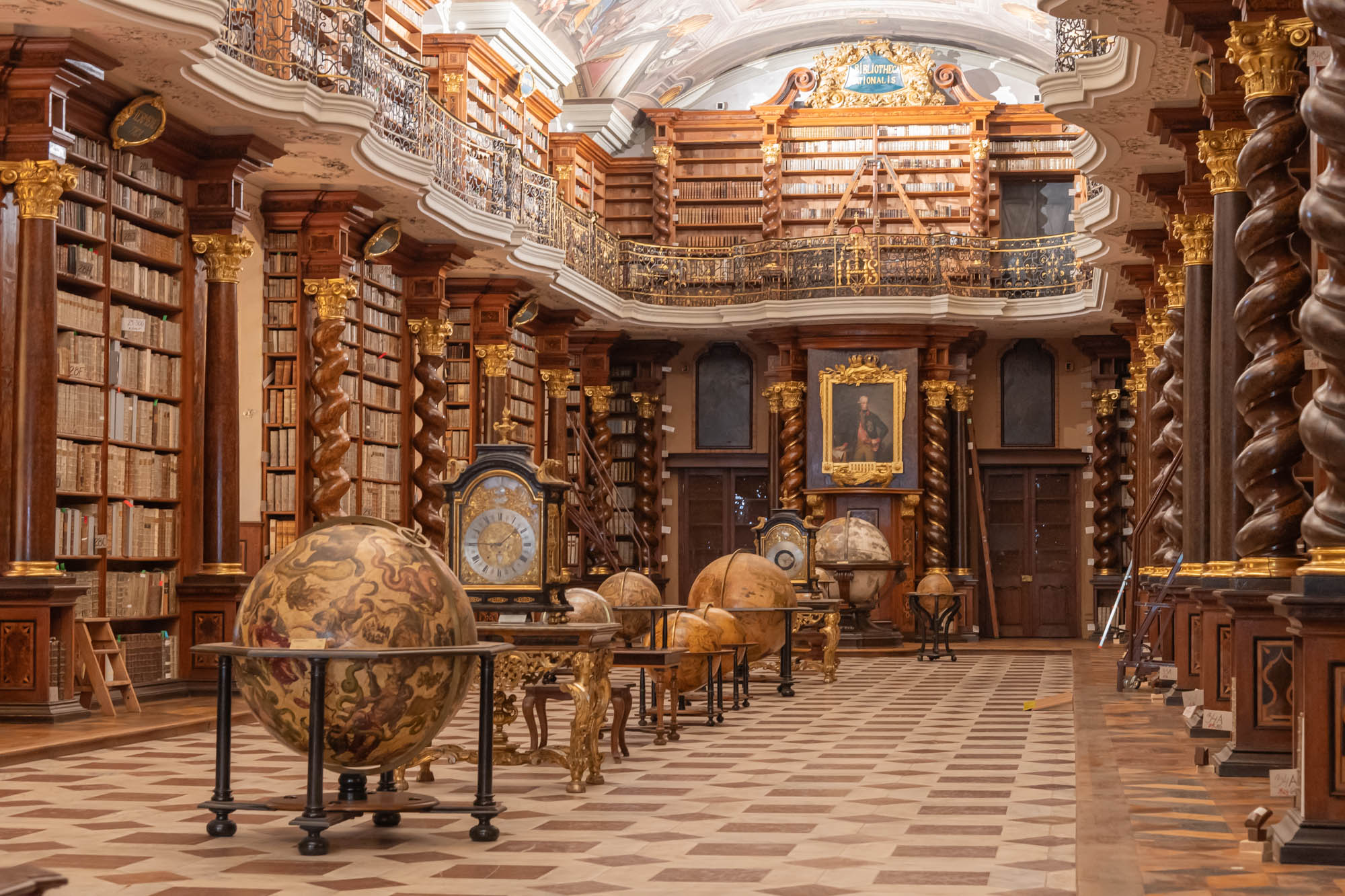
In Prague, a great attraction for me was the Clementium which had started as a Jesuit college in 1556. The college merged with the Charles University in 1654. It was well known for its astronomical research, and the tourism website says that Albert Einstein taught there. The Clementium today has a great old library with about 27,000 printed books. Arguably, it is one of the most beautiful libraries in the world with its wonderful Baroque styling. Public is not allowed inside the library for fear that the precious books may get damaged. We could get a peek through the door, and it was simply breathtaking.
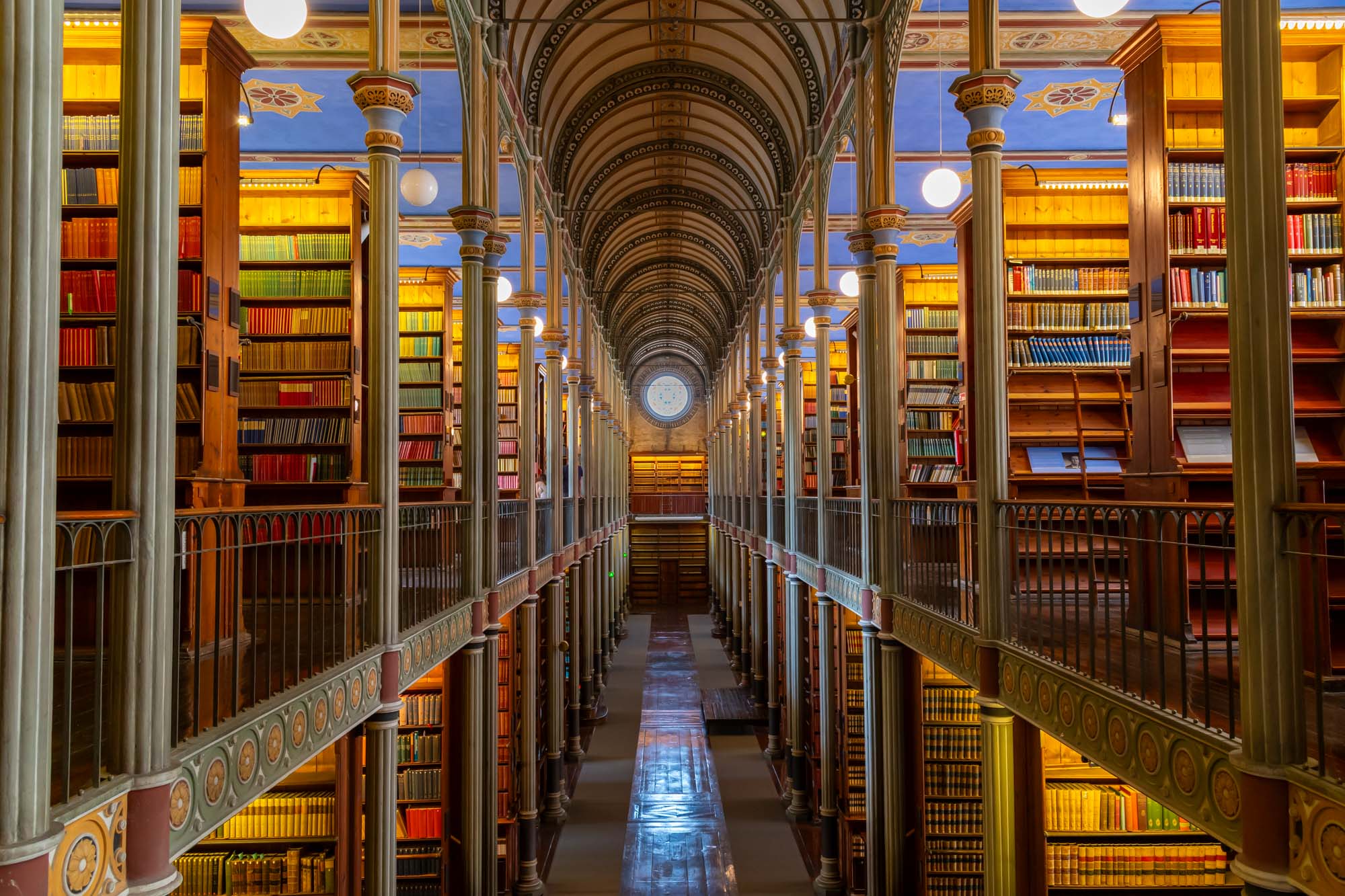
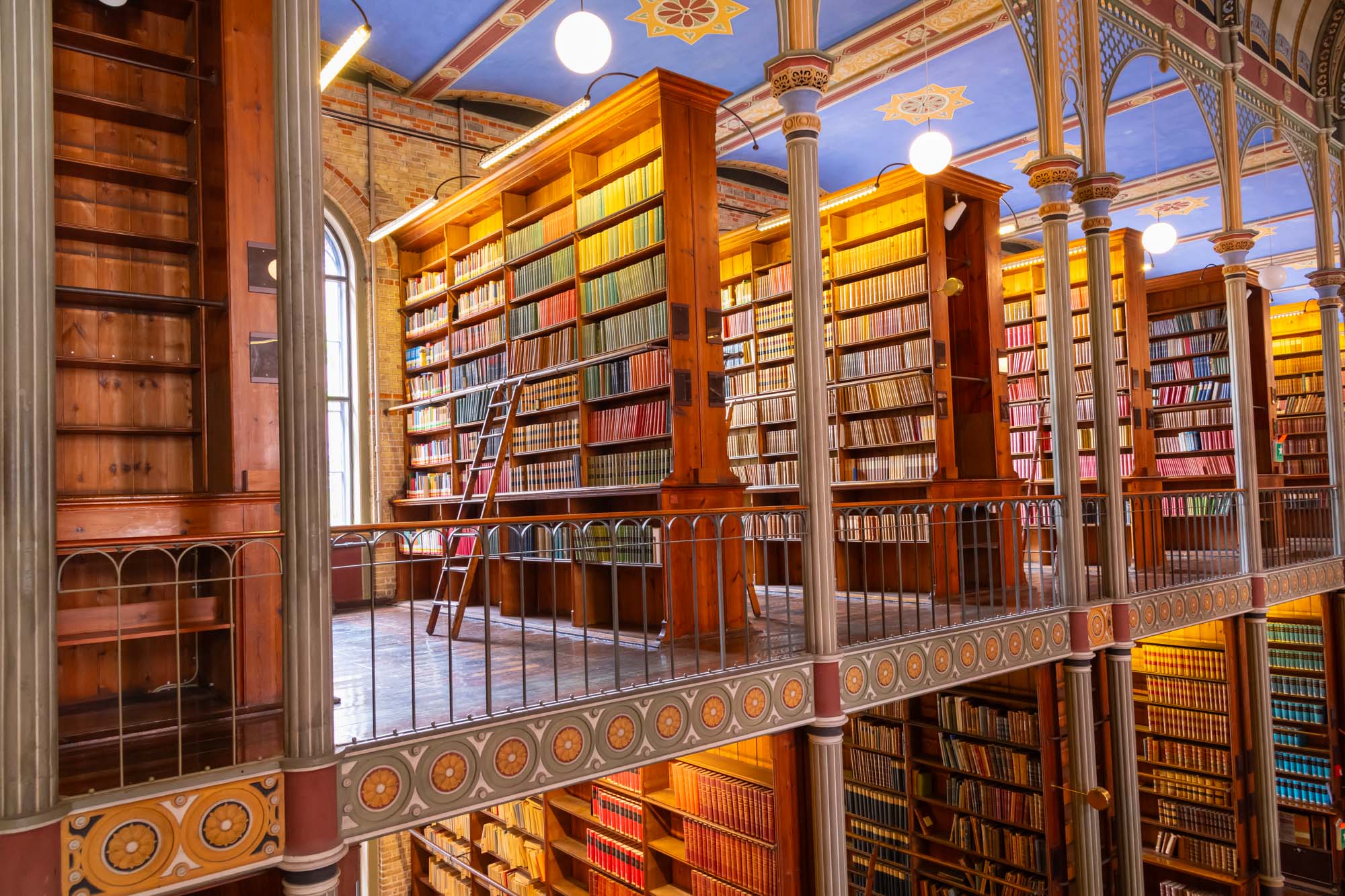
Copenhagen has understood that old libraries can be a big tourist attraction and so when the old University of Copenhagen library closed in 2009, after five hundred years of history, they decided to convert it to a kind of art installation. So, in this library, you have books arranged very aesthetically and it is quite a sight indeed. There are a hundred and twenty-five thousand books in this library now. One of the staff in the library conducts a guided tour and as she explained, the book covers have been designed to make them look attractive when displayed and the books per se are not of any great value. They are arranged kind of randomly as I found out, when I took down a couple of books. The visual impact is quite stunning, and you can happily send a couple of hours in this library, as I did.
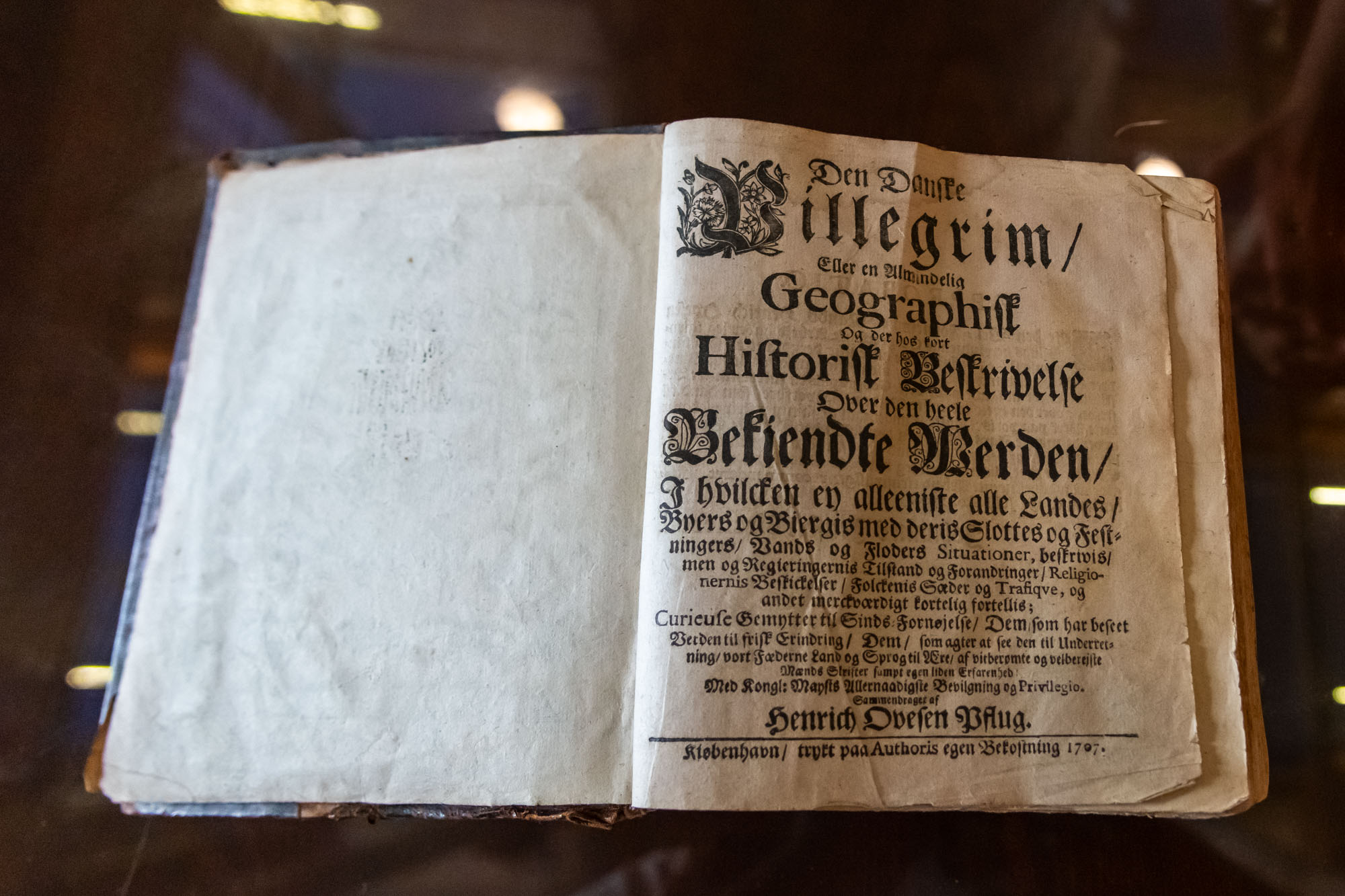
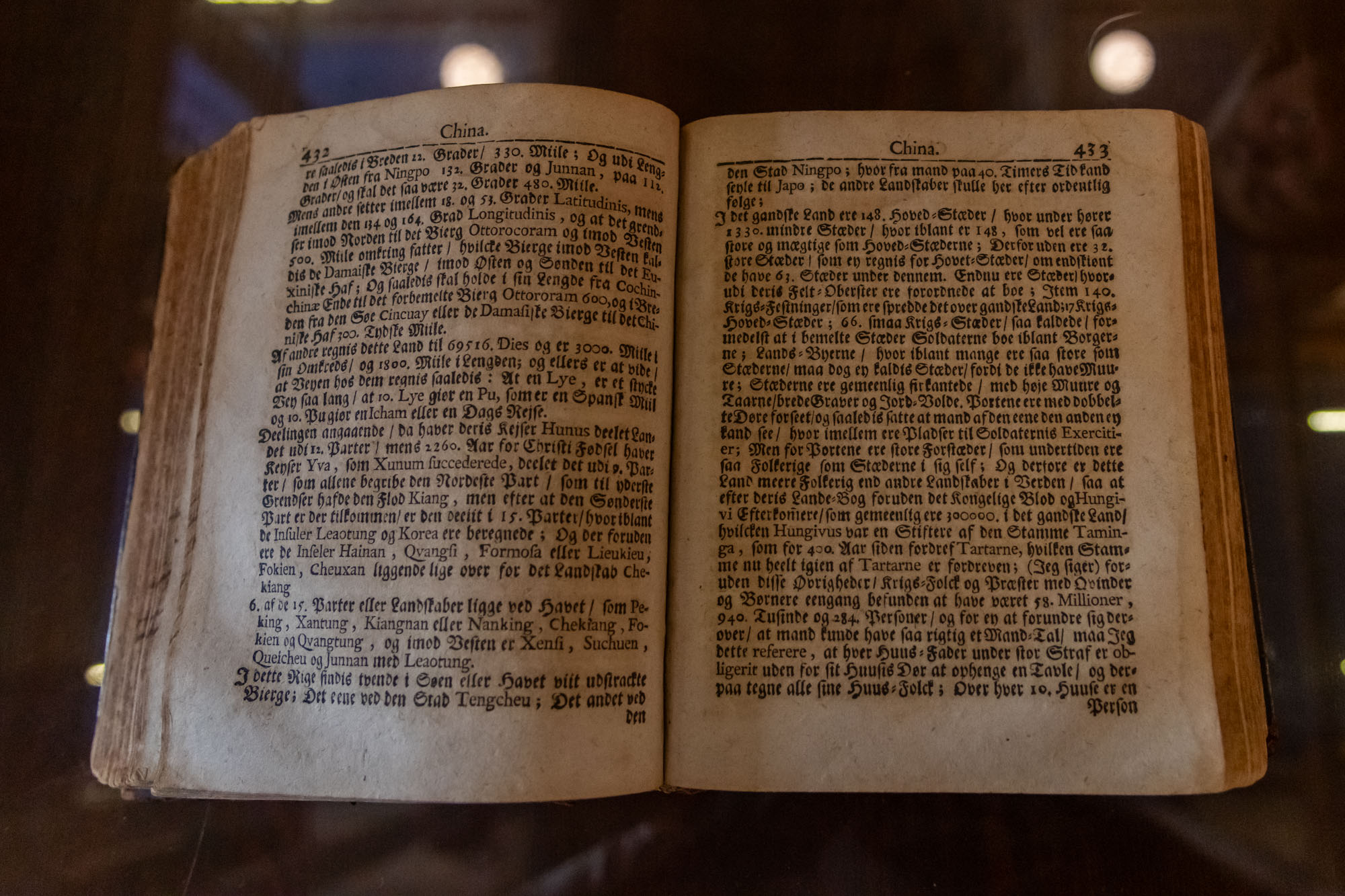
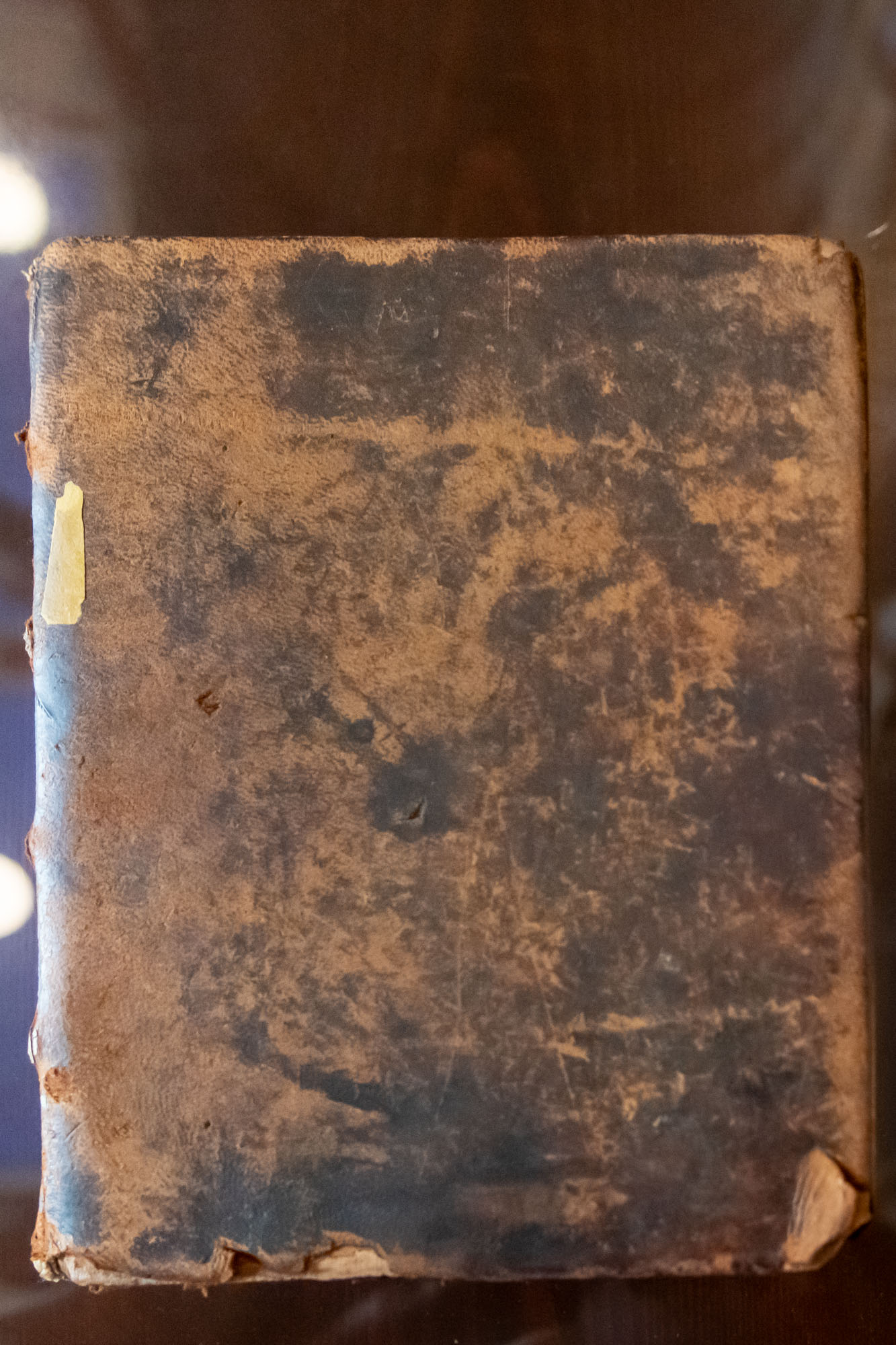
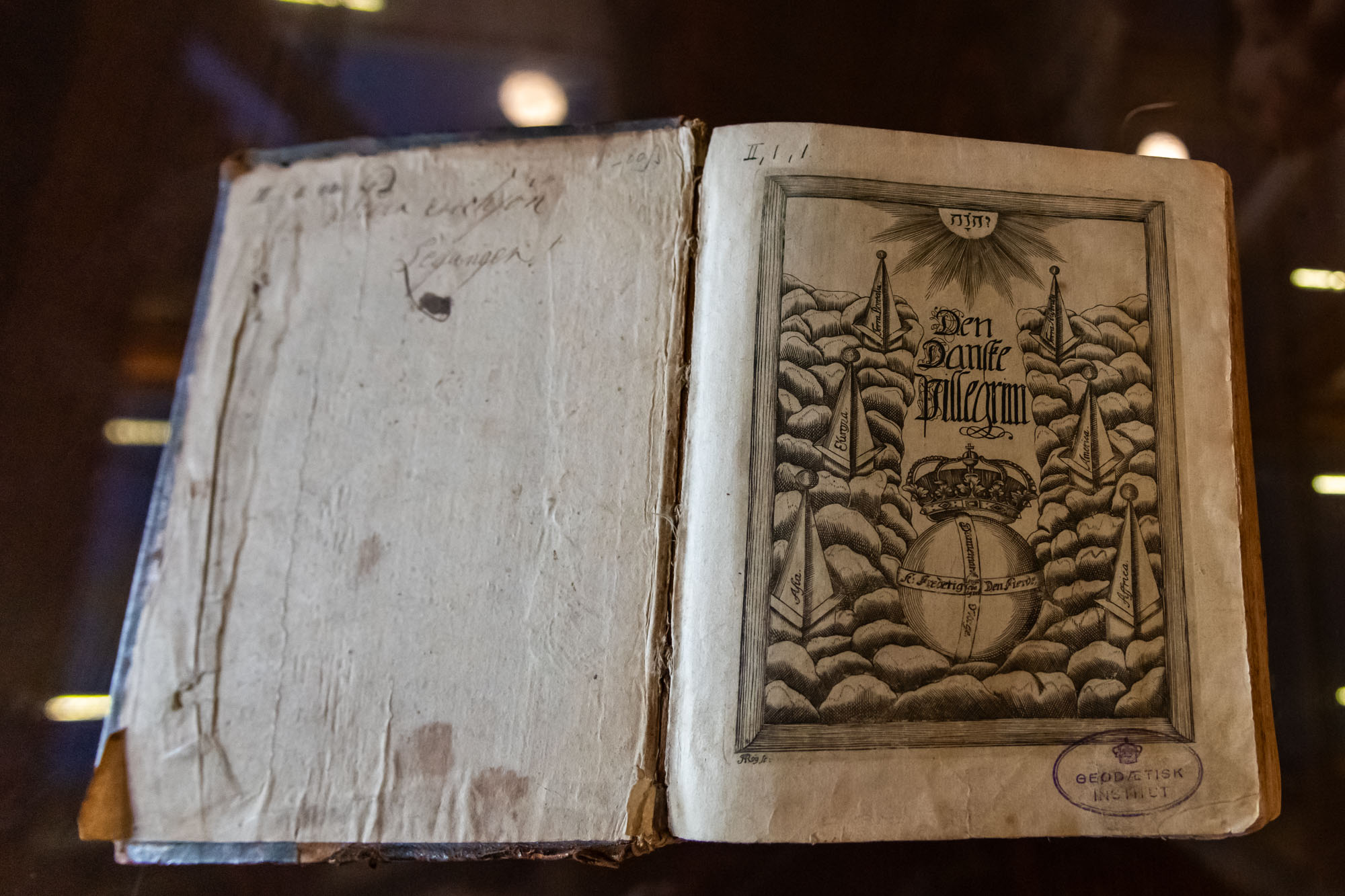
Perhaps because of my obvious interest in the library, the guide told me that she could show me the oldest book in the library. It is from 1707 and the title in the first page reads “Danish Pilgrim” and the one in the second page reads “Geographical and Political Description of the Whole Known World”. Supposedly, it is a collection of random details about various places. For instance, it might speak about the natural aspects of a location and be silent about its trade and commerce and vice versa about some other place. It seems this is a printed book and not a hand-written one. The guide handed over the book to me and when I leafed through the pages, I found a chapter on China but there was no information on India. The family of the person whose name is scribbled inside the cover did some research and found that he was the captain of a ship. This book must have belonged to him. This was a very special experience for me as this is the oldest book I have held in my hands! It was almost like touching history and going back three centuries!
One of the most interesting aspects of European cities is the presence of public spaces. You find squares large and small scattered everywhere across the cities. Some are old and some are new, but they are there, and everyone has access to those. They are maintained well with seating provided and people use them well. Since I was travelling in summer, I saw many people always gathered in these squares, especially in the evenings. They were friends and families, connecting and having a good time. Some of the squares are very large and would be ideal places for public gatherings and demonstrations. In Helsinki, I noticed that there would be a café selling drinks like beer, wine, coffee etc. in the square and I saw many people coming there to socialize, after dinner. In some places, there were free concerts and such other events. Overall, there was a lot of life around these public spaces, and I feel this is one significant thing we are missing in our cities. We used to have such spaces before but now with our uncontrolled “development” most of these have been lost. There would be a few parks here and there but that would be about it and even those won’t be available in the newer areas. In smaller towns, especially in Kerala, the athanis around temples or aaltharas, which play this role, are still present but they are mostly male dominated spaces and even these are changing in character today to become even more exclusive. 

Getting around most of these cities is quite easy as the public transport is pretty good. I had a car with me in some cities like Budapest and I found that to be a liability as parking was a hassle and a bit expensive. Most cities seem to have made parking very expensive to discourage people from using cars; maybe it also an avenue for the city council to generate income. Buses, trams and metros were very convenient, and you could buy daily tickets or trip tickets. The whole experience of buying these tickets was also very, very seamless through their app or website or simply tapping your credit card on the machines inside the vehicles. In most cities, they seem to rely on people’s honesty in buying tickets as you could just hop in and hop out without having to present the ticket. There is random checking, of course, and the fines are quite hefty. Cars are needed if you want to go to the countryside but otherwise, in cities, the public transport was more than enough. Moreover, these days, with Google maps available, you really don’t need to be familiar with the city as the app will guide you perfectly. Of course, this means that you need to have mobile connectivity wherever you go. 

One thing I noticed was that the use of taxis has come down drastically, over the years. Even when using taxis, people are using ride hailing apps like Uber or Bolt. I went to Helsinki from Tallinn by ferry and from the port, out of curiosity, I decided to take a taxi. I had seen that my hotel was only three or four kilometres from the port. Taxi drivers were calling out and competing for passengers and with that itself my antennae went up. Sure enough, even before the taxi and left the compound of the port, the meter was showing 25 Euros! I pointed this out to the driver and then the discussion started with us finally settling on 30 Euros for the whole drive; my feeling was that the correct rate would only have been 15 or 20 Euros. 

This incident was the only negative experience in the whole trip that lasted 45 days and in general, travelling in Europe was a smooth experience. People were friendly and trusting. One day, in Ljubljana, we were eating at a temporary local market set up in a square and we wanted a glass of wine. The vendor had stepped out and his friend was minding the cart, and he didn’t know the price of the wine we wanted. He just poured us the wine and asked us to come back and pay later. We could have just walked away without paying but he trusted us. In interior Scotland the roads are very narrow and sometimes, you have to wait at a particular spot so that the vehicle coming against you can pass. People waited patiently and politely and waved at each other when they passed. There was no honking and light flashing. In fact, the attitude around flashing one’s headlight best describes the difference. In India, when we flash our headlight, we intend to convey to the other driver that we are going, and she or he should wait; it often is a contest of who flashed first. In Europe (and many other countries including US), when they flash their headlight at you, they are conveying that they will wait, and you can go ahead. One is about me, and the other is about you. Such small, everyday instances make or break your experience. 

As mentioned, there is hardly any abrasive experience when travelling in Europe. This is not the situation when we travel around India. The traffic is violent, there is much haggling, pushing and shoving which basically leaves you exhausted. I was just wondering how Europe got to be like this. In the medieval times, Europe was one of the most violent places in Earth with their inhumane colonization and such. Even if you look at the nature of the punishments they handed out like “hung, drawn and quartered”, it was just horrible. In those times, violence was an everyday event as well, as I understood. I was curious on how such a violent people become so peaceful. This is not to say that there are no violent crimes in these places; there are. I am talking about the small incidents in everyday life. 

Of course, I mean only the people in their everyday lives and not nation states, which continue to be violent as we can see from their behaviour in Iraq, Palestine, Ukraine and such other places across the world. I don’t have an answer to this question, and I did discuss this with a couple of people. The only theory I could come up with was that maybe the people have made the state the owners of violence and decided to move away from it in their individual capacity. Of course, it might only be a thin layer of veneer that covers the underlying violent nature. Whatever it be, it makes everyday interactions a bit less stressful. I guess it must have something to do with education and culture. For instance, every city, big or small, has museums, theatres and such other cultural institutions. They take care to ensure that school children have exposure to these from a very young age. I am not sure what they are doing right or whether it is intentional; but is sure seems to have an effect. 
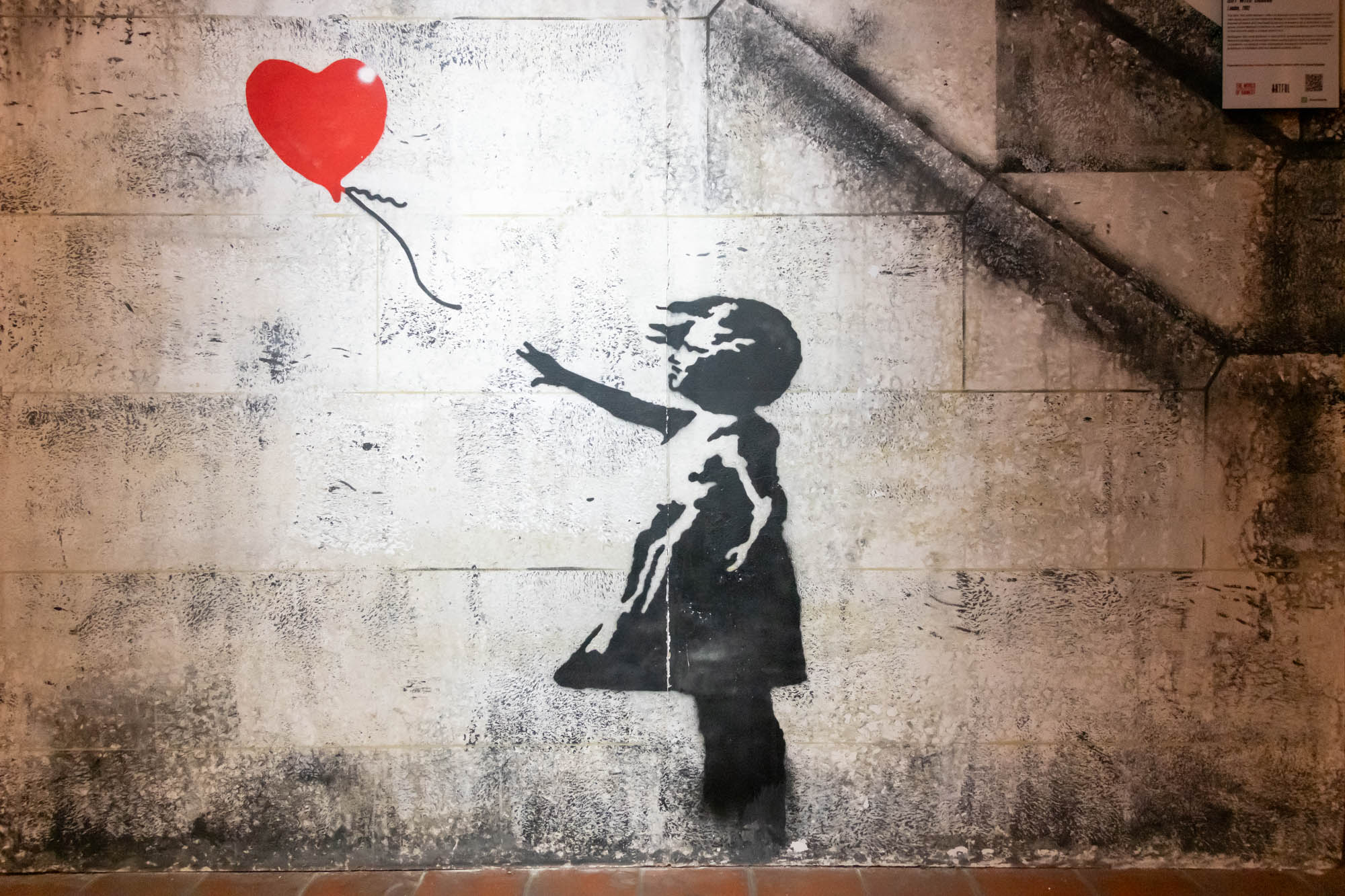
I was wandering around Prague yesterday when I stumbled upon the Banksy Museum (The World of Banksy), on my way to see the rotating Kafka head. A museum for the works of Banksy had never entered my imagination as it feels like an oxymoron. This is housed in a 15th century church and on the doorway, it is mentioned: “Just like Banksy usually presents his art at unusual places, our exhibition also takes place at an unusual location – a church right in the heart of Prague. Czech priest and church reformer Jan Hus used to preach here in the 15th century. The church and adjacent monastery were later disestablished during the reforms of Emperor Joseph II in the 18th century. In its most recent history, the church building served as a warehouse and a nightclub. Now, after centuries, it finally hosts another reformer – Banksy!”. I had to go in!

There are several works of Banksy organised inside the museum, and I guess most, if not all, are replicas. There are many videos as well and it was indeed a very good experience to see many works by Banksy at the same location. The show starts with the famous girl with a balloon, and I am reproducing some of the works that I could photograph. 

“Girl with Balloon” is one of Banksy’s most known works and was painted on the stairs near London’s Waterloo Bridge in 2002. This work announced Banksy’s arrival into the world of graffiti, and he has been instrumental in increasing the power and impact of the medium. 

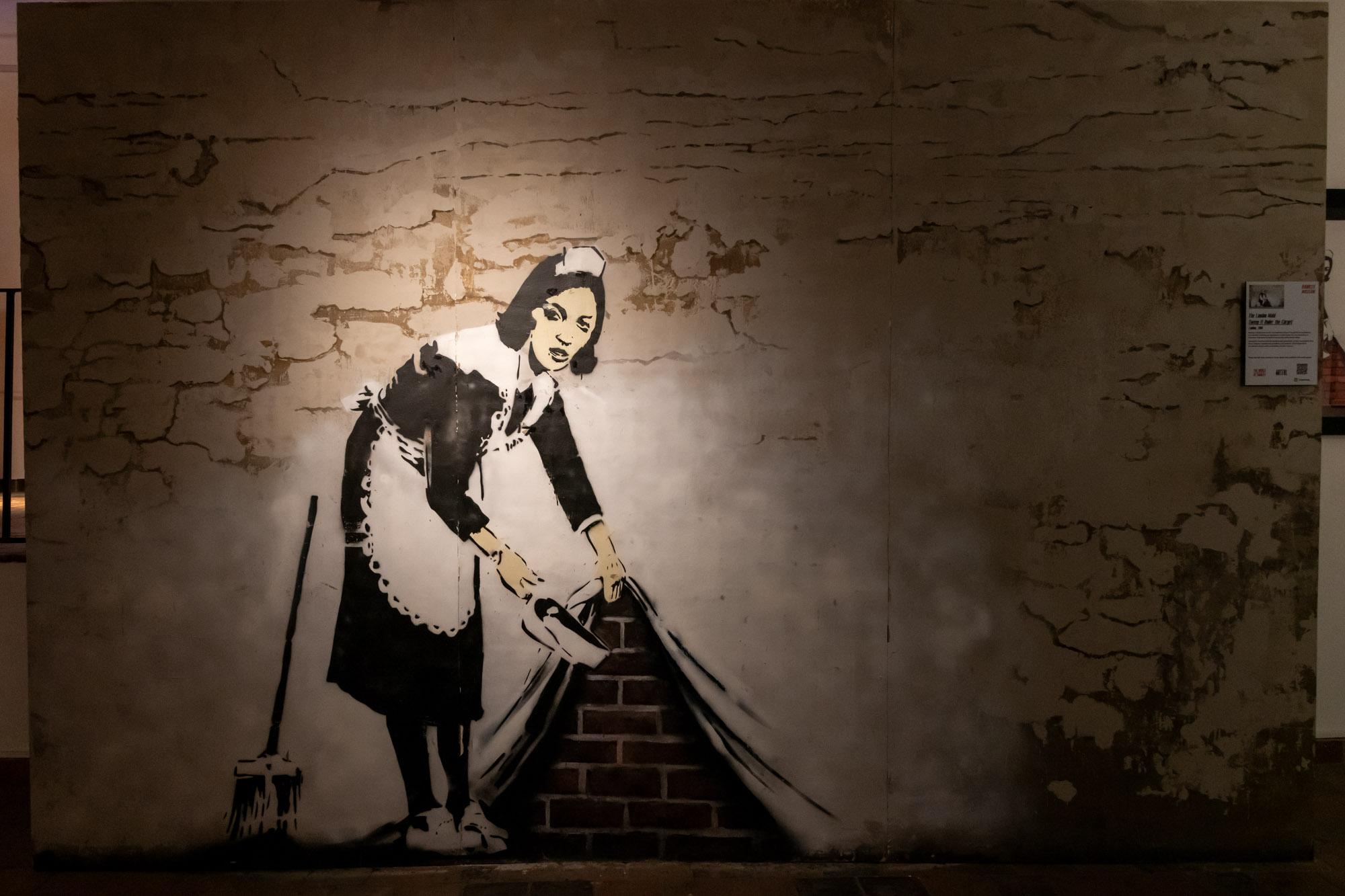
“Sweep It Under the Carpet” from 2006. In the make believe world that we live in, which is becoming more and more about just appearances and covering up, this work needs no explanation.

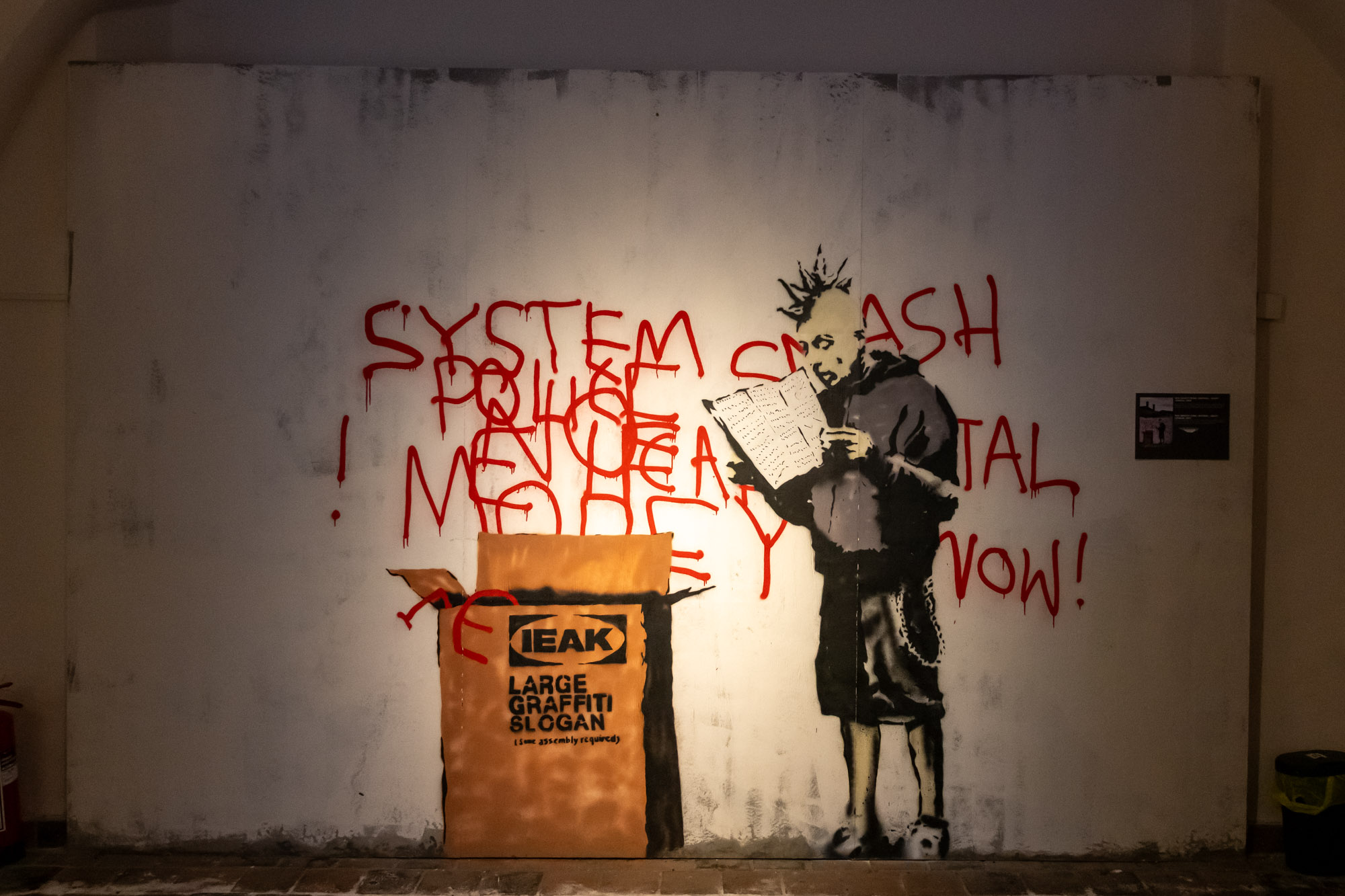
We live in the era of DIY where we can just assemble everything ourselves with the set of instructions provided. Ironically, even art seems to be headed in that direction!

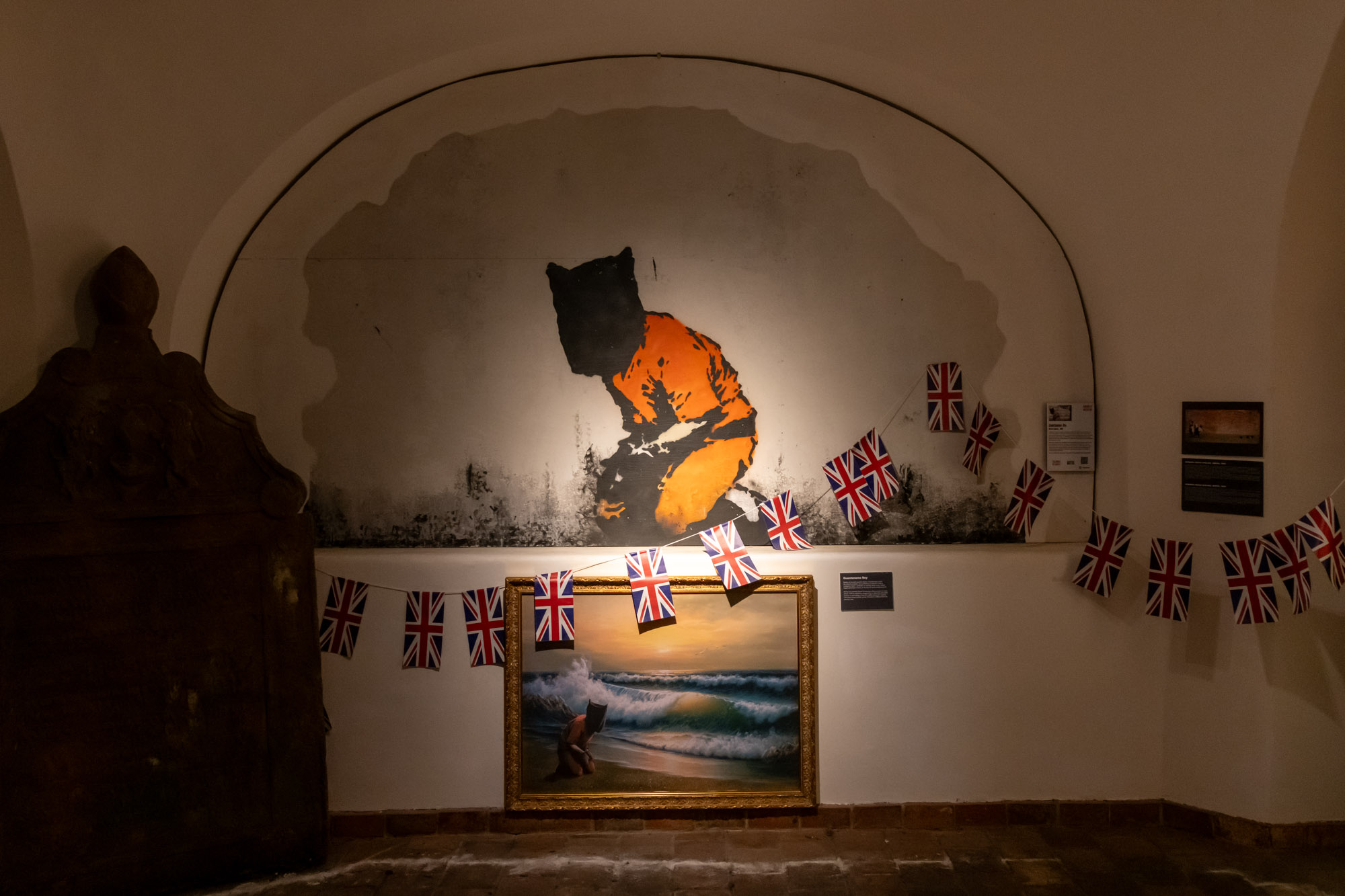
A work related to Guantanamo Bay; in the painting, the prisoner is placed on an idyliic seashore. 

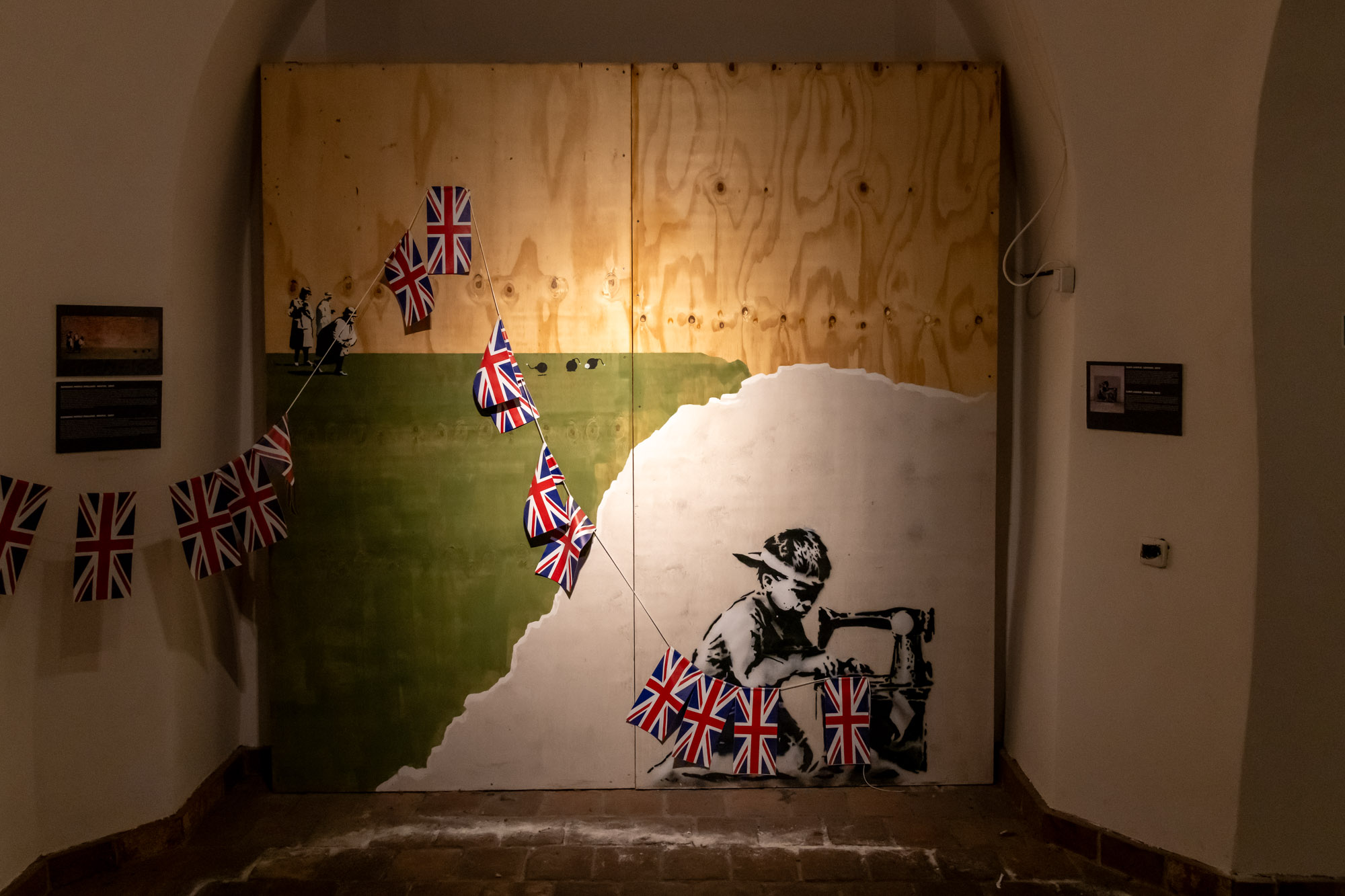
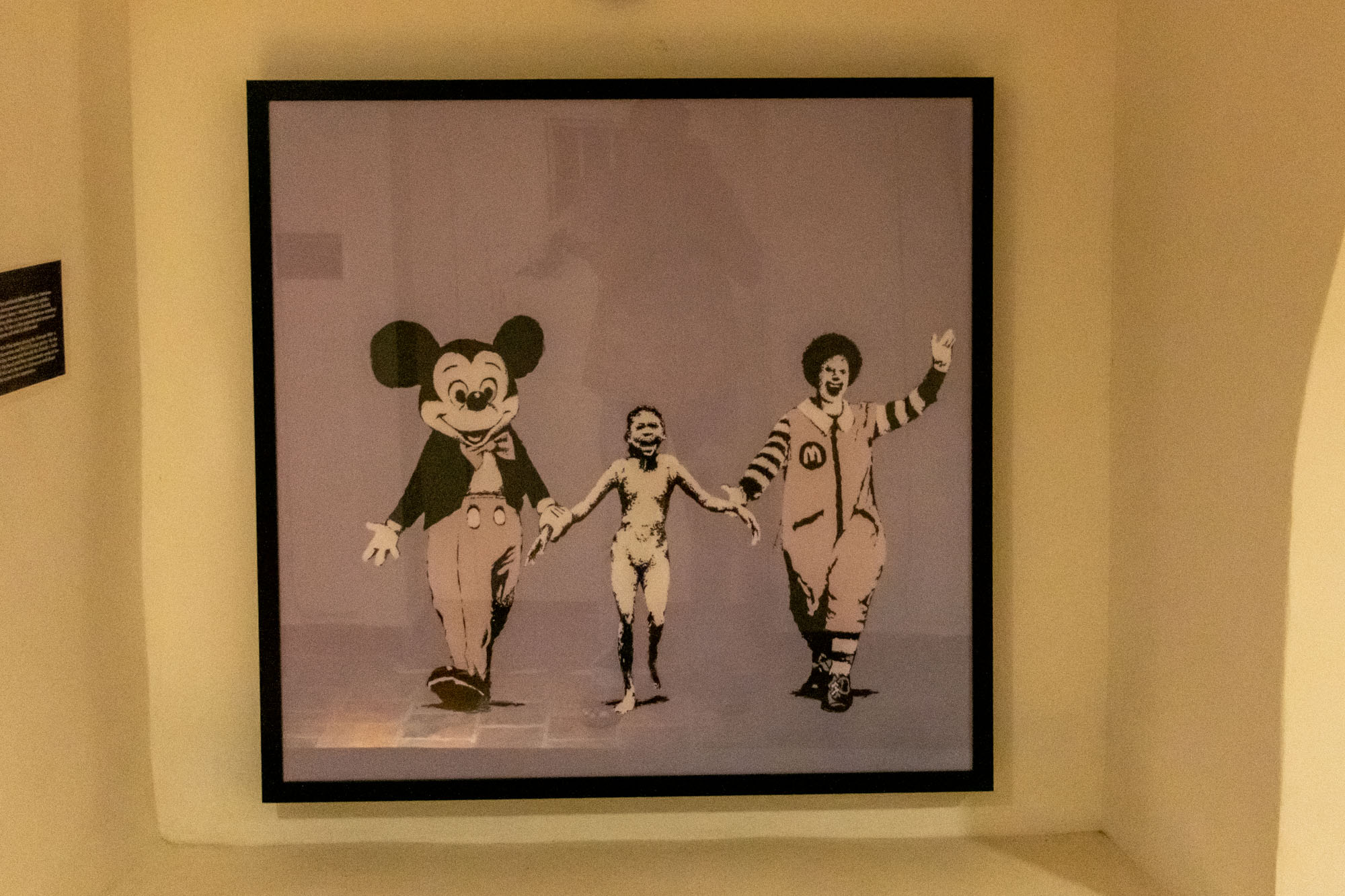
This was to expose the issue of using child (often slave) labour, so that the twin celebrations on the 2012 Olympic Games and Queen Elizabeth’s Diamond Jubilee could go on in all its pomp and gaiety. 

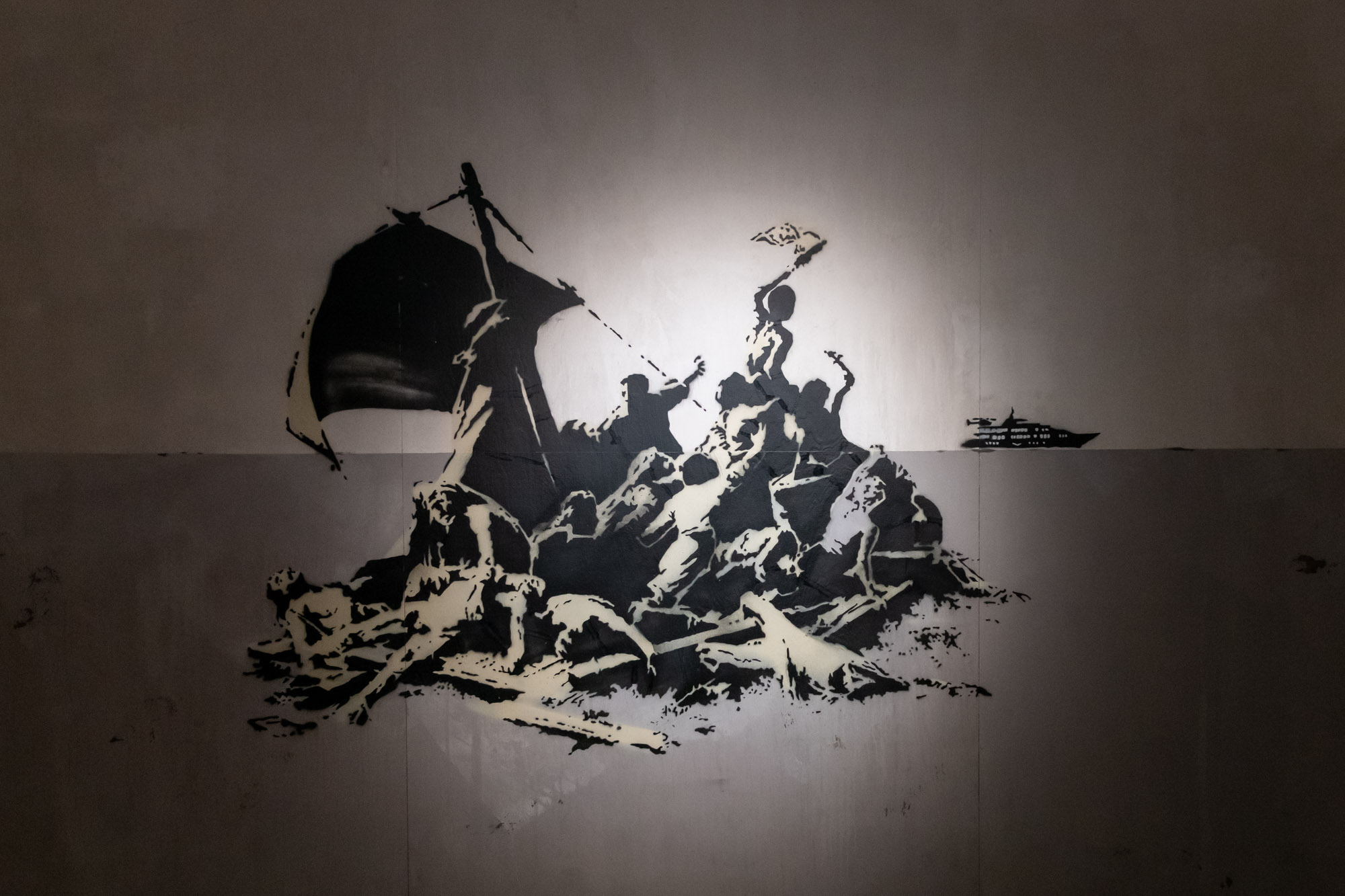
This is an artistic parody of Théodore Géricault’s “The Raft of the Medusa”. While Gerricault painted the plight of a bunch of shipwrecked soldiers, Banksy that projected that idea on to our times of the have and have-nots, with a luxury yacht thrown in.

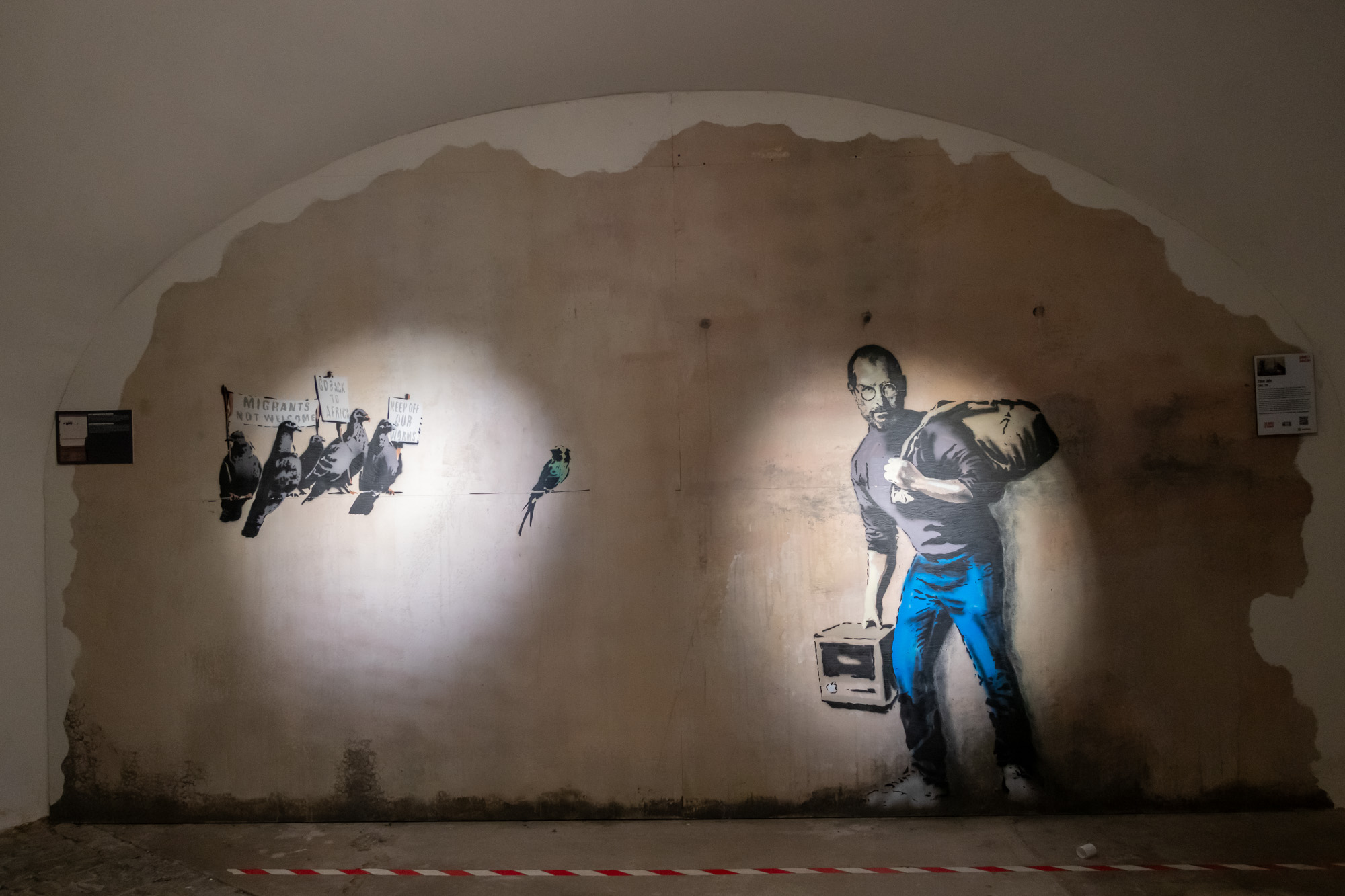
This artwork was executed in a refugee camp called “The Jungle” that existed in Calais in France between January 2015 to October 2016. In this mural, which was unveiled on 11 December 2015, Steve Jobs is shown carrying a typical black garbage bag as is often carried by refugees, slung over his shoulder and the original Apple computer in this other hand. At a time when the refugee crisis was at its peak with many countries looking down upon immigrants, Banksy was reminding the world that the founder of the most valuable company in the world, was himself the son for an immigrant from Syria. The sad truth is that this artwork is even more relevant today, than it was in 2015.

Capitalism, unabated.

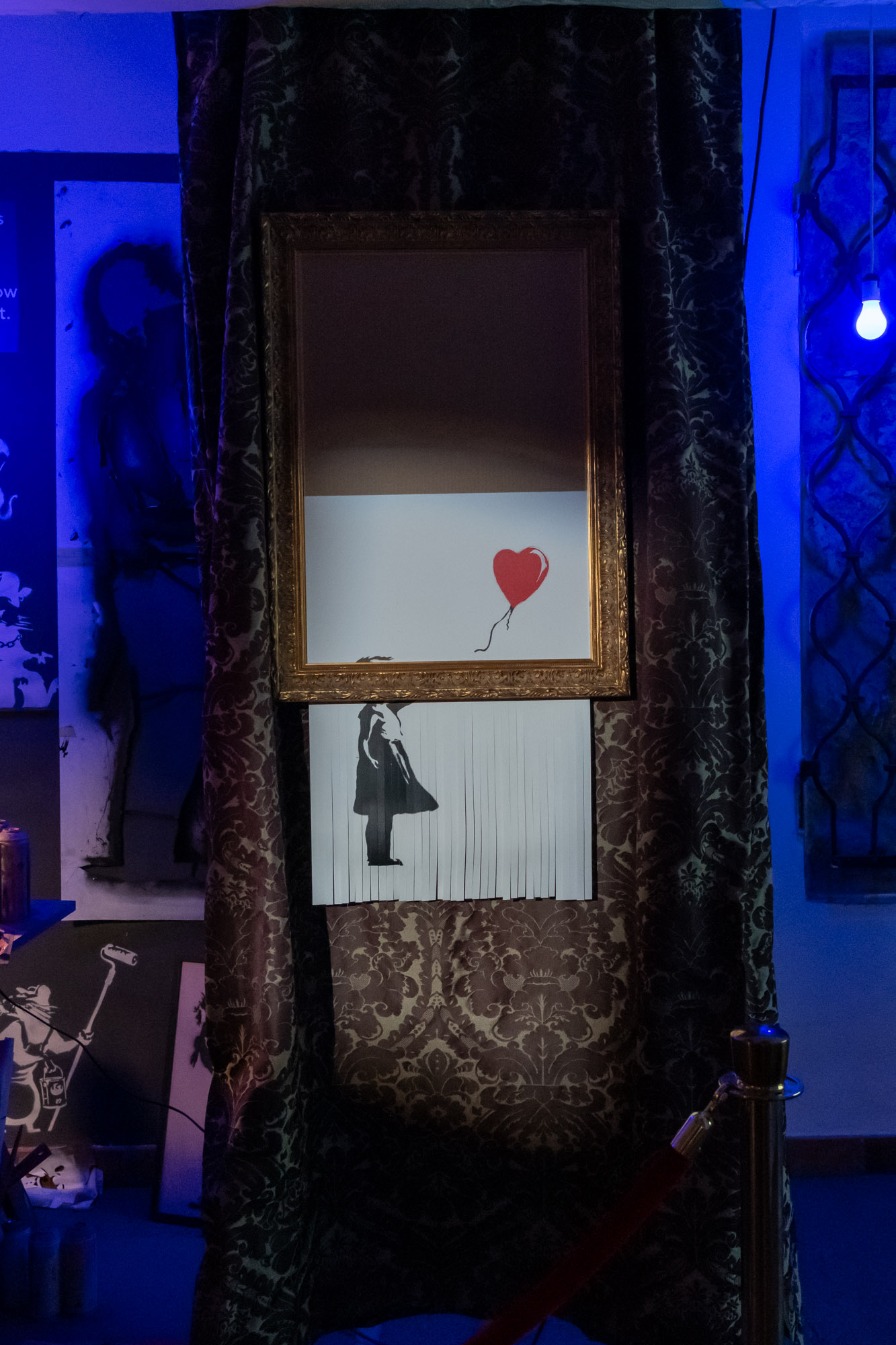
On 5 October 2018, the “Girl with Balloon” went up for auction in Sotheby’s as a framed artwork and it sold for a record-breaking (for Banksy) price of GBP 1,042,000/-. Immediately after the final bid was accepted, a mechanical paper shredder hidden in the frame started destruct the painting, much to the dismay and horror of a room full of bewildered art collectors. The shredder malfunctioned when it was about half-way through and so the painting was not fully destroyed. It seems that Banksy had gifted this artwork to a friend in 2006 and he had installed the shredder then itself with a plan to destruct it, should it ever be sold in an auction. 

Three years later, this artwork, which was partially destroyed, was renamed as “Love Is In The Bin” and was sold at another auction at the same Sotheby’s for a yet another record-breaking price of GBP 18,582,000/-. 

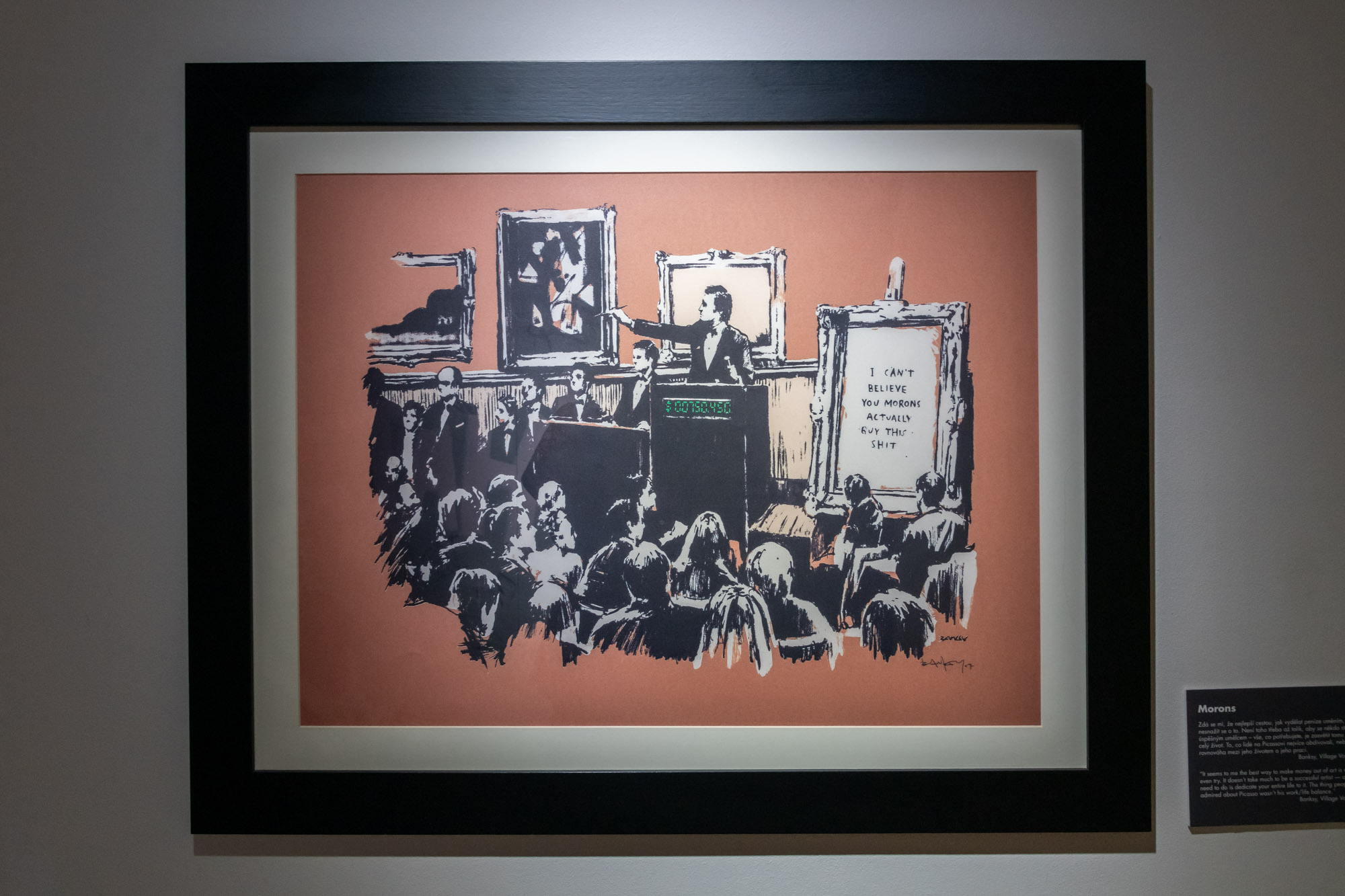
Here Banksy is seen mocking the art collectors who buy artworks at astronomically high prices. I was tempted to compare this work with what happened with the Girl with Balloon. I had read about the incident at the time and wondered whether the purchaser would agree to buy it now that the work itself was damaged. It just showed how little I understood the brains of the moneyed that operate in the art world. After the event, there were some negotiations, and the buyer agreed to pay the full price. Sotheby’s labelled the whole episode as “the first artwork in history to have been created live during an auction”. It sems market watchers had speculated then itself that the self-destruction would increase the value of the painting. Looks like they were right because the artwork appreciated in value from 1 Million to 18.5 Million in just three years; a return in investment that even the best investors can only dream about. So, they are not “morons” as Banksy states in his work. This ability to pivot and take on challenges and convert them into opportunities is a unique aspect of capitalism. 

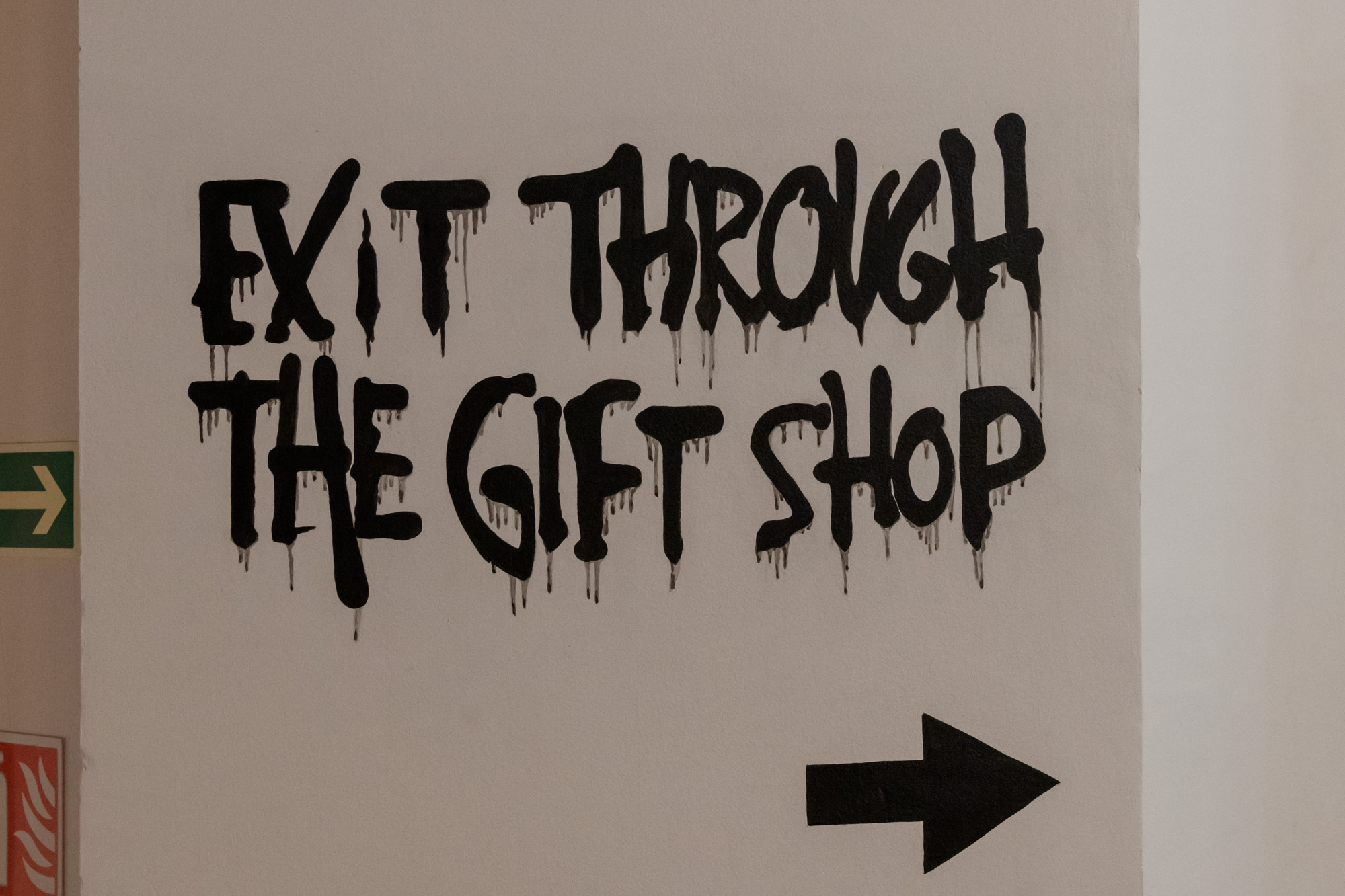
No, this is not an artwork artwork (yes, this is a Banksy work, but here it is actually meant to be functional)! The Banksy Museum is no different from other museums in this aspect and they too force the visitor to move through a shop, hoping to monetise the viewer’s receptive state of mind, coming after watching the exhibition. Banksy is a genius, and I felt this was an insult to him. Or maybe, as a friend remarked, when I sent him a photo of this, “That is the actual Banksy work there”. 

Yesterday, a chance encounter in the tram, enroute to the Van Gogh Museum resulted in me changing plans and heading to the Stedelijk Museum. This is a museum dedicated to modern art and is right next to the Van Gogh Museum, in Amsterdam. I have seen many Van Goghs in different museums and so I thought it would be good to check out what the Stedelijk had in store. 

They have three sections dedicated to period upto 1950, 1950-1980 and 1980 onwards. A large painting and an installation by Anselm Kiefer greet you as you enter the museum. These fantastic works speak about the futility of war and are just phenomenal. However, this piece is not about these works or the museum itself. There are many interesting pieces in the museum, and you can easily spend hours there. 

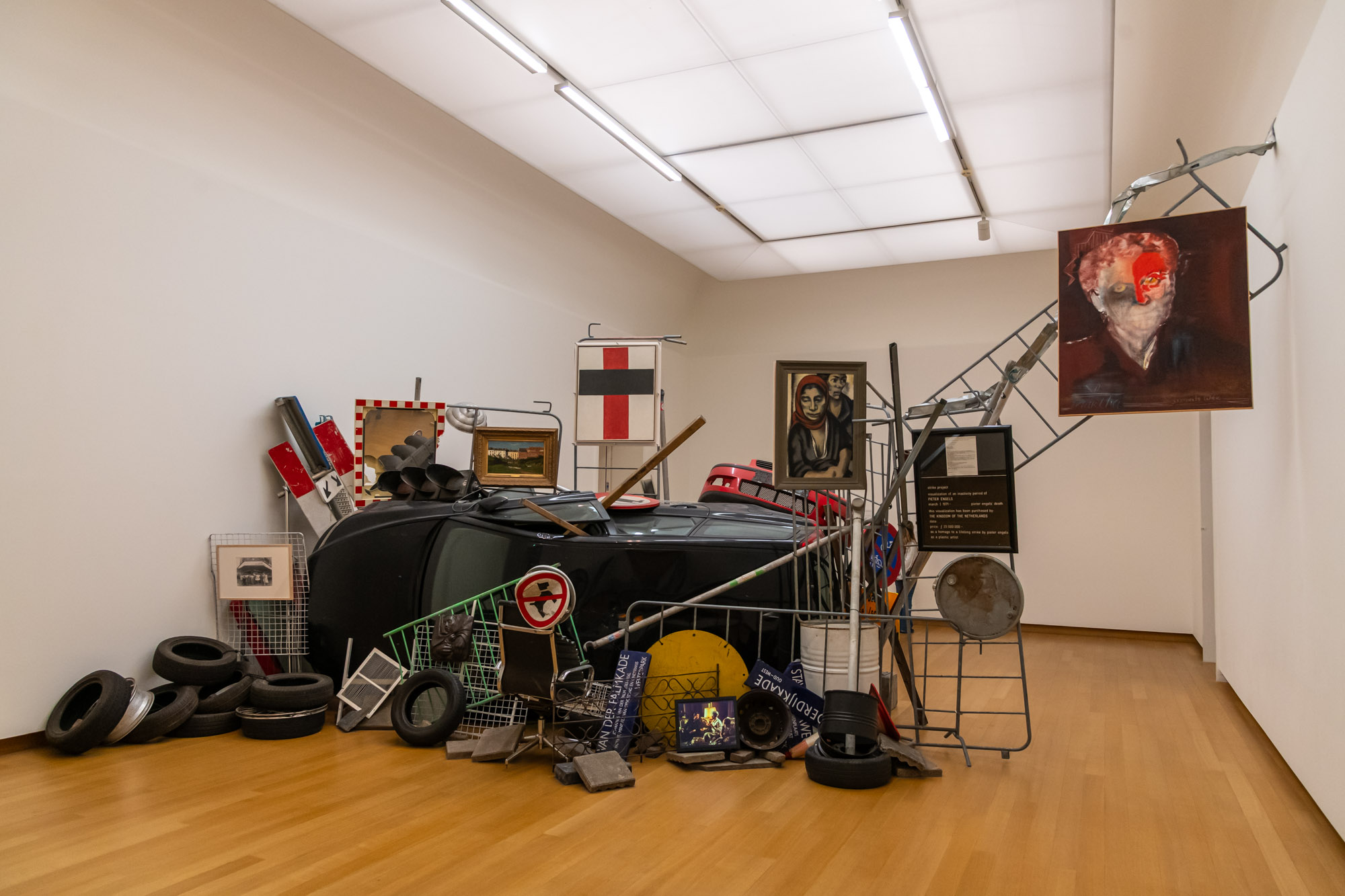
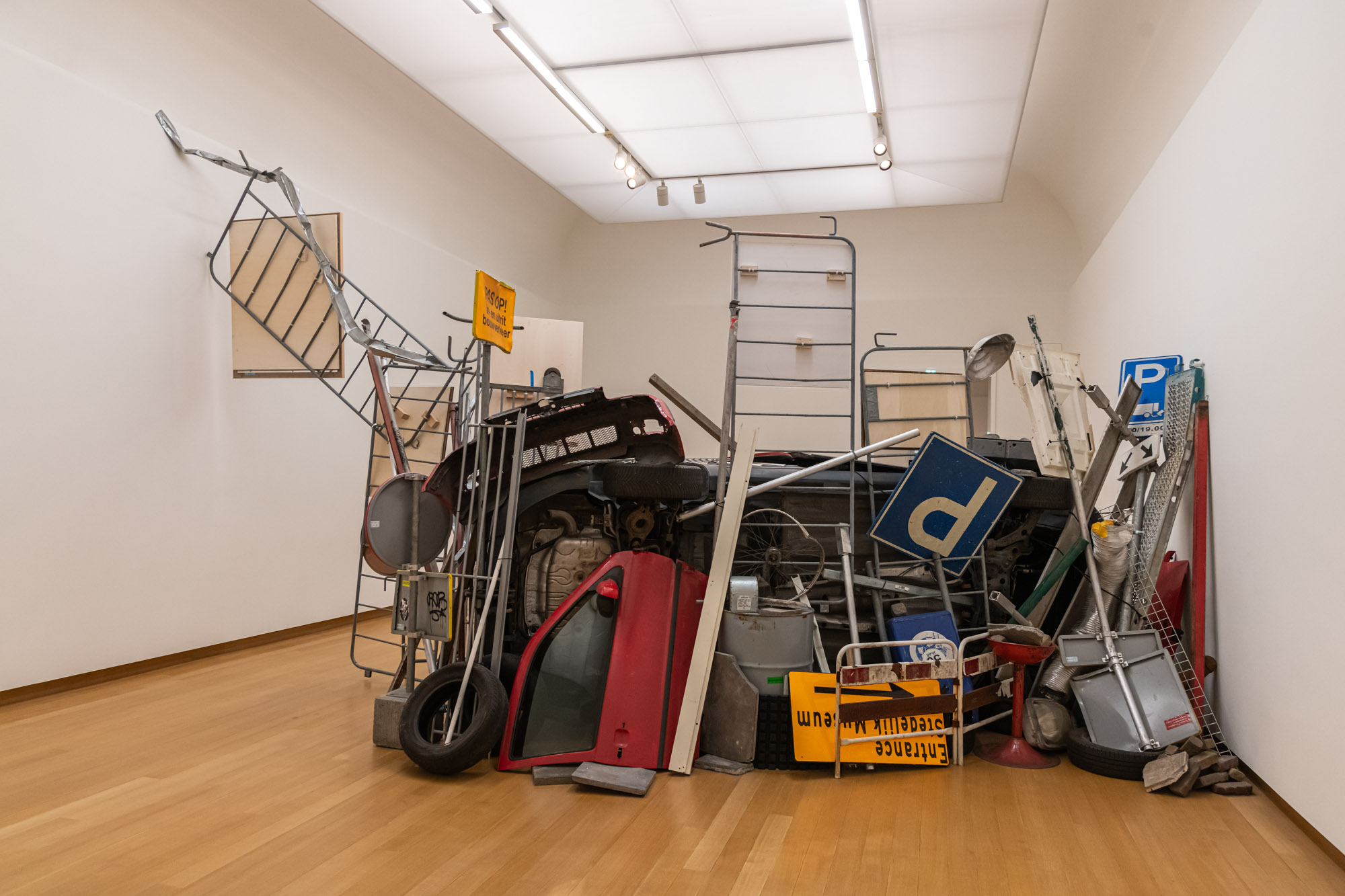
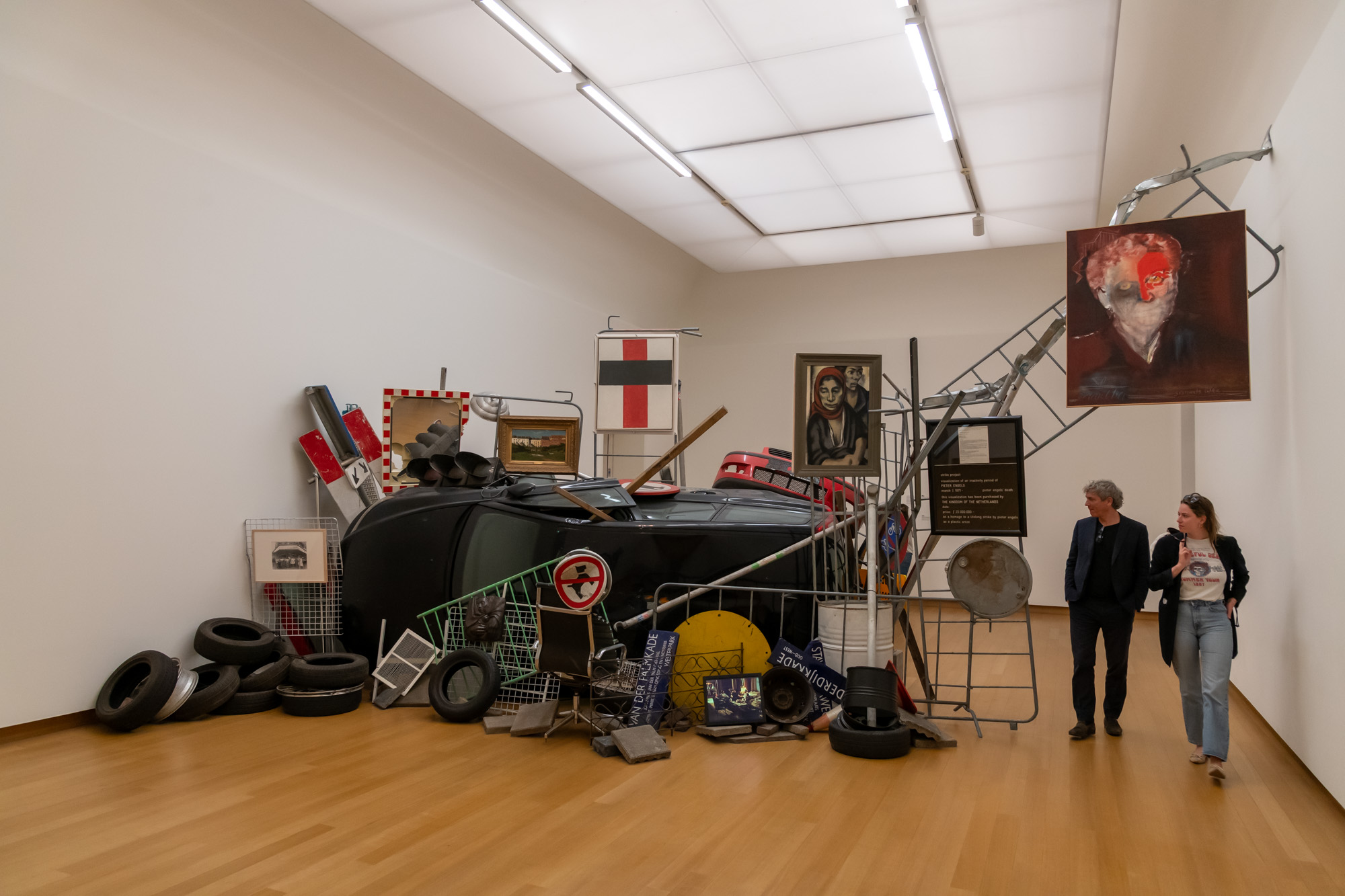
For me, one installation stood out and that was the central attraction for me in my visit to the museum. This was “Bakunin’s Barricade” by Ahmet Ogut. I wasn’t familiar with him, and a quick look on the internet made me realise that my lack of familiarity was clearly a pointer to my awareness about the art world. He is a Kurdish conceptual artist who studied art in Istanbul and Amsterdam and works mostly in Amsterdam now. 

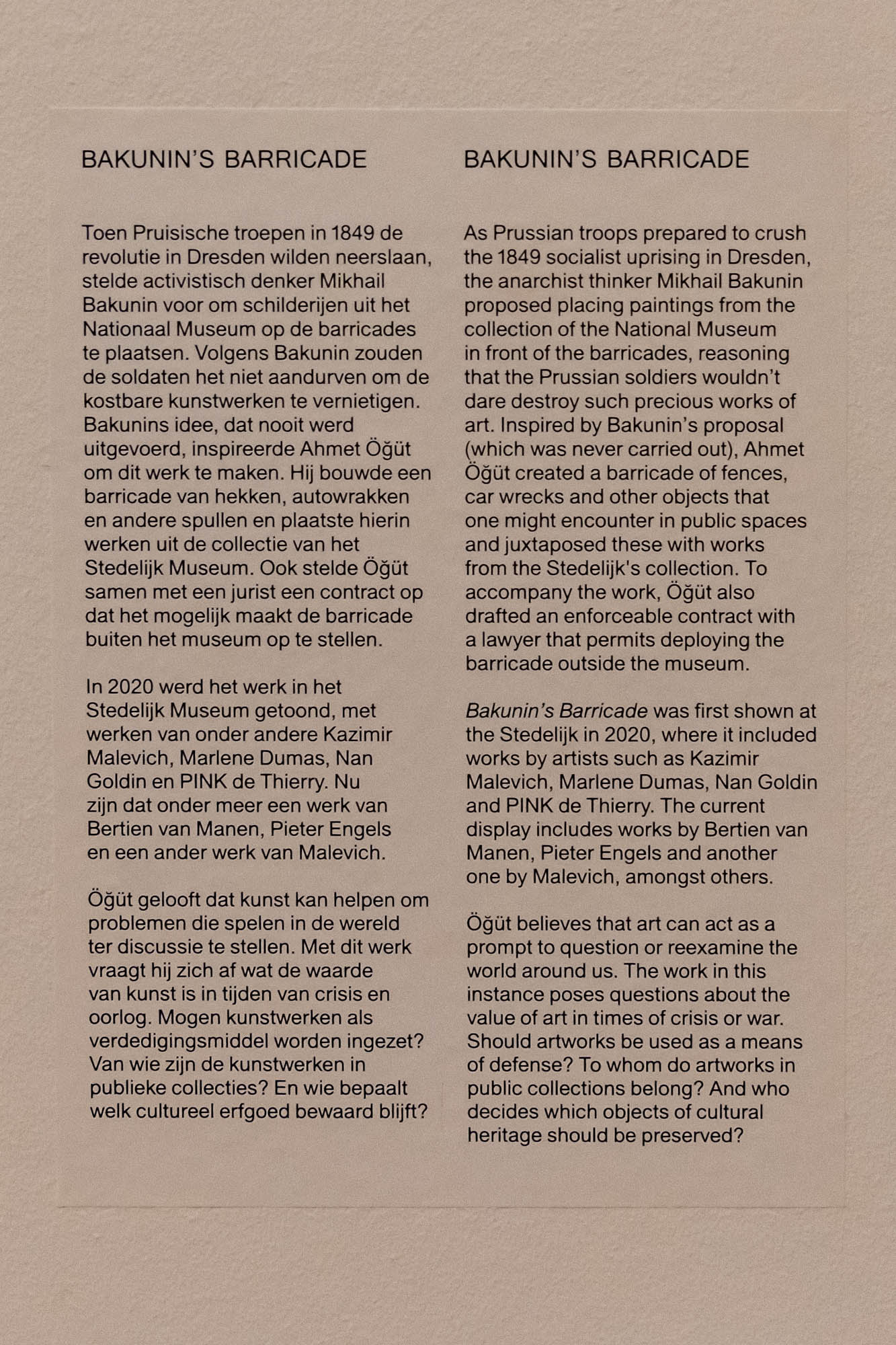
In 1848, there were Socialist uprisings in German states and it spread to Dresden in May 1849. The Municipal councillors in Dresden revolted against the King and with the help of the Municipal Guards, prepared themselves to stop the expected Prussian intervention. About 108 barricades were set up across the town. Mikhail Bakunin, the famous Russian anarchist was involved in this uprising, and he came up with a suggestion that they could place paintings from the National Museum in front of the barricades to protect them. His theory was that the Prussian soldiers would not dare to destroy those important works of art. However, there was not much support for this idea, and it was not carried out. 

Ahmet Ogut has taken inspiration from this event and made his work, Bakunin’s Barricade, as part of an exhibition titled “In the Presence of Absence” in 2015. The Stedelijk Museum procured this artwork in 2020 and as part of the procurement, a contract was signed between the museum and Ogut, and in the contract, it was mandated that the installation should be permitted to be deployed outside the museum, should anyone ask for it. The installation is a barricade as one that would be made by protestors in the streets and in front of the barricade, are works from famous artists like Kazimir Malevich, Marlene Dumas, Nan Goldin, PINK de Thierry and others. Ogut has recreated Bakunin’s idea in this installation. 

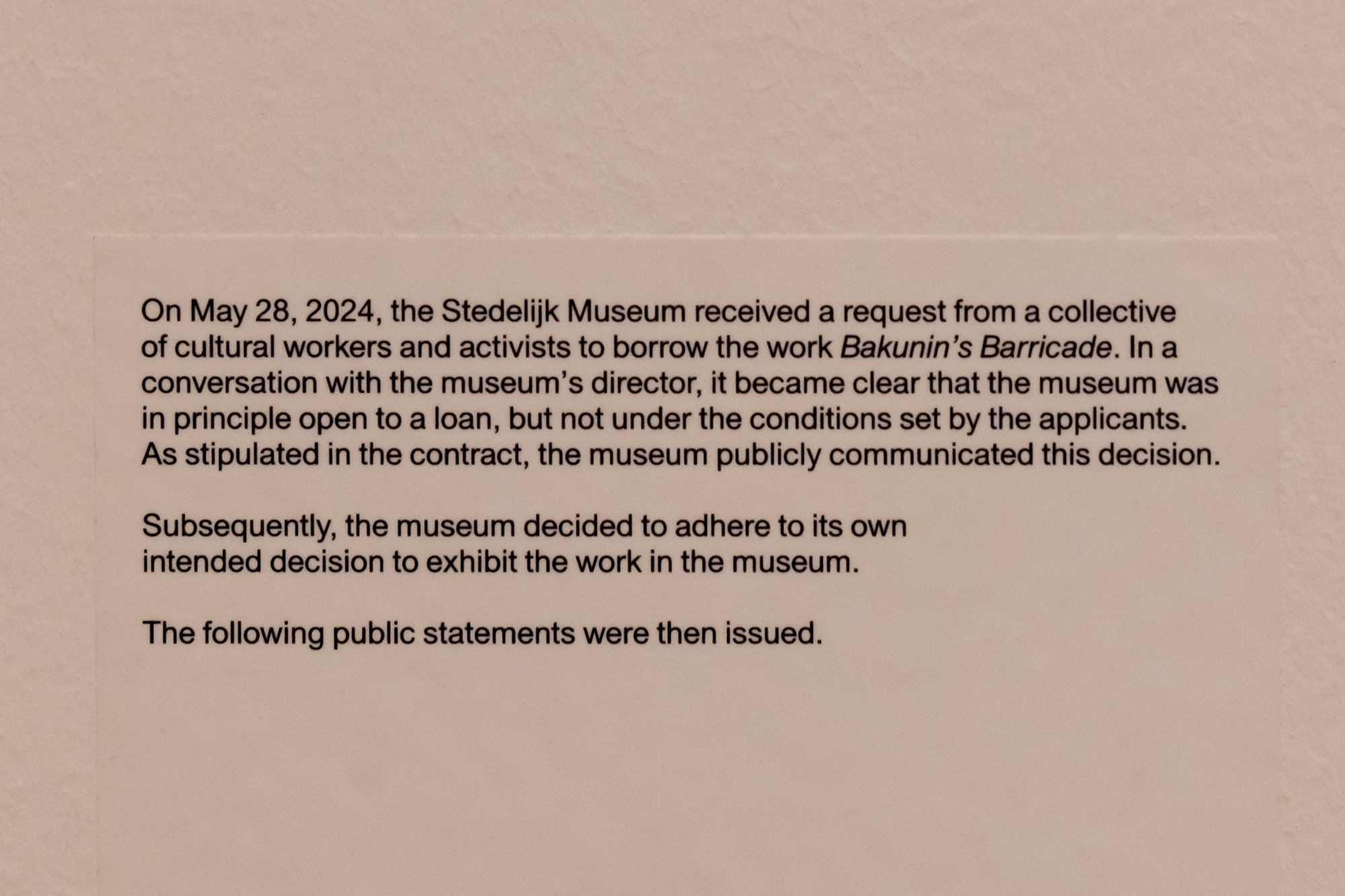
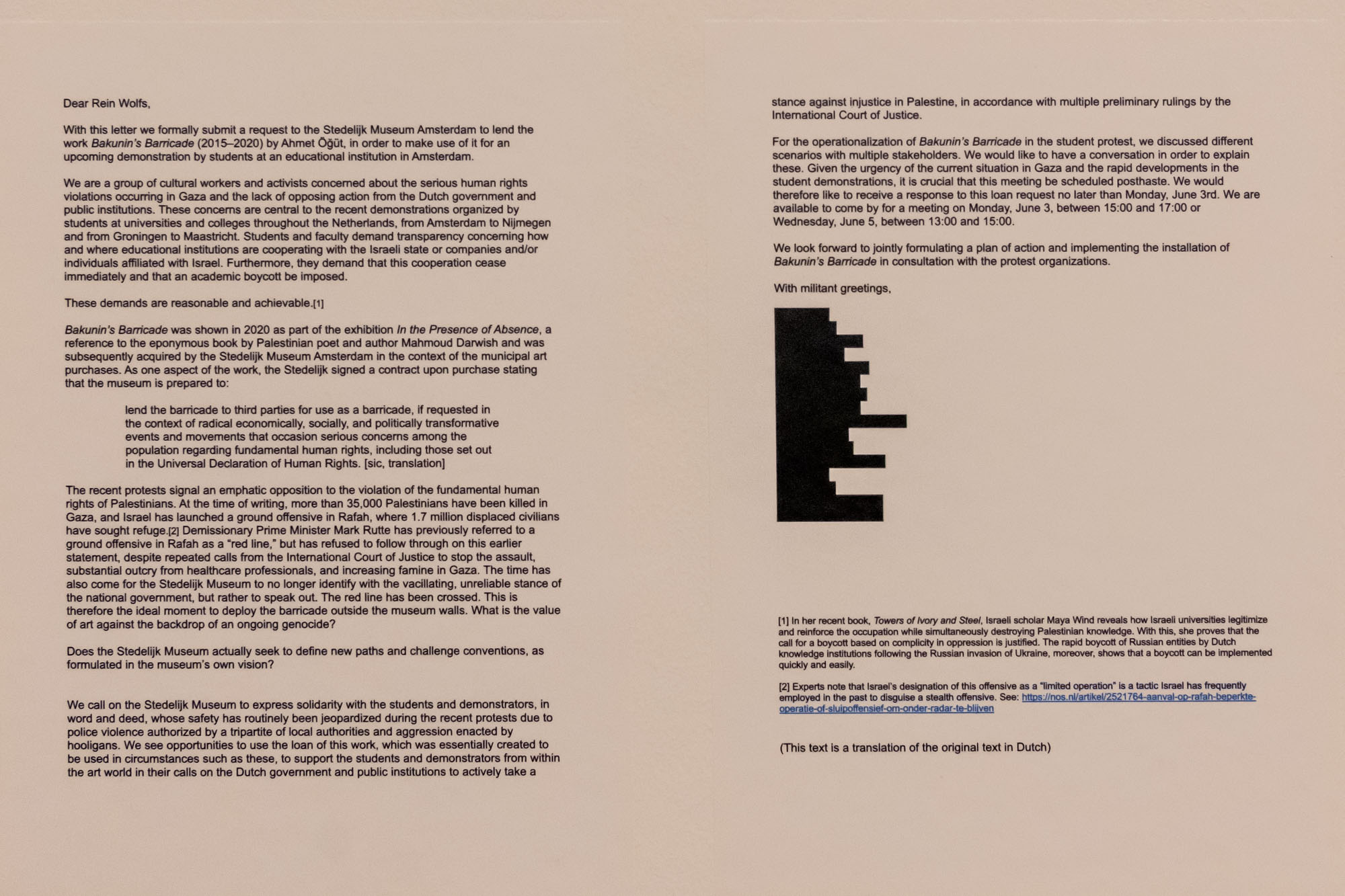
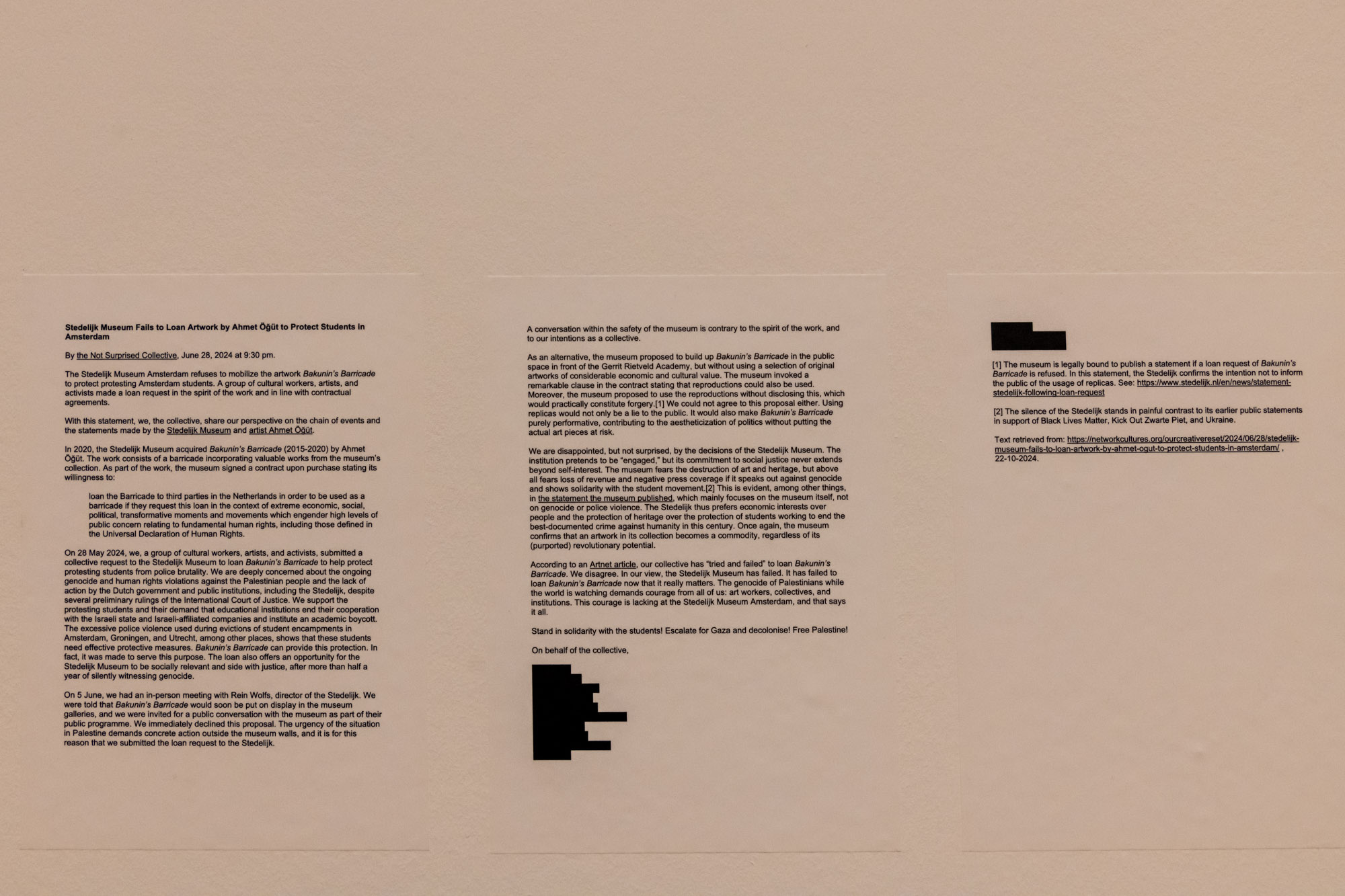
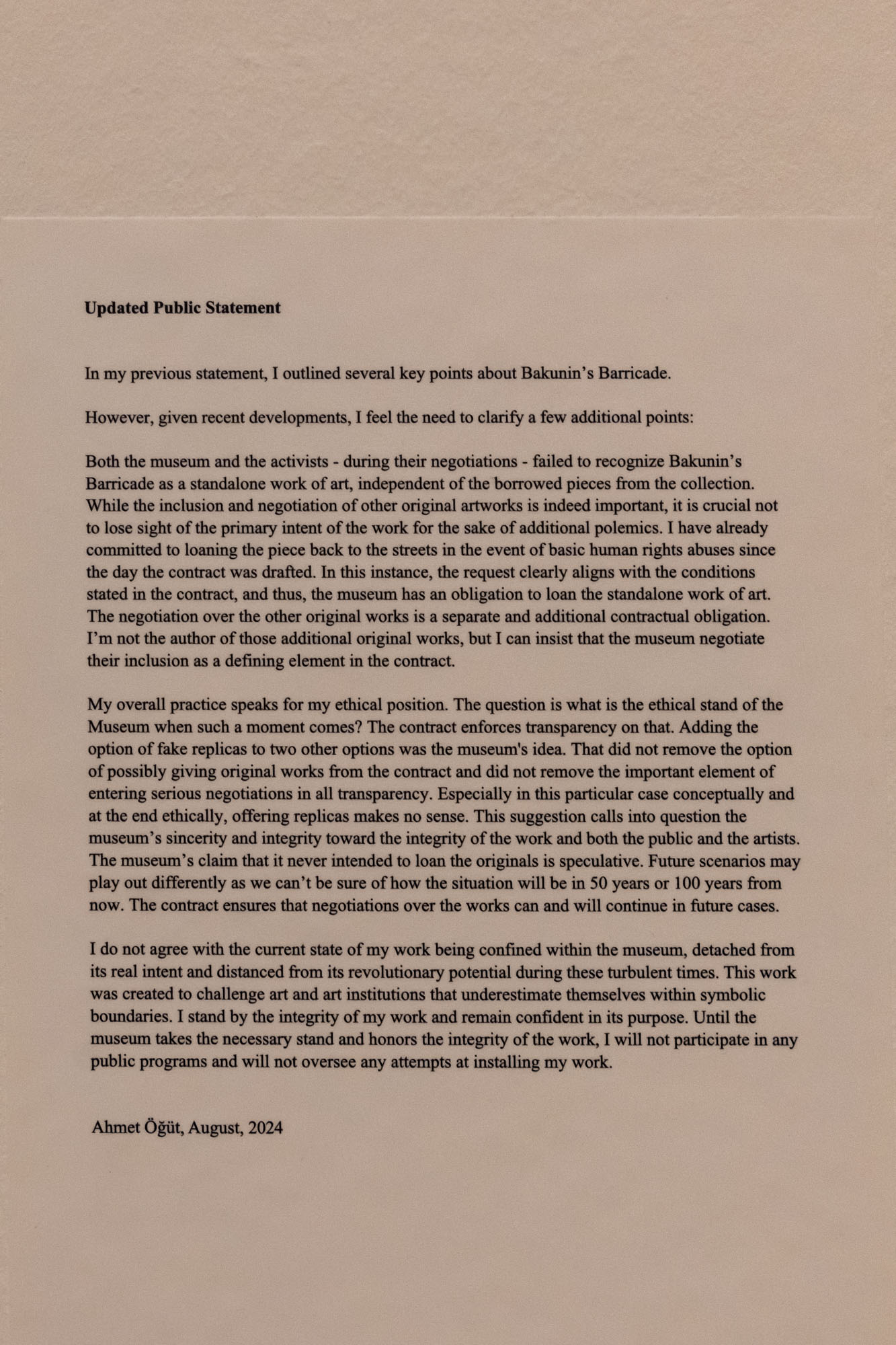
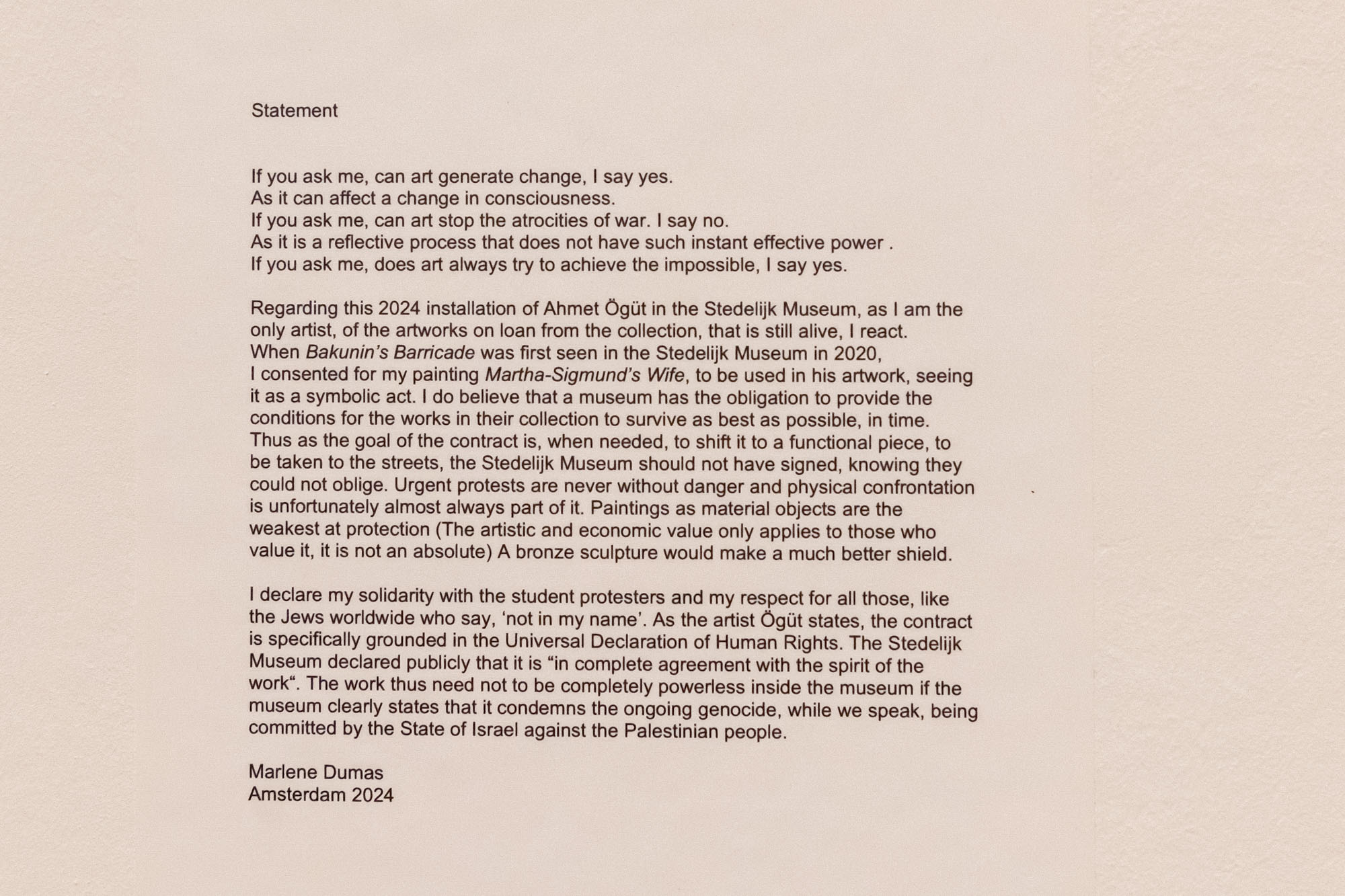
On 28 May 2024, a group of activists planning a protest against the human rights violations in Gaza, asked the museum to lend the artwork to them for using in a demonstration by students. They wanted Ogut’s artwork to play the role it was supposed to. The museum authorities were in a fix! They had signed a contract which specifically mandated that they should honour such requests, but it looks like they never expected anyone would actually make such a request. The contract also had a clause that the museum could decide, on a case-to-case basis, at their own discretion on whether a specific request was to be honoured or not. After mulling over the matter, they took a position that they could not take the risk of lending original artworks to be put on the barricade, as they might be damaged, but offered to provide replicas. Obviously, this was the same as refusing to lend the artworks as Bakunin’s whole premise was that government authorities would not destroy the barricades because the art works were original and thus precious. Nobody would have bothered about replicas. The museum authorities took the position that they had a responsibility to the people to protect original art works and could not jeopardise the safety of the art works by lending them to the protestors. 

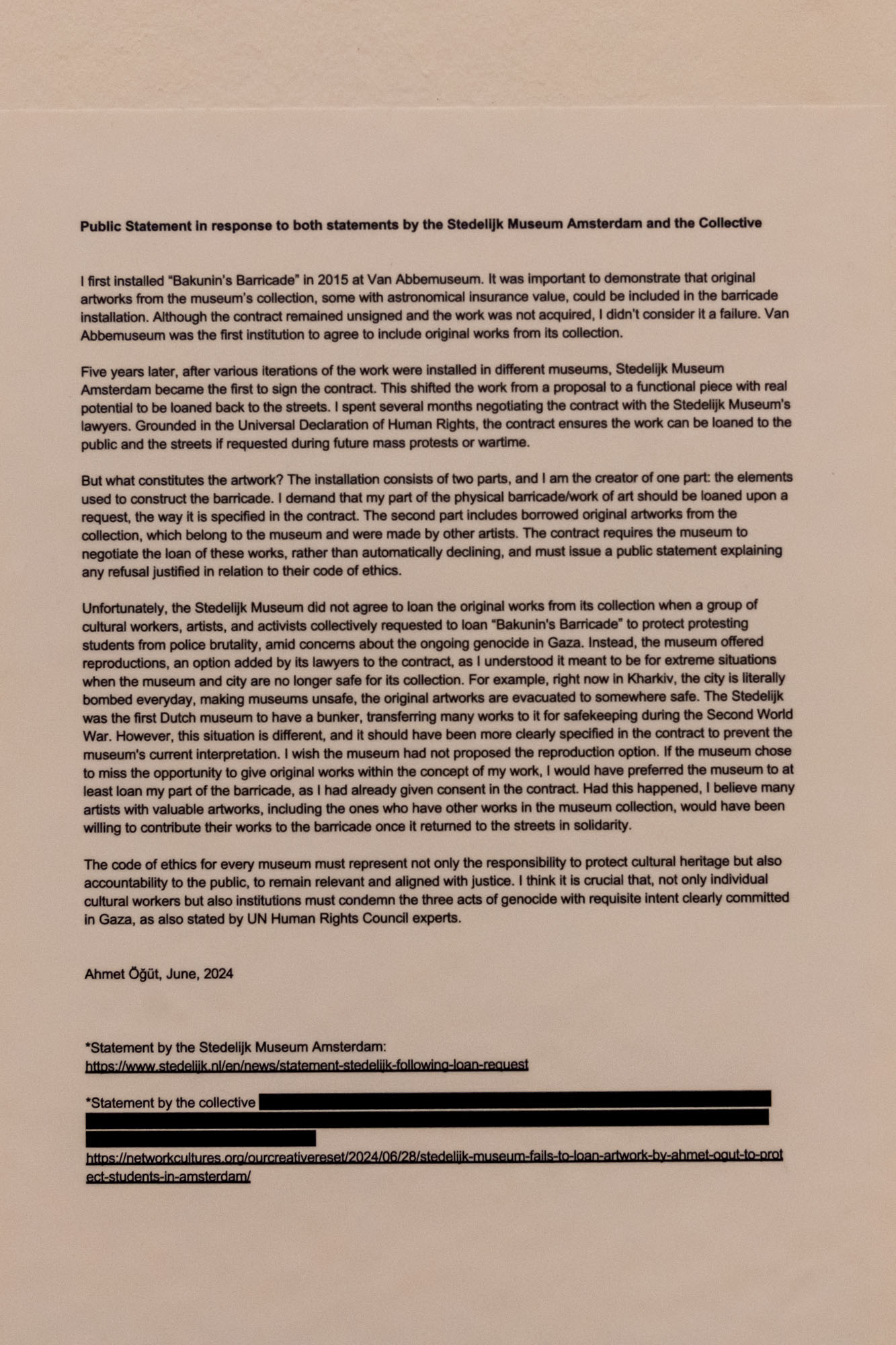
The protestors and Ahmet Ogut himself were not impressed; Marlene Dumas also was not convinced by the position taken by Stedelijk. The question that came up was why the museum had signed such a contract in the first place, if they had no intention of honouring it, especially when the request was made for an event to protest against the genocide in Palestine. Ogut contended that if the Museum did not want to lend artworks of others, they could have lent his work, just the Barricade. He felt that once other artists saw his Barricade being lent, they would have come forward and given their works as well. He condemned the position taken by Stedelijk and announced that he would not take part in any program nor oversee the installation of the Barricade elsewhere, till the museum changed its position. The group of activists didn’t mince their words and accused Stedelijk of preferring “economic interests over people”.

The museum authorities have now displayed all of this as part of the installation. The letters sent by the activists, the response by the museum, statements by Ahmet Ogut and Marlene Dumas are all displayed. In the audio commentary, the museum director asks a question to visitors on what they would have done, in this situation.

I found this to be a very remarkable artwork altogether. Firstly, the fact that an idea proposed and abandoned more than 175 years ago found relevance in a contemporary political action, is just astounding. Even more is the vision of Ahmet Ogut in coming up with this artwork and then inserting that clause in the contract. It speaks volumes of his genius and his politics. Clearly, the museum was caught totally unawares and I also suspect that the cause itself – that of protesting against Israel’s genocide – had something to do with the decision to not lend the artwork. 

The most intriguing aspect was the museum itself deciding to curate and present this issue in front of the public. In nine cases out of ten, museums would have just kept silent and hoped that the controversy would just die down over time and go away from public memory. However, in a very clever (or should I use the word cunning) move, the museum itself has chosen to project the issue and keep it in the public discourse. I found that quite unusual and interesting. I tend to agree with the position taken by Ahmet Ogut in this issue and the museum should have lent at least his work; but these days, integrity and justice are two concepts that are felt more by their absence than by their presence. 

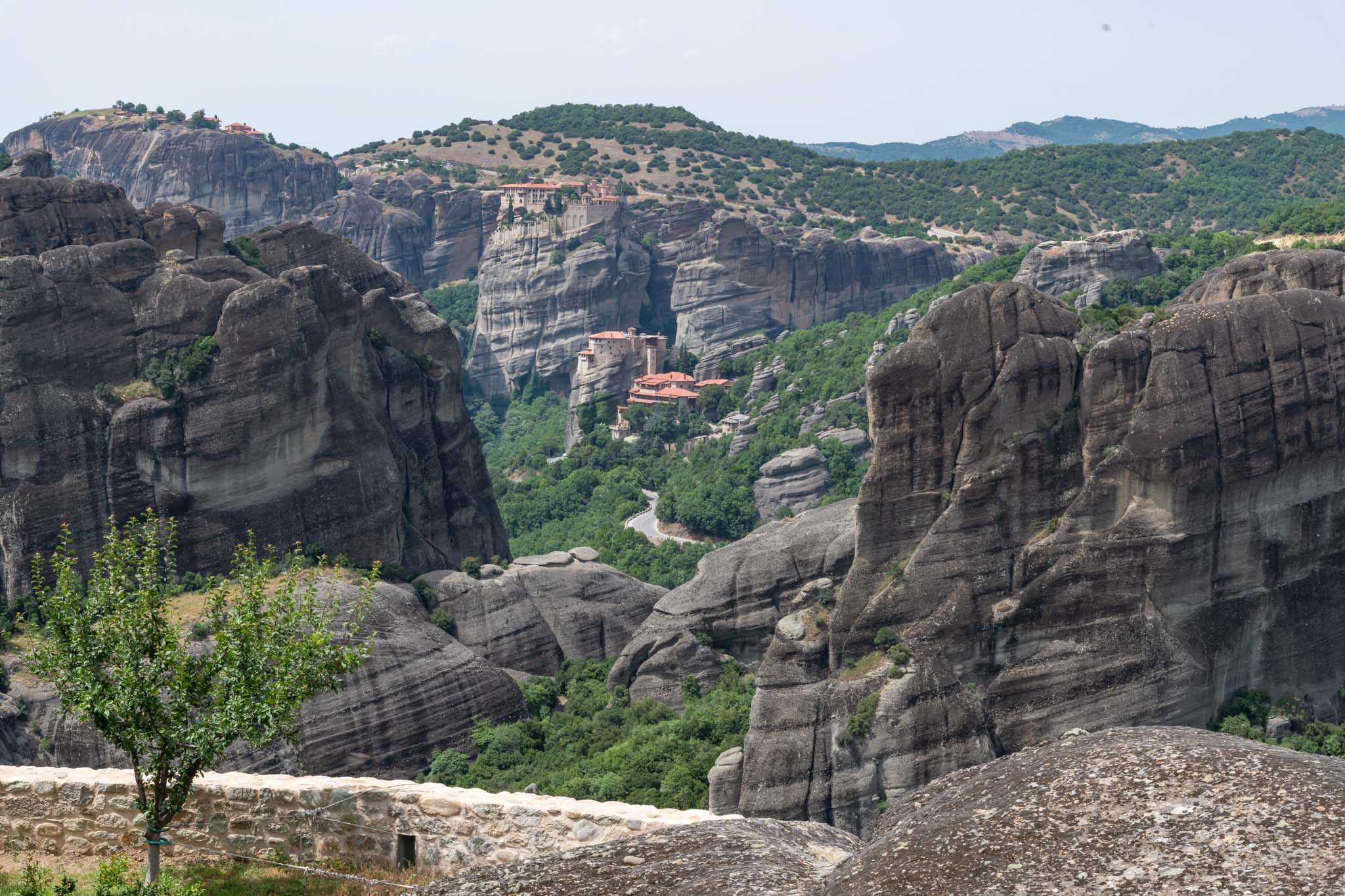
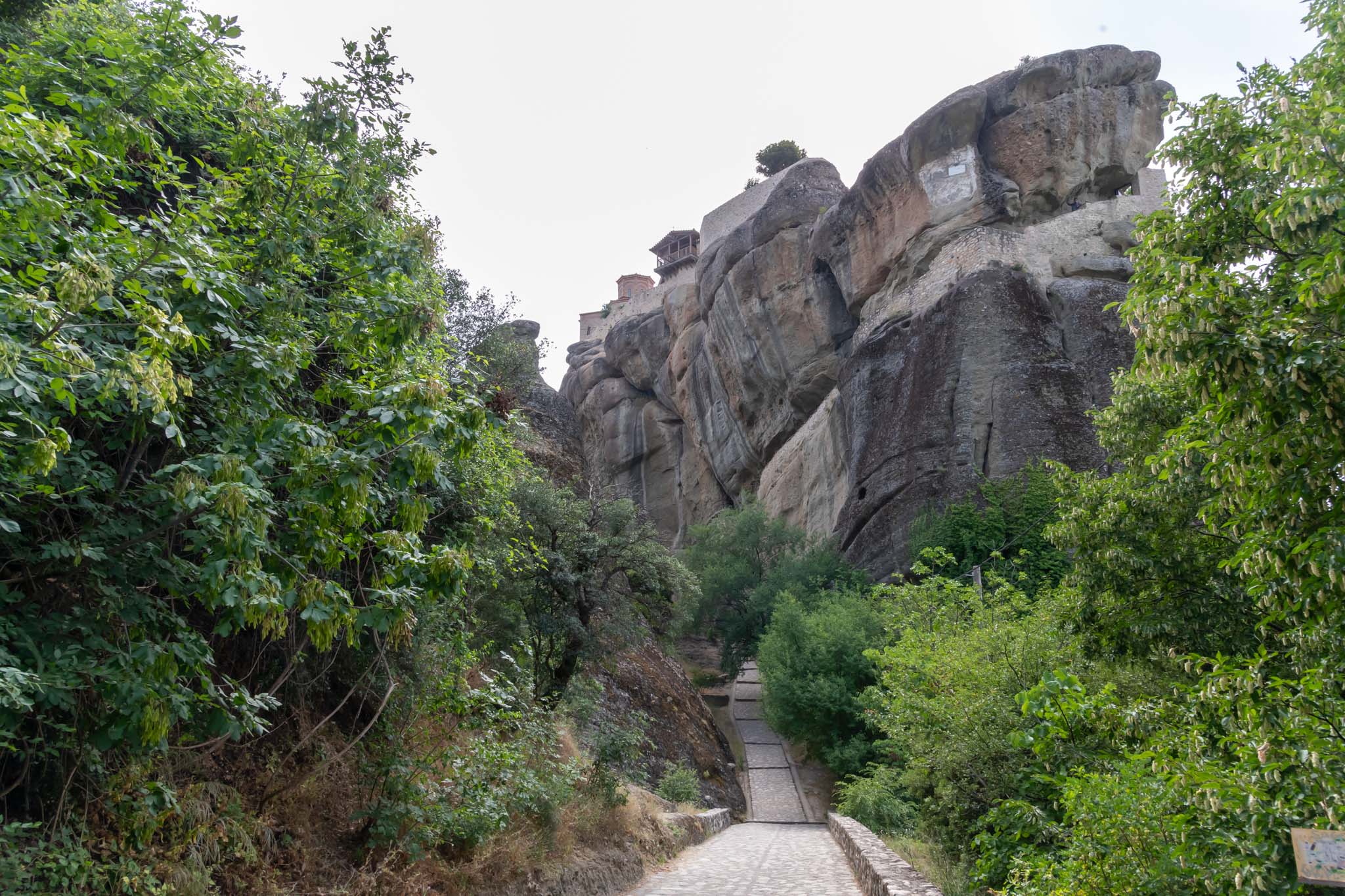
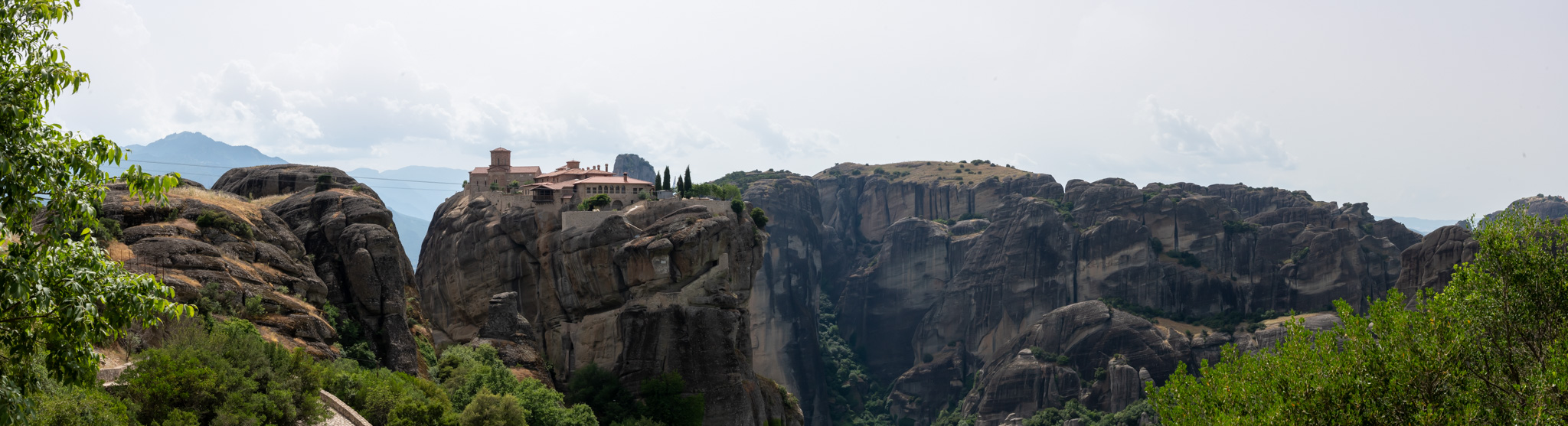
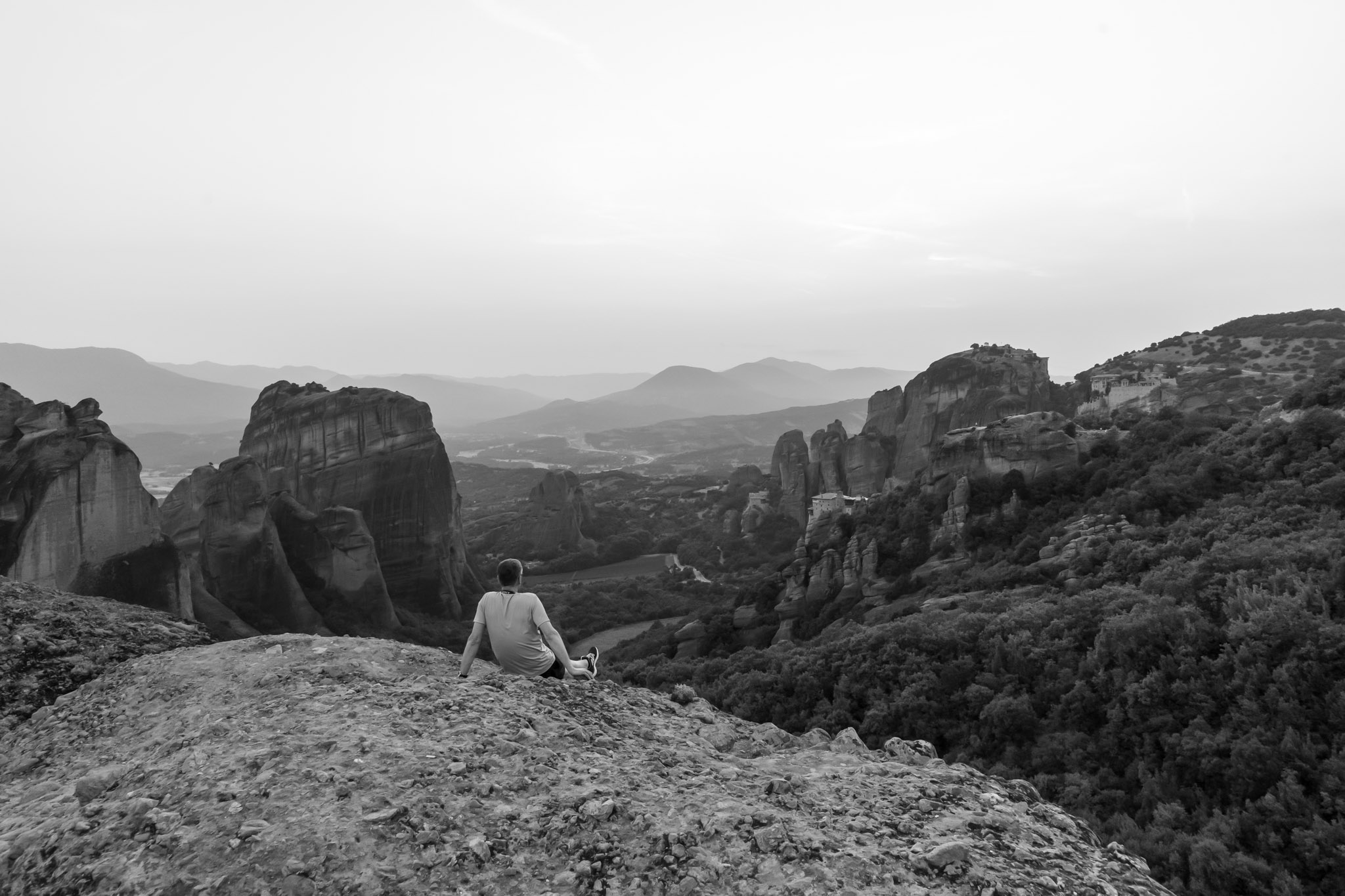
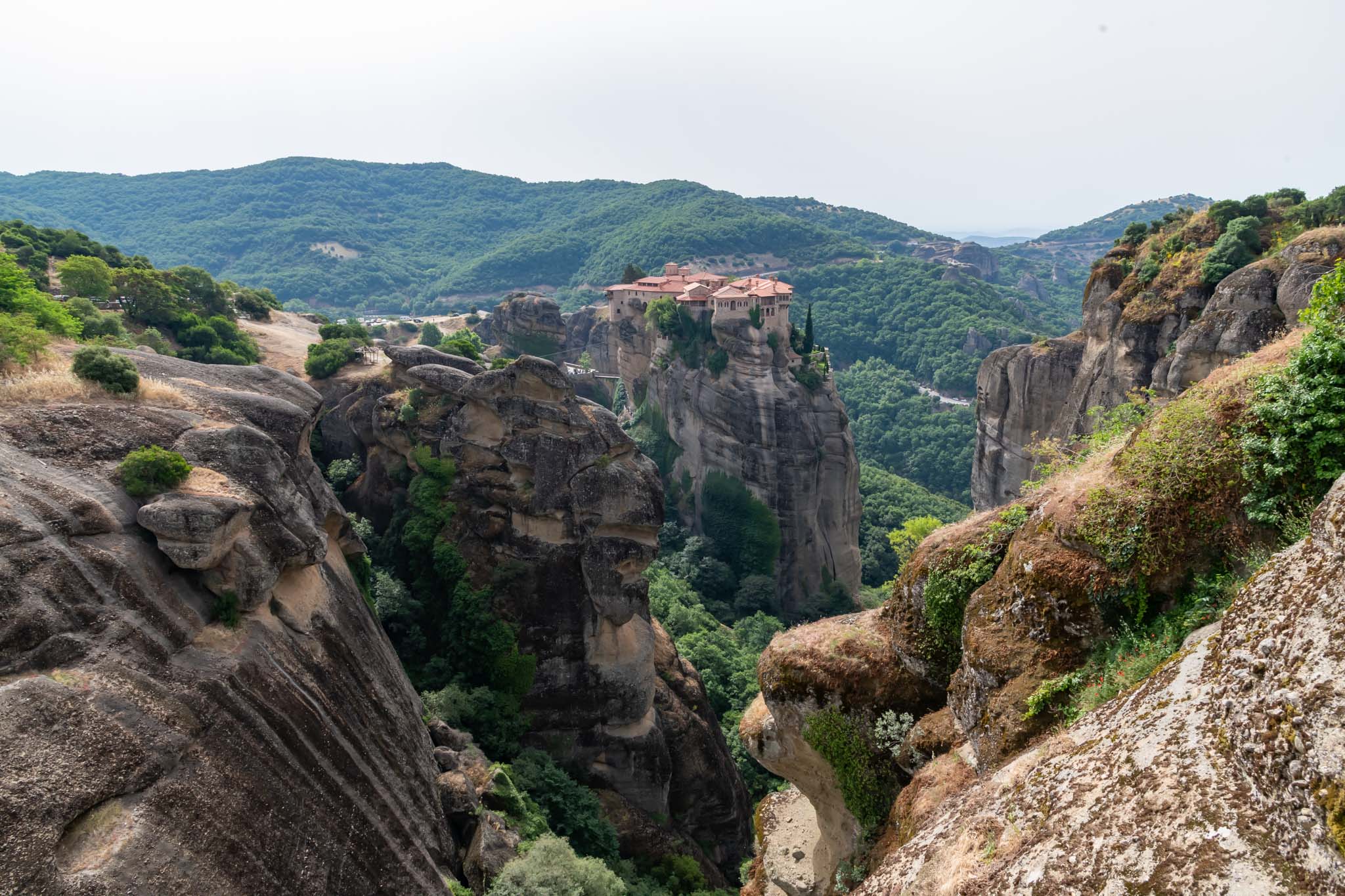
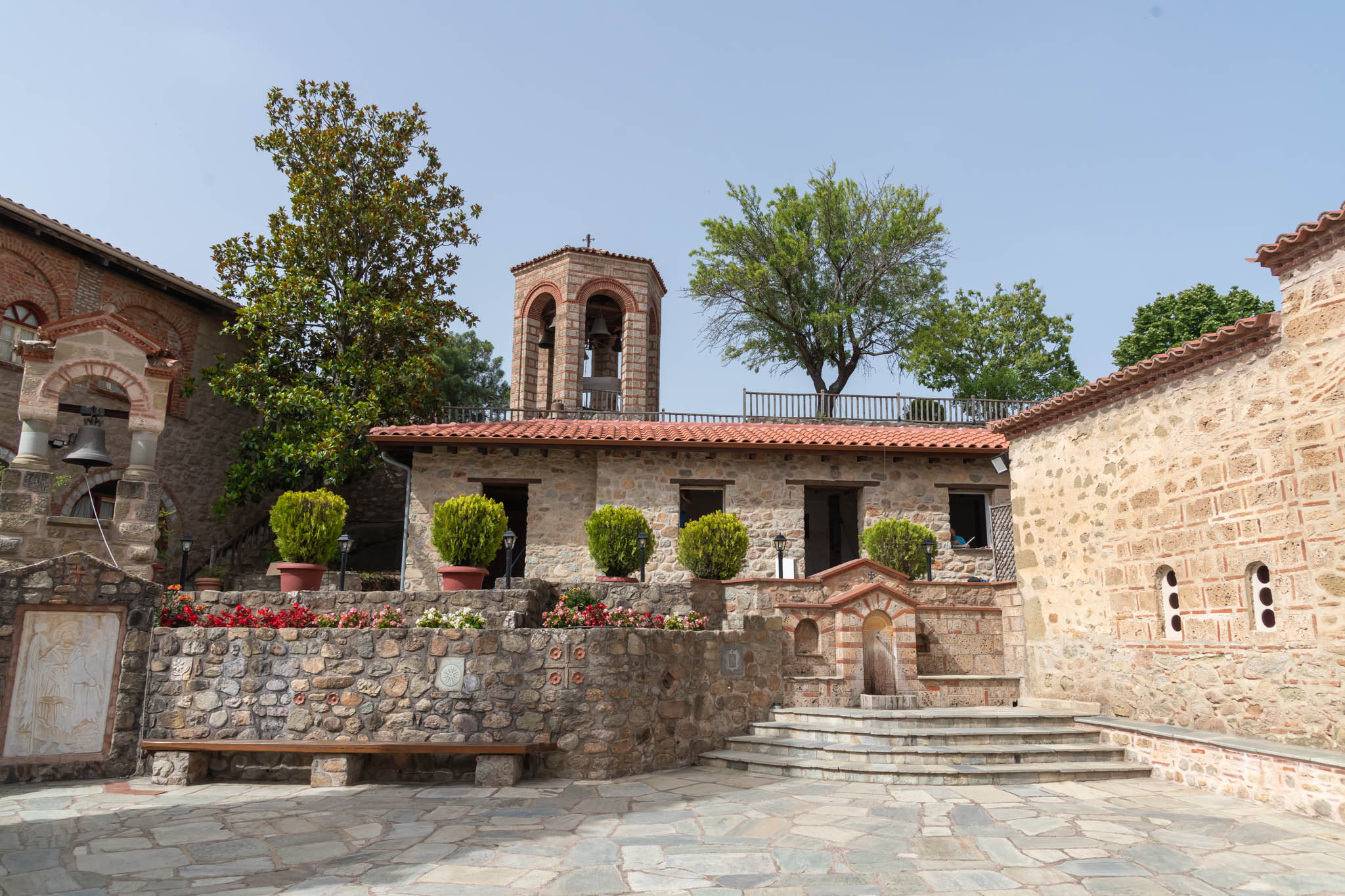
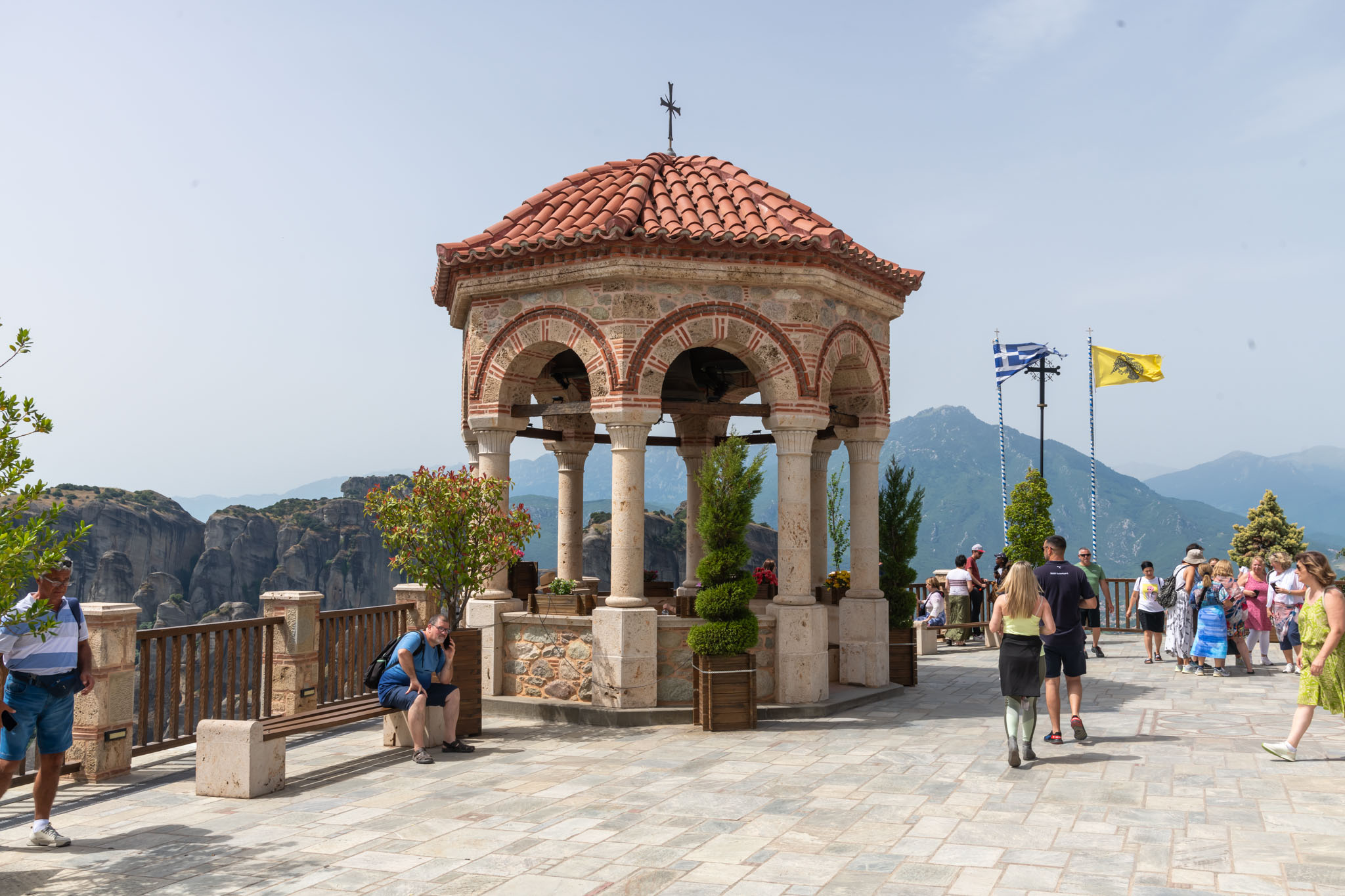
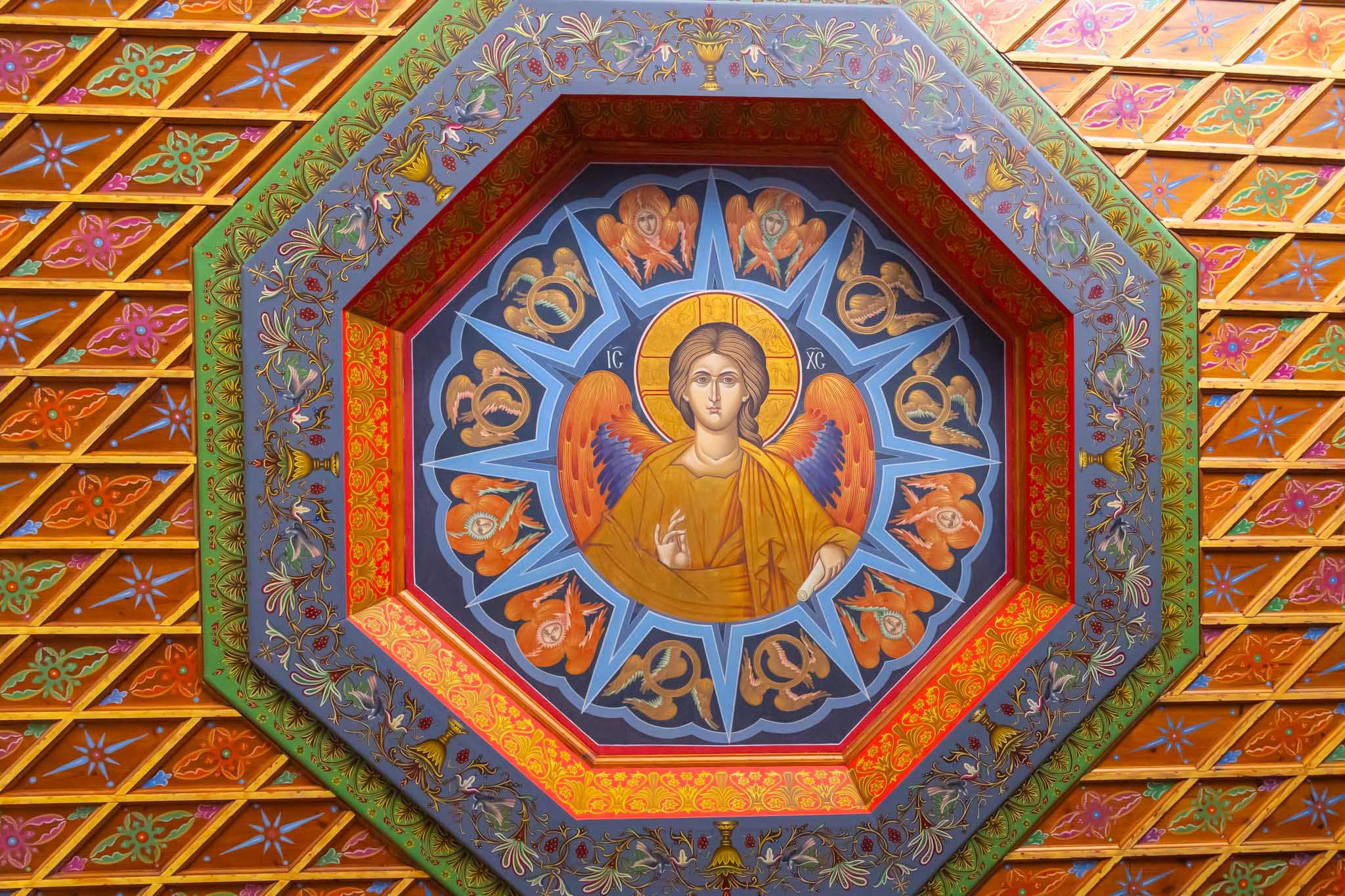
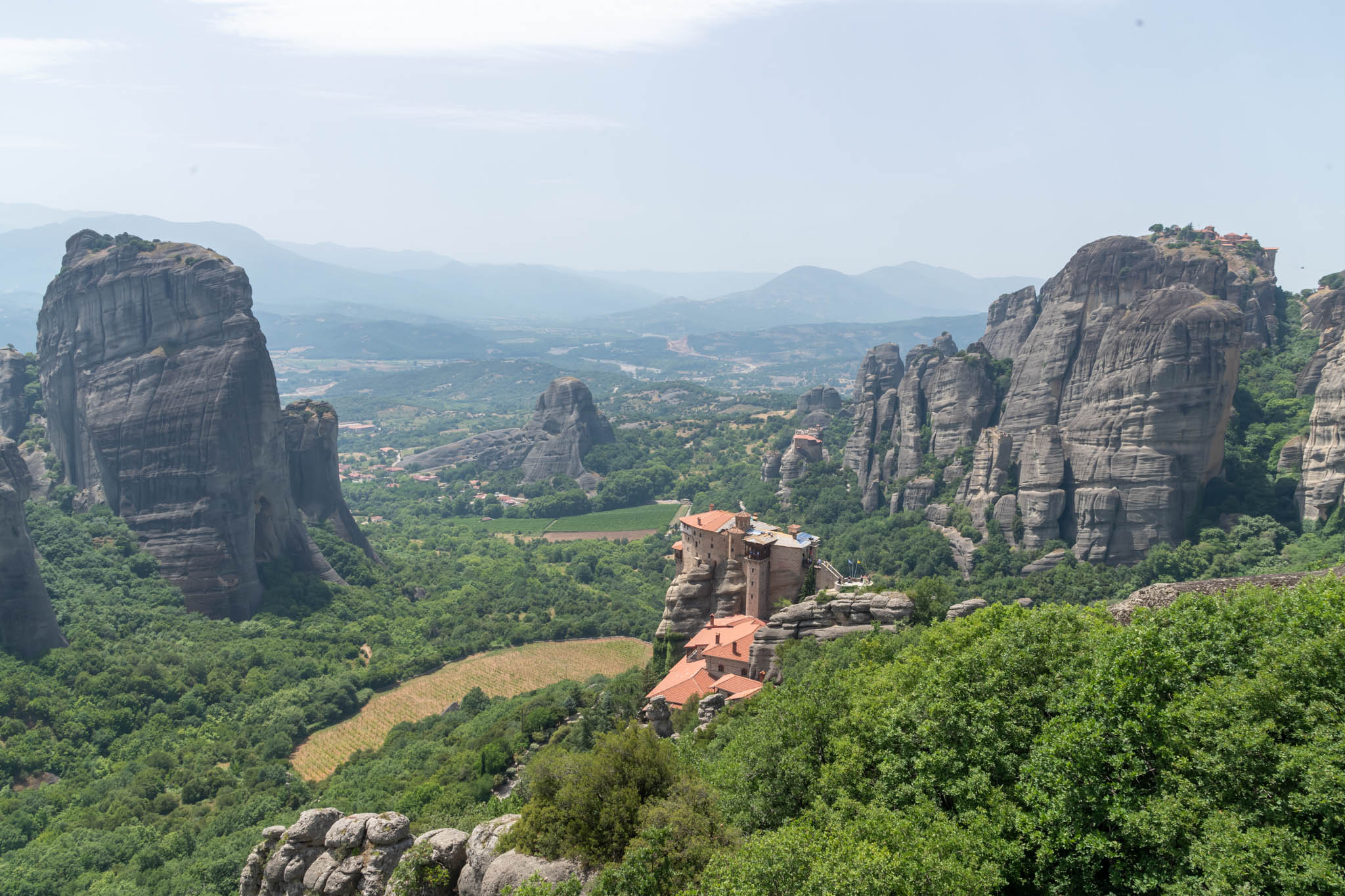
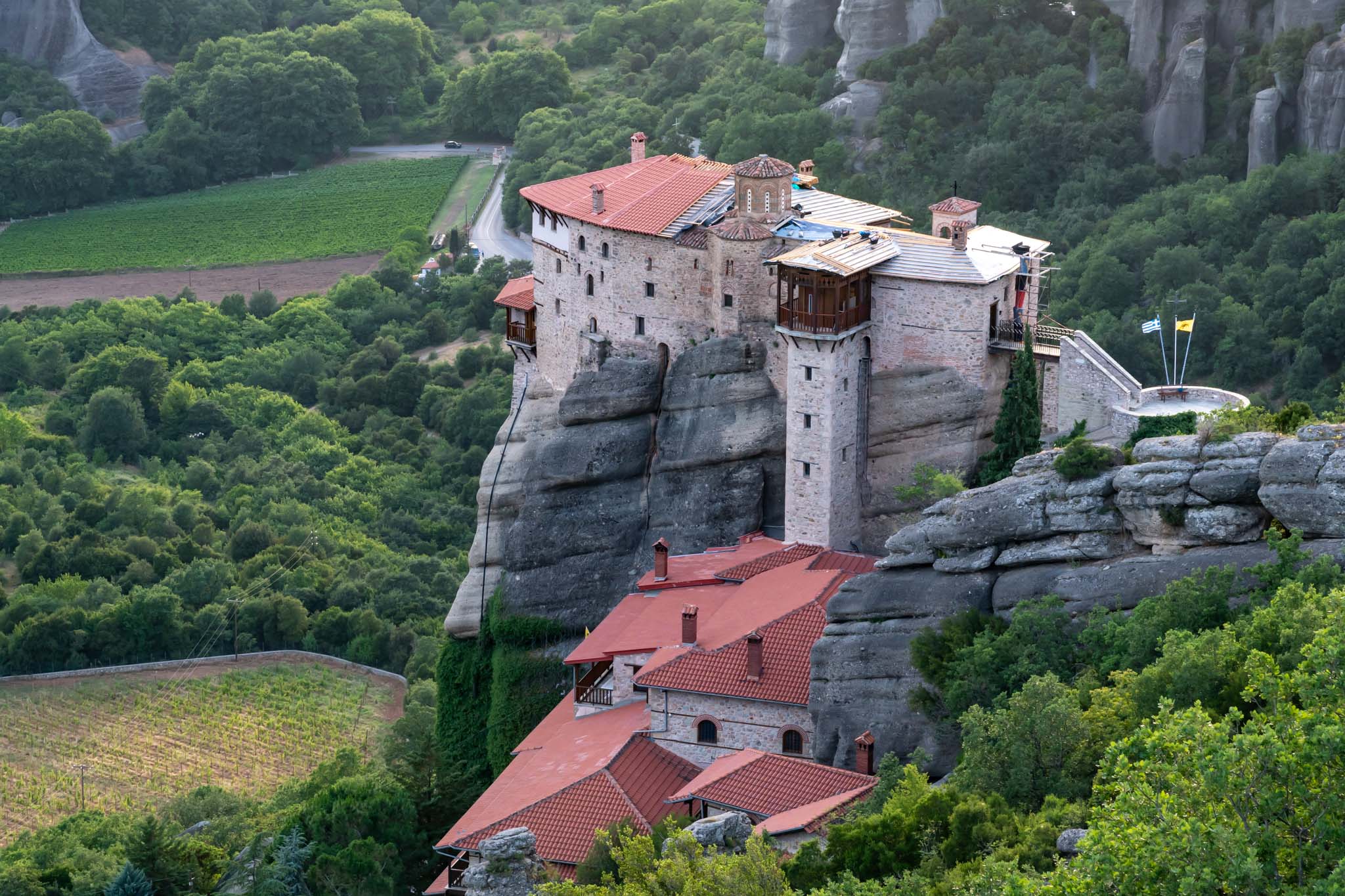
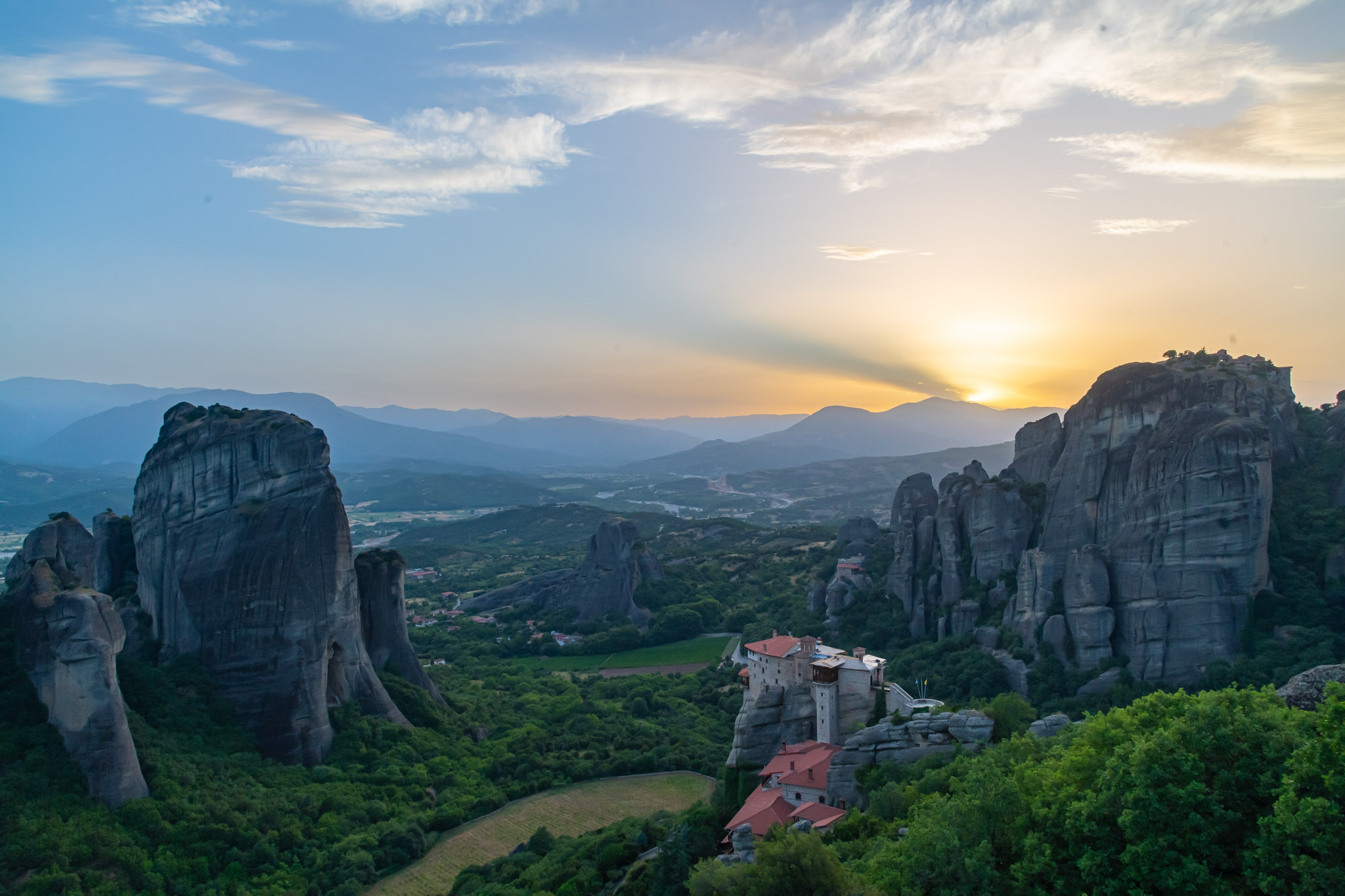
Floating Monasteries! What image does that phrase bring up, when you close your eyes? I actually pictured medieval buildings floating in air. Needless to say, this caught my fancy, and I decided to include it as part of our itinerary during our visit to Greece. I am talking about Meteora, which literally means “suspended in the air” in Greek; the land where twenty four monasteries were built on inaccessible peaks. Monks started settling in this region of Thessaly from the 11th century itself; some records says that monks with climbing skills had been living in rock caves since the 9th century. In the 14th and 15th centuries, these Christian monks faced increasing persecution as the Ottoman empire expanded and, in this period, these monasteries were built on inaccessible locations so that the monks would have a safe haven. How they managed to build in such places, is quite beyond me.

The town nearest to Meteora is Kalabaka, which is about three and a half hours’ drive from Athens. Kalabaka is basically a small, quaint one street town with some nice restaurants. There are day trips by bus from Athens but since we prefer to explore on our own and wanted more flexibility, we decided to rent a car and drive. We started from Athens by mid-morning and arrived at Kalabaka by around 3 pm. While there were twenty four monasteries that were set up during the medieval period, only six are operational now and they house about 17 monks and 40 nuns. The monasteries are all set up to handle the tourist traffic and you don’t see any monks or get to see the areas that they use regularly. These monasteries are closed on different days of the week and our plan was to spend the afternoon of Sunday and full day Monday at Meteora and cover the important monasteries, as all but one of the monasteries were open on those days. An additional point to be considered while planning the itinerary is that the monasteries close by 3 pm or 4 pm. On the day of arrival, we had planned to go to the Holy Trinity Monastery and so we rushed there, soon after check in.

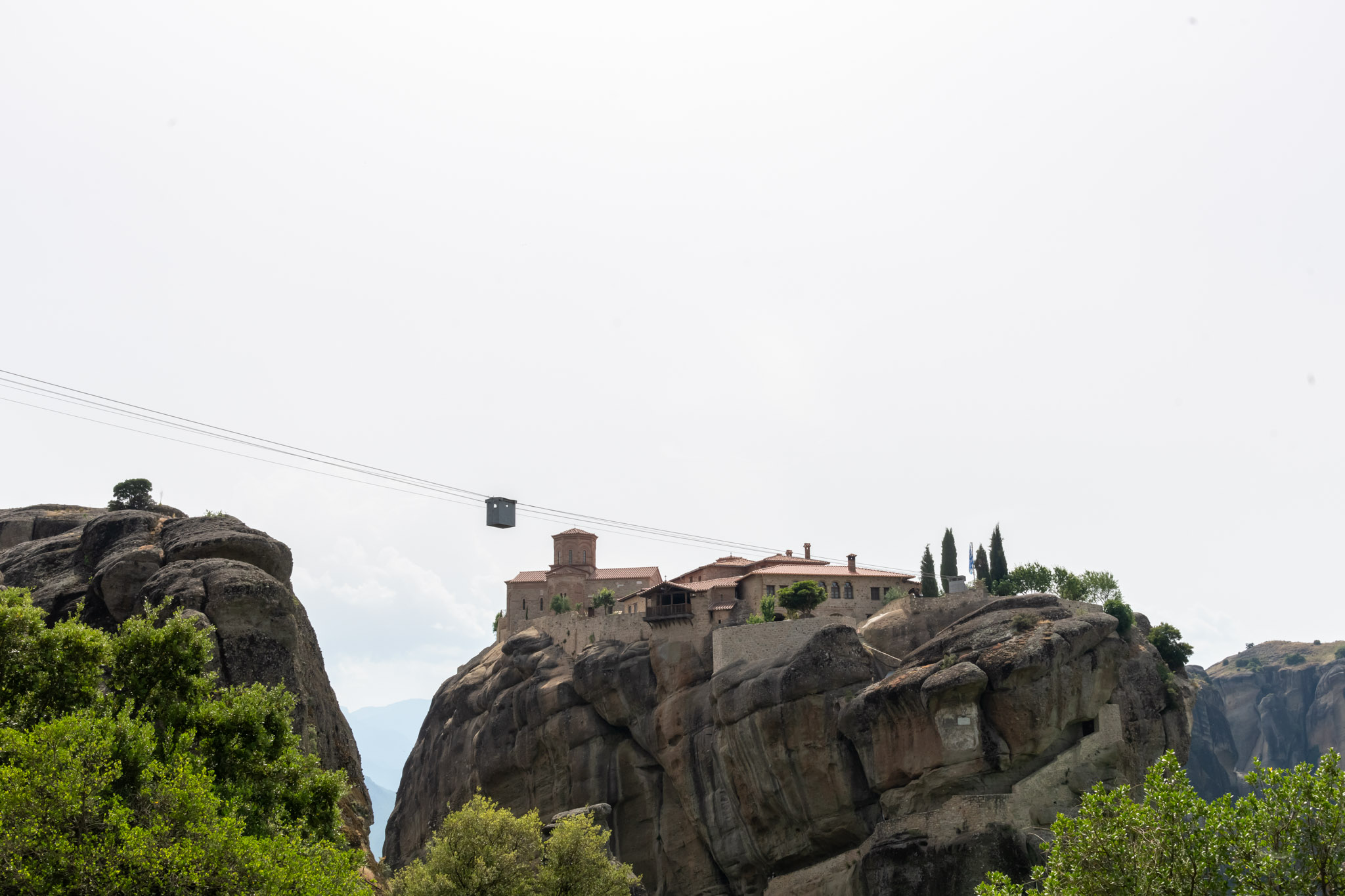
This monastery is also known as Agia Triada and is a difficult to access as it involves climbing up some 140 steps. It was set up in 1475-76 according to Wiki though local legend says that the monk, Dometius, the founder of the monastery, arrived at the site in 1438. During the initial times, it could only be accessed by ropes. This was the case with most monasteries, and it was only about 90 years back or so that the Greek government made roads that could help with the access to these monasteries. 

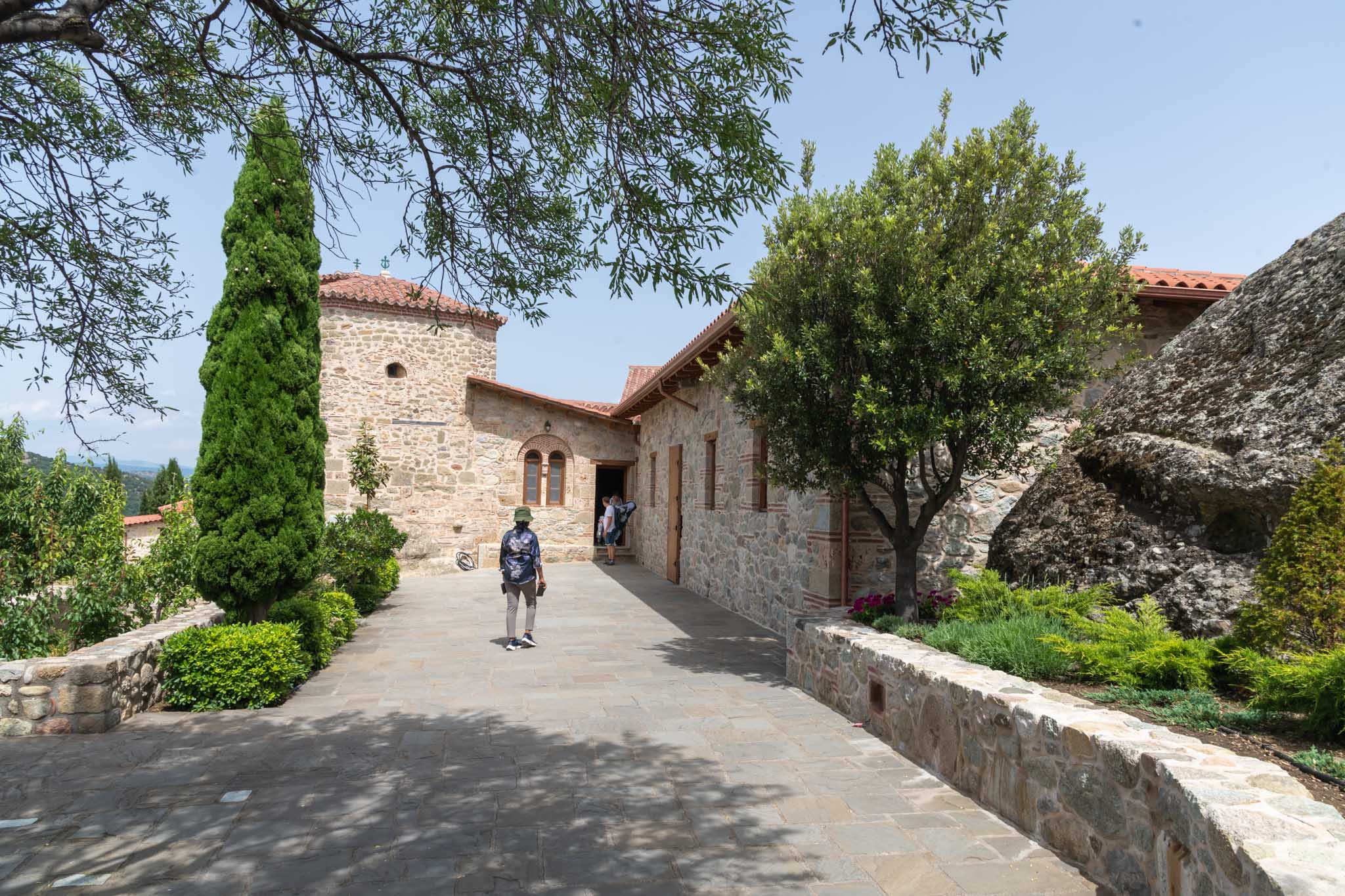
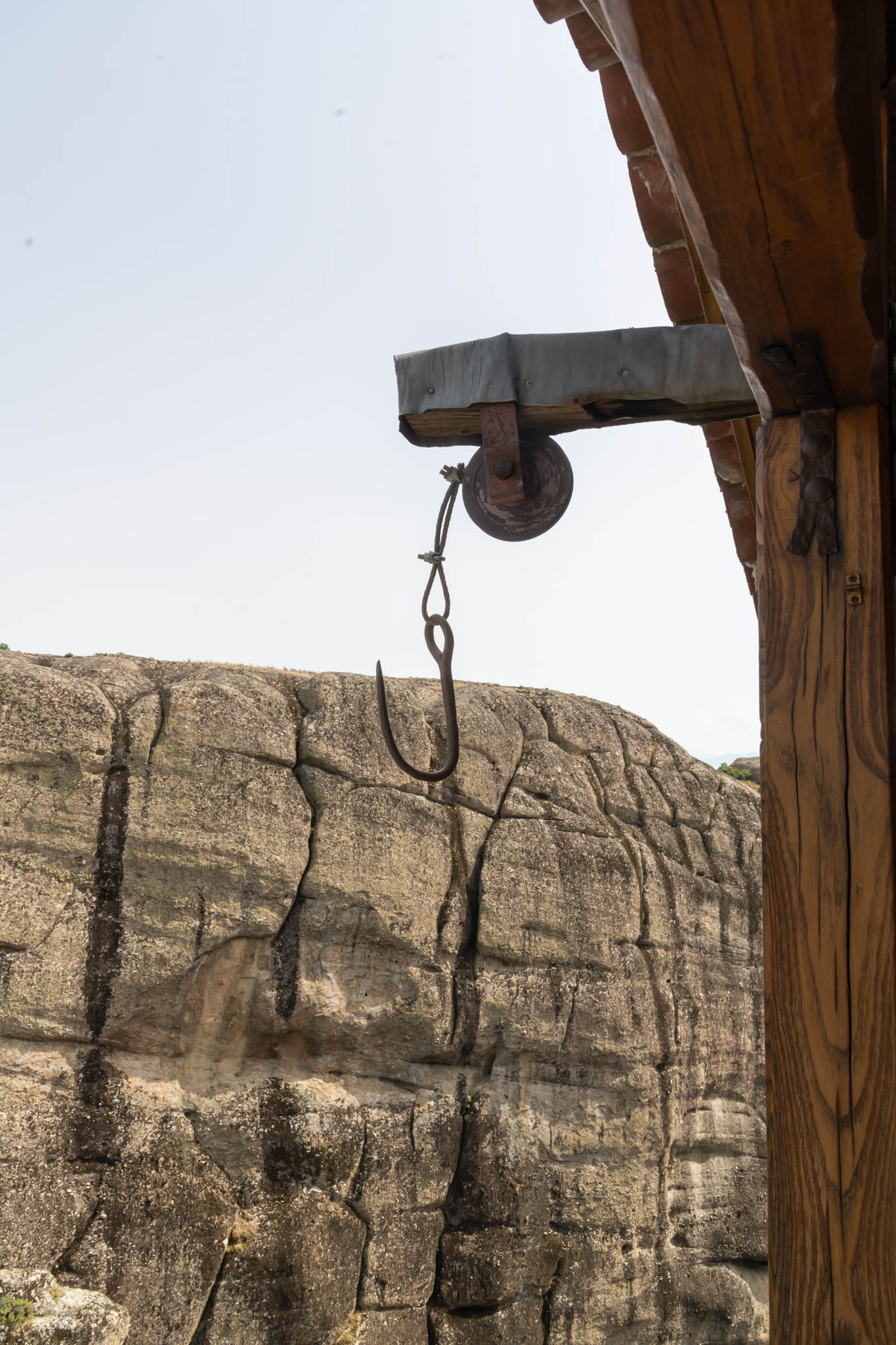
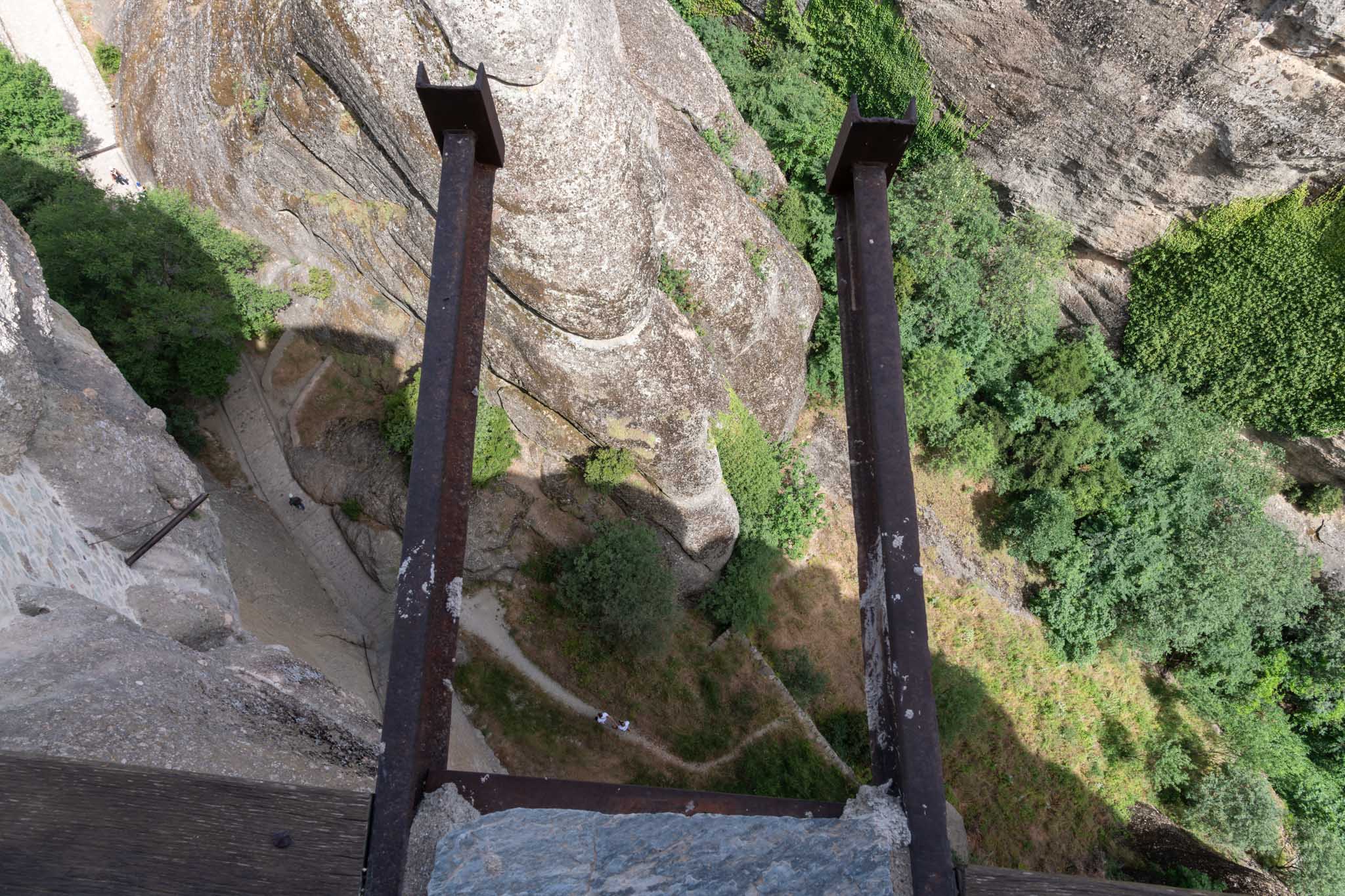
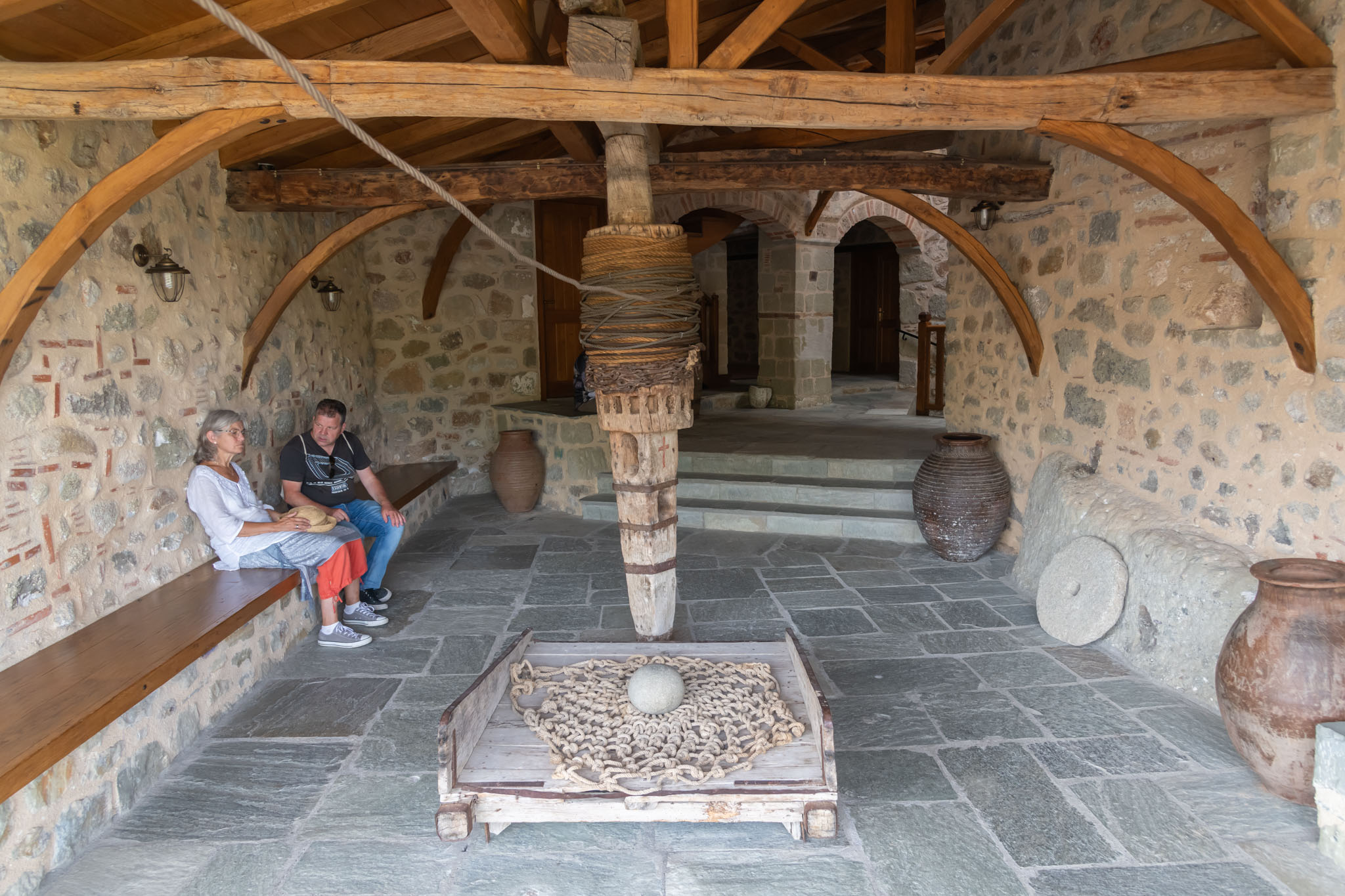
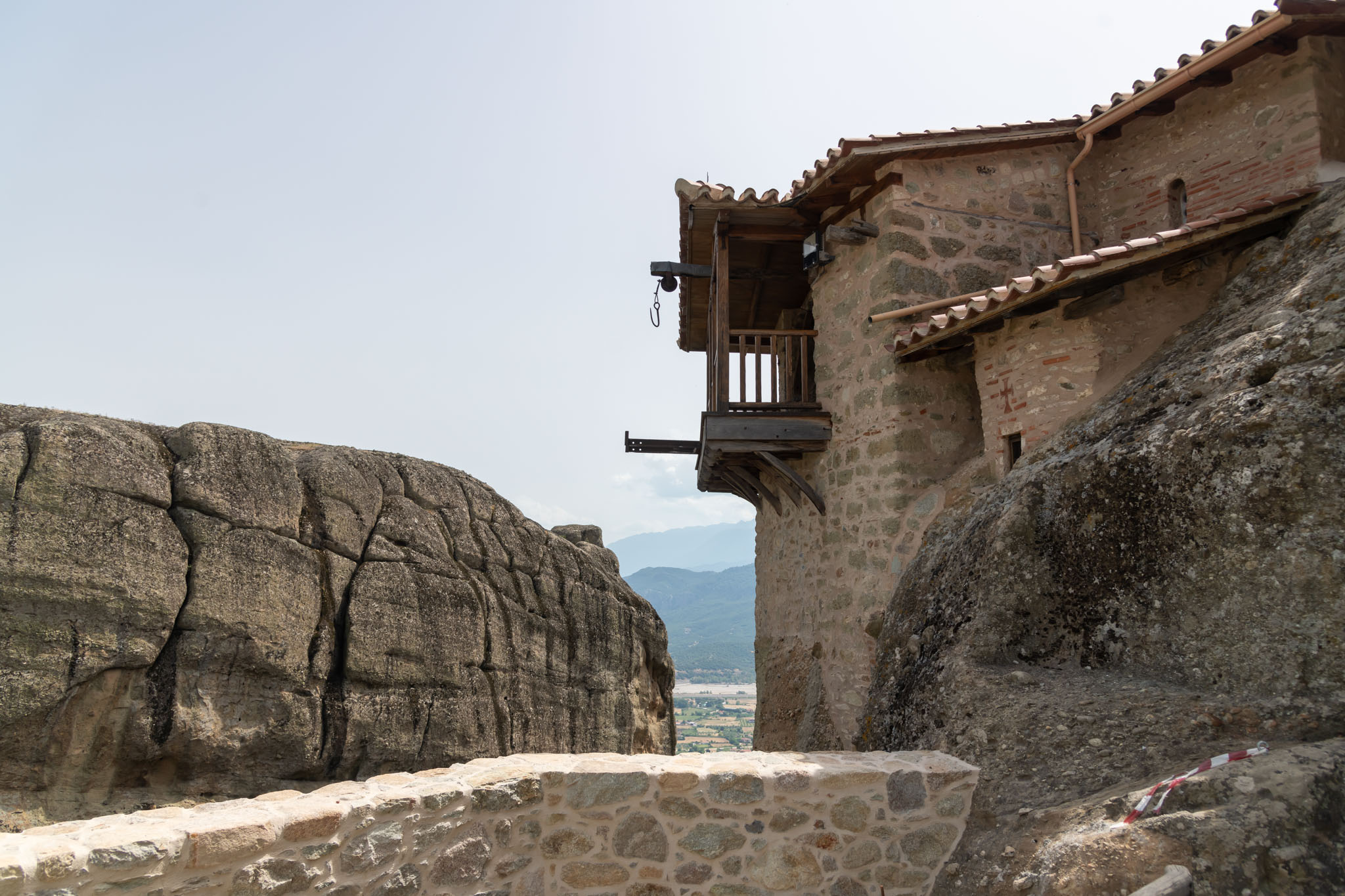
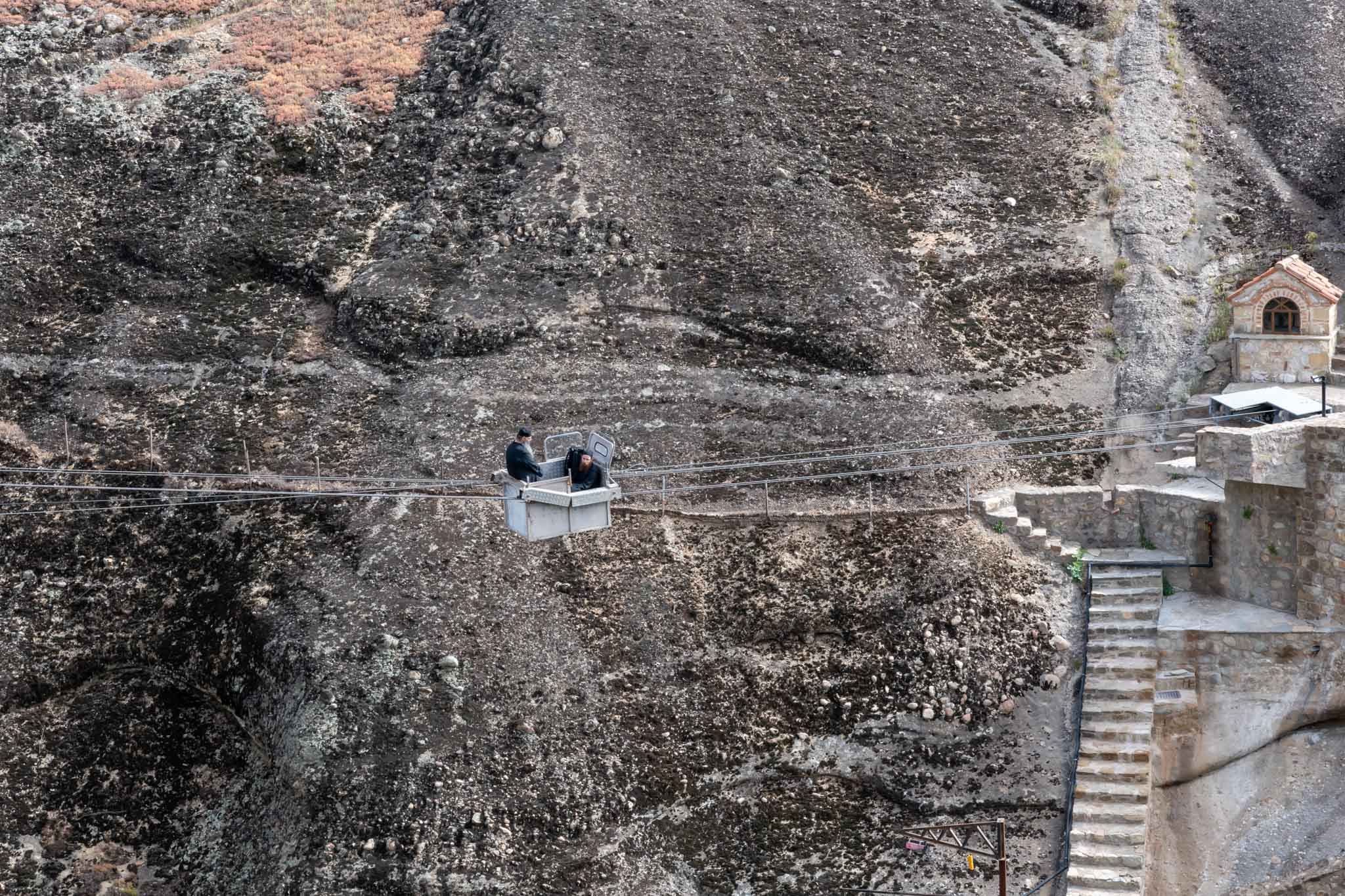
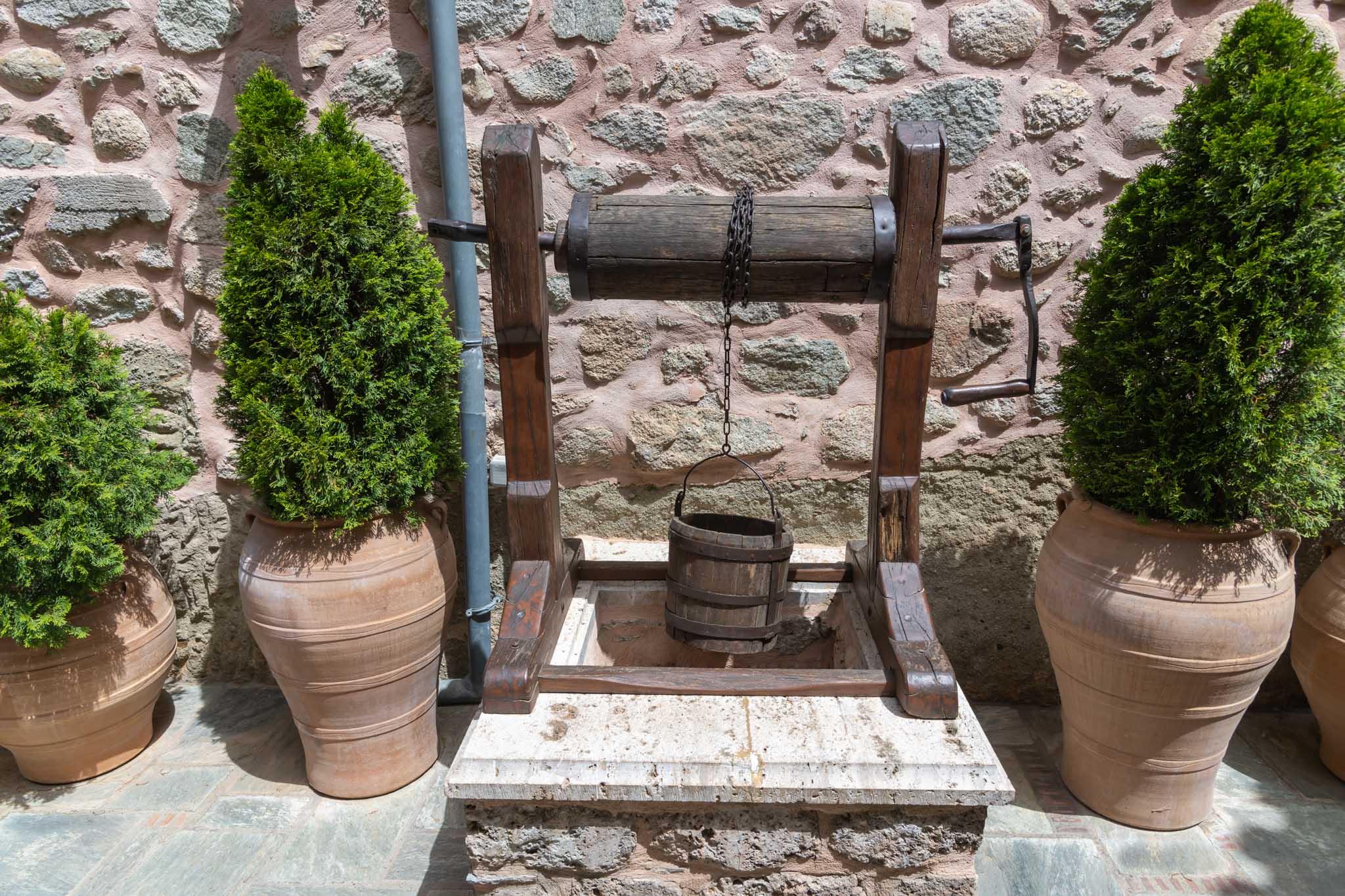
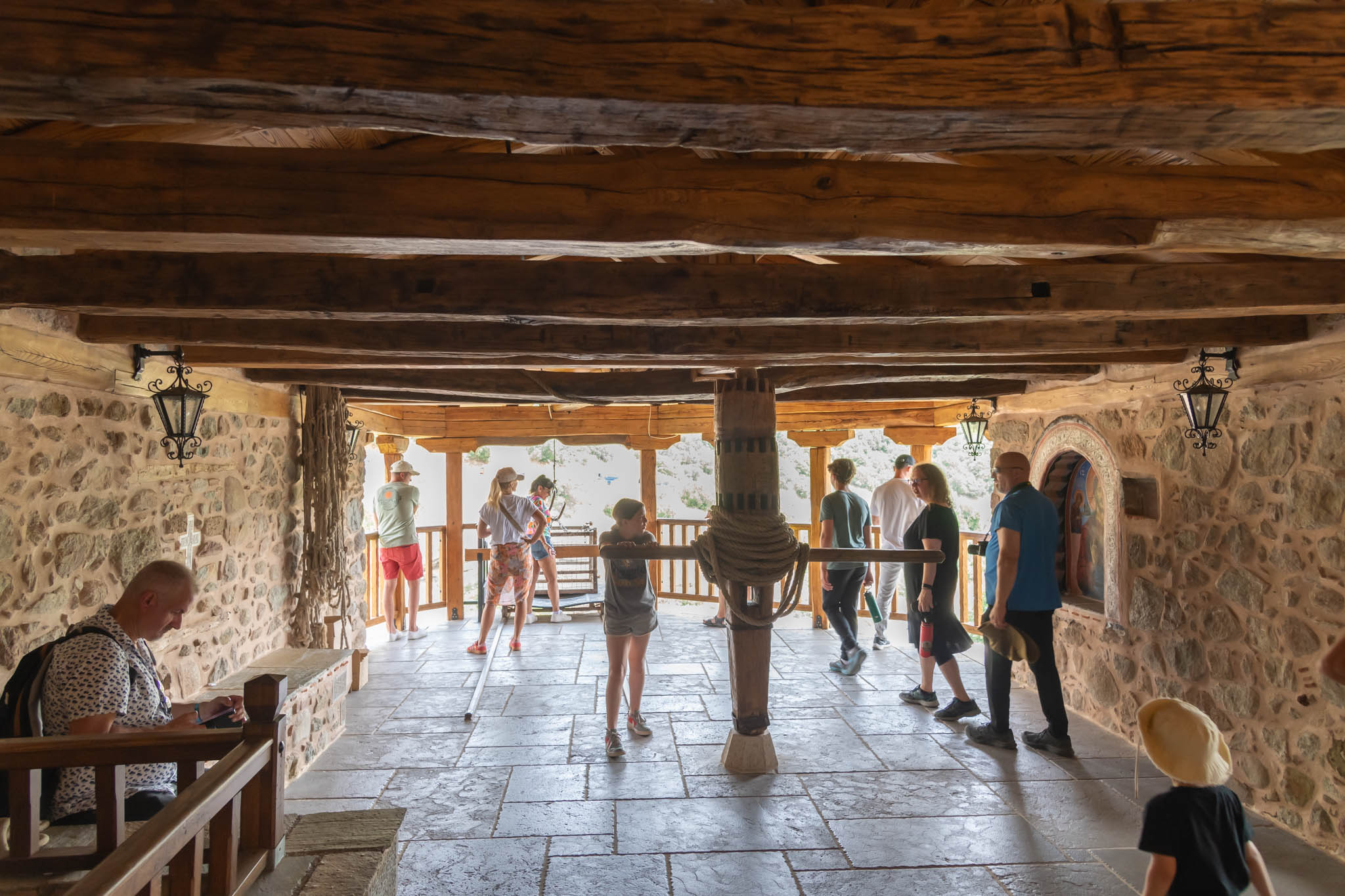
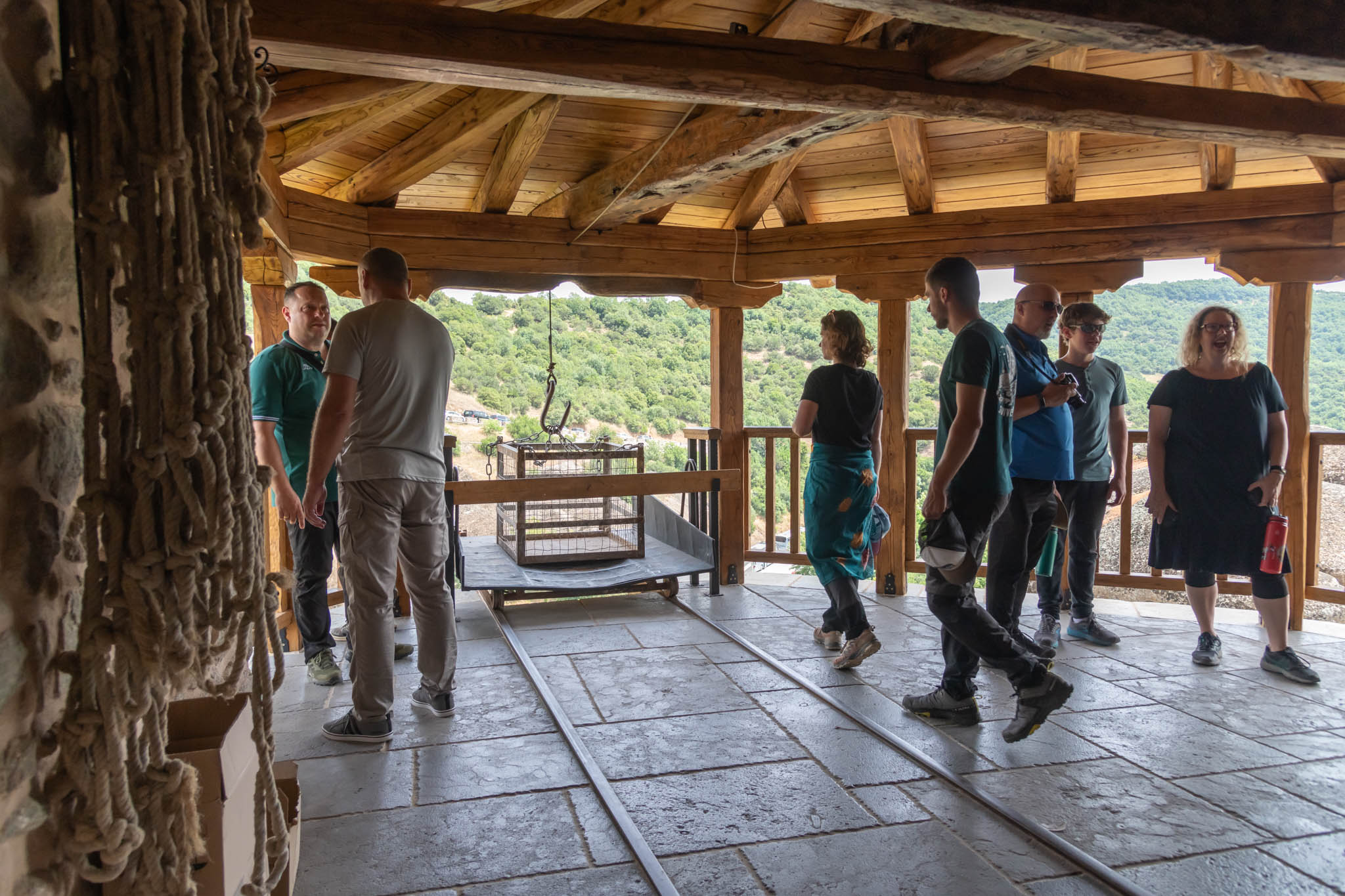
We made the climb up the 140 steps without too much trouble and there is a small courtyard on top and a chapel. The views were just breath taking and I don’t think I am capable of describing it. On the top, we found the arrangement used by monks in earlier times to haul up people and material. There is a large pulley like attached to a rope that passes over a hook dangling over a sheer drop, right to the bottom. People and material were then carried up in a rope net; the steps we used were added much later. Of course, prior to this arrangement, access was possible only through rope ladders and whenever the monks faced any threat, they simply pulled up the rope ladders and secured themselves. Some of these rocks are about 400 metres high and going up and down must have taken some effort! These days, there is also a small cable car type of arrangement from the car park directly to the monastery. This is used for transporting goods and the monks that can’t make the climb. 

The Monastery of Holy Trinity was featured in the 1981 James Bond film “For your eyes only” and couple of other films as well. 

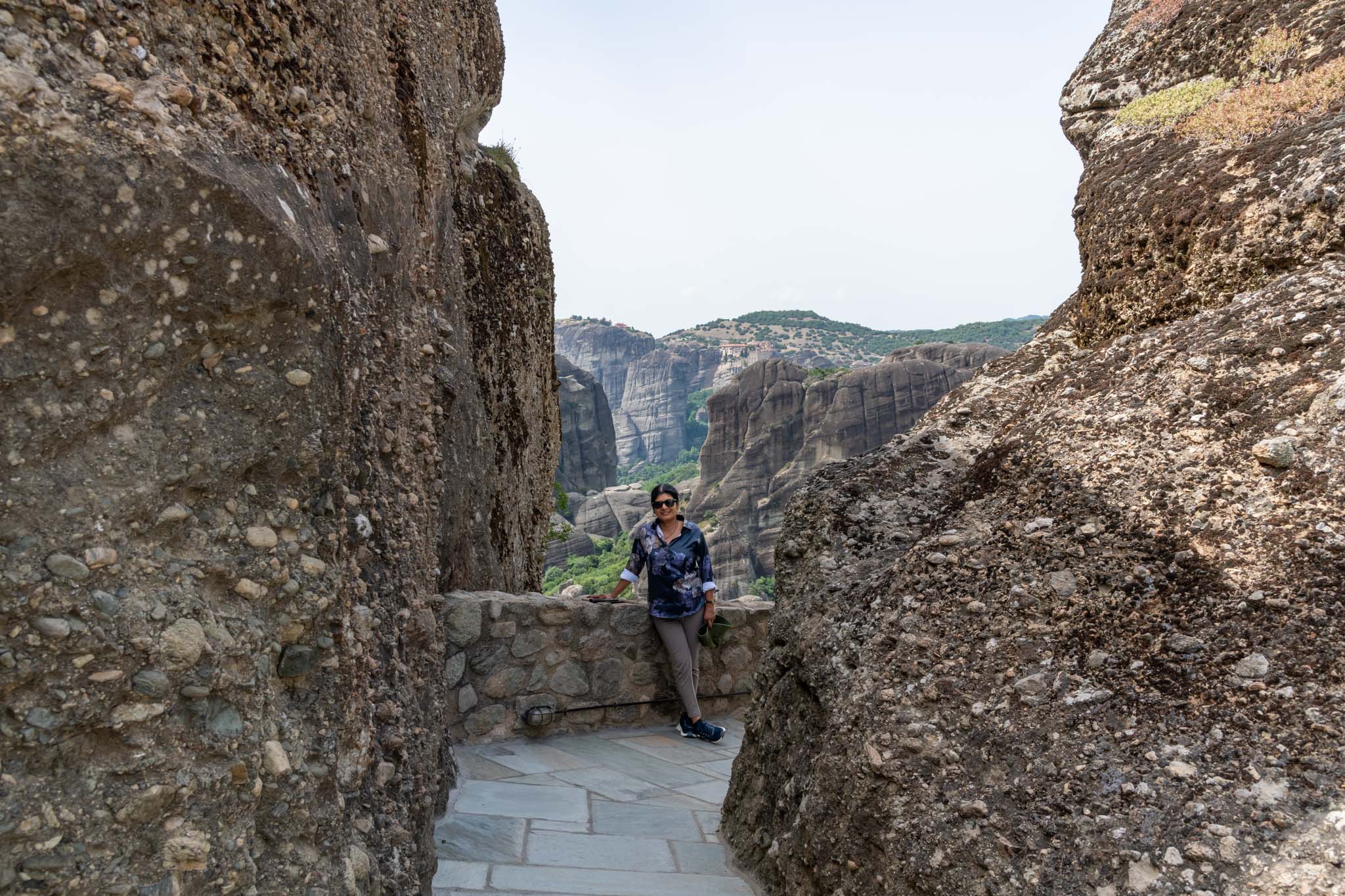
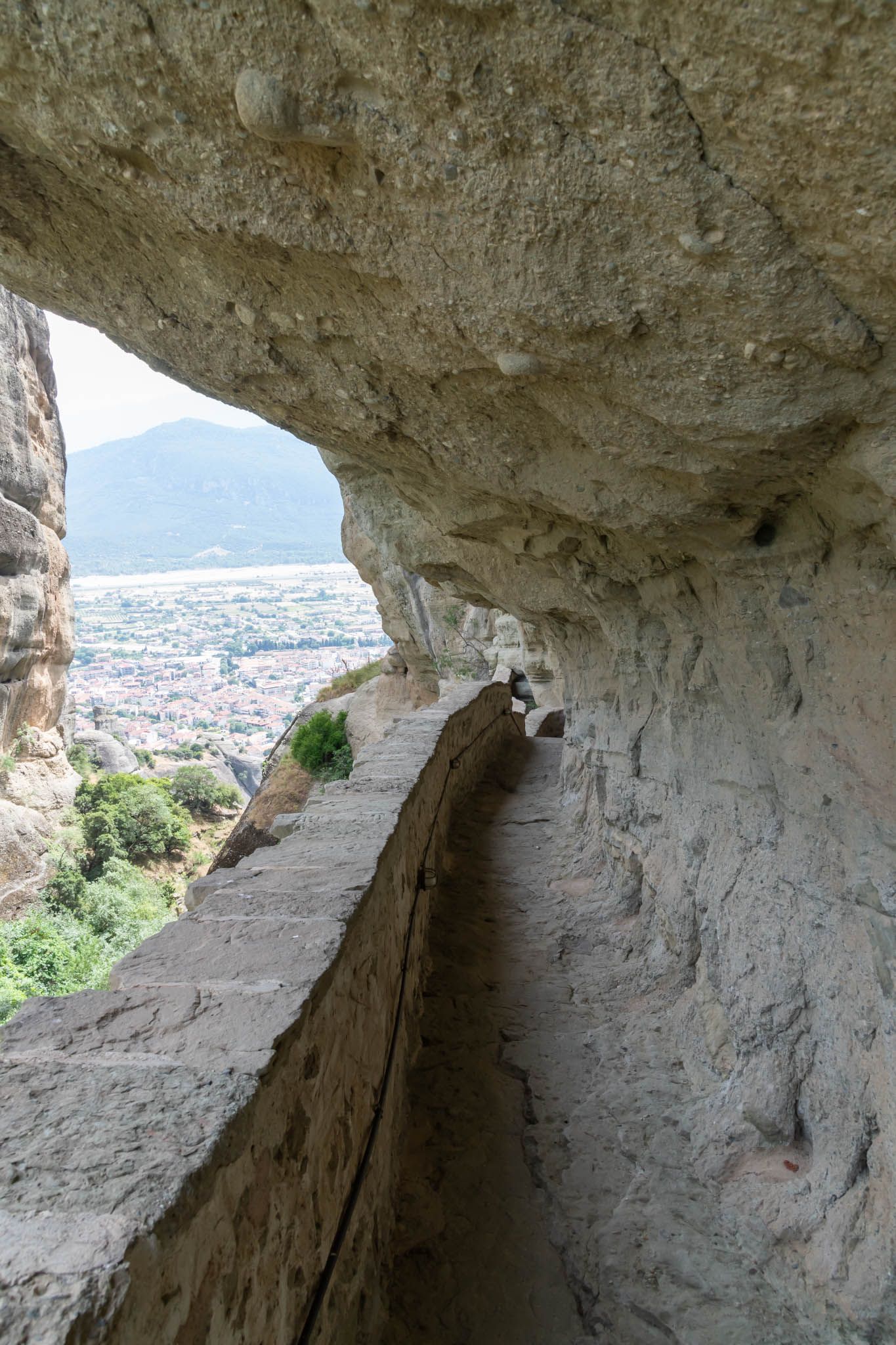
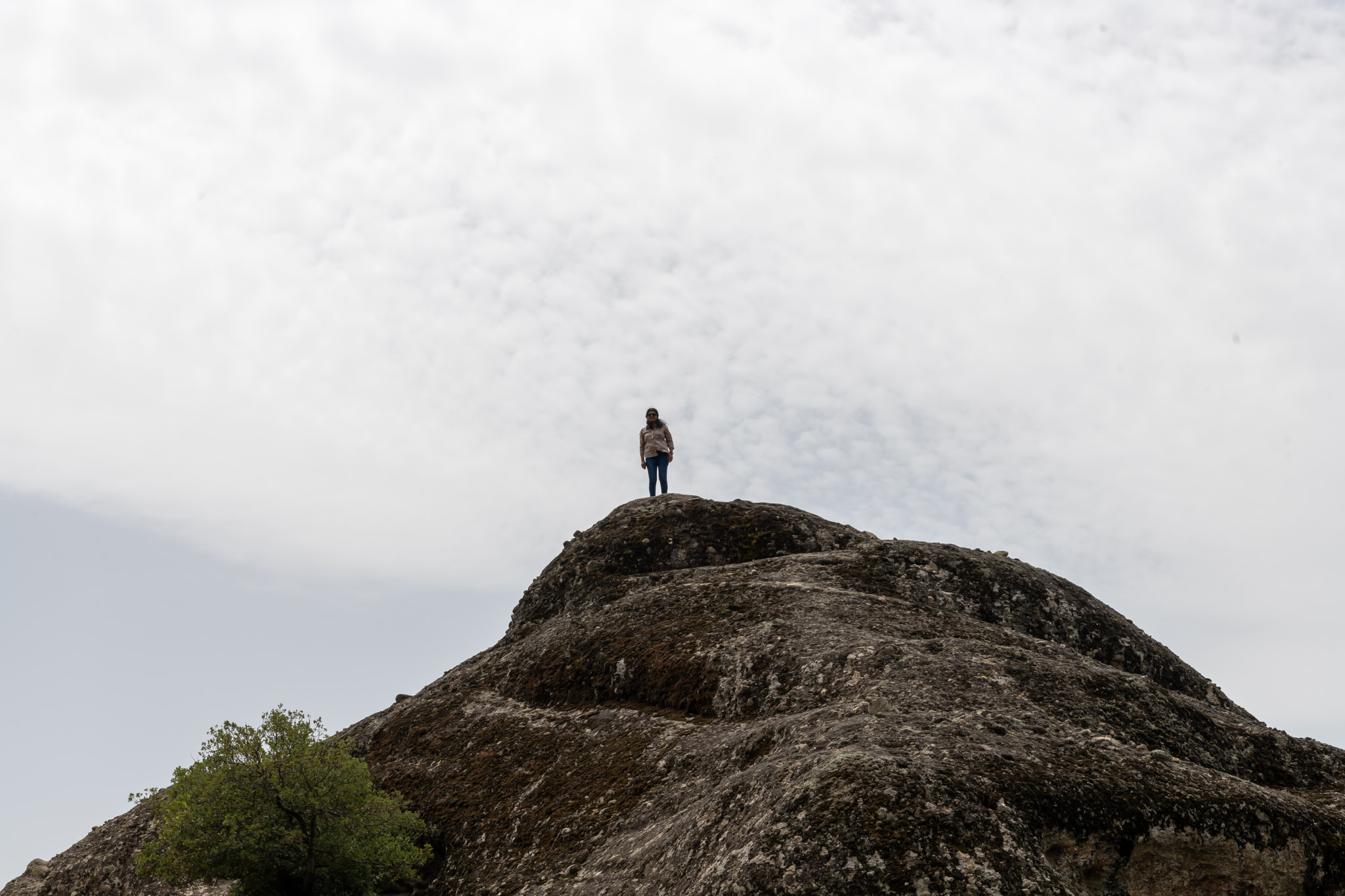
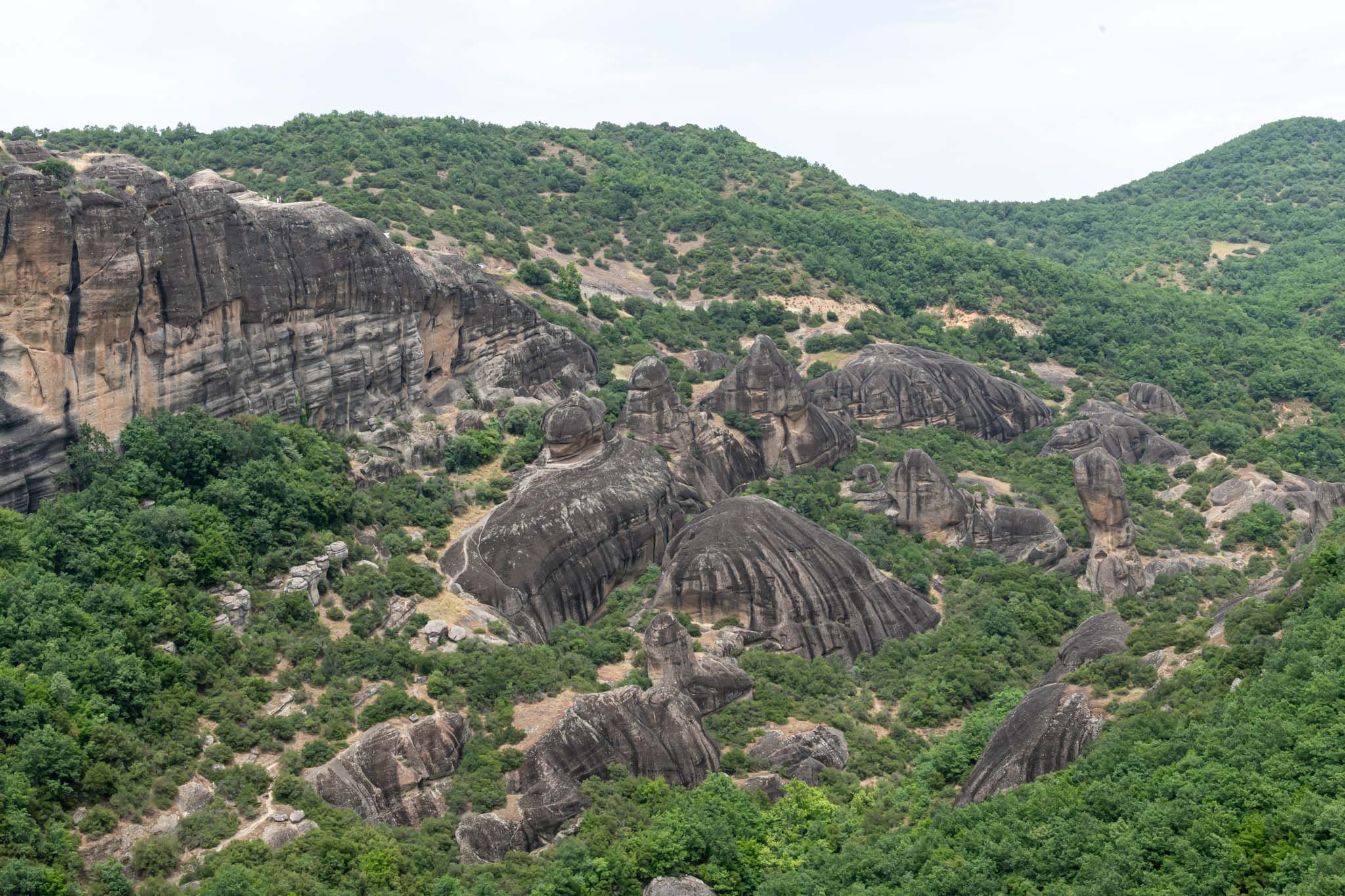
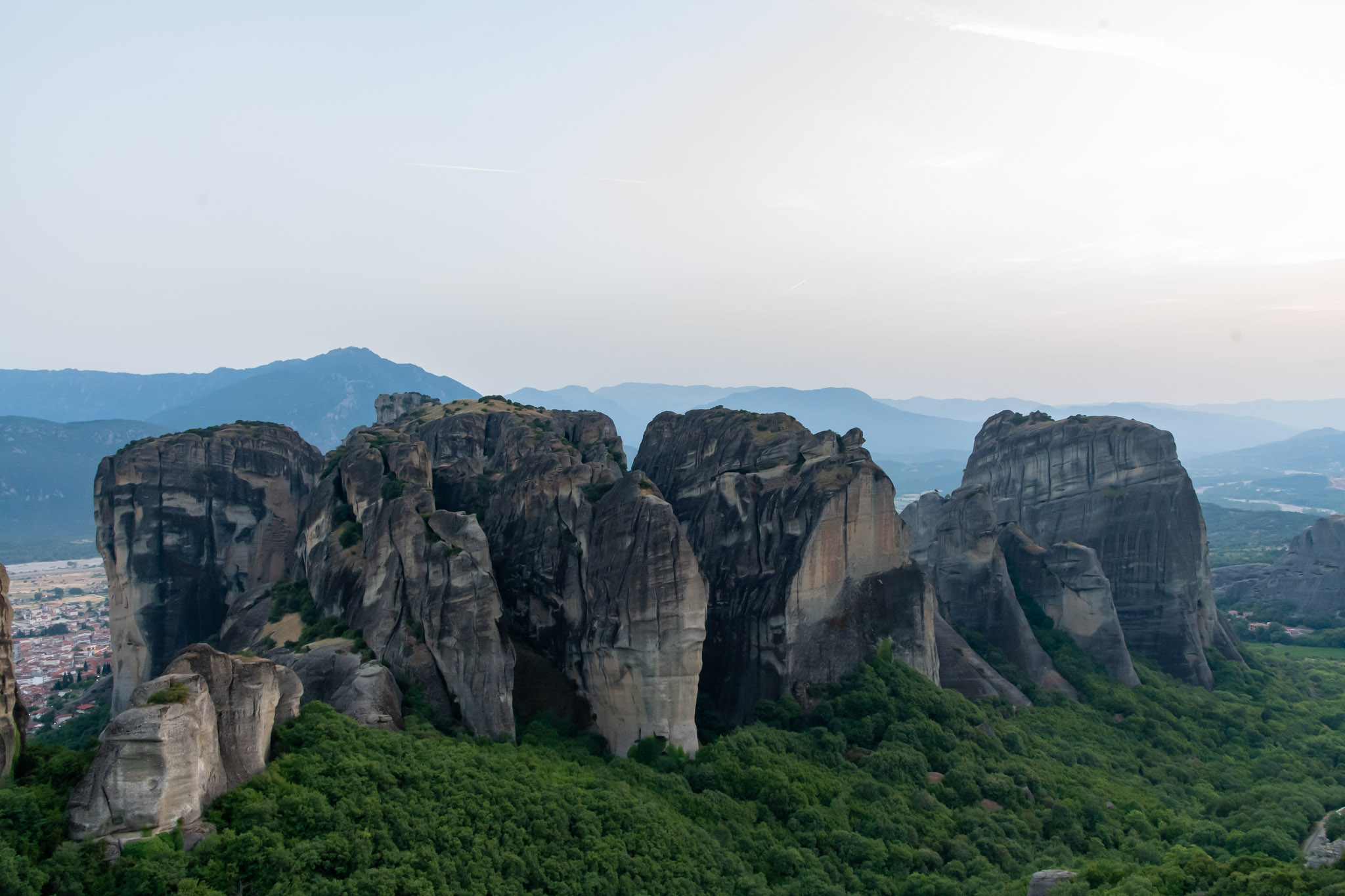
You can see many unusual and thus interesting rock formations as you drive around the mountains in Meteora. Wiki says that about 60 million years ago, a series of earth movements caused the seabed to go up, creating a high plateau. The rocks are mostly sandstone. There are many trails one can take in Meteora but we didn’t try any because of lack of time. There are many rocks that can be accessed from the road, or the car parks and climbers would really love it.

As can be expected, such a location has great sites to watch the sunset and there is enough information to be found on where to go, on the internet. After finishing the Holy Trinity Monastery, we went to Sunset Rock and the sunset was just amazing. It was so peaceful and quiet. No wonder that the monks came to this area, meditation comes rather naturally here. We made best use of our two evenings at Meteora and visited two spots and spent time there. There was a reasonable crowd in each location, and you had to arrive a bit early to get the best spots.

One interesting aspect I noticed is that there is no railing or any such protection anywhere. You are expected to behave reasonably and sensibly and watch out for your own safety. The drops are rather sheer and deep and a fall could definitely be fatal. On the second day evening, someone lost a bottle or something like that and it caused a little bit of consternation among those present – guess it struck everyone that it could be you instead of the bottle, if you aren’t careful!

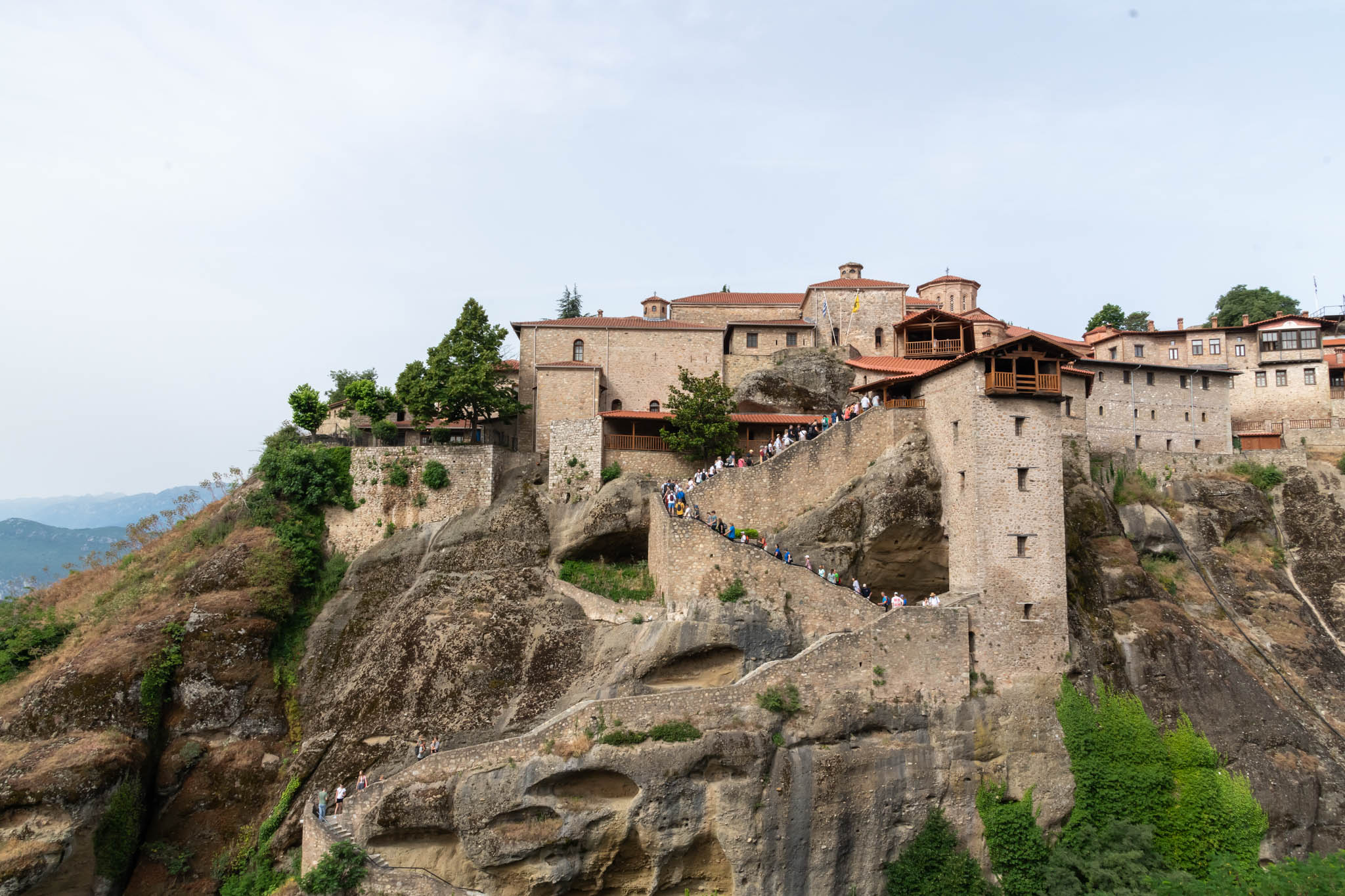
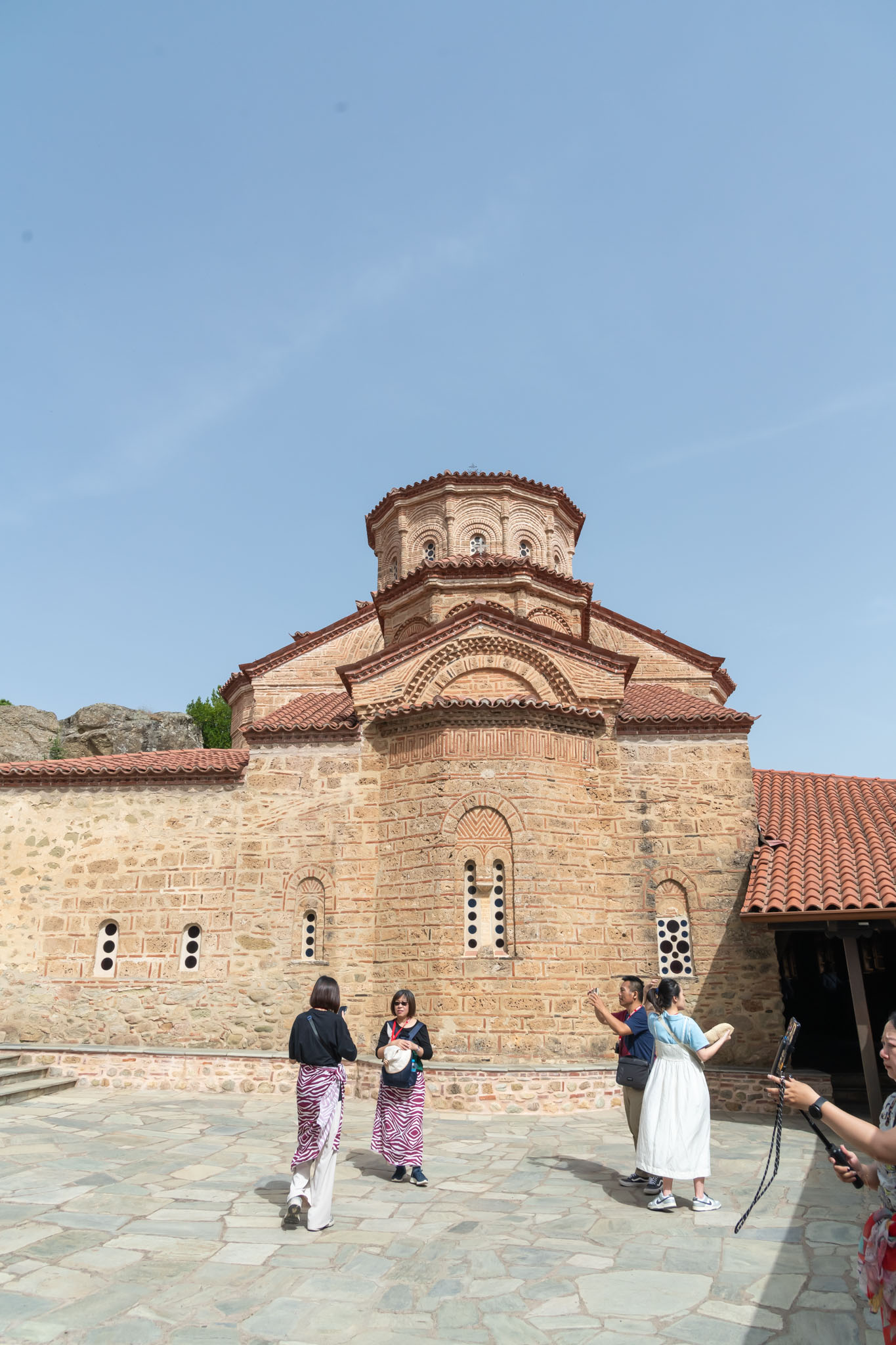
Next day morning, we set out to see the most famous of the Meteora monasteries – The Great Meteoron. It is the oldest and largest of the monasteries and was founded in 1356. We arrived early, as soon as the monastery was opening up, as this place could get crowded as the buses from Athens started arriving. Even then, we had to wait for a bit. This is quite a steep climb (more than 300 steps) and we overheard a Malayali family discussing the climb and in the end, the elderly parents decided to not attempt it. This monastery also has a cable car from the car park area, but I guess it is only for official use. We made it to the top without any trouble and the climb itself is worth it because of the views, especially that of the Monastery of Varlaam, which is quite nearby.

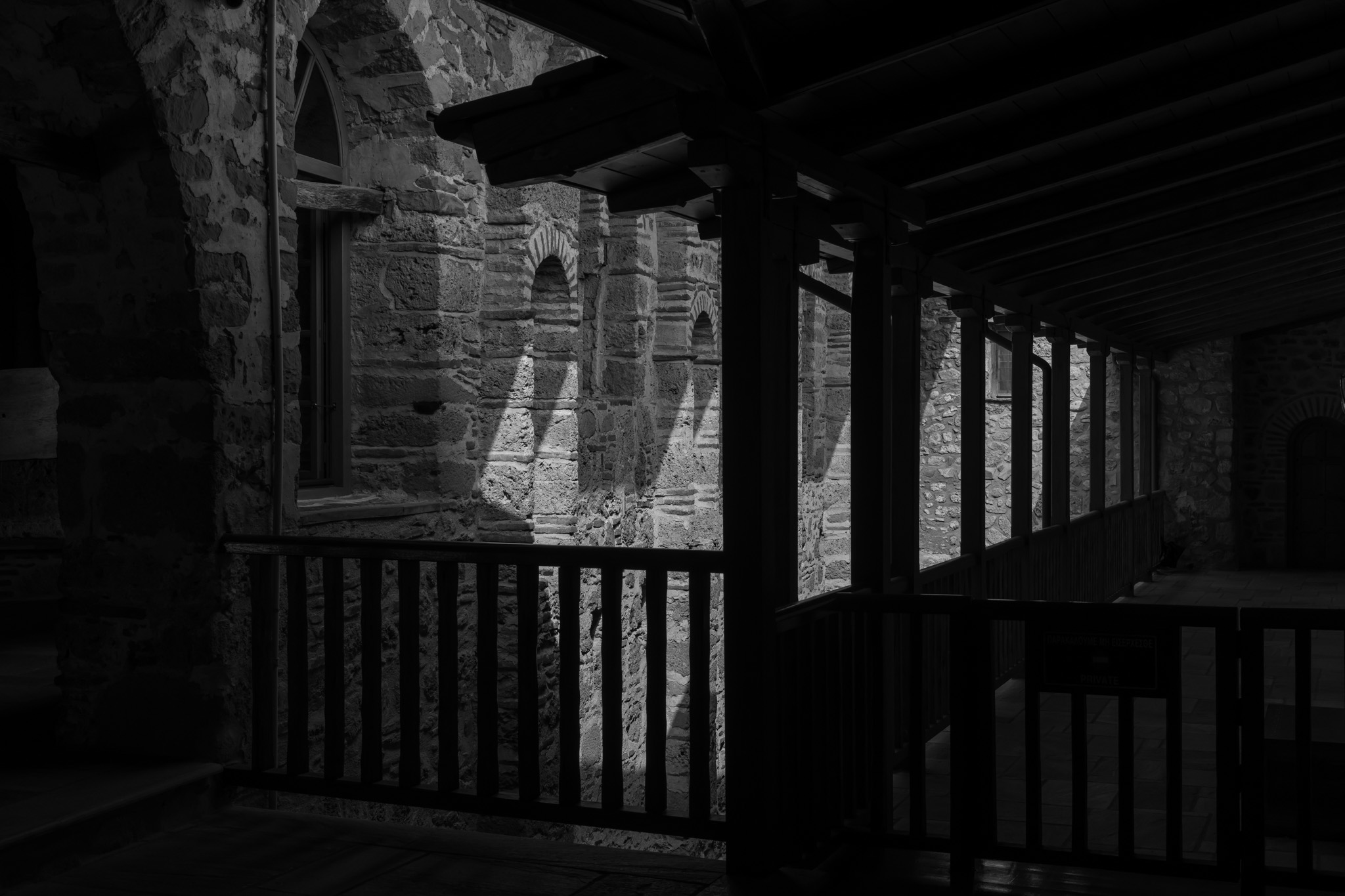
There are many buildings at the top including a beautiful church, courtyard, kitchen etc. Some of the areas have restricted access and there is no photography allowed inside the church (the image below is one I found on the internet), which is quite a pity as the interior of the church is quite rich and beautiful. There is also a museum inside the monastery and supposedly, the library at the Grand Meteoron is the largest in Meteora and it has about 1350 codices. 

Note: This photo of the interior of the church is sourced from the internet and not taken by me.

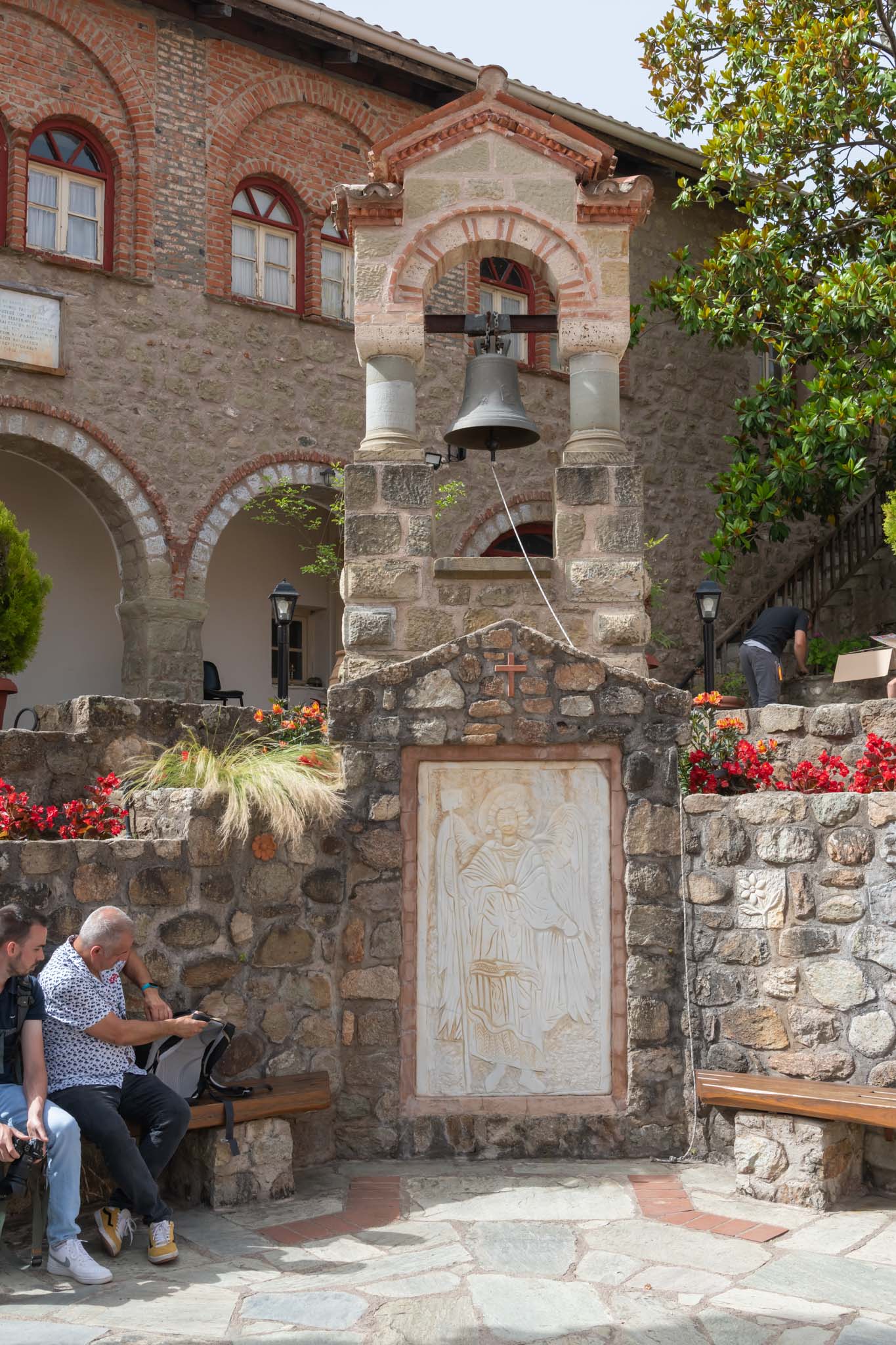
The courtyard had some beautiful frescoes and the rope net arrangement was seen here as well. 

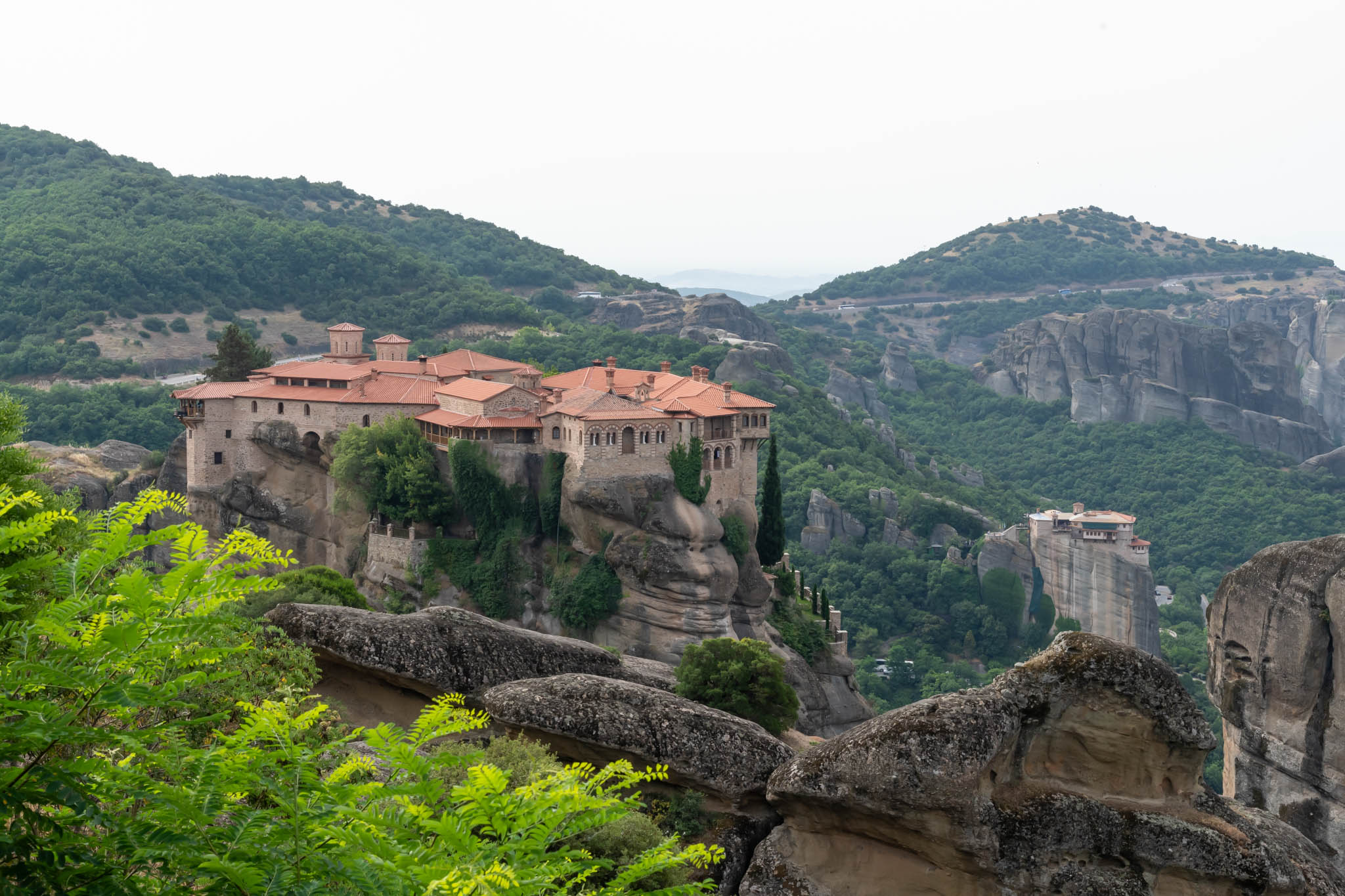
View of Monastery of Varlaam from the Great Meteoron.

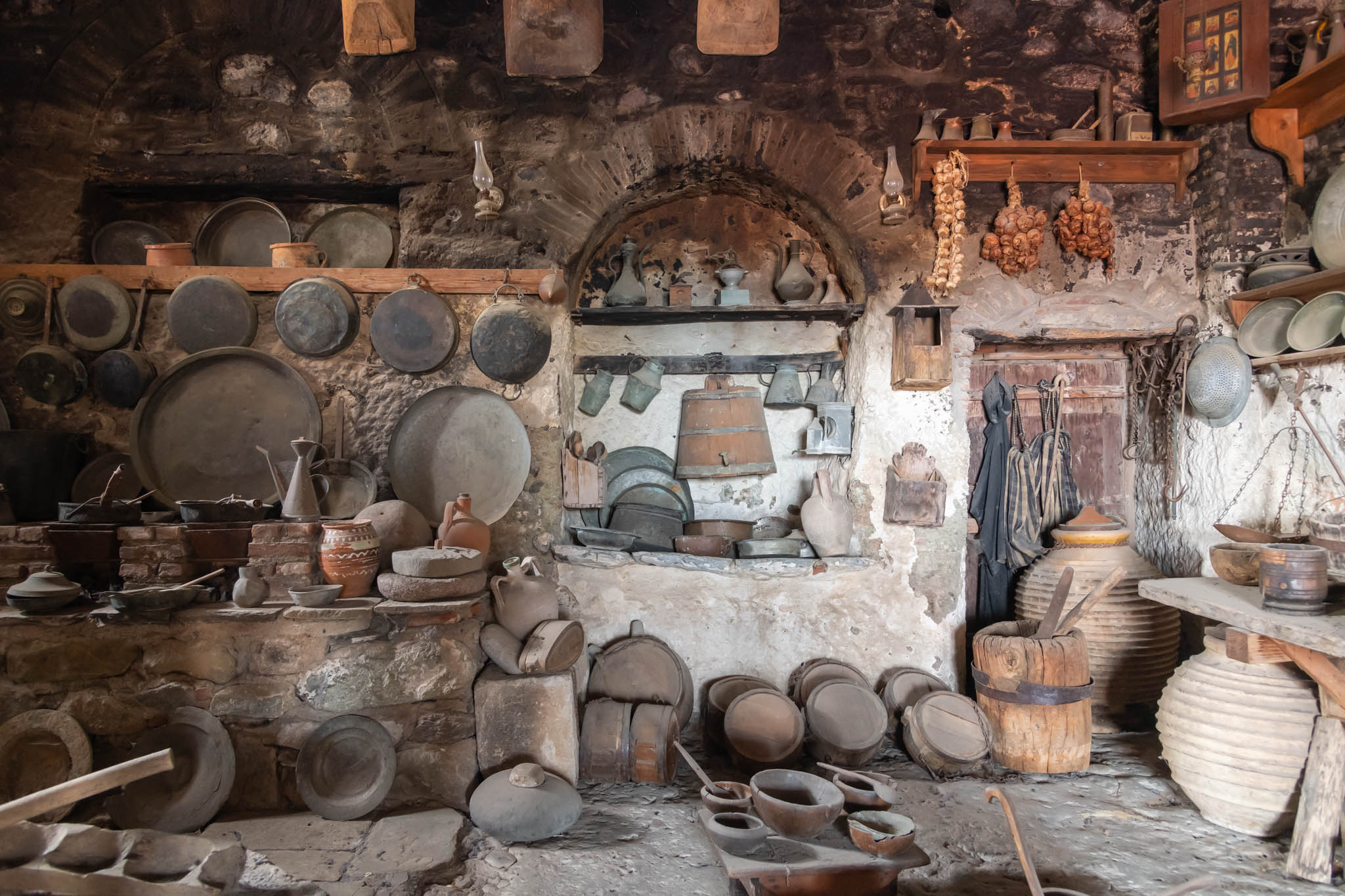
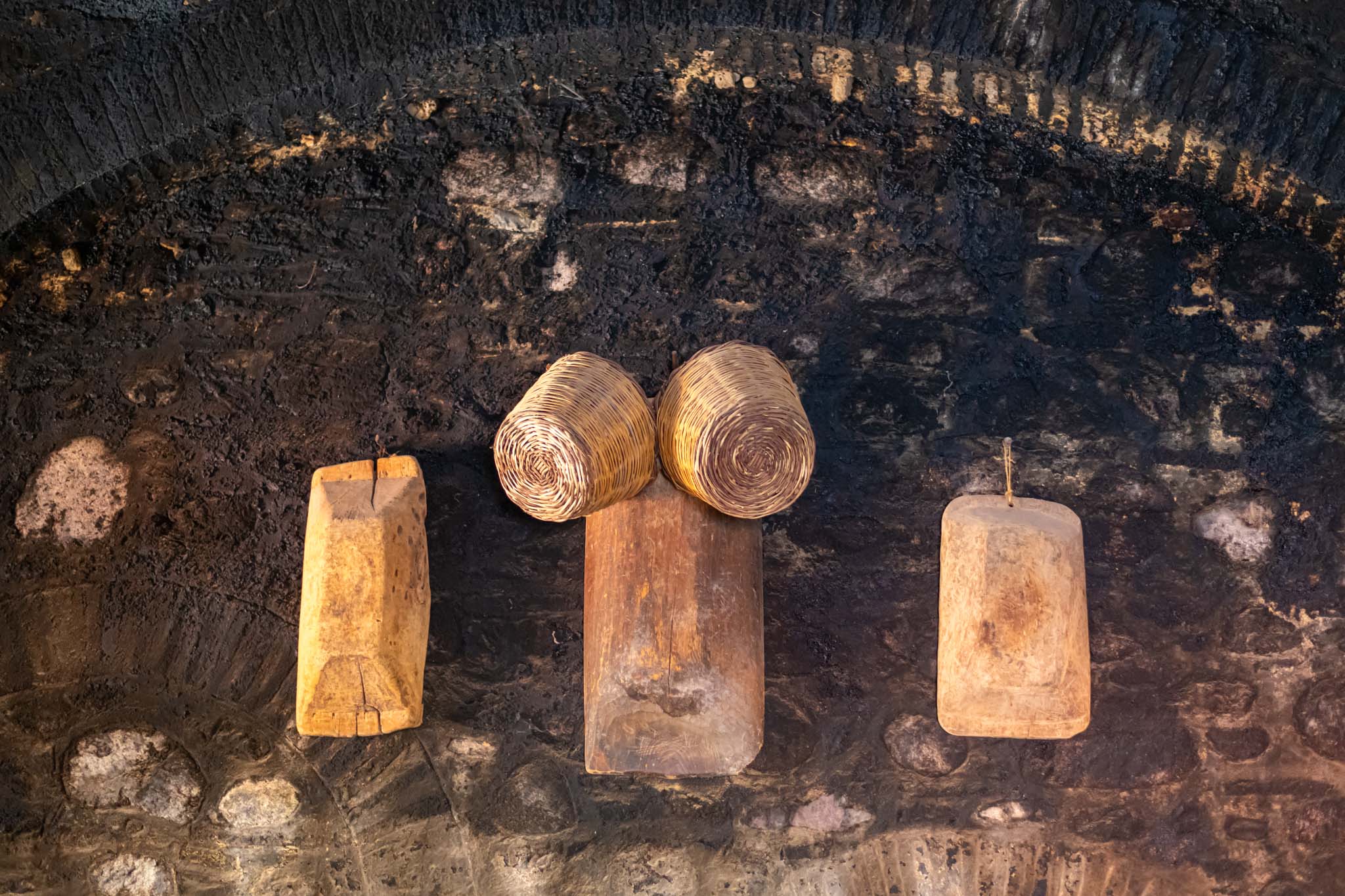
The kitchen was pretty large and had all kinds of utensils, baskets and all preserved as it might have been in the olden times. 

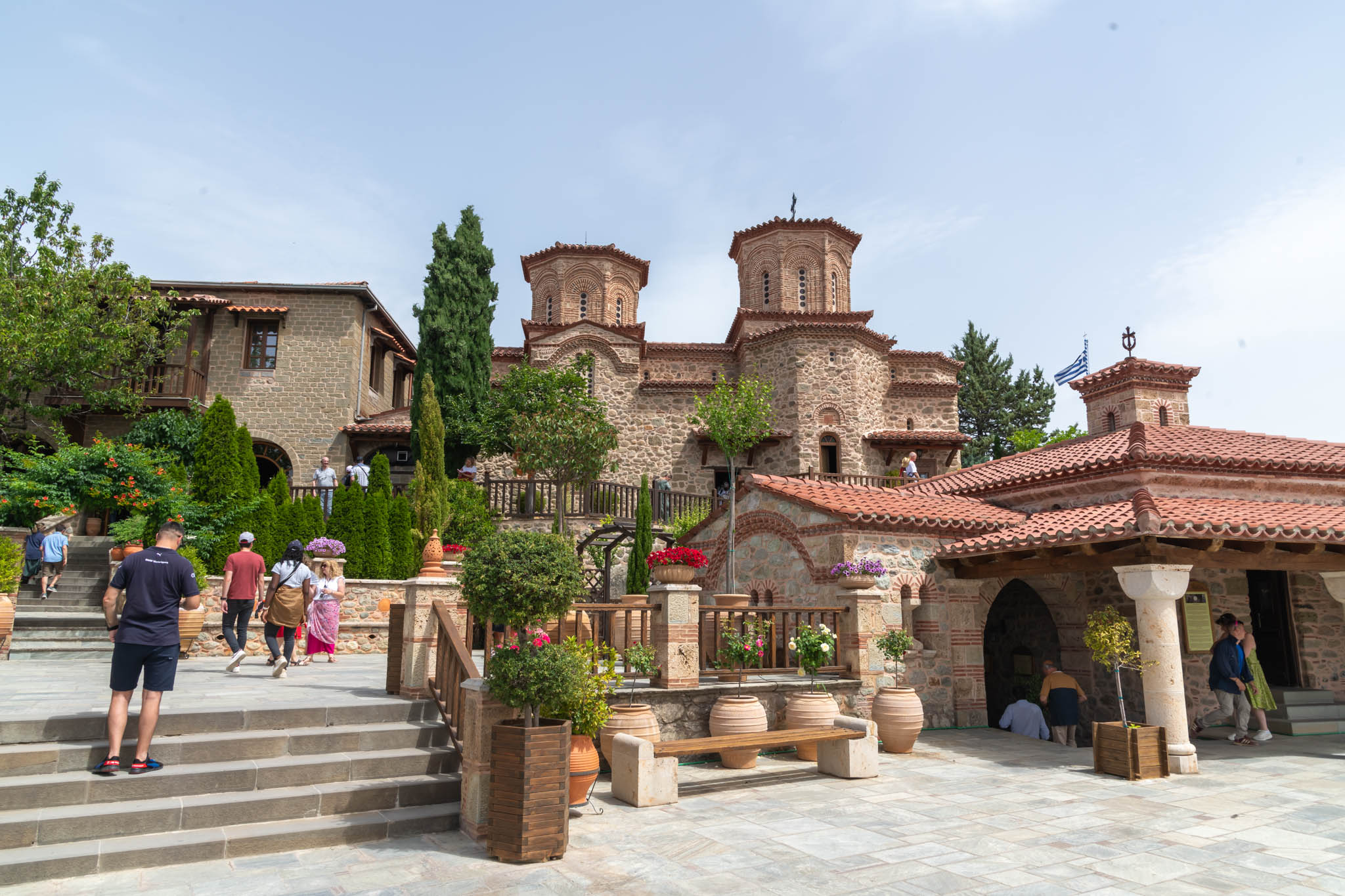
The Great Meteoron left us in awe, and we all felt it was well worth the effort. It was quite hot in Meteora in June and the sun was doing its best to make it even more uncomfortable. Next on the list was The Monastery of Varlaam. It is the second largest monastery in Meteora and was founded in the mid of the 14th century by a monk named Varlaam. After Varlaam died, the rest of the monks deserted the monastery, and it was abandoned for a century of so till two monk brothers named Theophanes and Nectarios reactivated it. 

This is a beautiful monastery, and you have to go up some 200 steps or so before you step into a wonderful courtyard. 

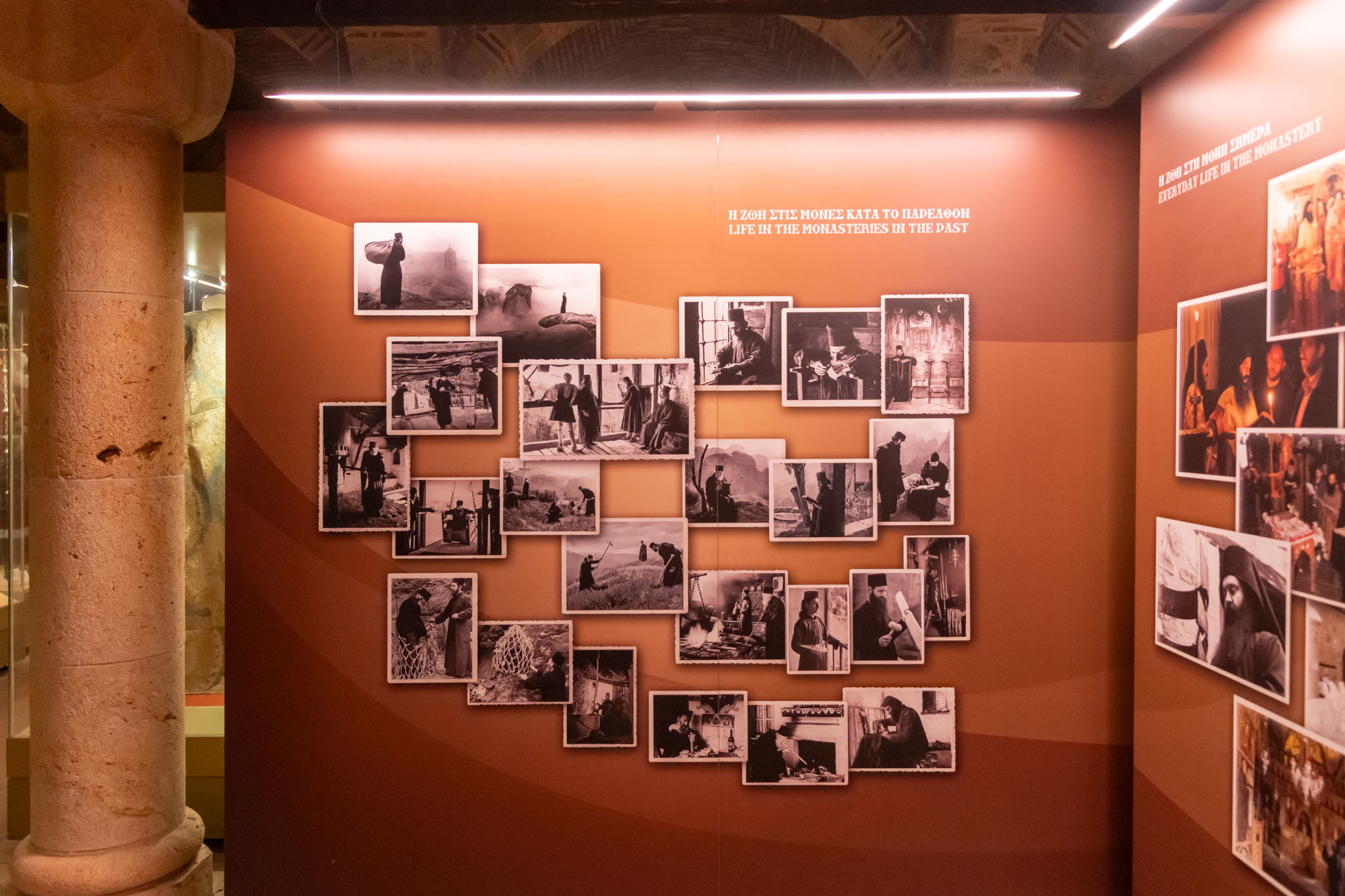
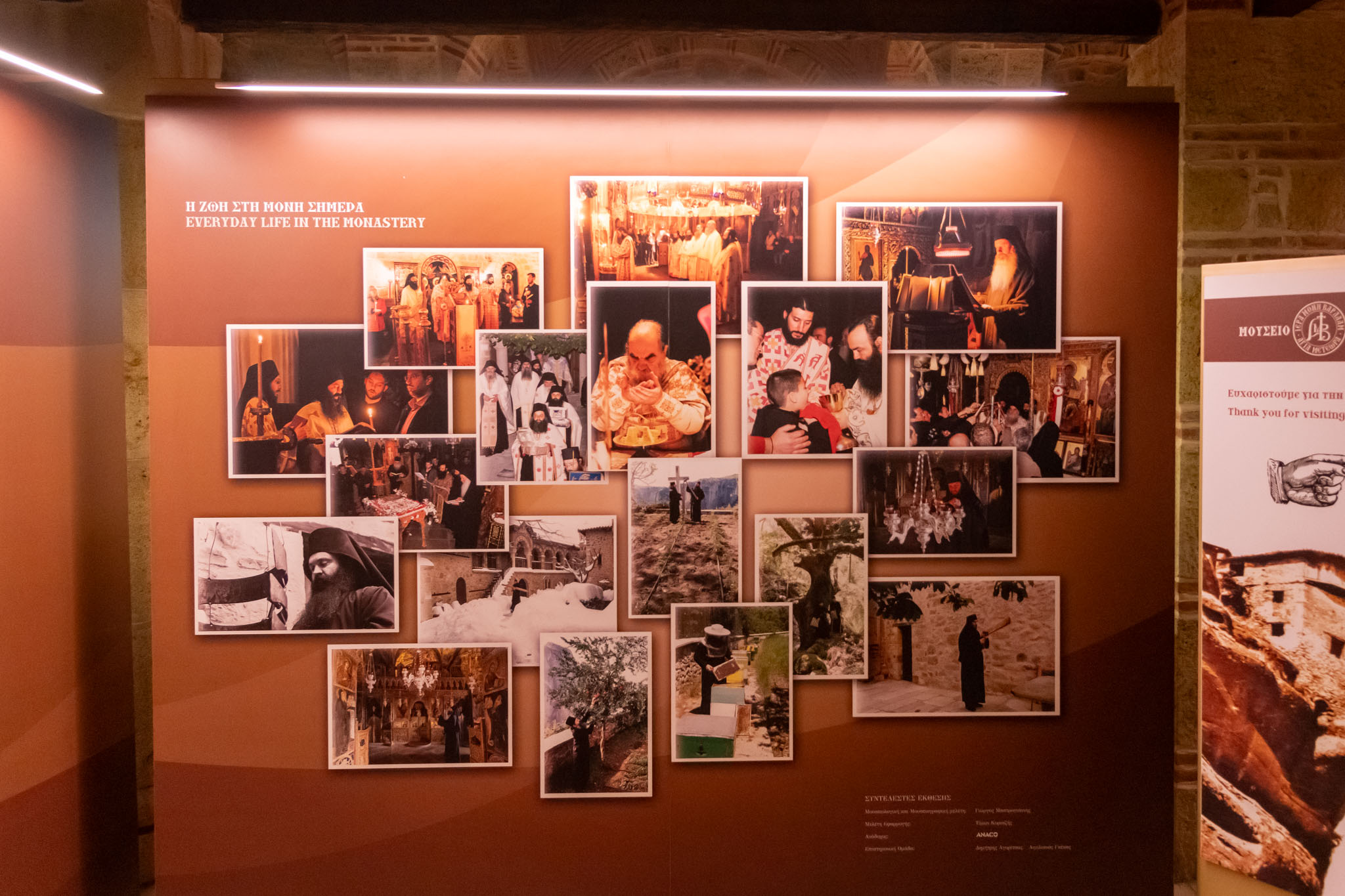
There is a small museum that brings out how life was, for the monks in the olden times. I found that quite interesting. I tried to imagine myself as a monk here, without the tourists milling around, contemplating the mysteries of the universe and time. If there is a ranking of locations suited for such an activity, this must definitely be one of the top-ranking ones.

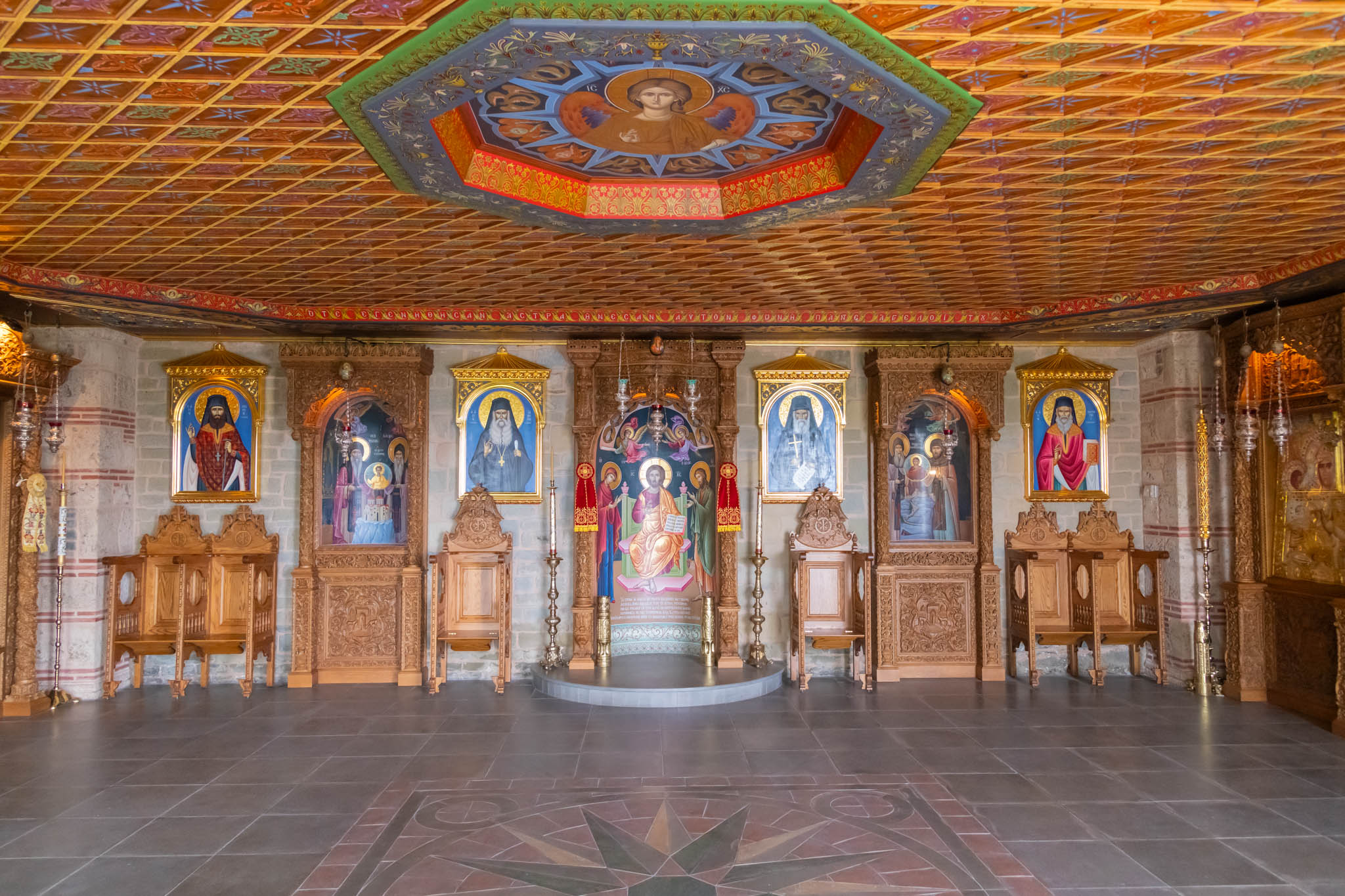
There is also a small room with beautiful frescoes and a fantastic ceiling.

Here too, photography is banned inside the church – which is quite a pity – and I reproduce an image I found from the internet.

Note: This photo of the interior of the church is sourced from the internet and not taken by me.

One key attraction at the Varlaam is a wooden barrel that was used to store rainwater. This is a huge barrel which can hold up to 12,000 litres. It is made entirely of wood and the locking system to make the planks watertight is quite clever. 

The lift arrangement used in other monasteries was found here as well.

After lunch, we proceeded to the Monastery of St. Barbara or Roussanou. This is a small monastery, occupying the whole of the rock it stands on and was built in the 14th century. These days it is occupied by nuns and about 15 nuns live here. It is very easily accessible from the road and from the other side, there is a wooded path that leads to a bend further up the road. The Malayali family we had seen at The Great Meteoron came here as well and a nun came out to meet them. So, I assume a Malayali nun has made it to this remote monastery. We didn’t see them afterwards and so couldn’t check the veracity of this assumption.

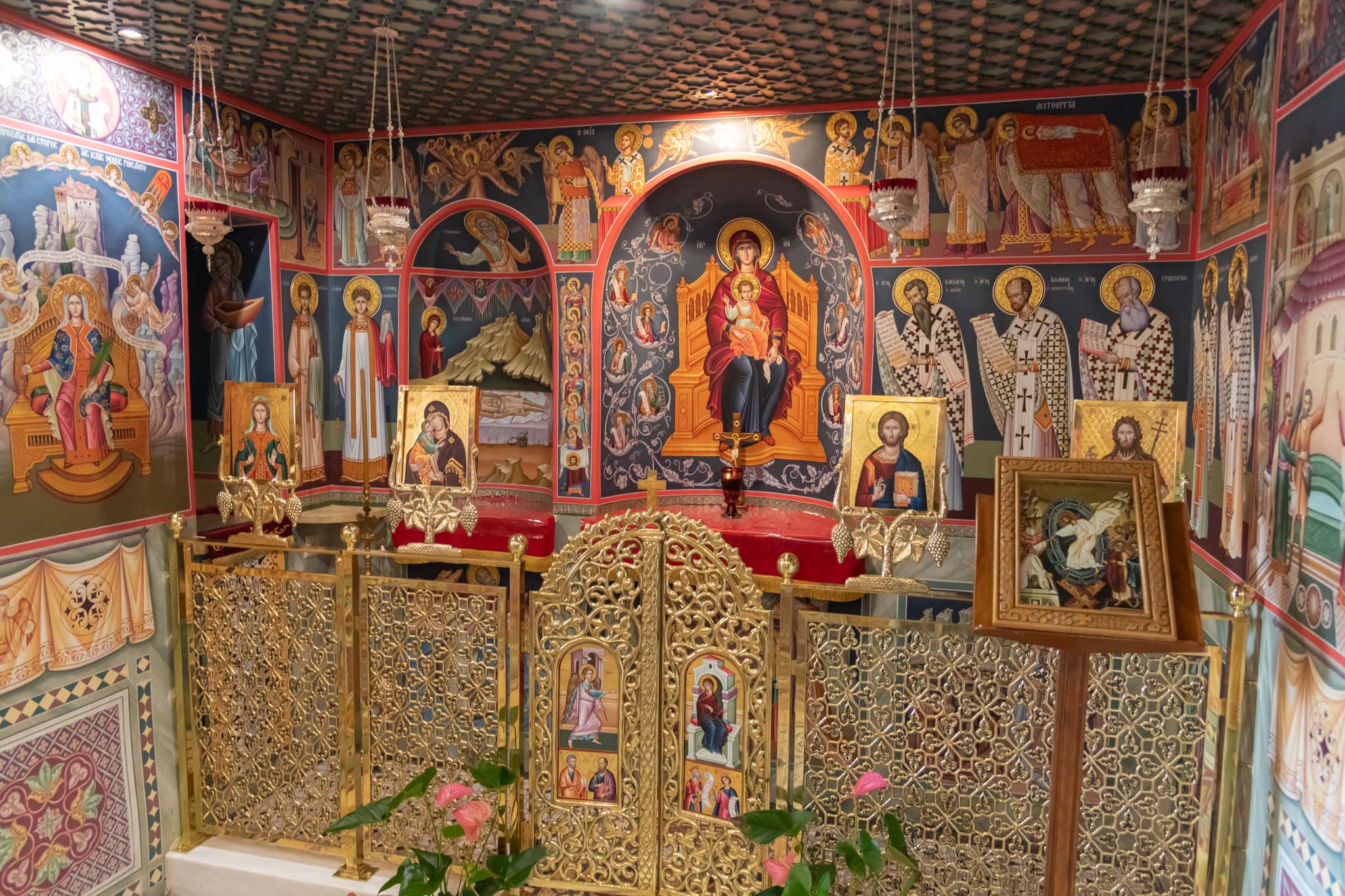
Photography wasn’t allowed inside the monastery, but I wasn’t aware of this and clicked a few photos before the clerk alerted me. 

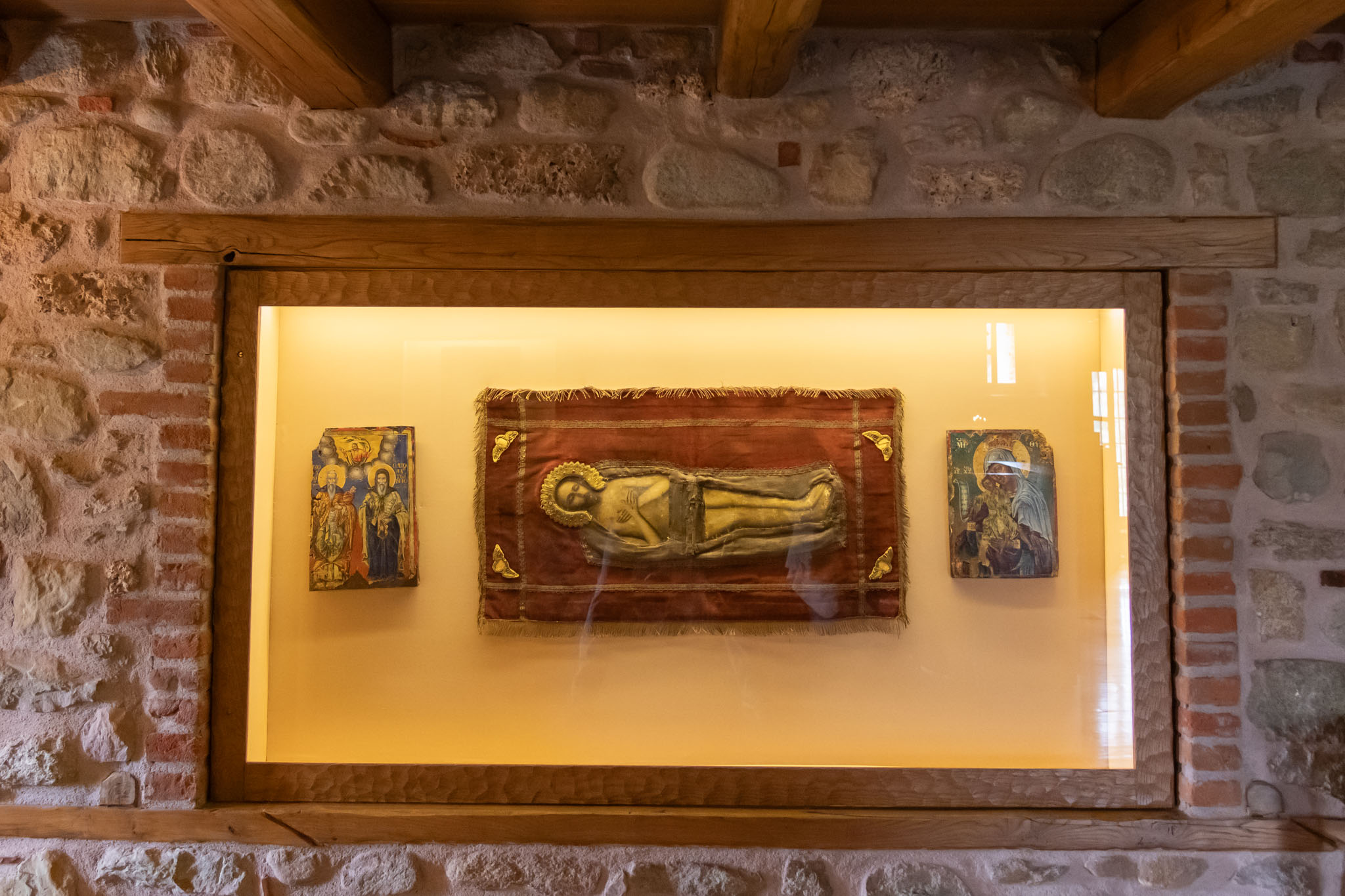
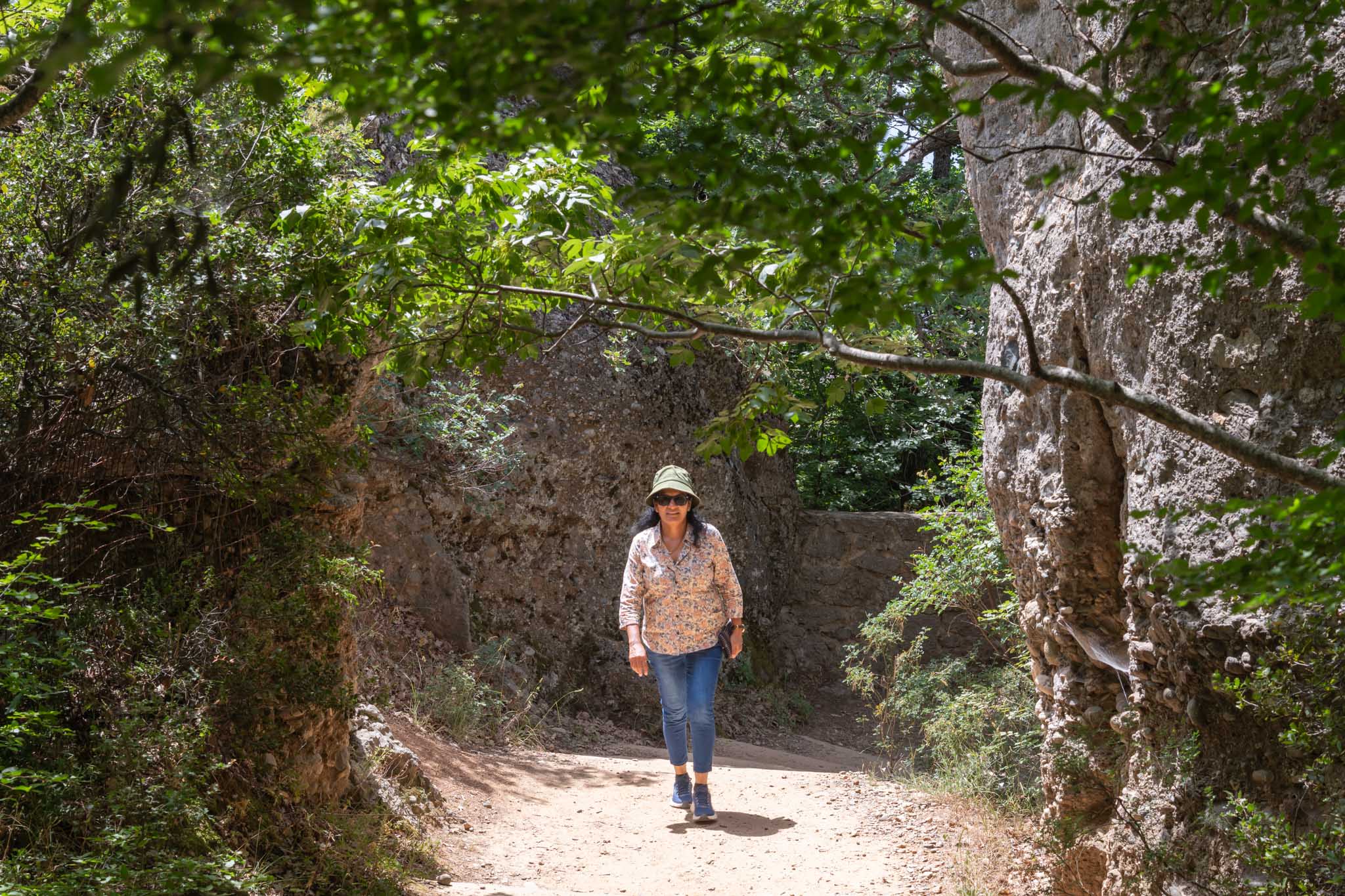
It has a nice small chapel and some displays in a room outside. The pathway through the woods, behind the monastery, is quite enjoyable.

This was the fourth monastery we visited, and we didn’t have enough time left, to visit the remaining two. The two days involved a lot of going up and down steps and we were happy we could handle it without any trouble. 

Meteora is a magical place indeed and I wasn’t disappointed that the experience didn’t do justice to the image that came into my mind when I heard of this place the first time. The town of Kalabaka is pretty nice too and I can easily see myself spending a week here trekking to the various monasteries and taking life easy, in between. It was our last evening at Meteora and we soaked in one more sunset before we said goodbye. 

“He was an old man who fished alone in a skiff in the Gulf Stream and he had gone eighty-four days now without taking a fish.” Thus starts the story of Santiago and one of the most famous novels in modern literature – The Old Man and the Sea. This novella marked the highest point in Ernest Hemingway’s literary career, and such was its impact that the committee specifically mentioned this book when they awarded Hemingway the Nobel Prize for Literature in 1954 (a rare occurrence as the Nobel Prize is given for lifetime work and not any specific work). It is believed that Hemingway conceived this story during his time in Cuba, from the various stories he heard from the locals. Hemingway had a deep love affair with Cuba and even today, when you visit Havana after sixty years of his death, you find that Hemingway still lives on in Cuba. 

Hemingway is one of my favourite authors and in my travels, whenever I have come across a location connected with Hemingway, I have always made it a point to visit the place. I have been to his house in Key West[1] and to the bar he used to frequent in Venice. Thus, Hemingway was very much on my agenda when I landed in Havana. The first day itself, I went on a tour of old Havana with a guide and came across Hotel Ambos Mundos where Hemingway used to live when he first arrived in Cuba in 1932. This is a beautiful building in the heart of the historic and picturesque old town. Supposedly, Hemingway moved from here to a house outside Havana in 1939 when the view from his fifth-floor room was obstructed by a new building that came up. 


[1] Captured in my blog post: https://yezhuvath.wordpress.com/2016/10/04/key-west-in-a-day/

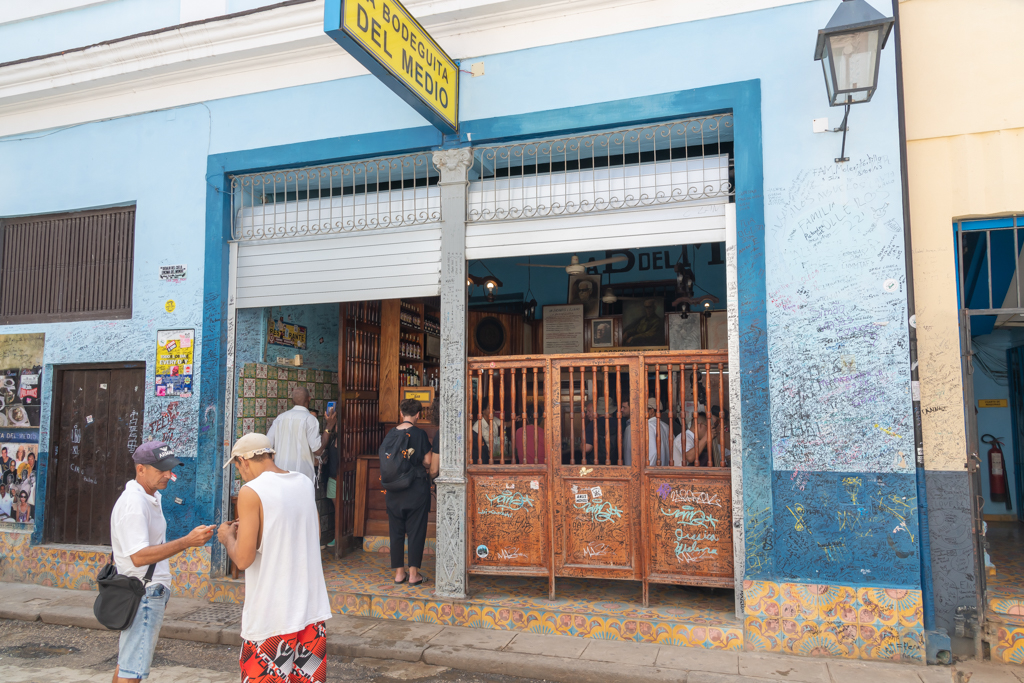
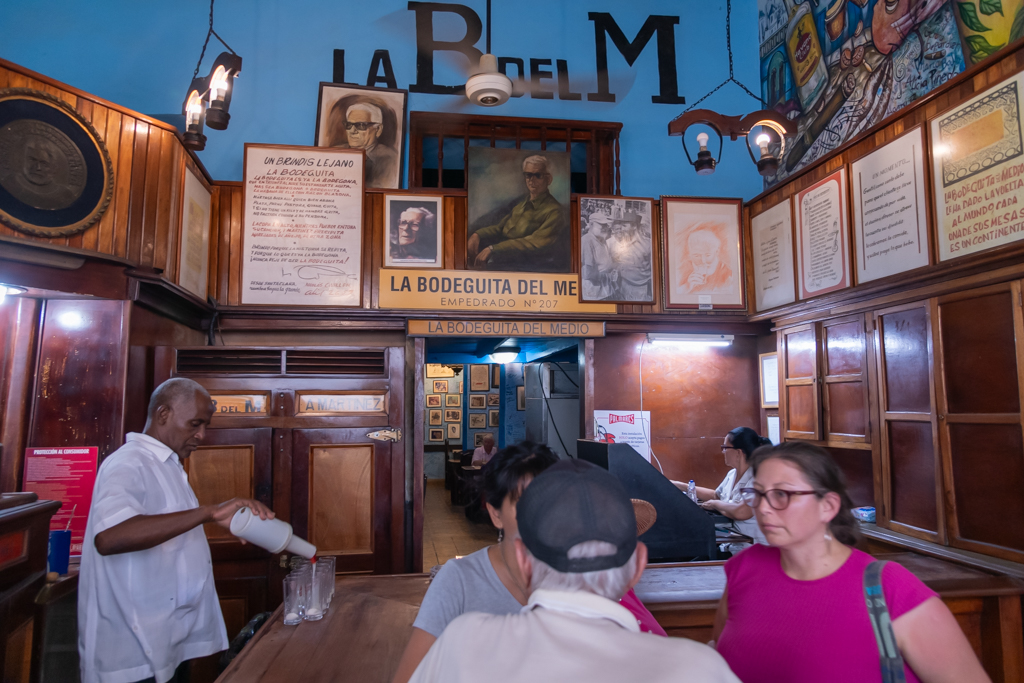
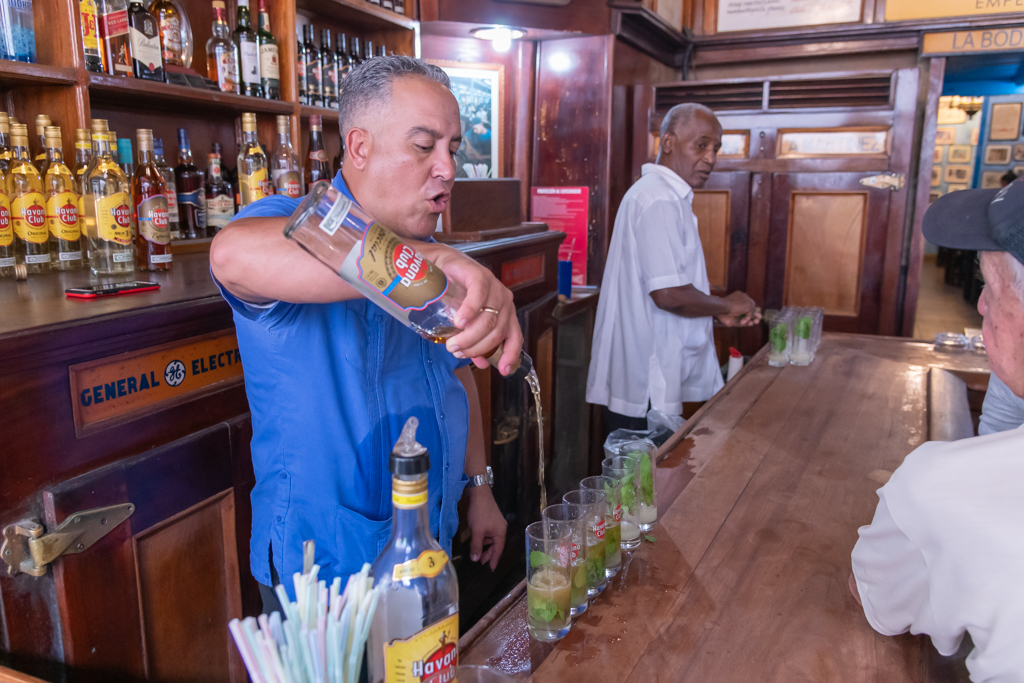
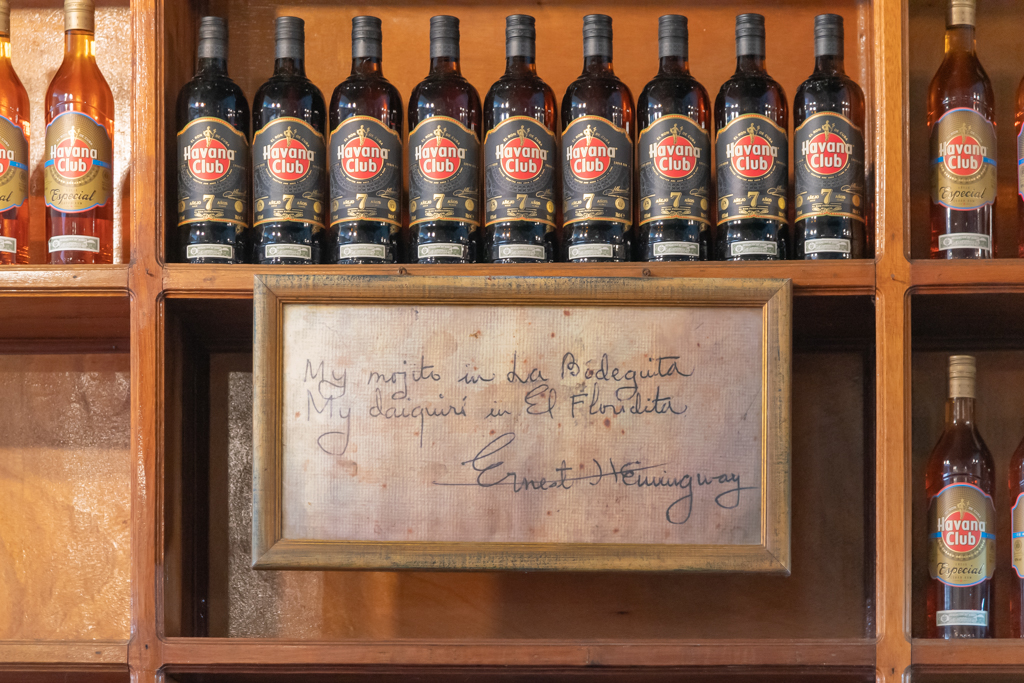
Very close to Hotel Ambos Mundos is La Bodeguita del Medio, a bar that claims to have invented the cocktail Mojito. Hemingway used to visit this bar (though not frequently) and they have a board that is supposedly signed by him. His biographer Philip Greene says it is unlikely this was actually signed by Hemingway as there are differences in the signature. In any case, La Bodeguita does brisk business because of this connection, and I too was a visitor there. The Hemingway connection must obviously be very profitable for them, given the high price (compared to going prices in Havana) they charged for my Mojito. Frankly, it did feel like a bit of a tourist trap.

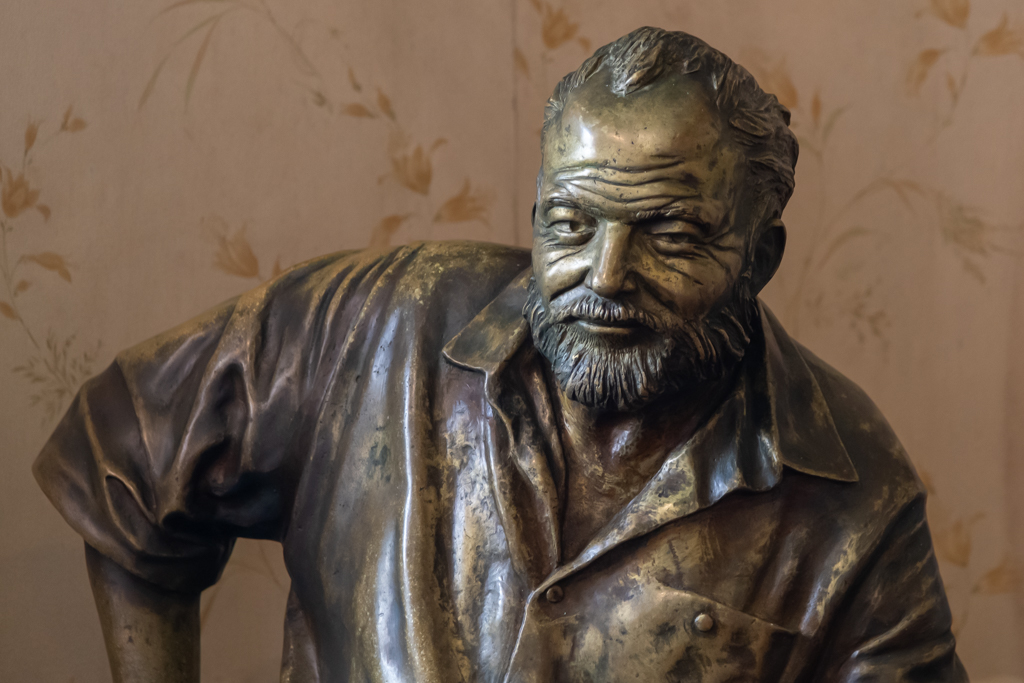
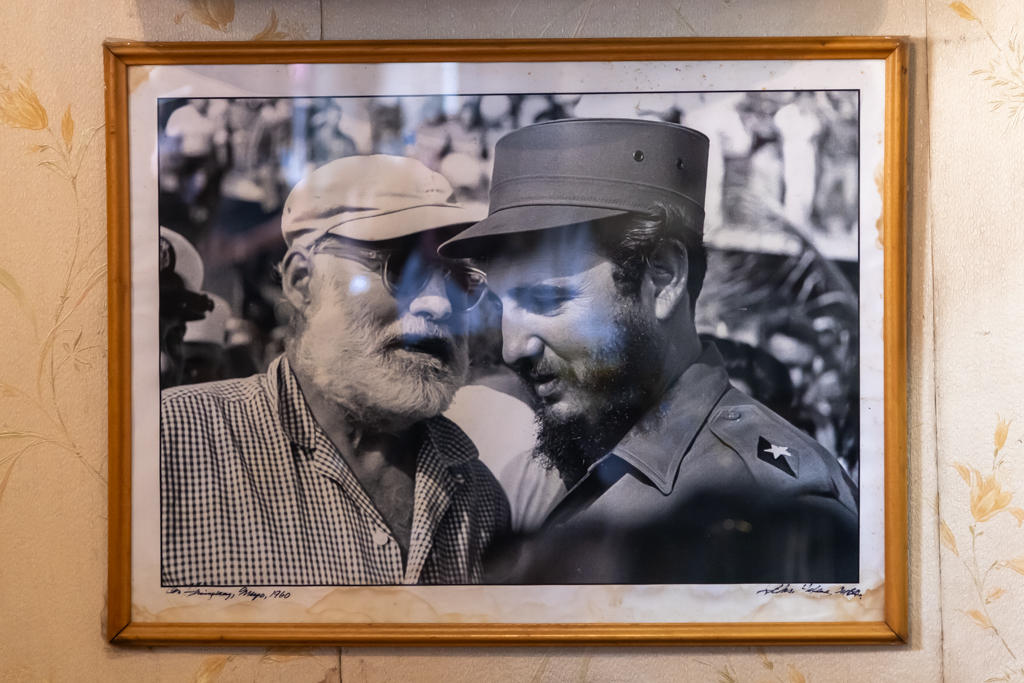
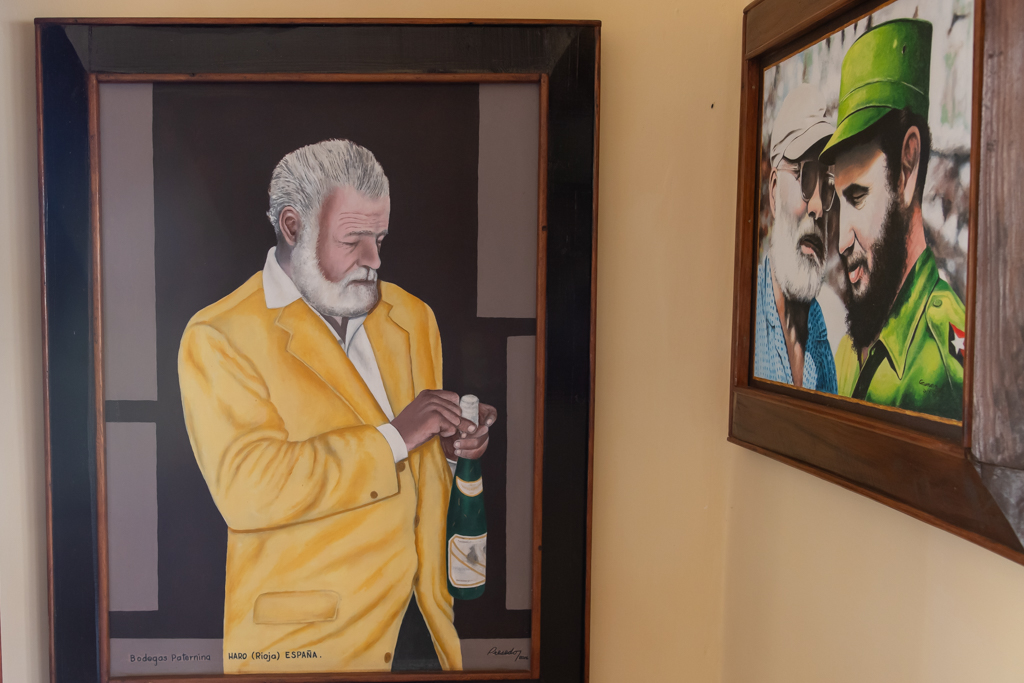
There is another restaurant and bar that Hemingway did use to frequent, named El Floridita, which is also in Old Town and just a short walk from Hotel Ambos Mundos. El Floridita holds the distinction of being the inventor of the cocktail Daiquiri. Unlike the La Bodeguita, this place had a different charm with the rather lifelike bust of Hemingway that you see at the end of the bar (sculpted in 2003 by Cuban artist  José Villa Soberón) and it does feel like you are in his presence. For me it was magical to sit at the bar and have a Daiquiri thinking of Hemingway and the times he must have spent at the bar. As mentioned, I had been to Harry’s Bar that Hemingway used to frequent in Venice. When I was there, I was having a Martini thinking about him and his novel “Across the river and into the trees”, parts of which he wrote in Harry’s Bar (the bar itself is mentioned in the book). However, my meditative musings at Harry’s Bar were rudely interrupted by the arrival of four, rather loud Americans who set about complaining about the bar promptly and about how it lacked a view. I was quite irritated and left quickly. Thankfully, El Floridita was a very different experience. People were friendly and there were many photos of Hemingway including a photo of Hemingway and Castro. Supposedly, that was the only time they met, during a fishing competition. However, Castro was quite an admirer of Hemingway and was instrumental in ensuring that his house was preserved and converted into a museum. 

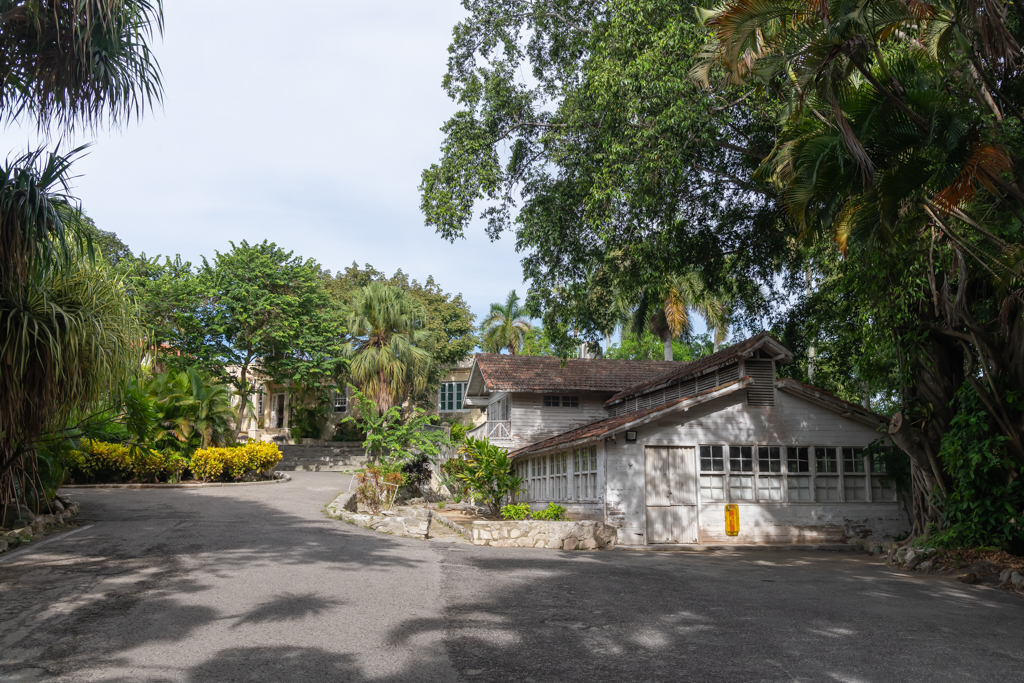
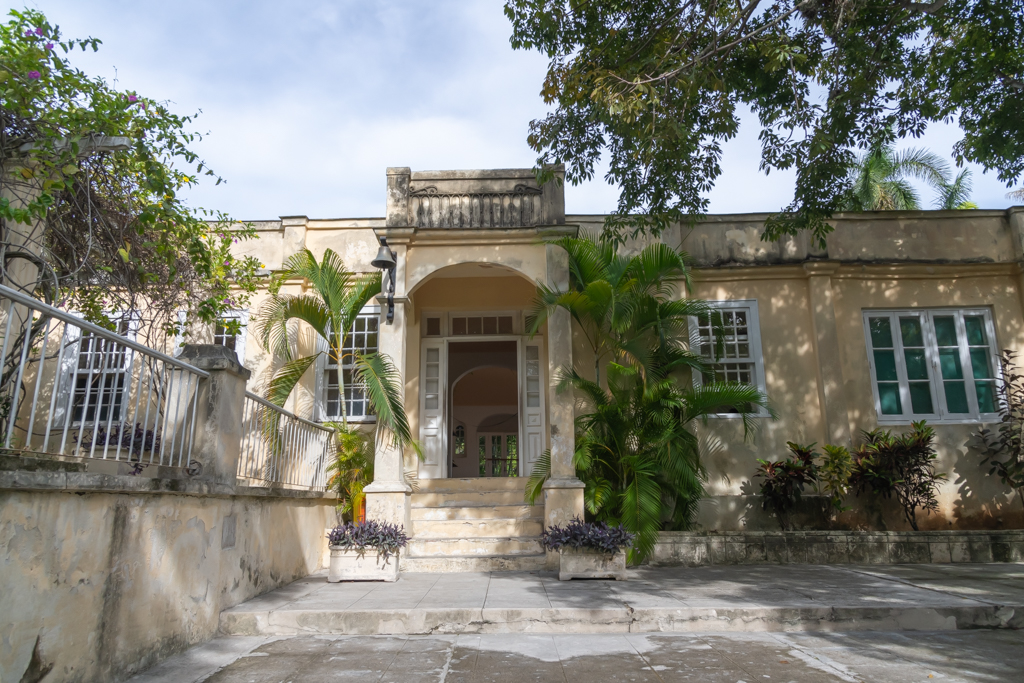
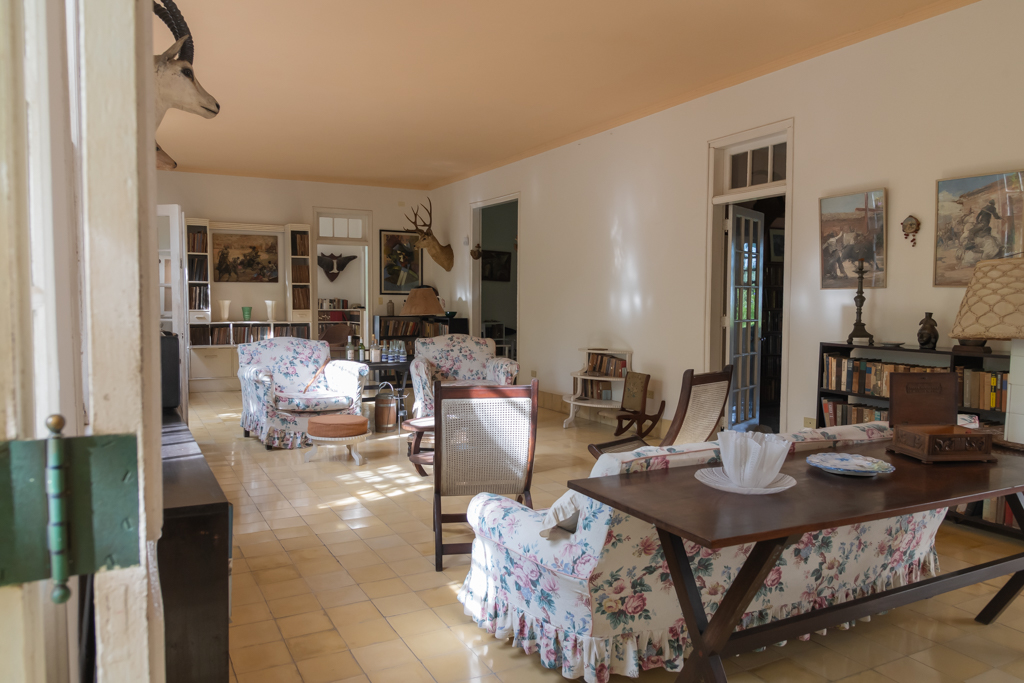
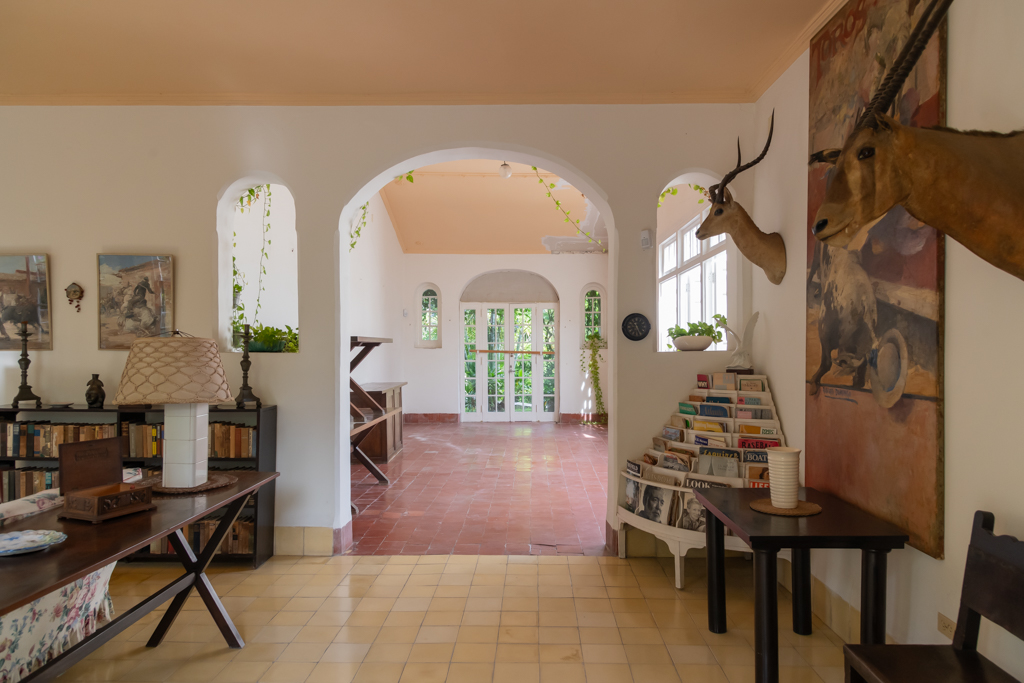
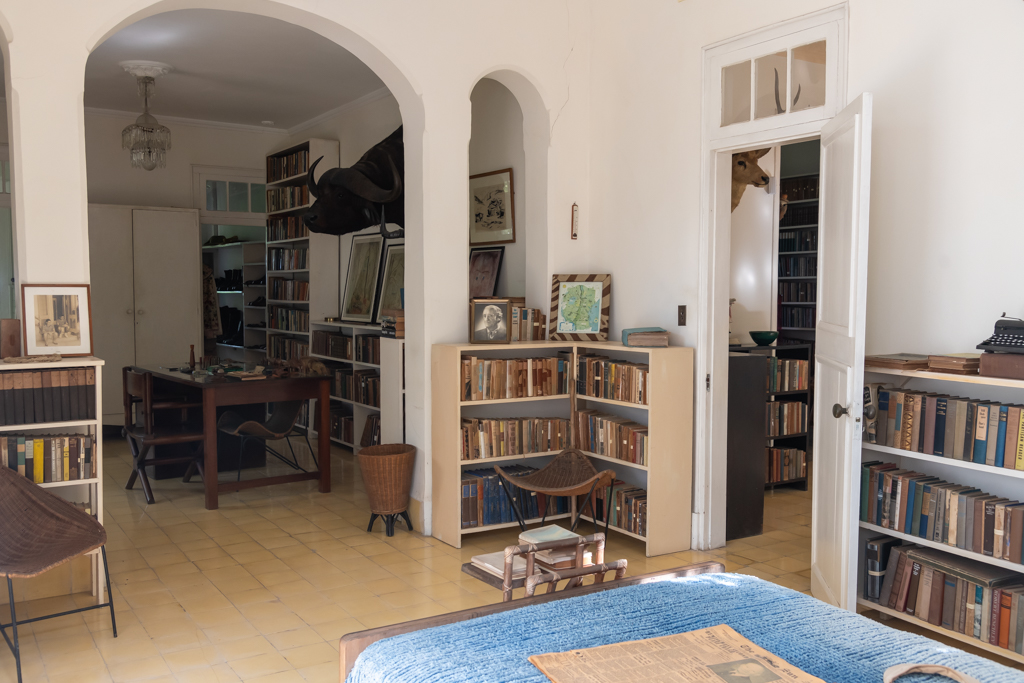
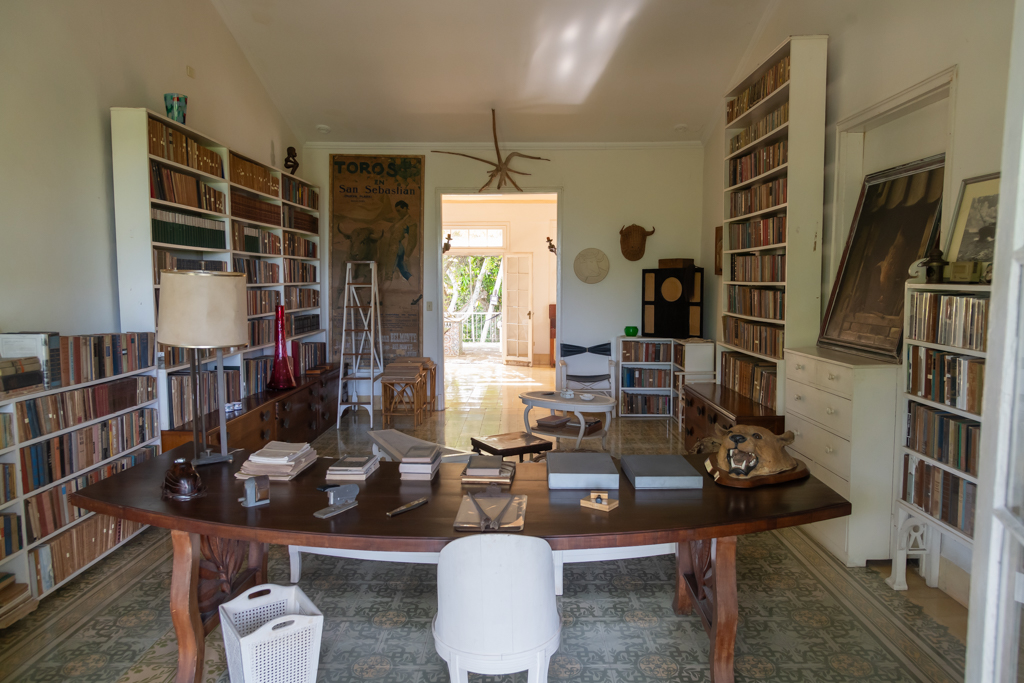
In 1939, Hemingway moved out to a farmhouse called Finca Vigía, which is just outside Havana. After Hemingway’s death in 1961, this was converted into a museum through the active intervention of Fidel Castro. Hemingway had wanted the house to go to the people of the locality after his death. It is now preserved as it was when Hemingway left Cuba in 1959. Unfortunately, you cannot enter the house itself as it is roped off; it seems visitors were carrying off memorabilia from the house and so the authorities banned entry for everyone. It is a small, unimposing house with an outhouse attached to it. 

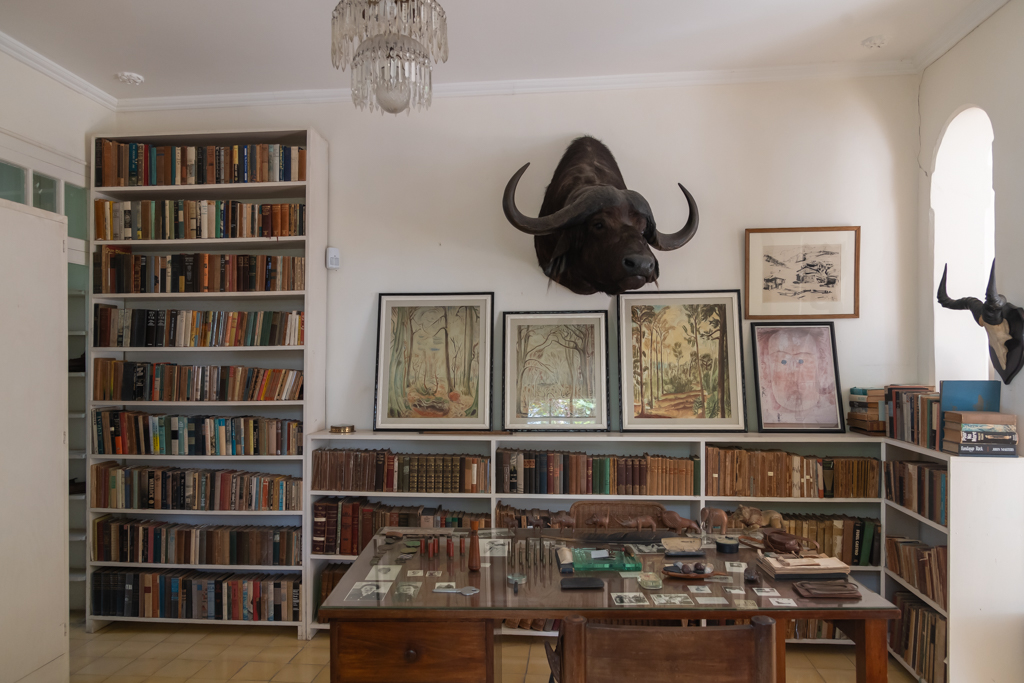
Hemingway was an avid hunter as well and often went to Africa on hunting trips and you can see some of his trophies on the walls. Another interesting aspect is that the house is filled with books, and you see them everywhere including the bathroom! There are about 9000 books in the house. 

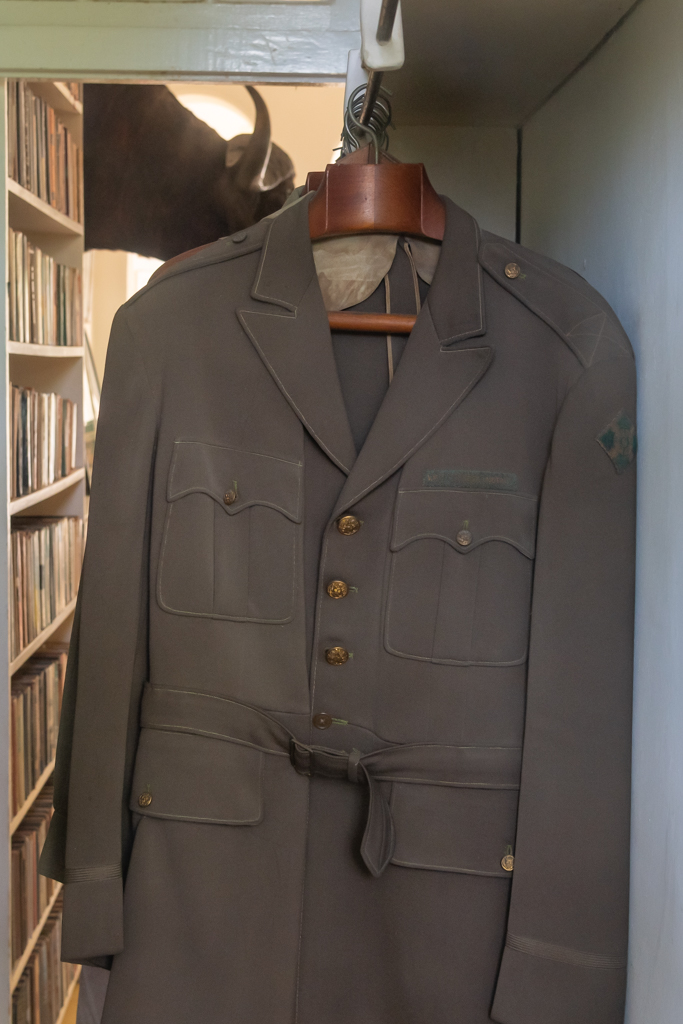
Uniform that Hemingway wore in the Spanish Civil War. 

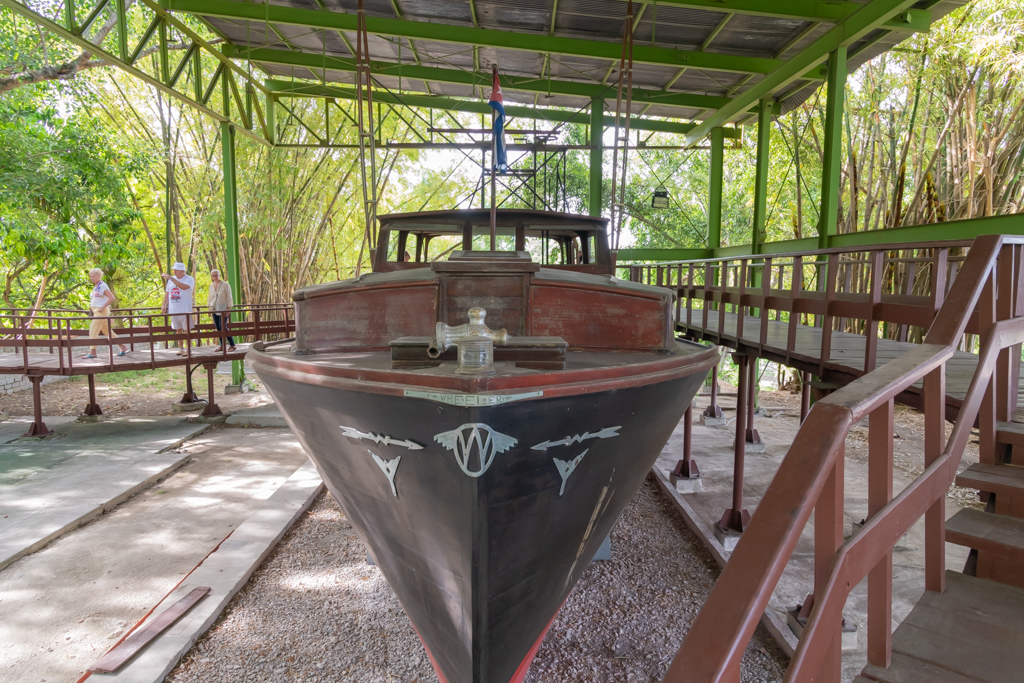
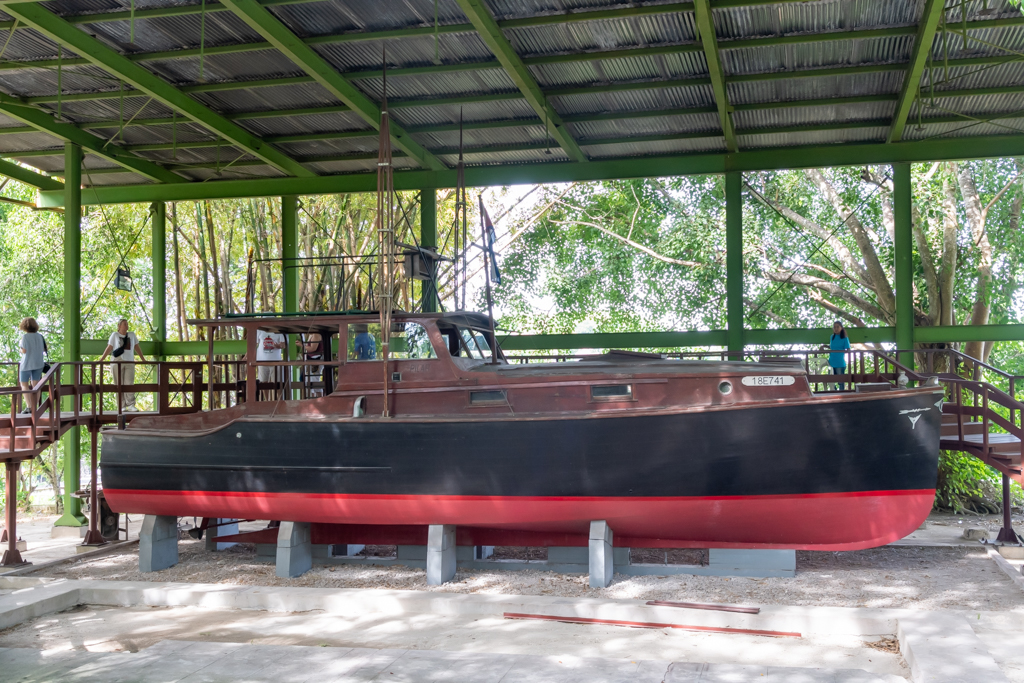
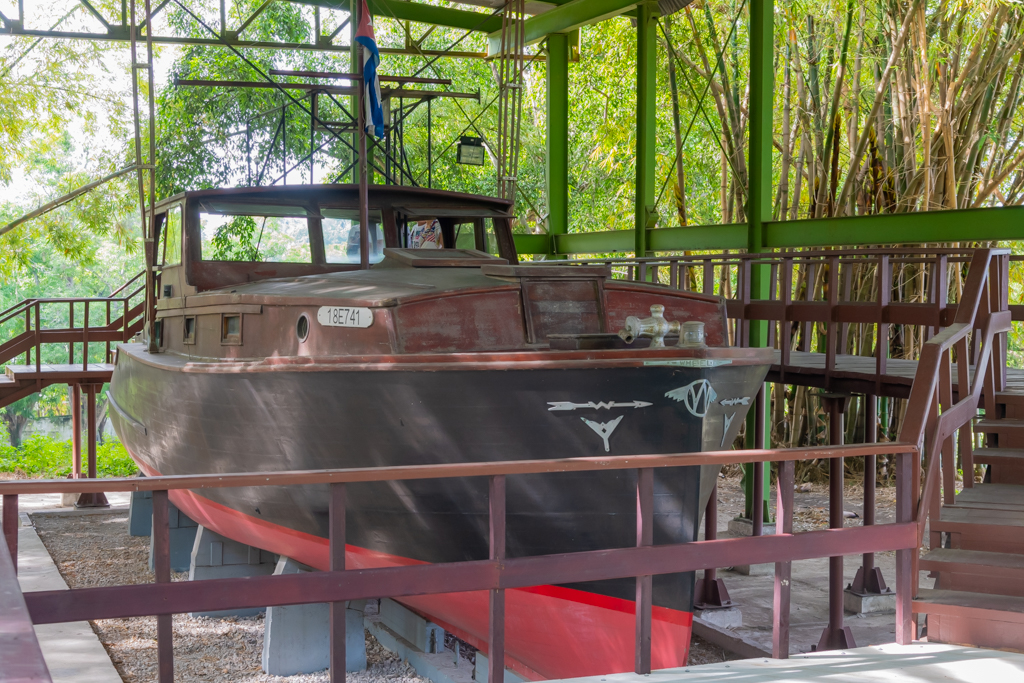
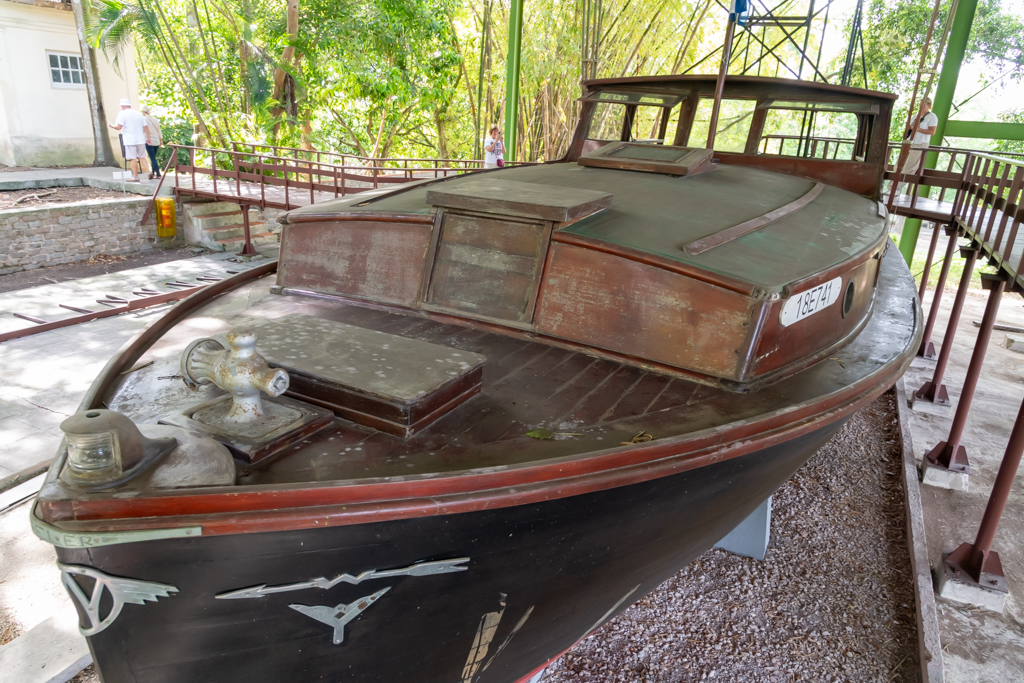
As anyone who has read Hemingway can make out, fishing was an important part of his life. In 1934, he acquired a yacht and named it Pilar. It was the nickname of his second wife, Pauline, and also the name of one of the characters in “For Whom the Bell Tolls”. He spent a lot of time on this boat and even used it to search for German U-boats; well, at least, that is what he claimed but Hemingway being the colourful man he was, there were allegations that this was just a fast one he pulled to get some extra gas rations. Whatever the case may be, he was very fold of Pilar and many of his works have been influenced by his experiences aboard this boat. When he left Cuba, he gifted the boat to his captain and friend Gregorio Fuentes, who donated it to the people of Cuba. Pilar is now on display at the museum.

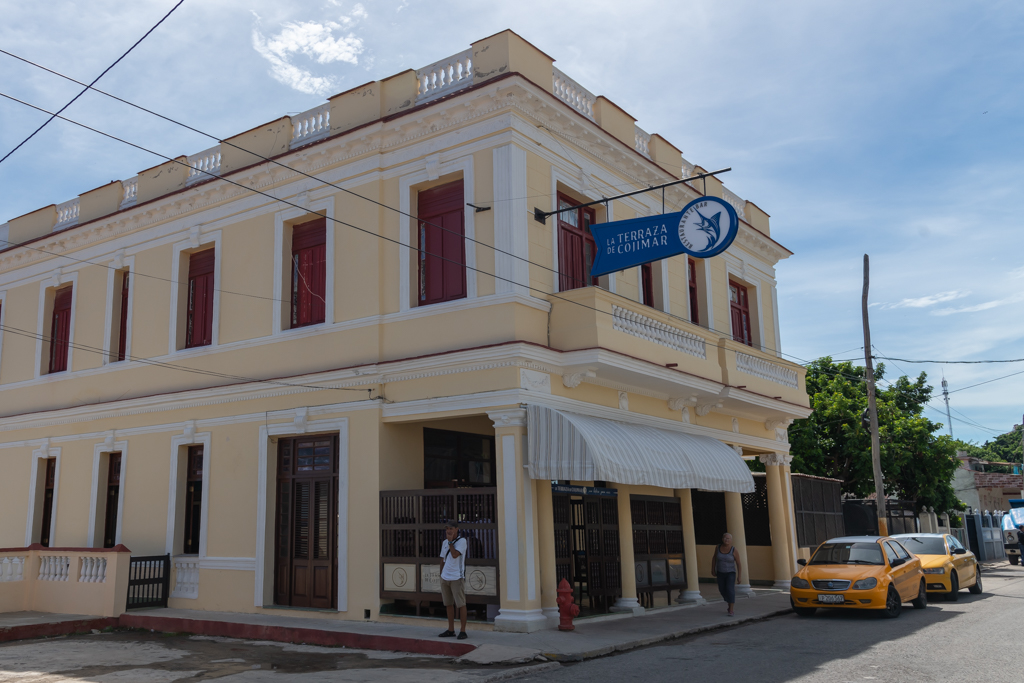
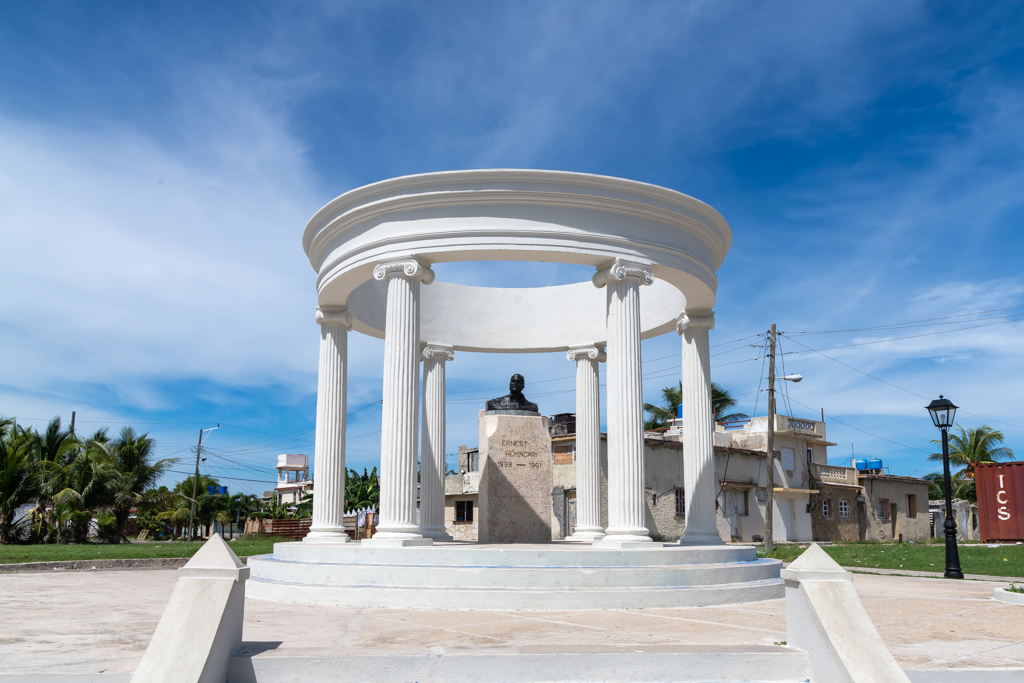
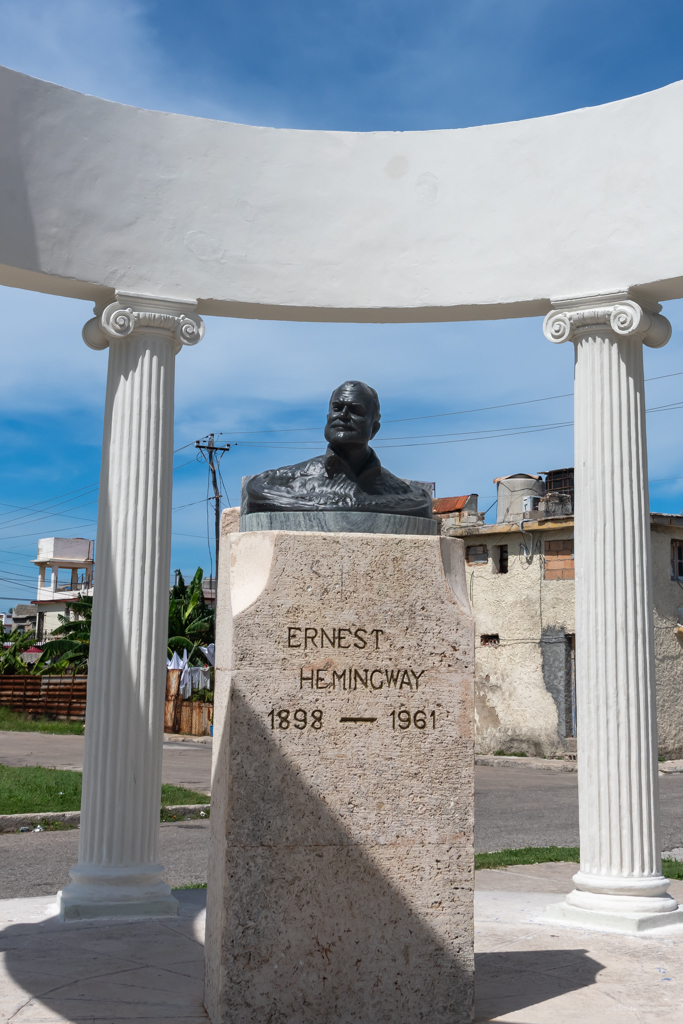
Hemingway used to frequent a small fishing village called Cojimar, which is a short distance away from Finca Vigía. One of his haunts was the restaurant La Terraza de Cojimar and that was my next stop. This is a beautiful restaurant right by the sea and there is a corner table that Hemingway used to sit at. It is now cordoned off and Hemingway is still there in the form of a small bust. The walls of the restaurant are lined with photographs including a couple with Castro. 

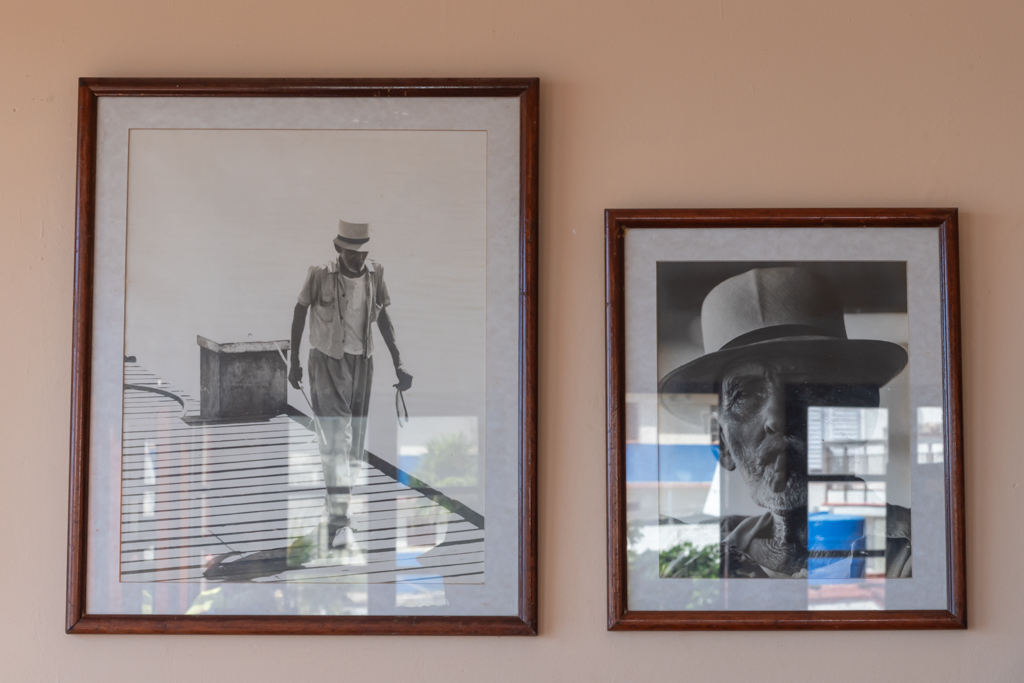
Hemingway spent a lot of time here with Gregorio Fuentes and also met a lot of fishermen here. It is likely he got the spark for The Old Man and the Sea from Cojimar. A story involving an old fisherman and a giant marlin had been part of the lore of the fisherfolk in Cojimar for several years. There is a photo of an old fisherman in the restaurant, and some say that Hemingway’s character is modelled on that man though my guide didn’t seem to agree with that. This restaurant is mentioned in the book quite a few times (The Terrace), including at the end where a woman sitting in the restaurant along with her friends, sees the spine of the fish. 

Hemingway considered The Old Man and the Sea to be his best work and he revised it countless times before he was happy for it to be published. Just before he wrote it, he had published “Across the river and into the trees” but that hadn’t been received well and Hemingway was hurt by the criticism. Personally, I was surprised to hear that this had not been received well as it remains one of my favorite Hemingway books. The Old Man and the Sea was a response to the critics and I read somewhere that Santiago was Hemingway himself, showing the critics that his skill and craft was still second to none. His first novel “The Sun Also Rises” was published in 1926 and it took him another 26 years to get to the pinnacle of his literary career with The Old Man and the Sea, while writing a series of great books along the way. 

Hemingway was a man of the masses and was friendly with everyone around and the fishermen at Cojimar were no exception. When he died in 1961, they were so saddened that they decided to build a monument for him in Cojimar a year after his death. They were poor and had no money but somehow found a sculptor who was willing to make the bust free of cost. However, there was still the problem of finding money to buy the metal needed to make the statue. They solved that by melting the propellers and other fittings of their own fishing boats! 

I don’t think a grander monument can ever be built for a writer and off the top of my head, I couldn’t think of many writers who would have been honoured like this, by the masses. But then, that was Hemingway and his relationship with Cuba and its people. He lived life to the fullest, much like his style in writing – direct and without frills. He mingled with everyone regardless of who they were, and they loved him back in return; so, Hemingway lives on in Cuba. 

Pattadakkal and Badami have been on my list of places to visit for a long time and after the unprecedented and completely unanticipated experience of the world shutting down, I thought a road trip was in order and set out from Bangalore on the afternoon of the first day in October. After a rather long drive that involved torrential rains and me losing my way, I eventually arrived at Badami. This is a very small town with limited options for accommodation and completely centred around the attractions such as the Cave Temples, Fort, Mahakuta Temple and Banashankari Temple. 

Badami is located in Bagalkot district in Karnataka and was the capital of the Chalukya dynasty between the 6th and 8th centuries AD. It was known as Vatapi at that time and there are some inscriptions that show that King Pulakeshin-I made some fortifications on the hill nearby, in the 6th Century. Sandstone cliffs surround Badami on three sides and that is possibly why Chalukyas chose Badami as their capital and moved there from Aihole. The Chalukya empire was at its peak during the reign of King Pulakeshin-II and it extended from Kanchi (Tamil Nadu) to the banks of the Narmada river and from Orissa in the East to the West Coast. A guide told me that the classical song “Vatapi Ganaptim Bhaje” is connected with Vatapi (Badami) and an internet search (Wikipedia) confirmed that. Muthuswamy Dikshithar wrote this song and it is dedicated to the icon of Ganapati that the Pallavas brought from Vatapi after they defeated the Chalukyas in battle. Pulakeshin-II was killed in that battle.

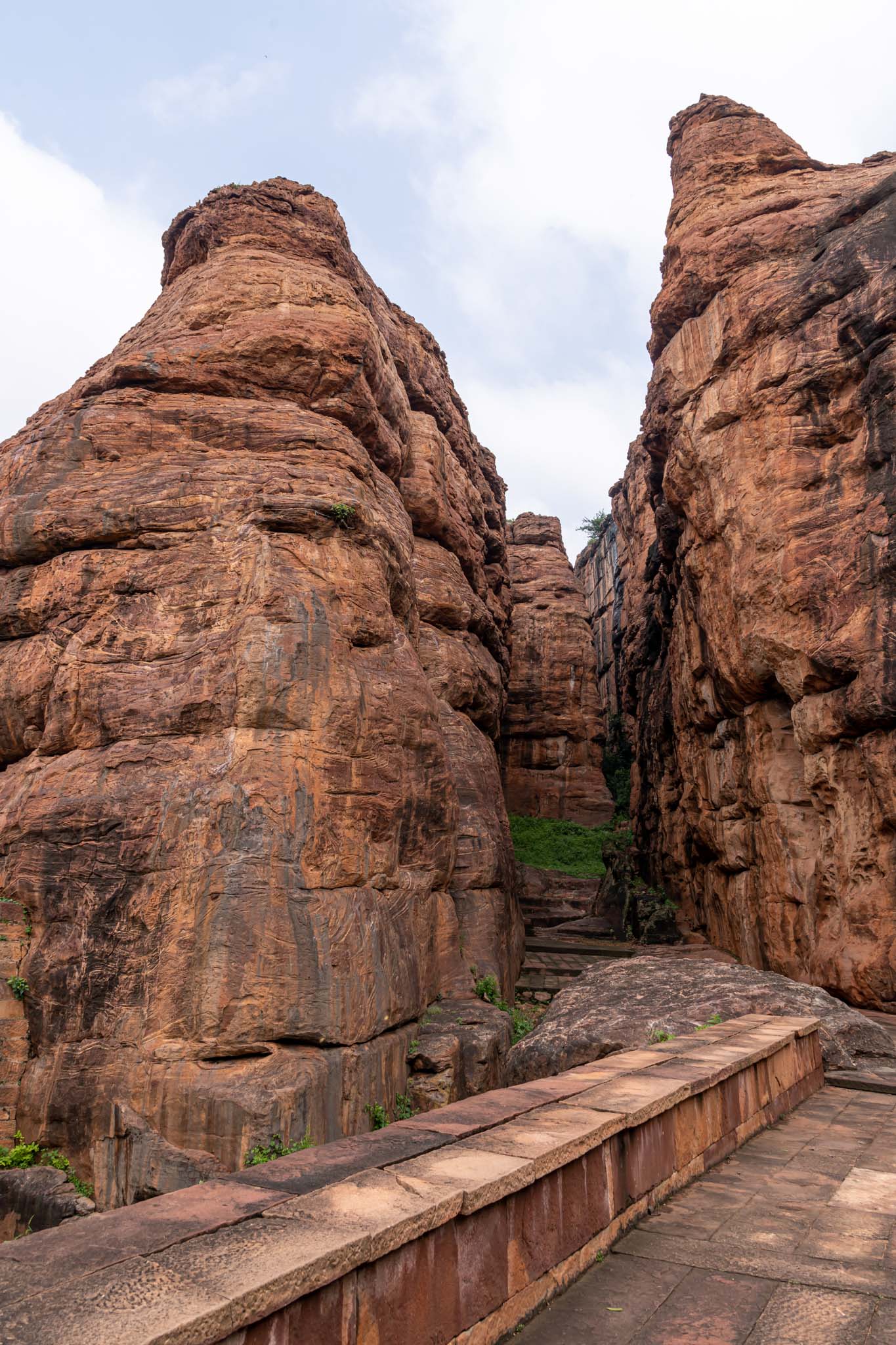
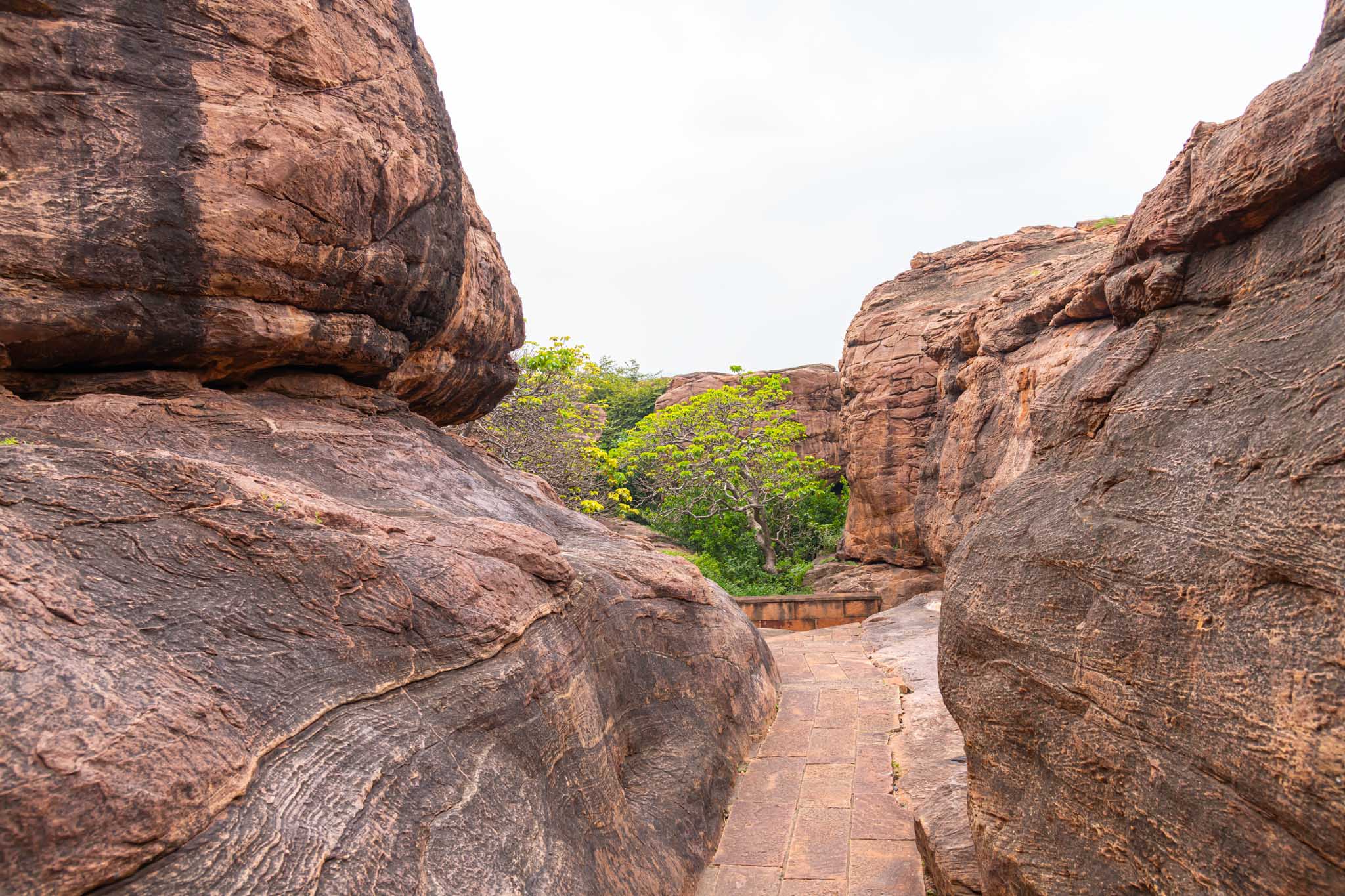
Supposedly, the name Vatapi changed to Badami over the years because of the almond colour of the sandstone rocks that you find everywhere in Badami. Truly, these rocks are of a beautiful reddish-orange colour and stunning to behold. 

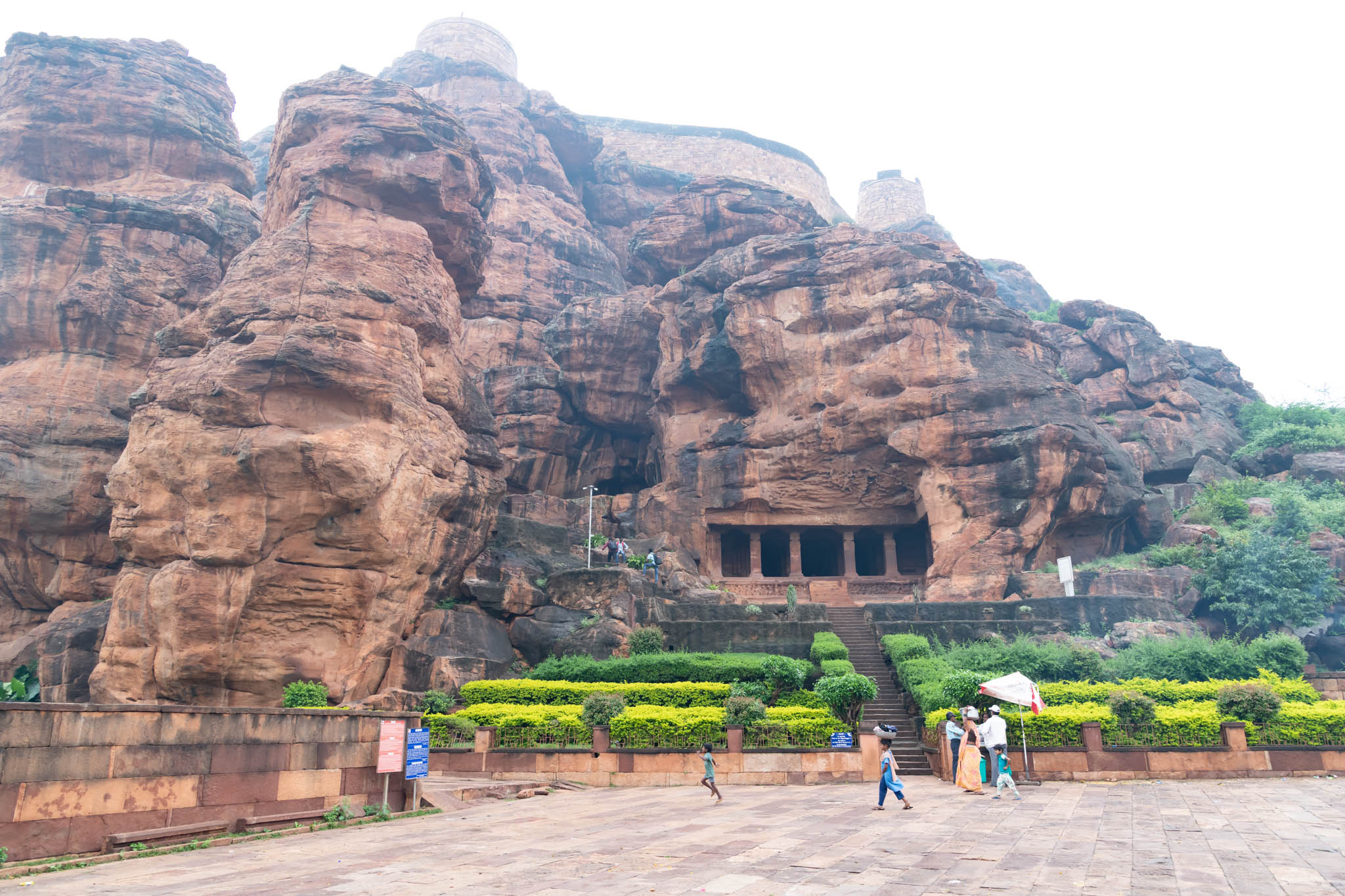
I was mostly interested in the Cave Temple and the Fort and set out early in the morning to view the Cave Temple. I knew that early in the morning, light would not be enough for any photography inside the caves but my plan was to enjoy the caves in relative peace before the crowds started coming in (especially as it was the Dussehra holidays) and come back later for photography. That proved to be a wise decision as there were very few people in the Caves at that time and the ambience was so very charming and relaxing. 

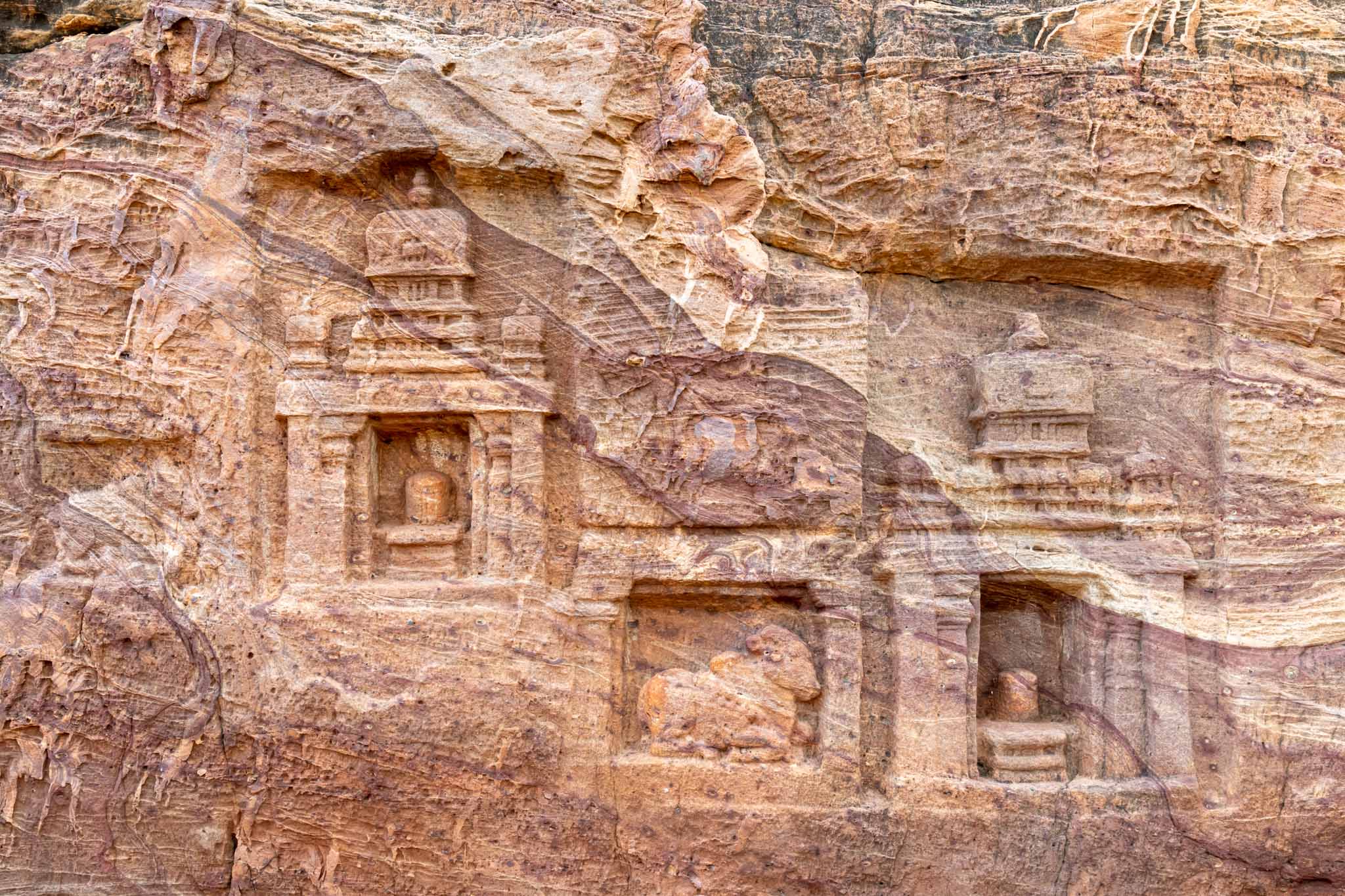
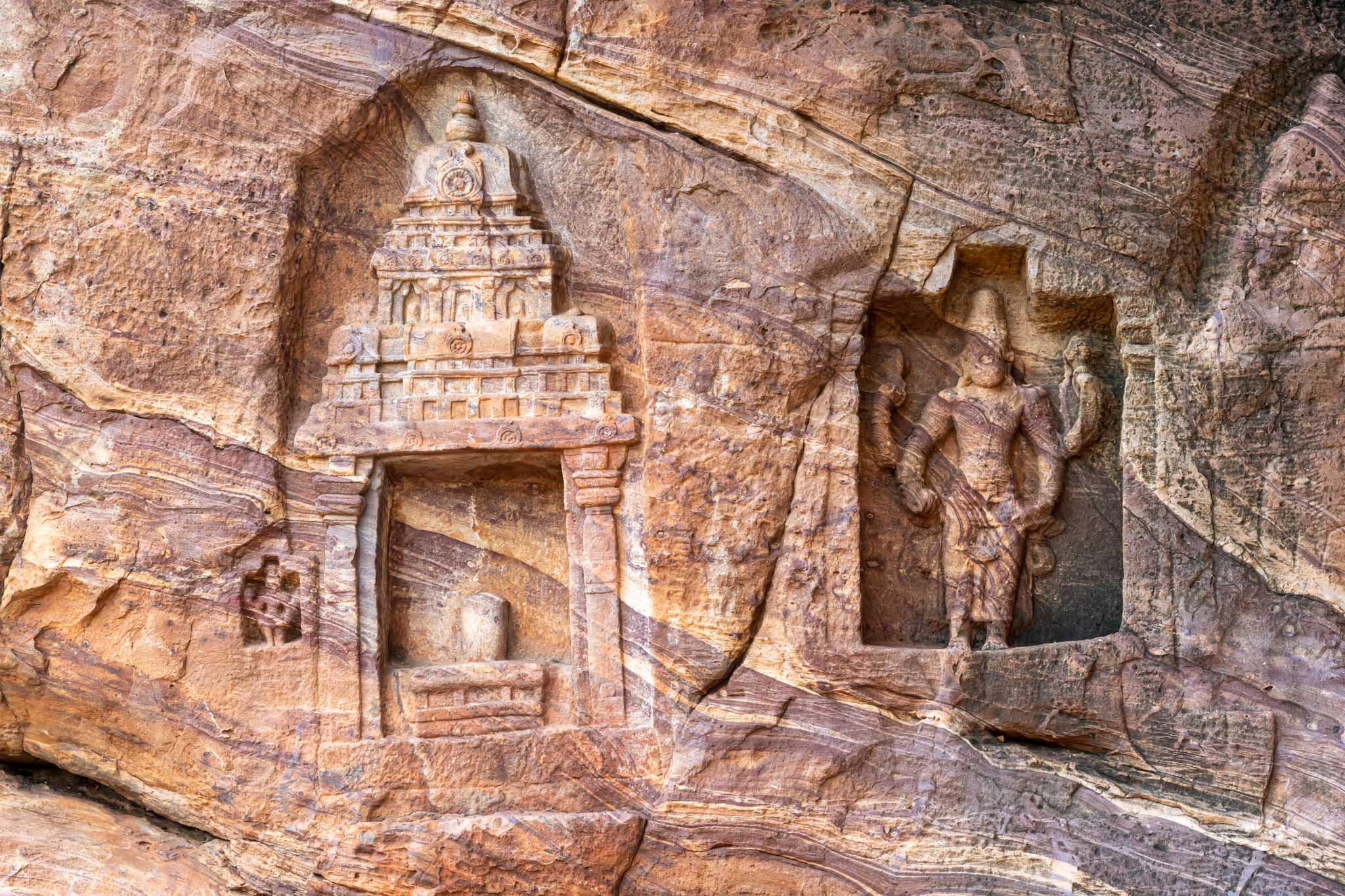
The caves have been carved out from a small hill and there are steps that lead up to the caves. There are basically four caves – the first one being dedicated to Shiva, caves two and three to Vishnu and the last one to Jain Theerthankaras. The Chalukyas were Vaishnavites but they constructed Shaiva and Jain temples as well. 

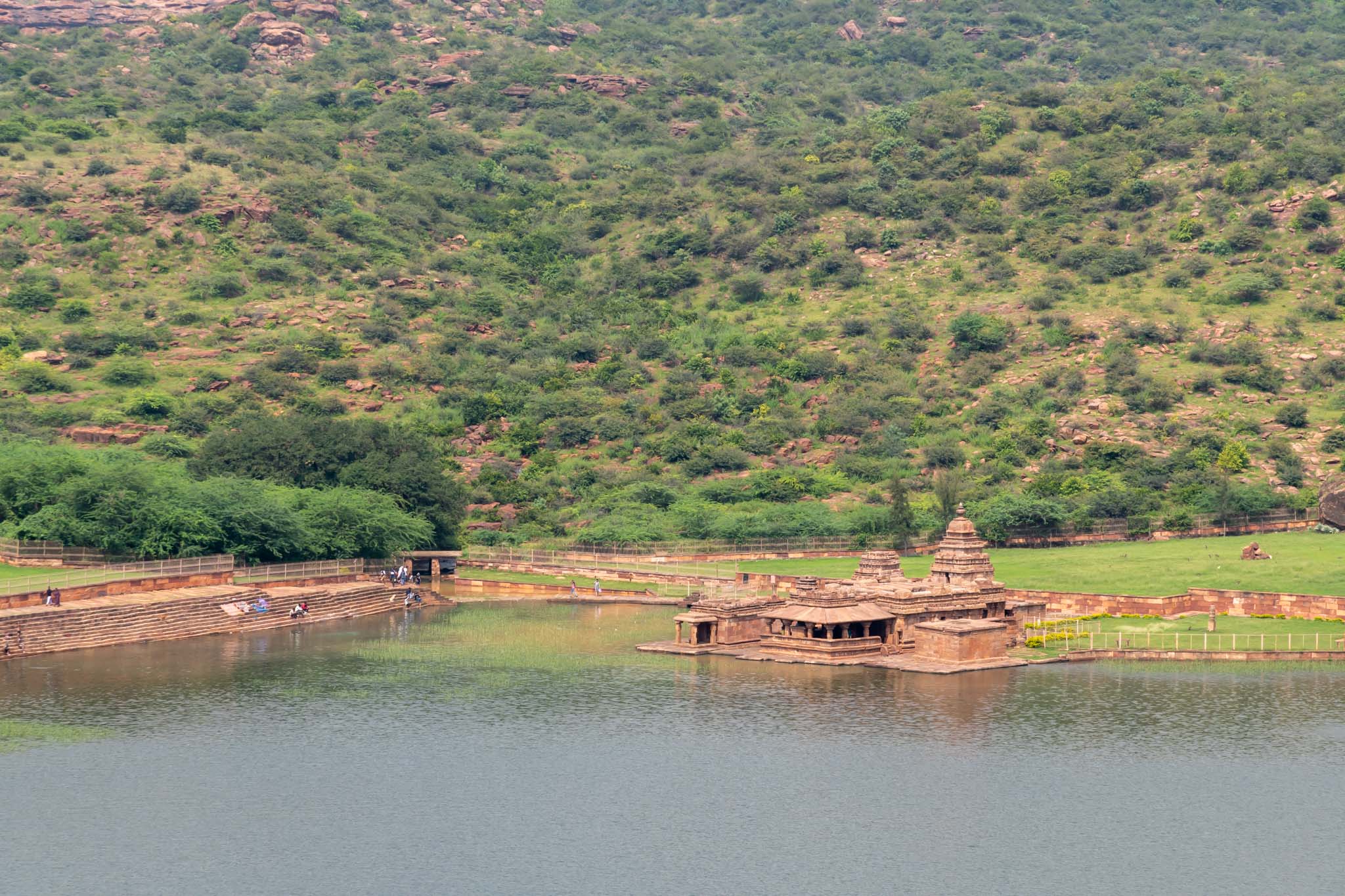
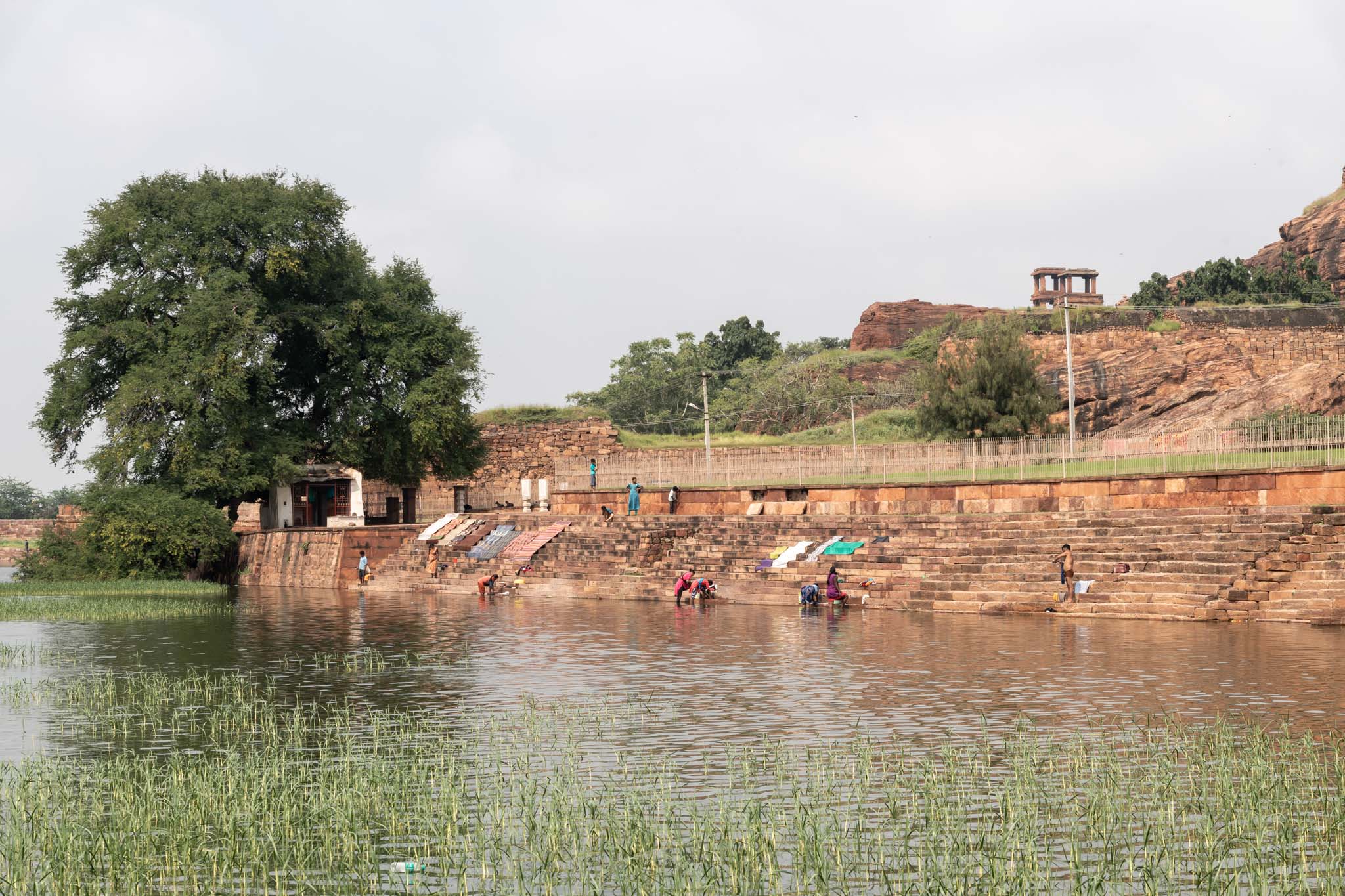
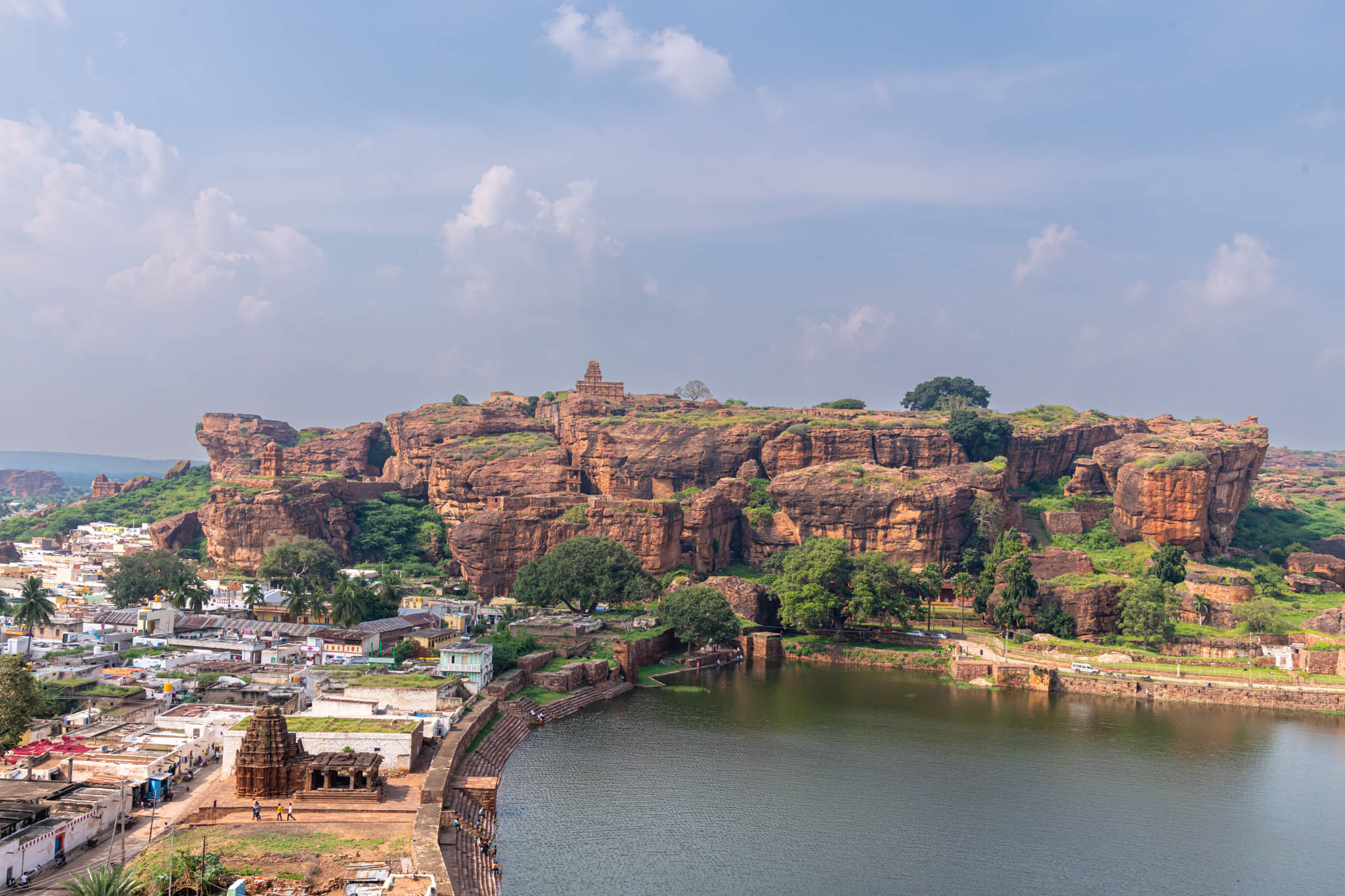
Right next to the Caves is a huge lake called Agastya Lake and this was probably the water source for the capital. The lake is named after Sage Agasthya and there is a myth that the lake was brought to Earth from the heavens by Garuda and hence the water has the power to cure illnesses and cleanse all sins. Wiki says that the lake is man-made and is from the 7th Century. The lake is used quite a lot by the citizens for their everyday life and I could see many people bathing and washing clothes. From the Caves, you get a beautiful view of the Bhoothnath Temple on the shores of the lake and the Fort on top of the hill. 

After breakfast, I set out to visit the Fort and Bhoothnath Temple. Autorickshaws ply from the Cave Temple and they take you through very narrow roads inside the village to the foot of the hill and the lake. The surrounding areas of the Cave Temple and the lake are rather dirty with pigs roaming around everywhere. However, the Archaeological Society of India is doing a good job in maintaining the monuments themselves as they are all very clean.

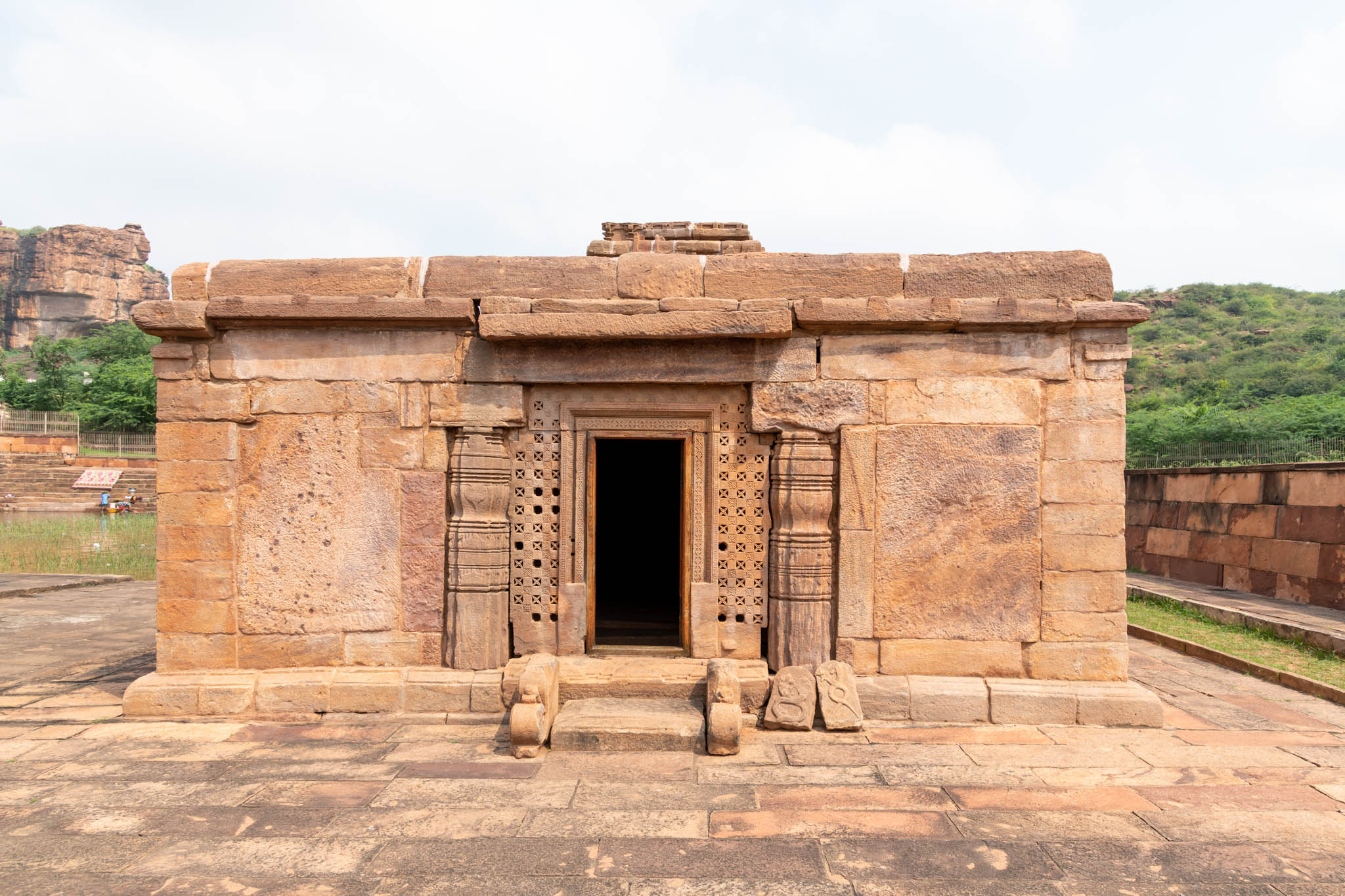
My first stop was at the Bhoothnath Temple. There are two, one small one close to the hill and another a bit far away at one side of the lake. In reality, these are temple complexes as there is more than one temple in any given location. However, none of these temples are used for worship now and are maintained by ASI. This means that these temples don’t have the normal eye sores that you see in temples that have active worship, such as bright, glitzy boards, steel bars and such. 

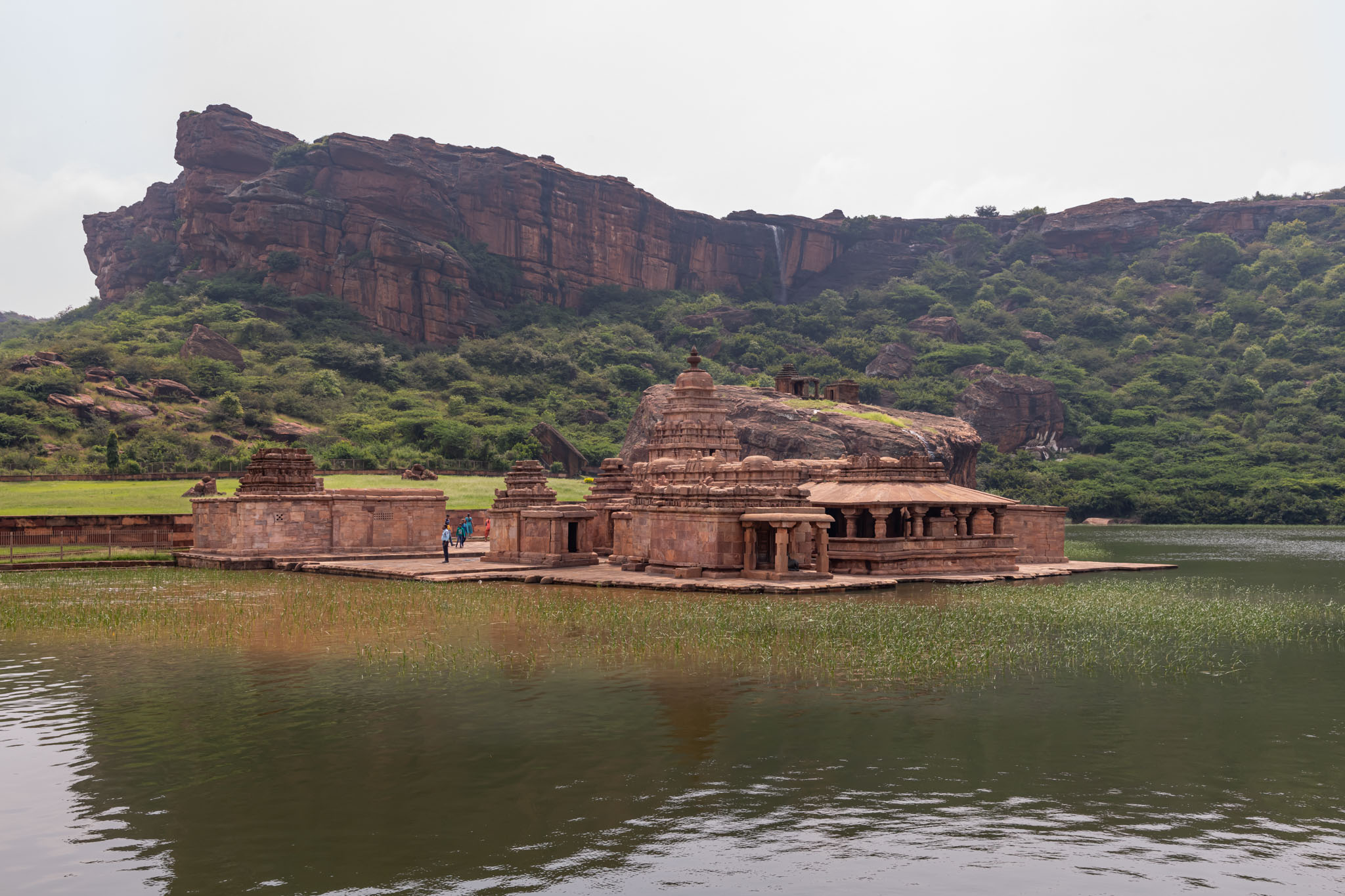
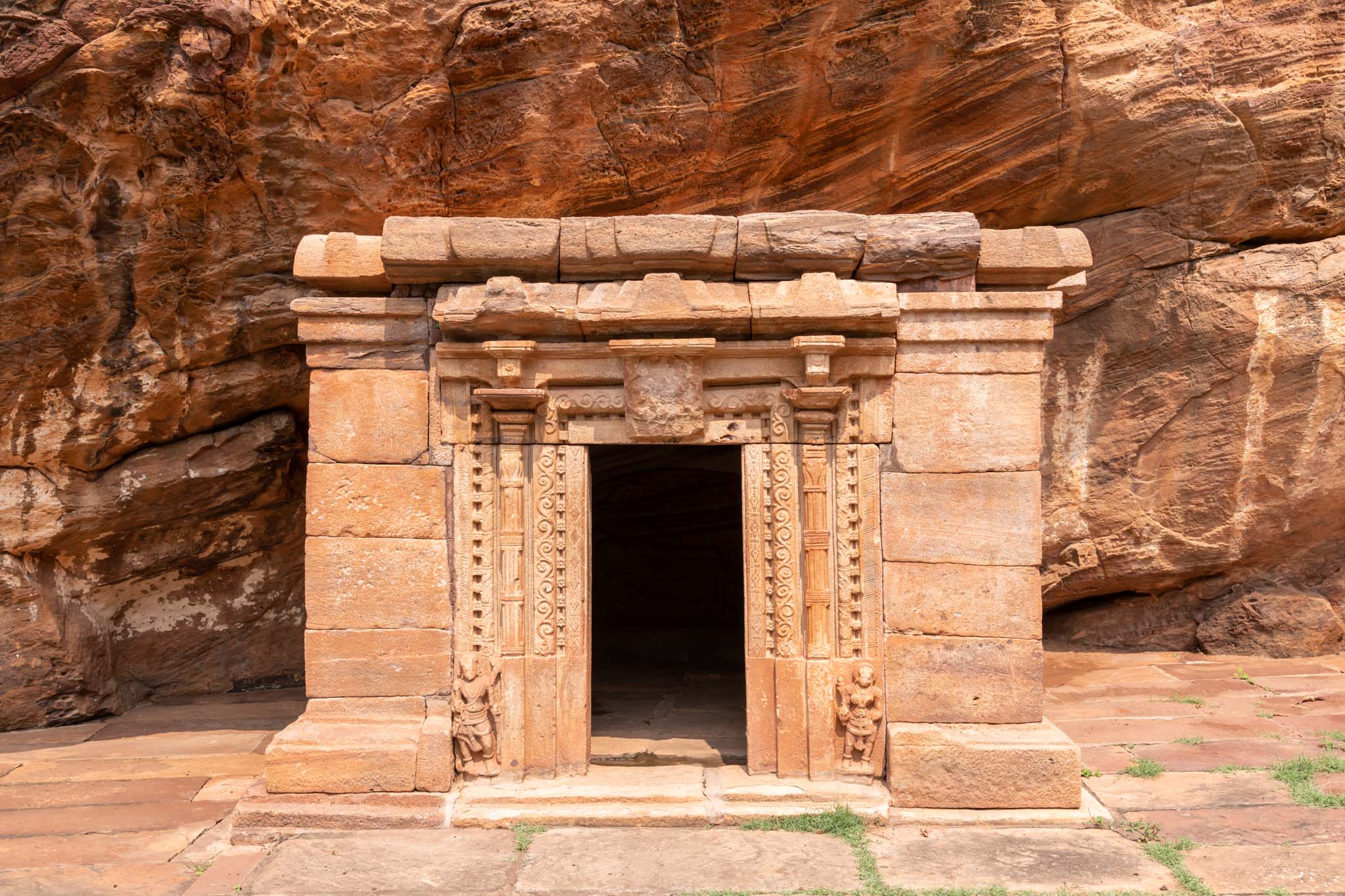
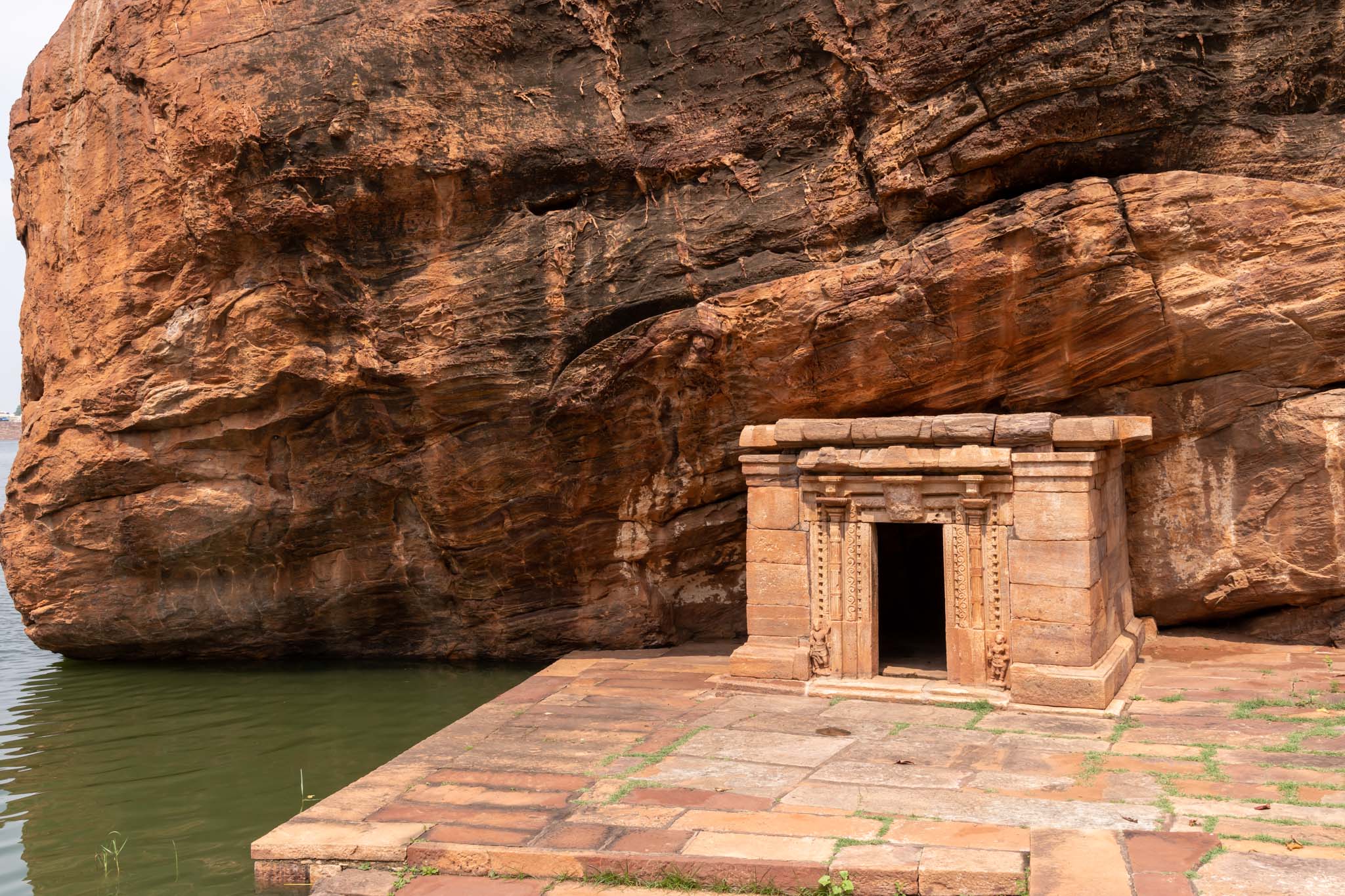
Bhoothnath Temple was quite deserted when I got there except for the guard that ASI had posted there. The temple is almost at water level and so, would definitely be flooded when water rises in the lake. There are three or four small temples in this complex and the carvings on the walls are intricate and amazing. There are some carvings done on the surrounding rocks as well. The colour of the rocks add to the beauty of the temples and with the designs used, they are just mesmerising. 

Behind the temple, the rocks rise up and there is a nice waterfall flowing down from the top. I am sure it would look majestic when there is enough water.

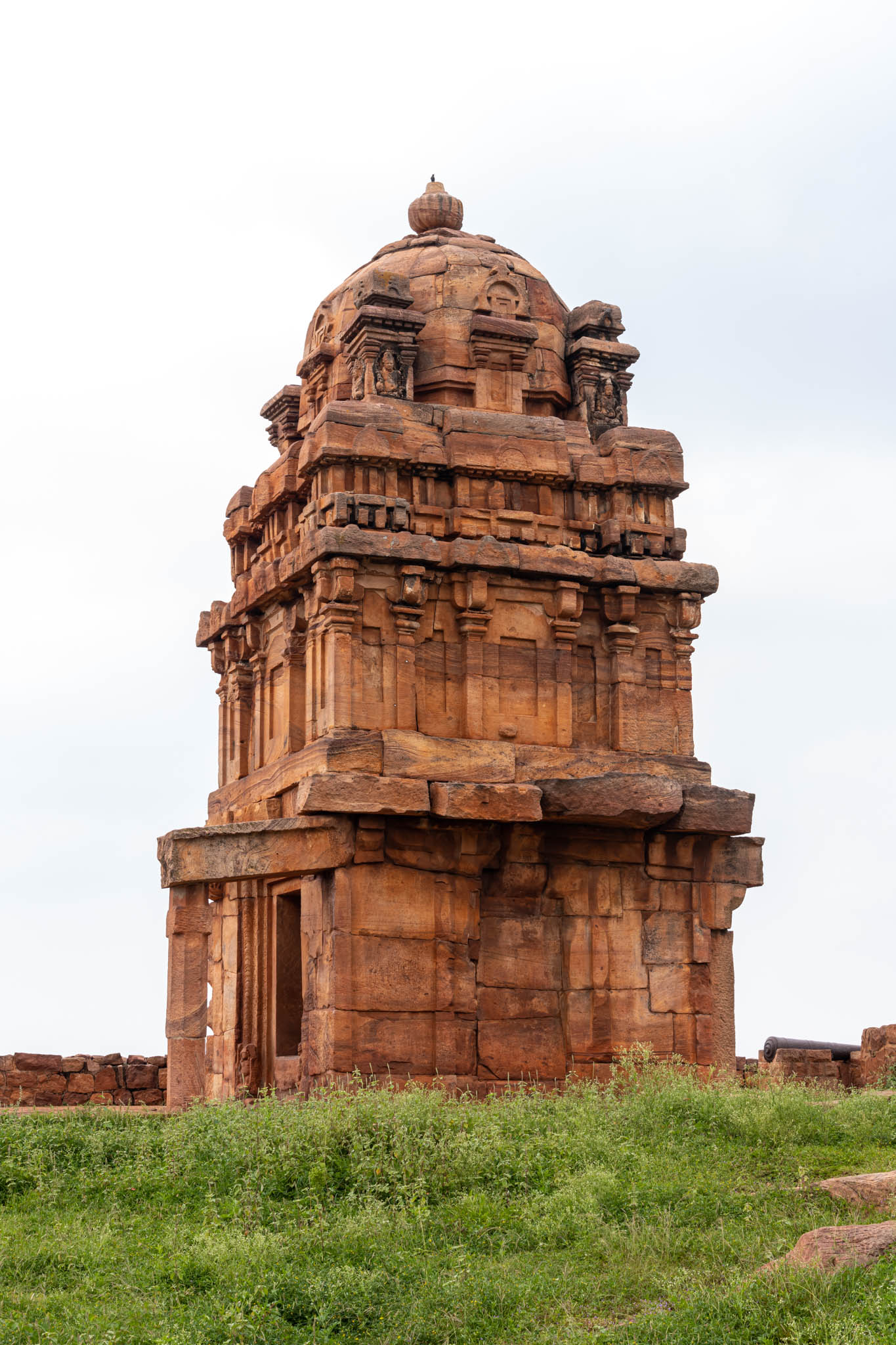
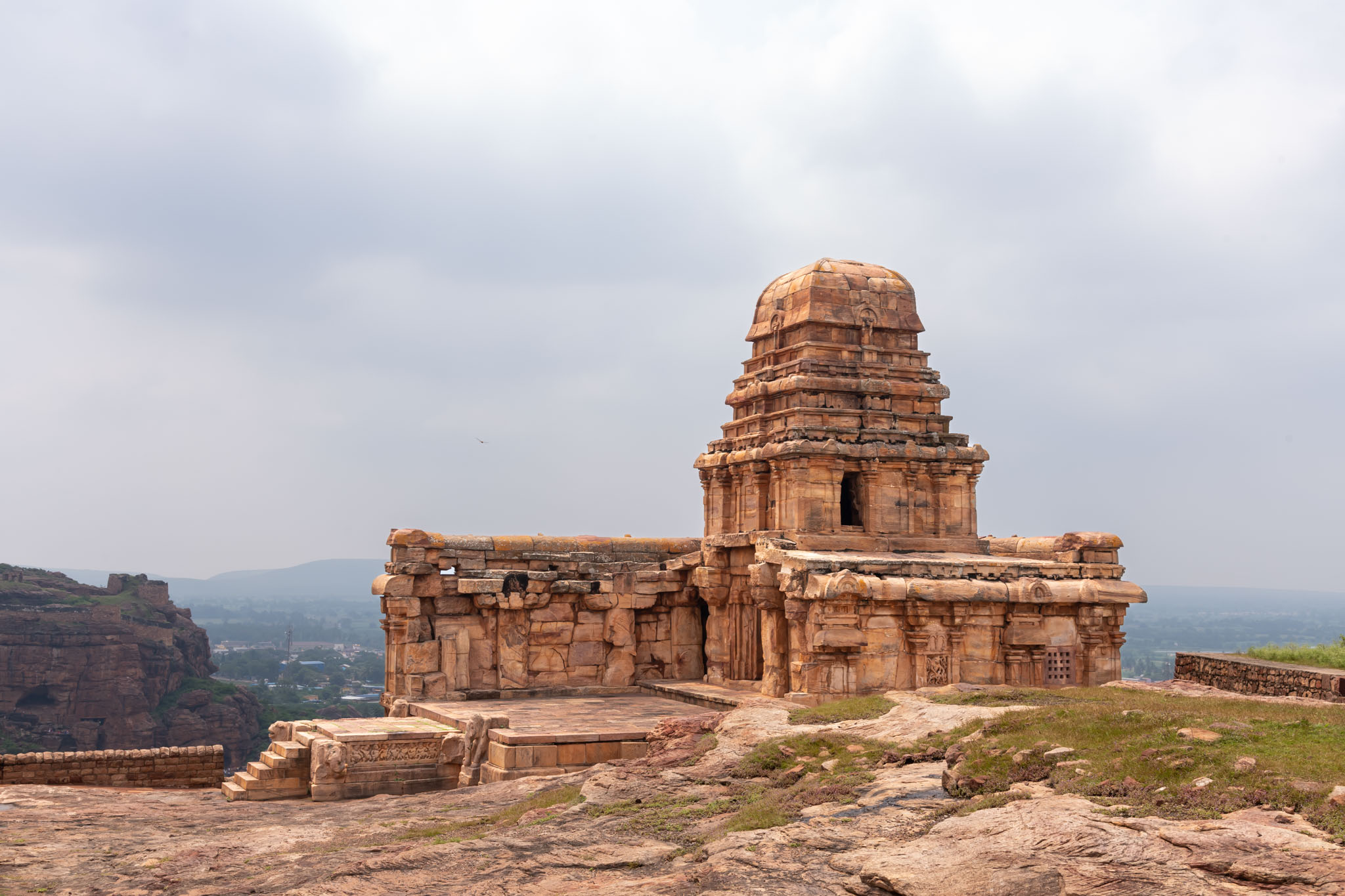
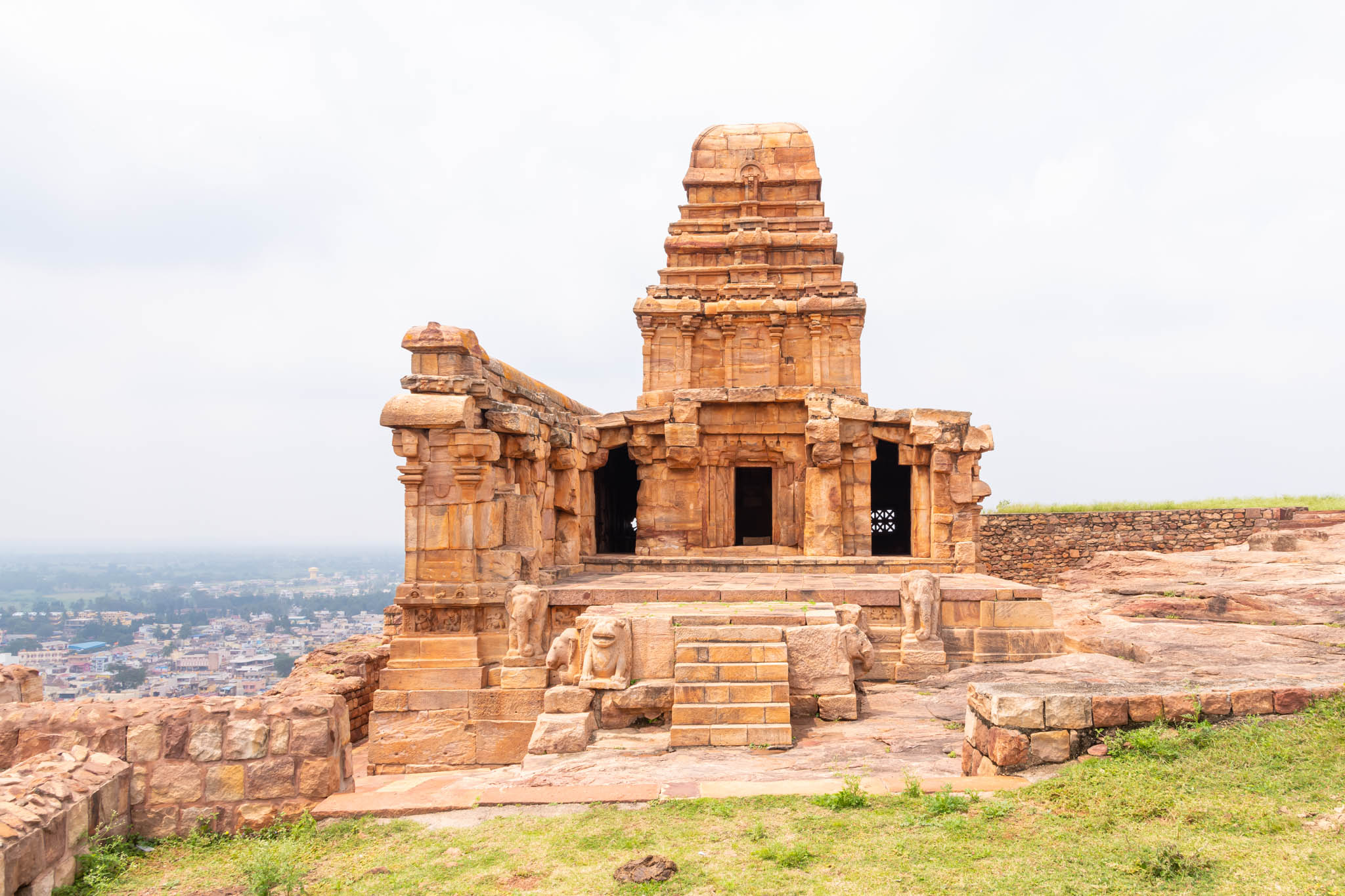
Next stop was the Fort. This was the abode of the Chalukyas and was built in 542 AD. It was destroyed by the Pallavas when they defeated the Chalukyas in battle. When Badami came under the rule of Tipu Sultan, he rebuilt some of the fortifications. You can walk up the hill using a paved pathway that has many steps. It is not a difficult climb at all and as I mentioned earlier, ASI has maintained it quite well. There are not many buildings left standing and the two important ones are two temples – Lower Shivalaya and Upper Shivalaya. The idol of Vatapi Ganapati was originally located in Lower Shivalaya before the Pallavas carried it away. 

Lower Shivalaya

Upper Shivalaya

Granary on top of the hill

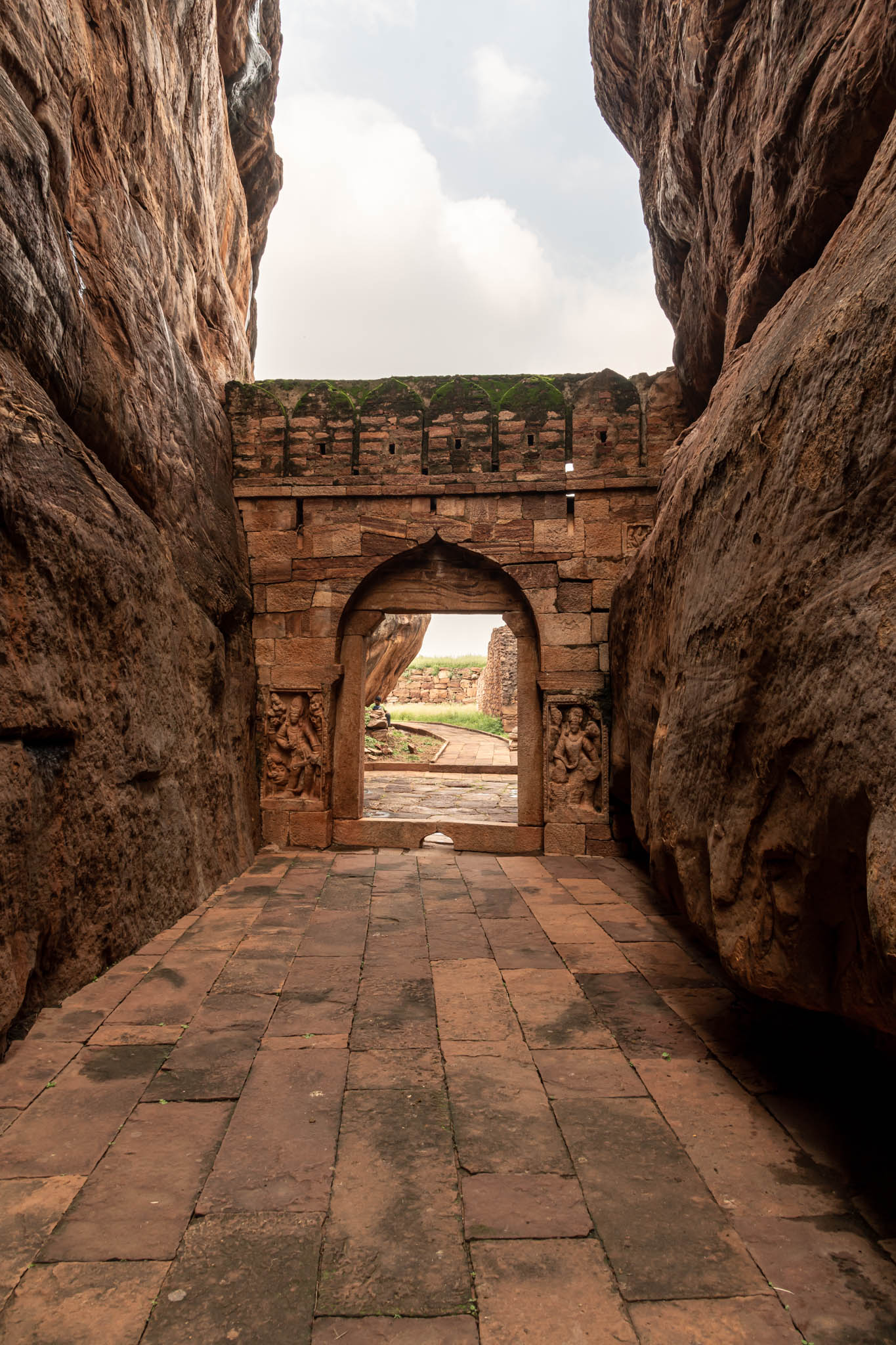
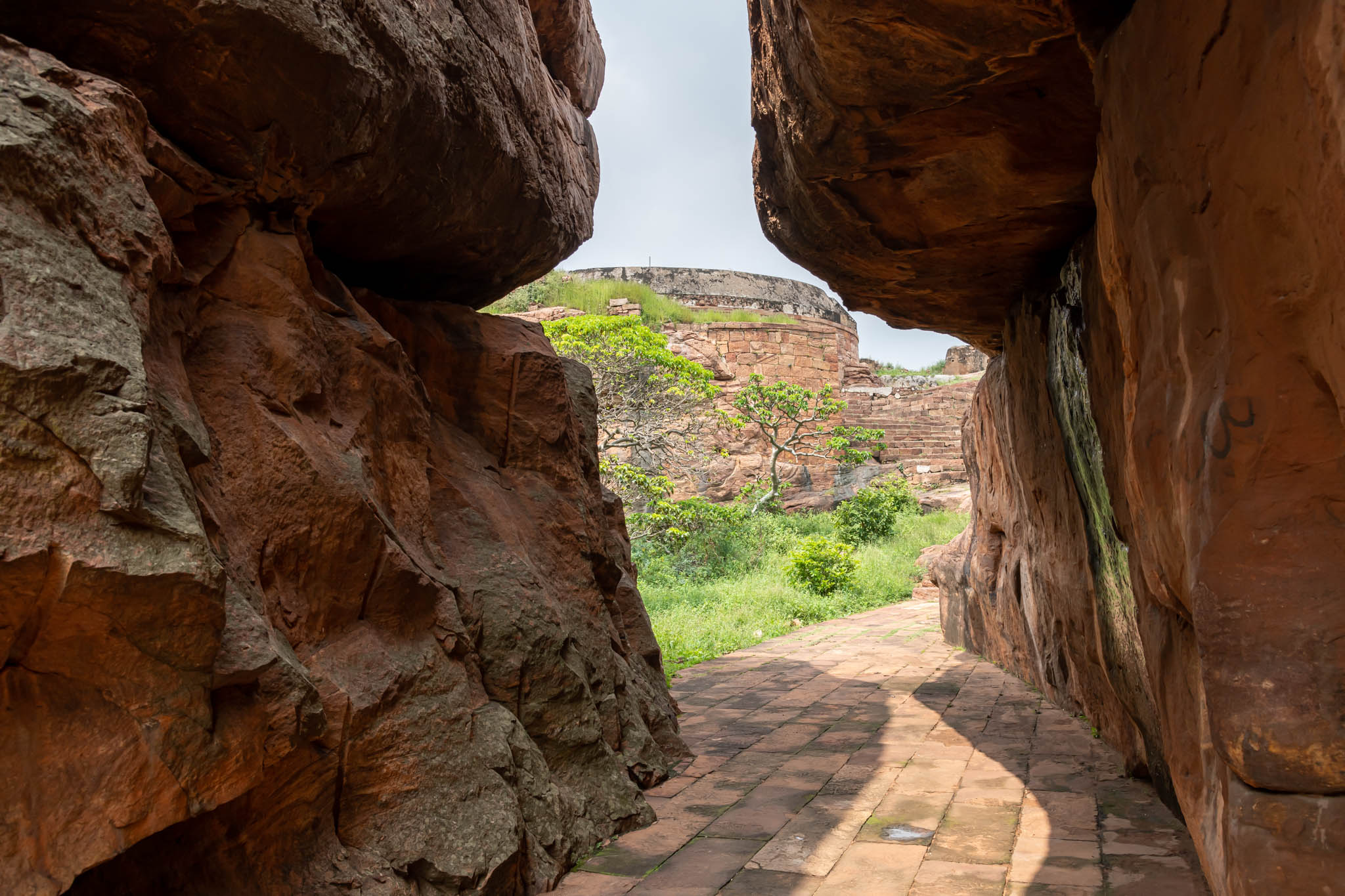
There are some doorways along the path and it is very evident that the fort could be defended very easily by a handful of soldiers, given the structure of the pathway. The time eroded rocks on both sides add significantly to the experience. 

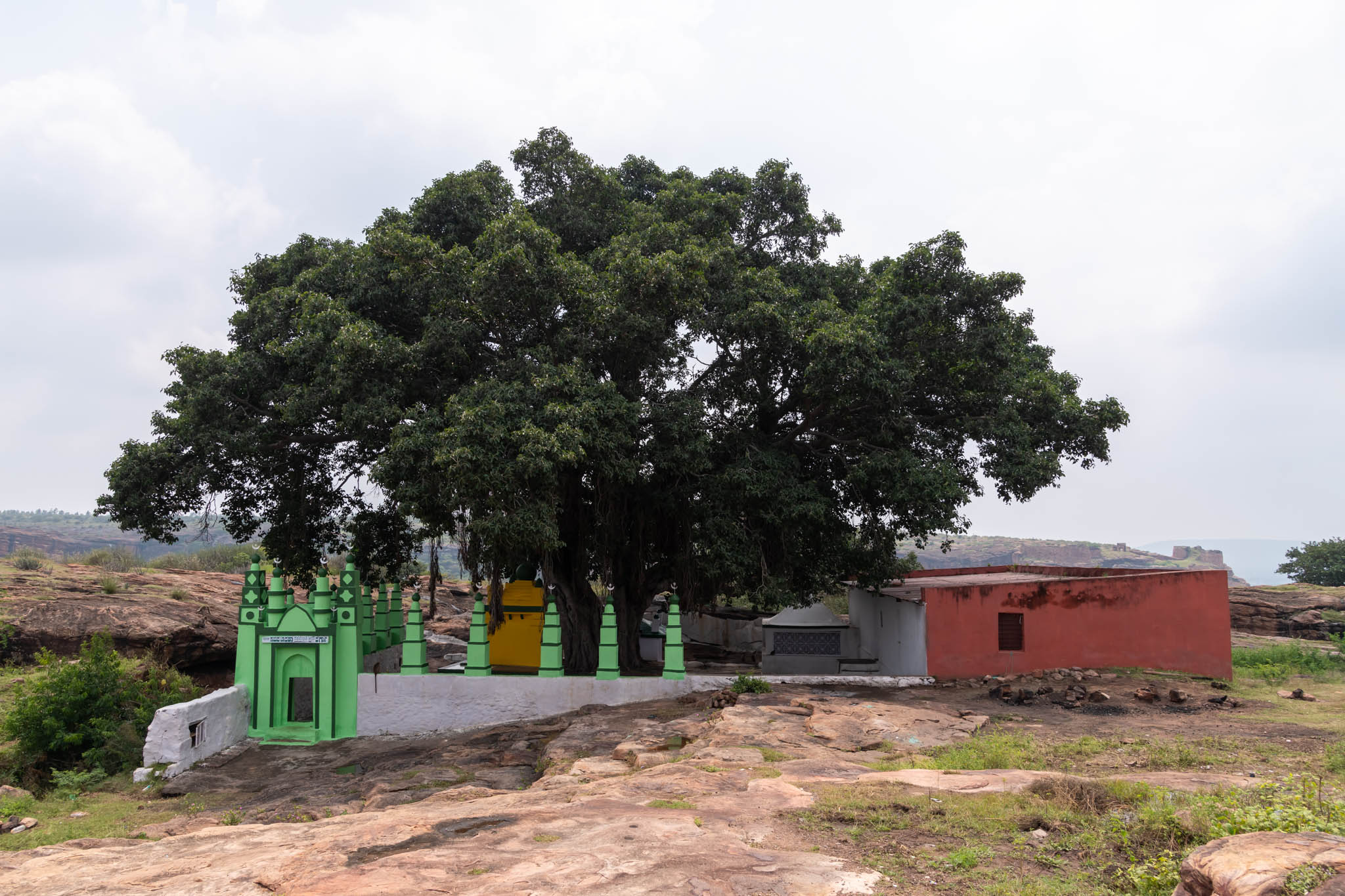
On the top there is a round structure that had cannons installed for defence. Given the style of the architecture, I guess this must have been constructed during the time of Tipu Sultan. At the top of the hill, very near to Upper Shivalaya, there is a Durgah that has the tomb of Sayyid Hazrat Badshah (I couldn’t find out who this person was). 

By this time, it was past noon and I headed back to the Cave Temple. After the fall of the Chalukyas, Badami came under the Deccan Sultanate and later Tipu Sultan and there are some evidences of Muslim rule, such as the Durgah mentioned above. Yet another is the charming Markaj Jumma mosque, built by Tipu Sultan, that is right next to the Cave Temple and hosts the tomb of Abdul Malik Aziz, a governor of Badami.

As is often the case with Archaeological sites in India, one will not be able to understand any detail about the caves if one doesn’t engage a guide. Sure, there are some small boards put up outside but those don’t have enough information and are often quite confusing. This is a real pity as most people do not or cannot engage a guide and so miss out many of the wonders and these sites are often so rich in history and culture. It would be great if the ASI can introduce a relatively cheap method like audio guides so that people can immerse themselves into the great experience that these amazing sites can provide. Since I knew that a guide is more or less mandatory if one were to try and get some understanding about the caves, I engaged one. Of course, these guides do also add some “interesting” bits from their side as well and I have often heard the same sight being explained in two different ways by two different guides; all the more reason for audio guides!

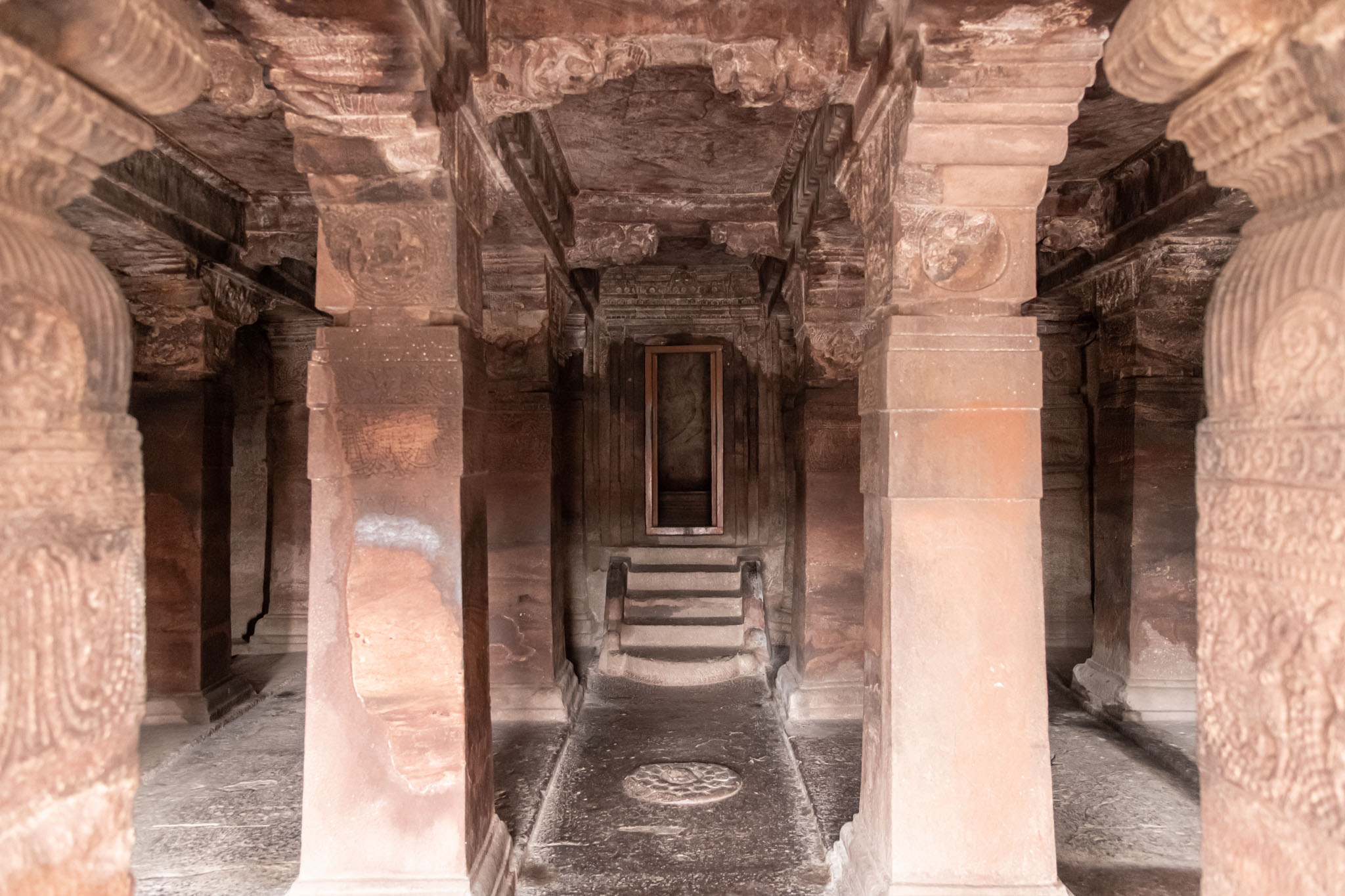
All the four caves have been carved out of rock and there are no joints anywhere in any of the pillars or statues. In other words, nothing has been worked upon outside and then brought here and fixed. It is assumed that each cave might have taken 12-15 years to finish. Data is available only about the third cave, which is the most ornate, as there is an inscription on one of the pillars in it. This cave took 12 years to finish, from AD 576 to 588. The first cave that was excavated was Cave-1 and then Cave-2 and so on. 

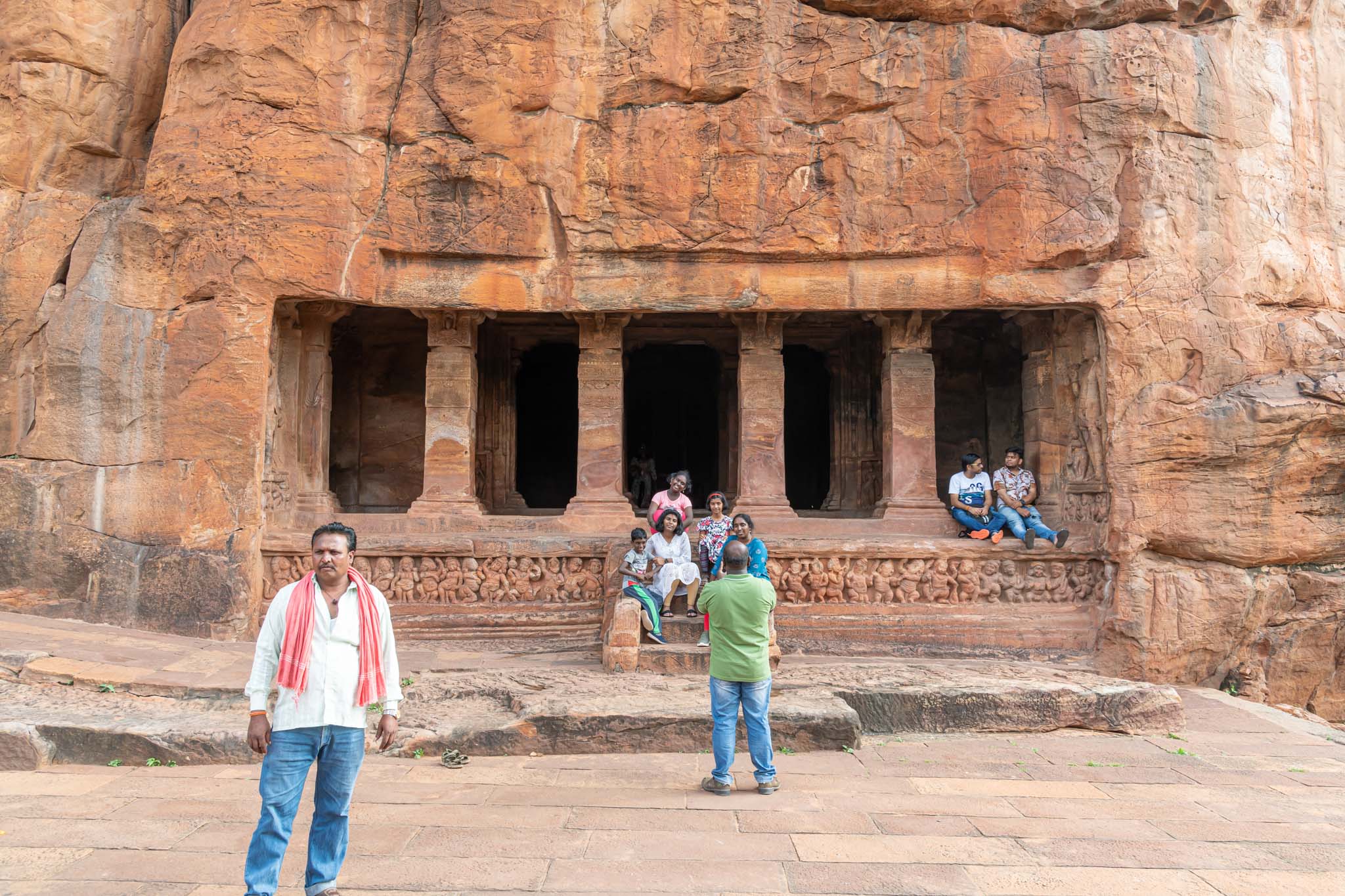
By the time I got back, there were a lot of people visiting the caves, as can be seen from the photo below, which shows the façade of the first cave. This cave is dedicated to Lord Shiva. 

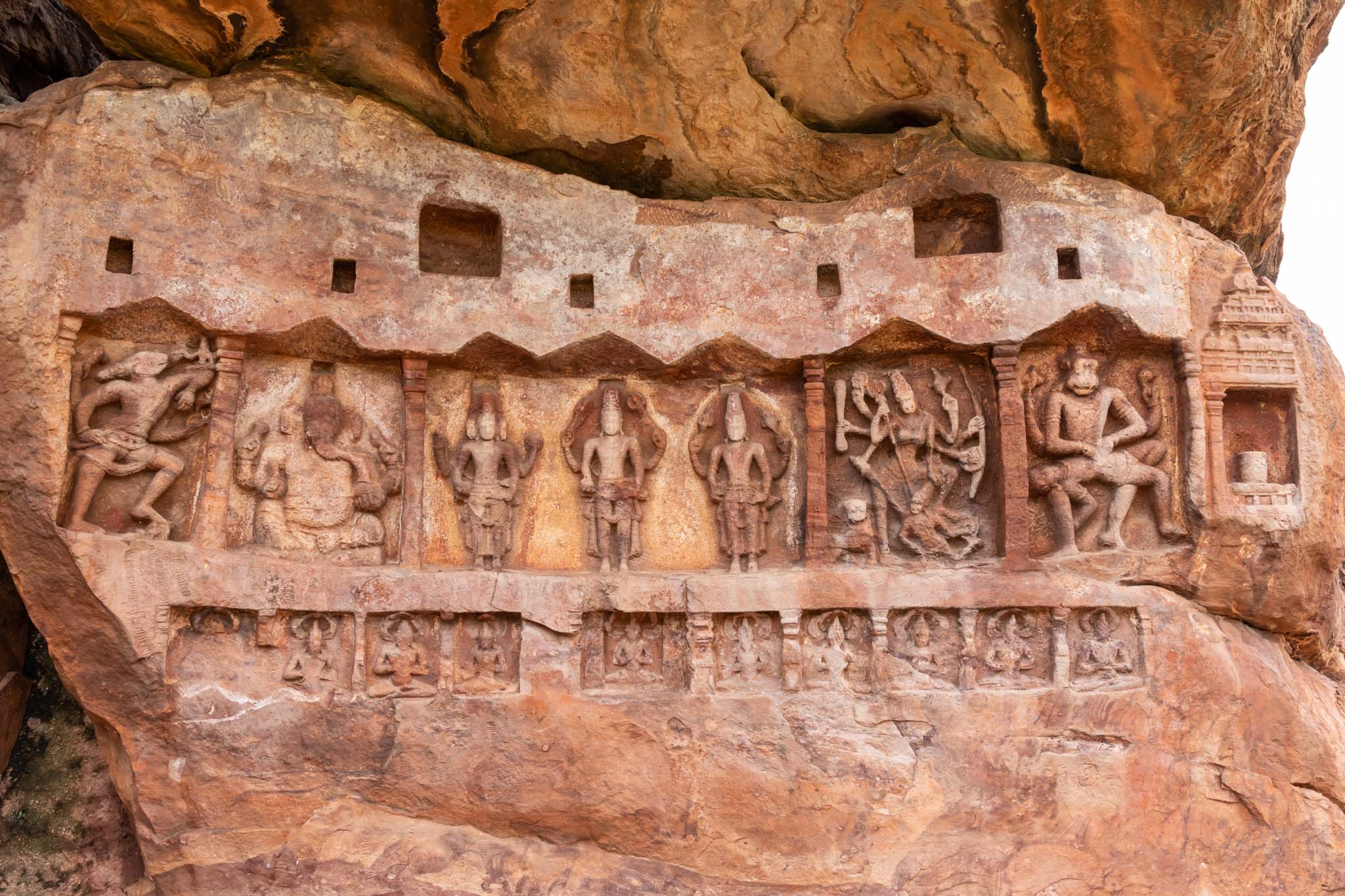
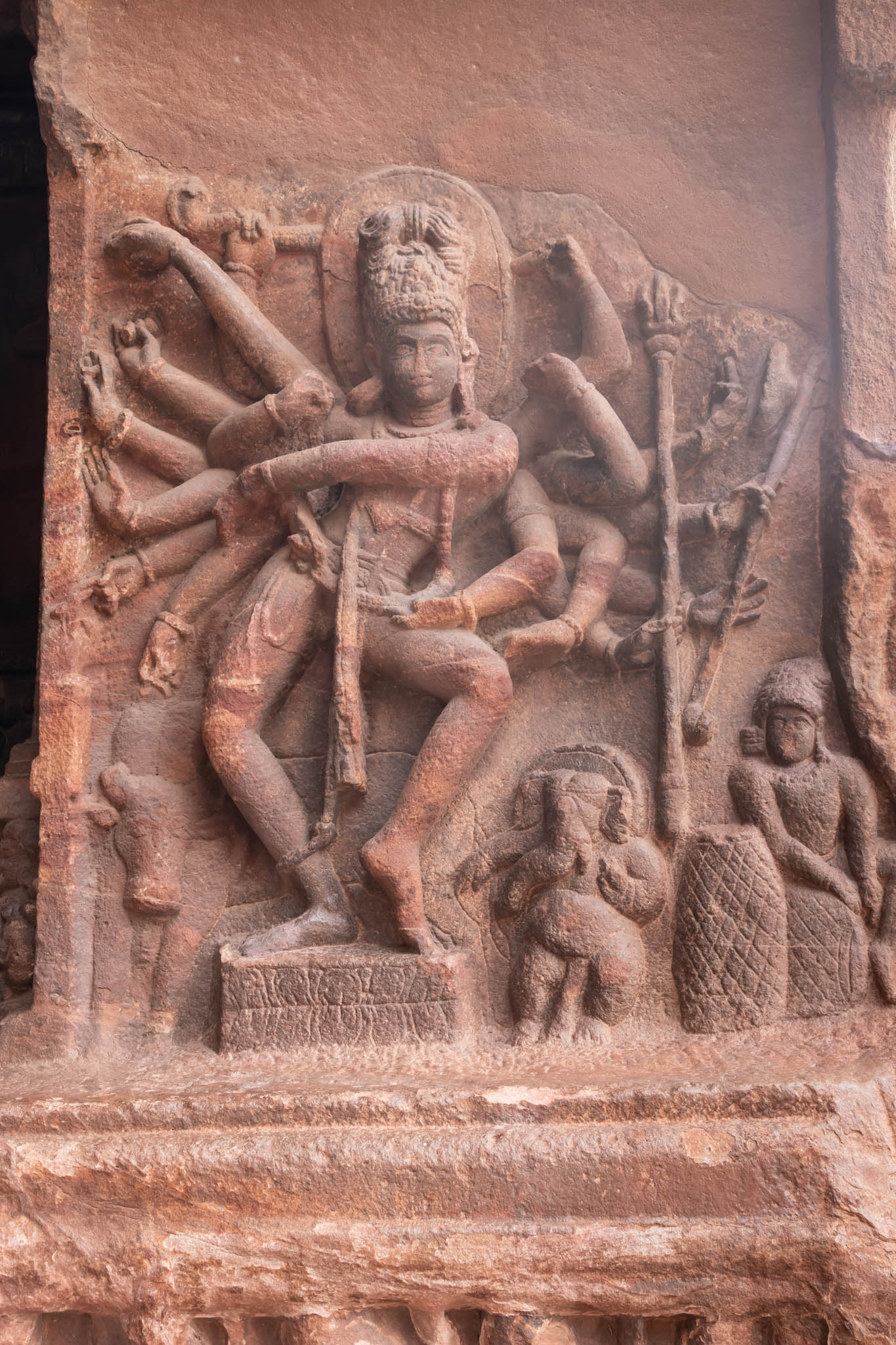
Dancing Shiva statue with eighteen arms with Ganesha and Nandi shown nearby

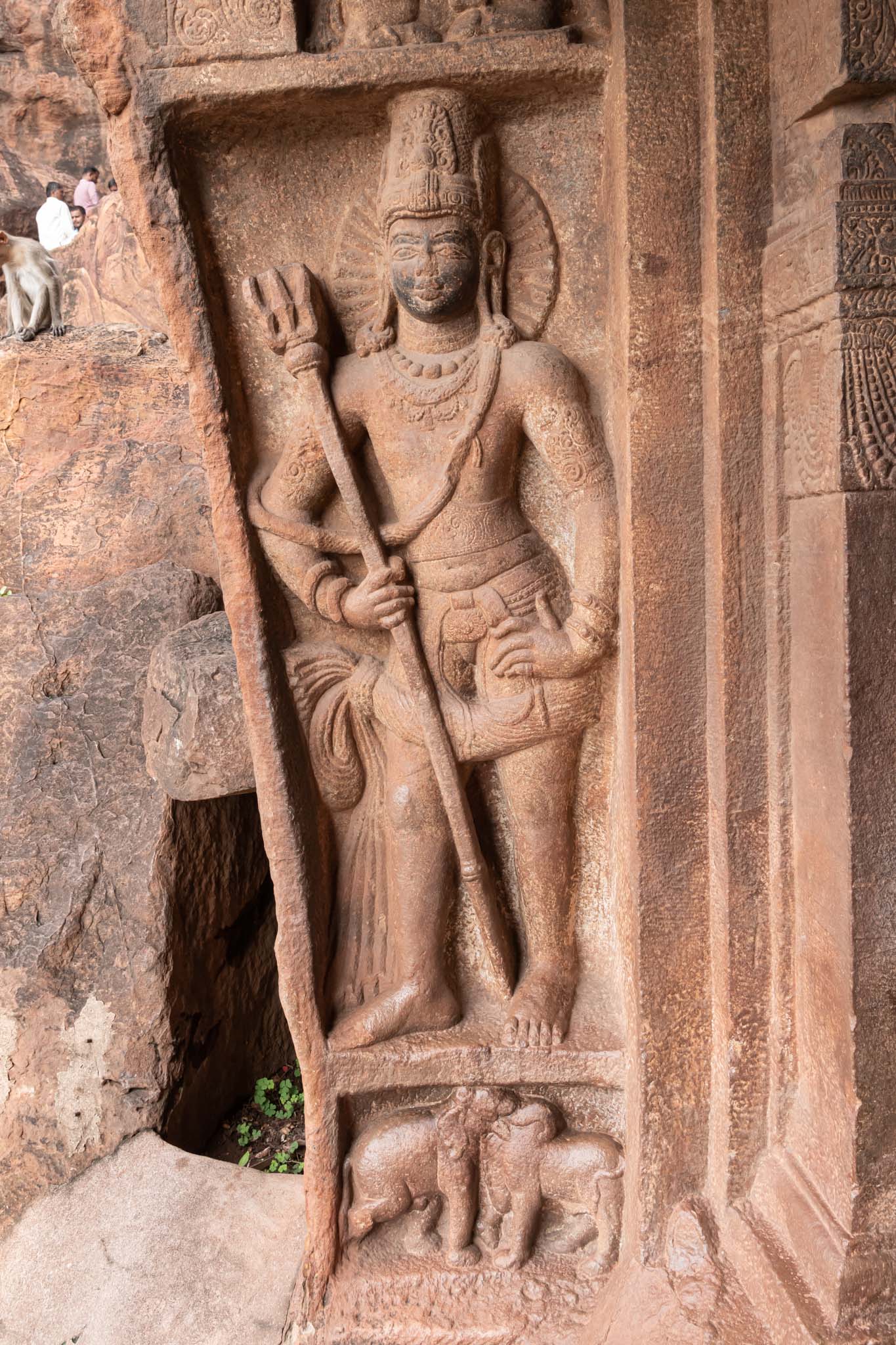
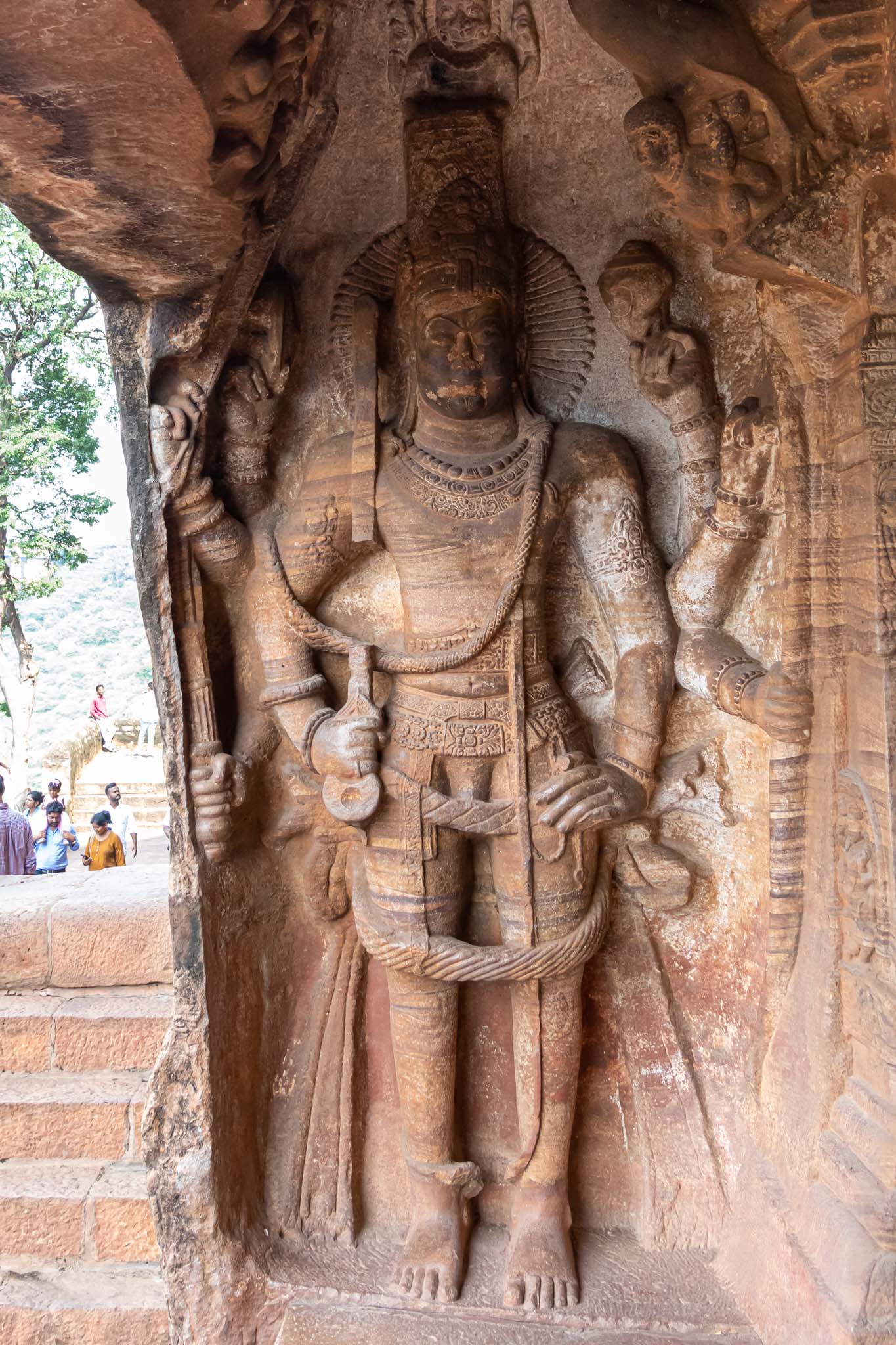
Dwarapalaka

Harihara – Vishnu and Shiva coming together, with symbols of Shiva shown on the right side of the statue (such as Nandi) and those of Vishnu on the left side

Mahishasuramarddini

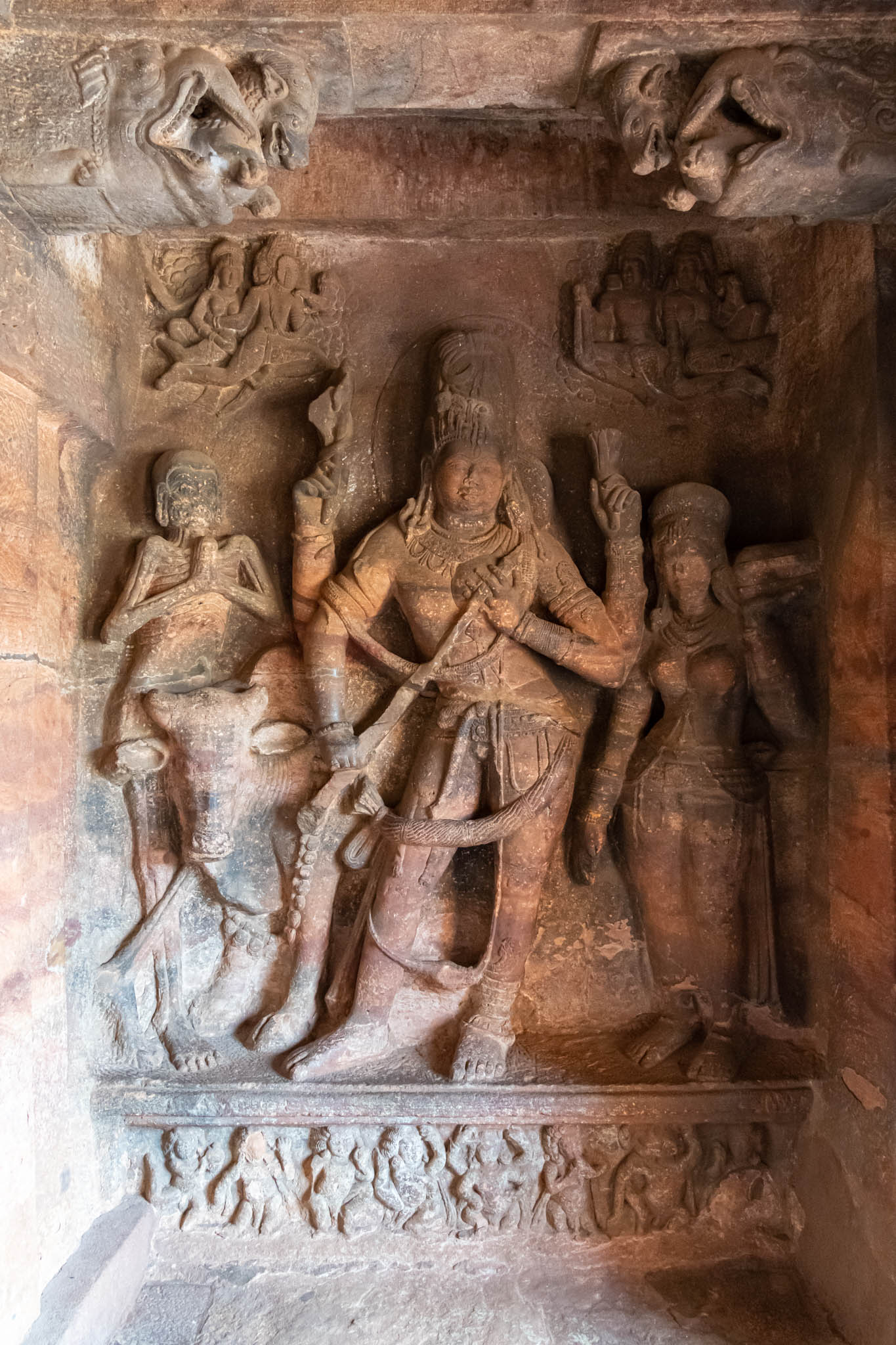
Statue of Ardhanaareeshwara with Sage Bhrigu (the skeleton like figure) and Nandi shown on the side of Shiva and a female consort on the side of Parvati. The guide told me that Bhrigu had become skeleton like after he was cursed by Parvati but that was not how I remembered the story and internet too confirmed that it was Lakshmi who cursed Bhrigu to be doomed to poverty. According to the puranas, Bhrigu had set out to find who among the three gods – Brahma, Shiva and Vishnu – was the greatest and when he arrived at Kailasa, Nandi did not let him enter as Shiva was busy making love to Parvati at that time. The enraged sage cursed Shiva that he would only be worshipped as a Lingam (phallus) along with a Yoni to depict Parvati. Perhaps, it is this story that the sculptor wanted to convey through this work. This story about Bhrigu is quite interesting and once again points to the richness of the Puranas which often did not follow any hierarchy with Sages being superior to Gods themselves, at times, while the Sages spent their lives worshipping those Gods. They provide so many such sly entry points to paths that lead to the questions on what is supposedly the main theme.

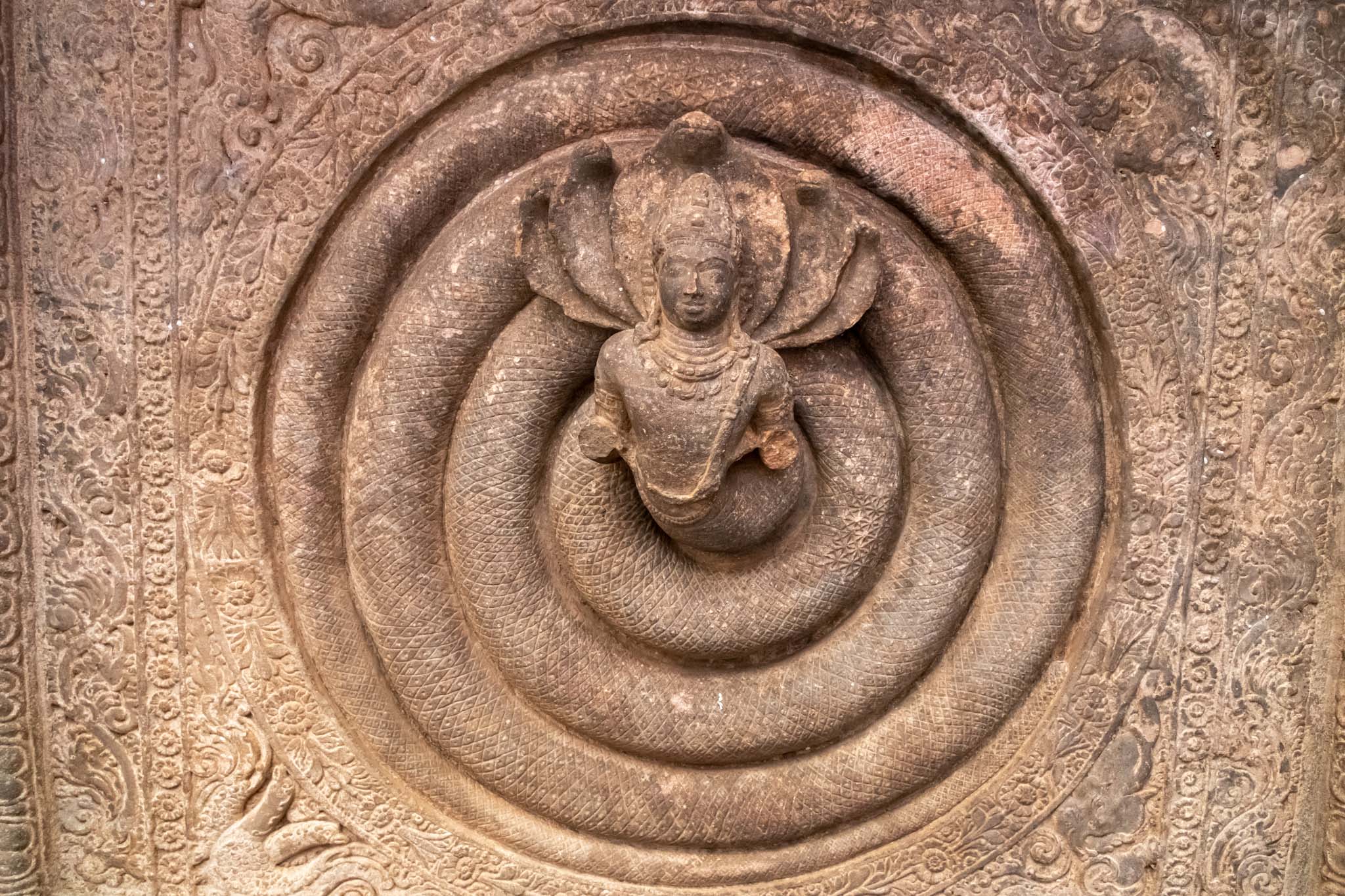
Adisesha shown with five heads in the ceiling of Cave-1

This Nandi has been brought from outside and is the only structure in the caves that has not been carved out of the rock and is free standing

Shivalinga in the sanctum sanctorum of Cave-1; however there is no worship in the temple

A climb up a small set of steps takes one to Cave-2, which is dedicated to Lord Vishnu.

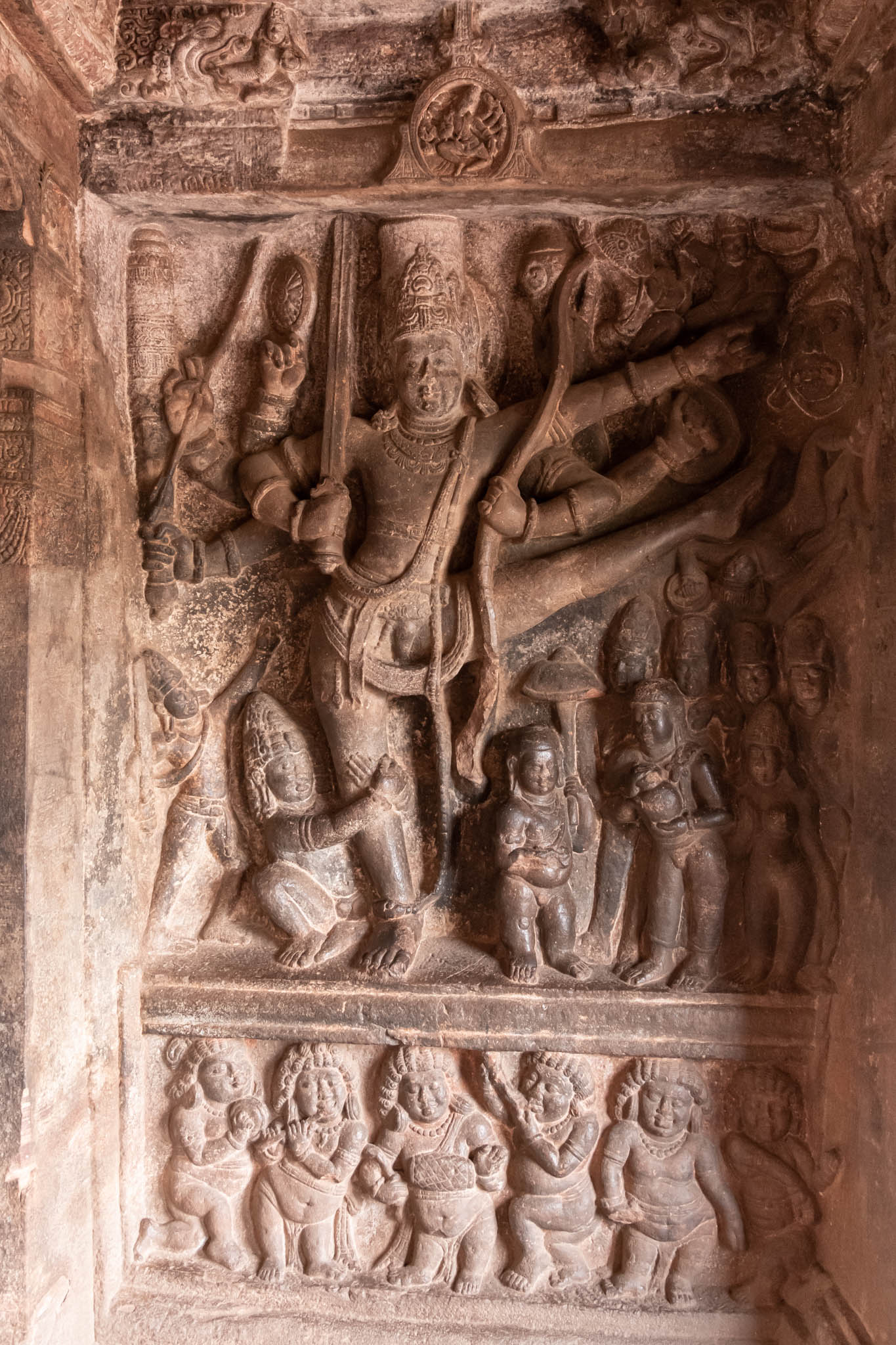
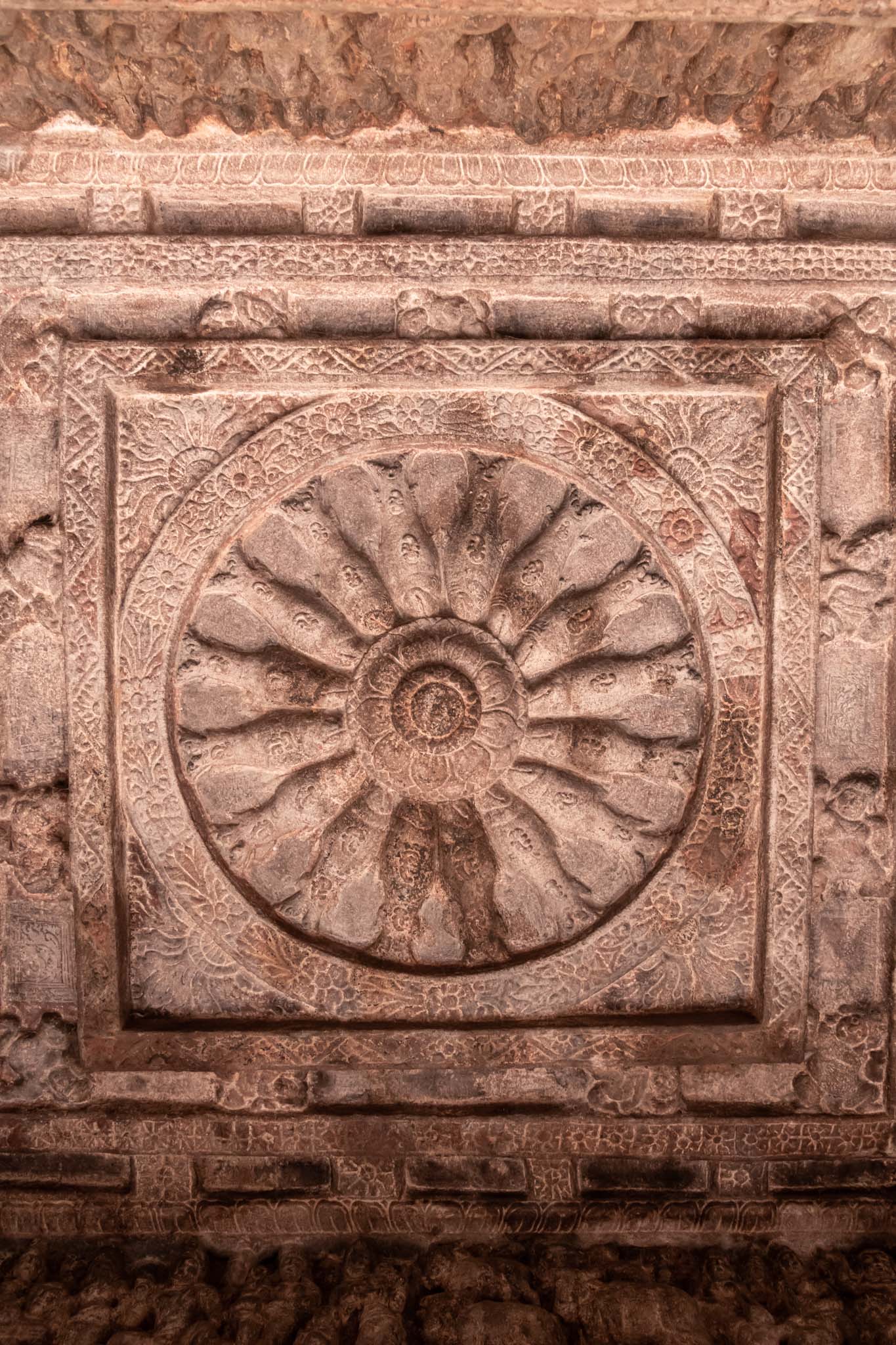
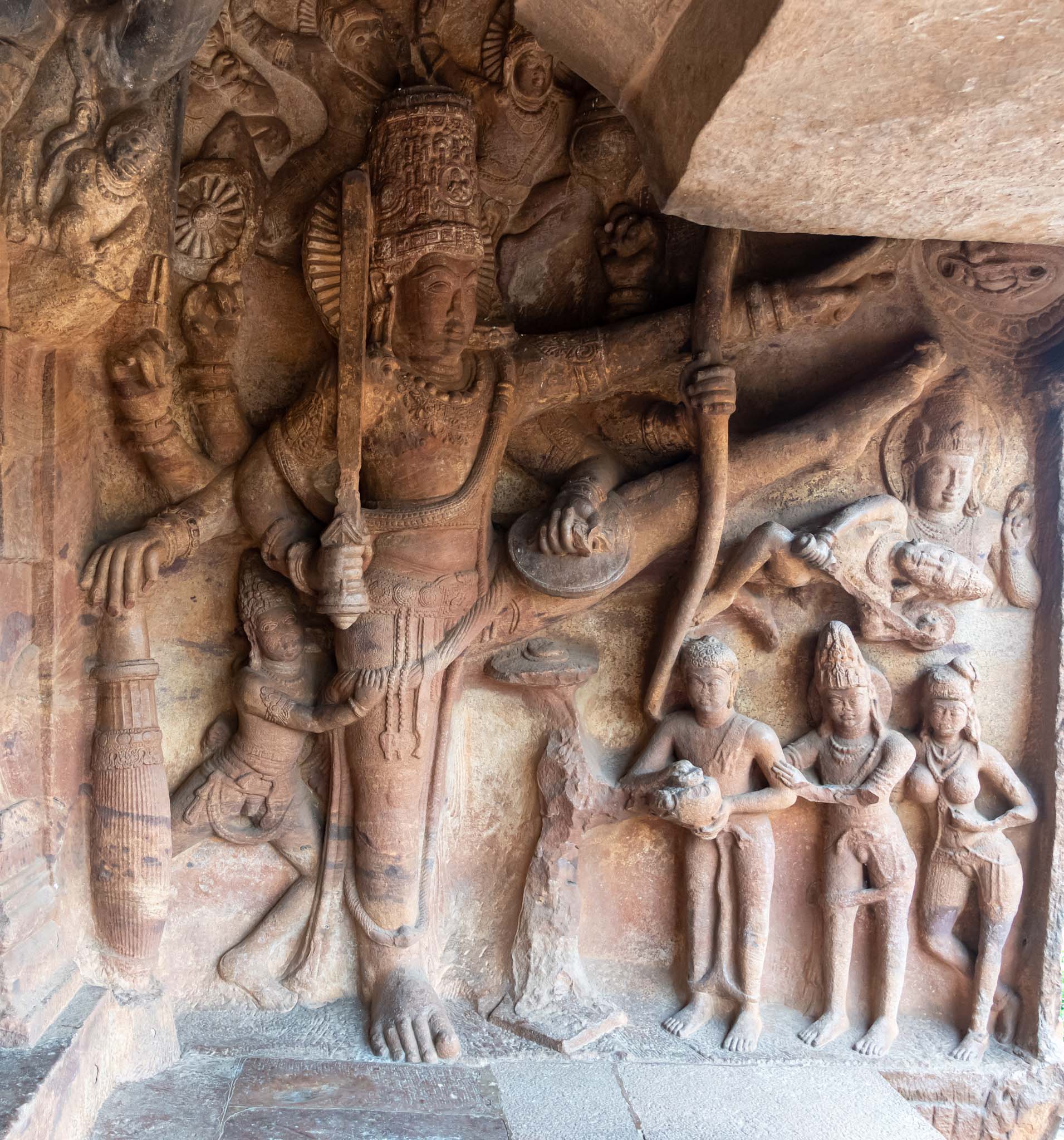
Statue of Trivikrama is seen at the entrance to the cave and Vamana can be seen holding an umbrella. There is intricate work in the ceiling with a design of four swastikas joined together in a never ending pattern and also a circle with twelve fishes in it. One can only marvel at the effort and care that must have been put in, to carve these out of rock. One mistake and the piece would go bad and there was no opportunity to replace the piece as everything was carved out and nothing was joined. There is no idol in the sanctum santorum of this cave and same is the case in Cave-3 as well.

Cave-3 is also a few steps away from Cave-2 and this is the cave with the most intricate carvings and its history is fairly well documented because of the inscription mentioned earlier. 

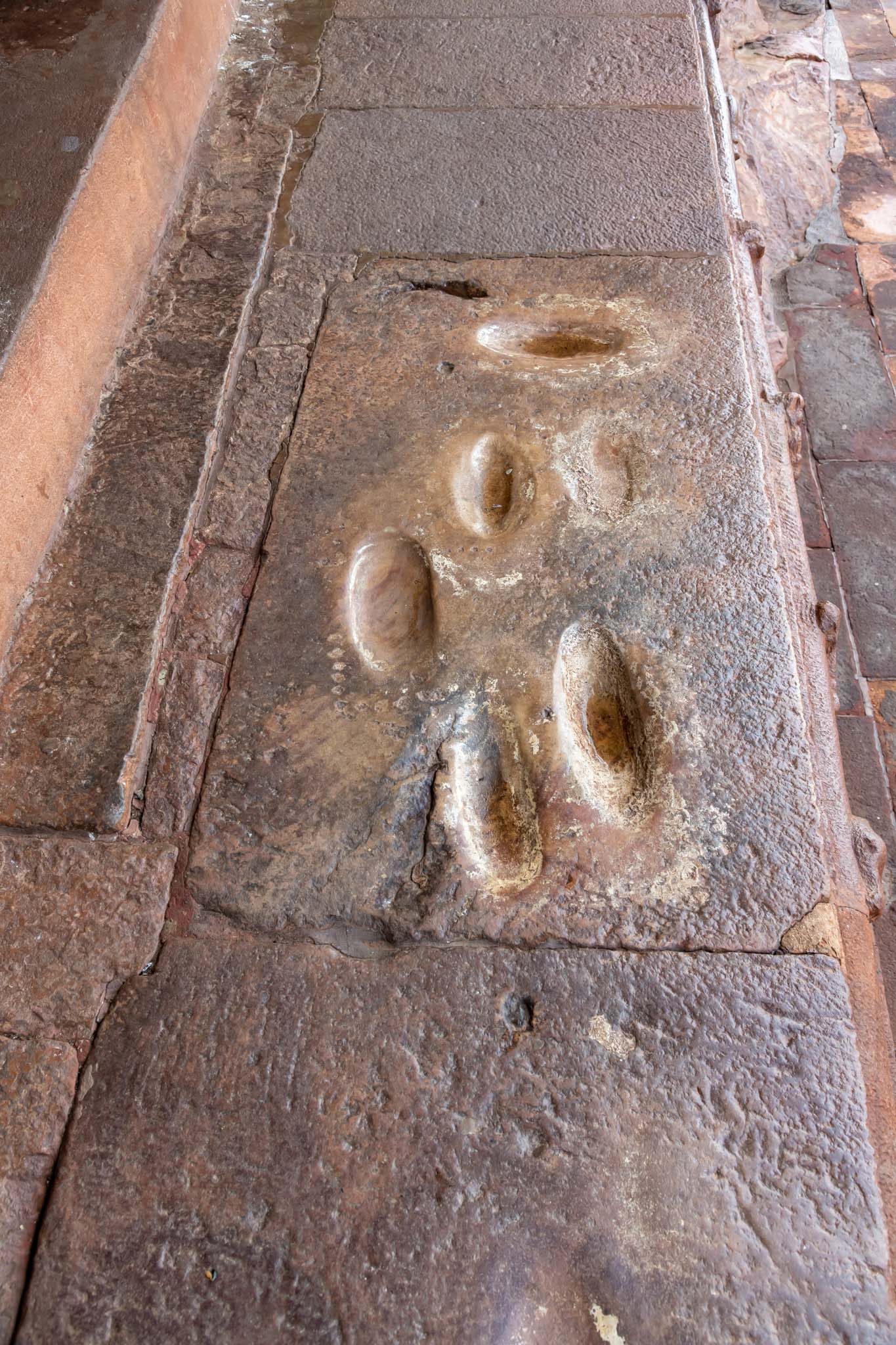
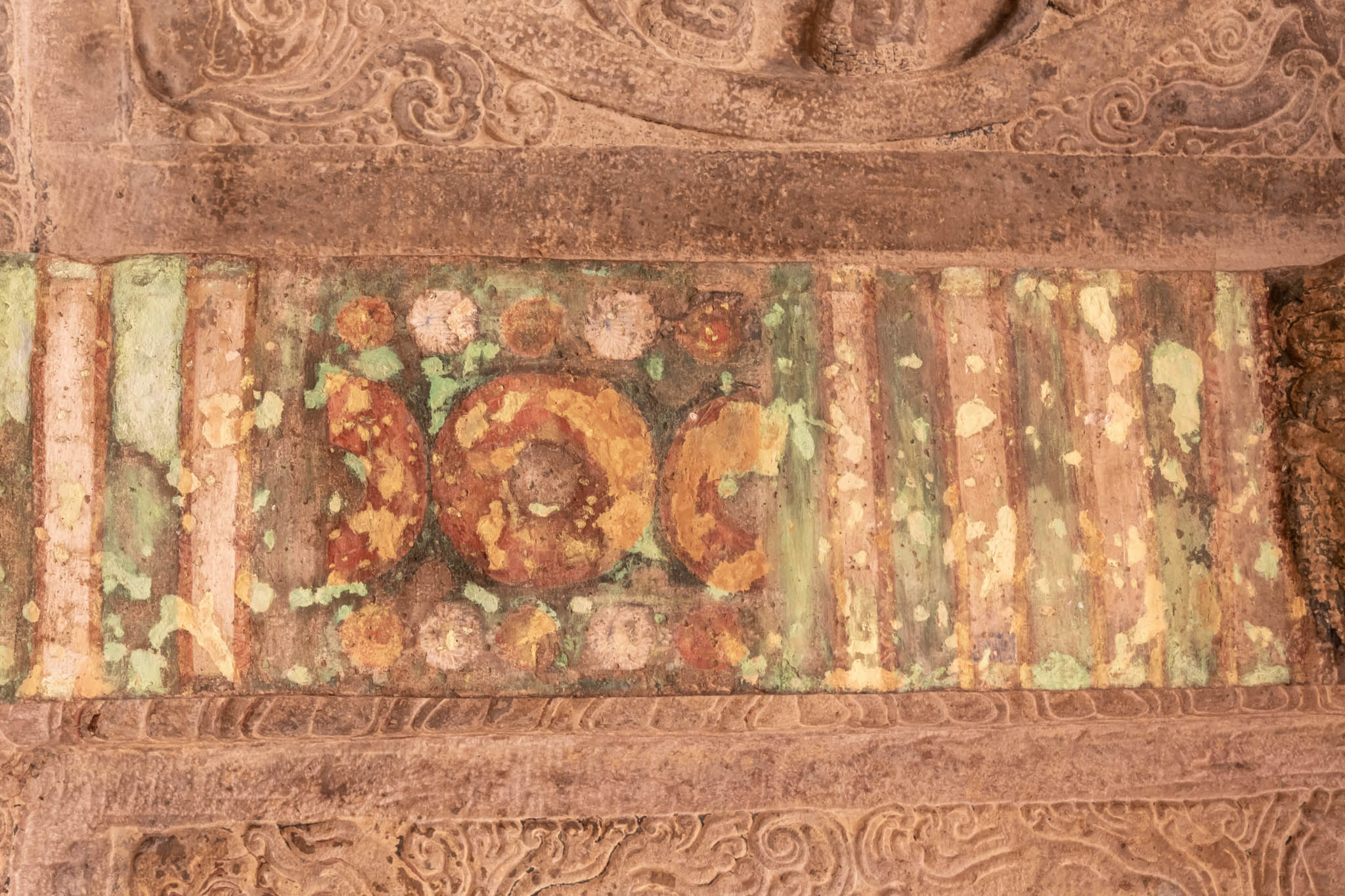
It seems that most of the sculptures were painted in the olden times but almost all of the colour has been lost. They must have used vegetable dyes and this must be why the colours were lost over time. In cave 3, we can see some notches on the floor and the guide said this was the palette for mixing the paint but I am not too sure. Currently you can see some colour only on one small section of the ceiling in Cave-3. 

Remnants of paint on the ceiling

Trivikrama statue in Cave-3

Eight armed statue of Vishnu as dwarapalaka

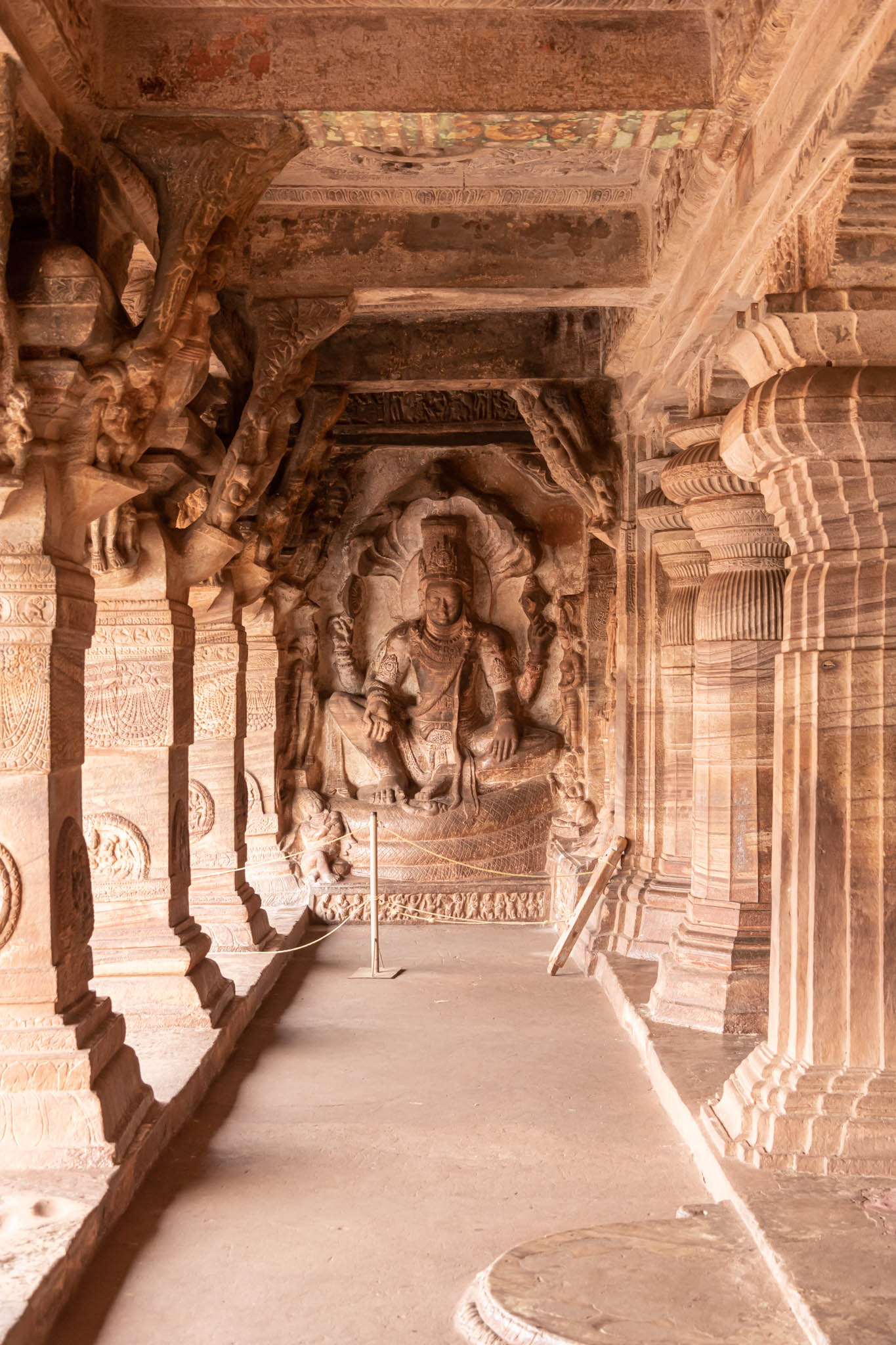
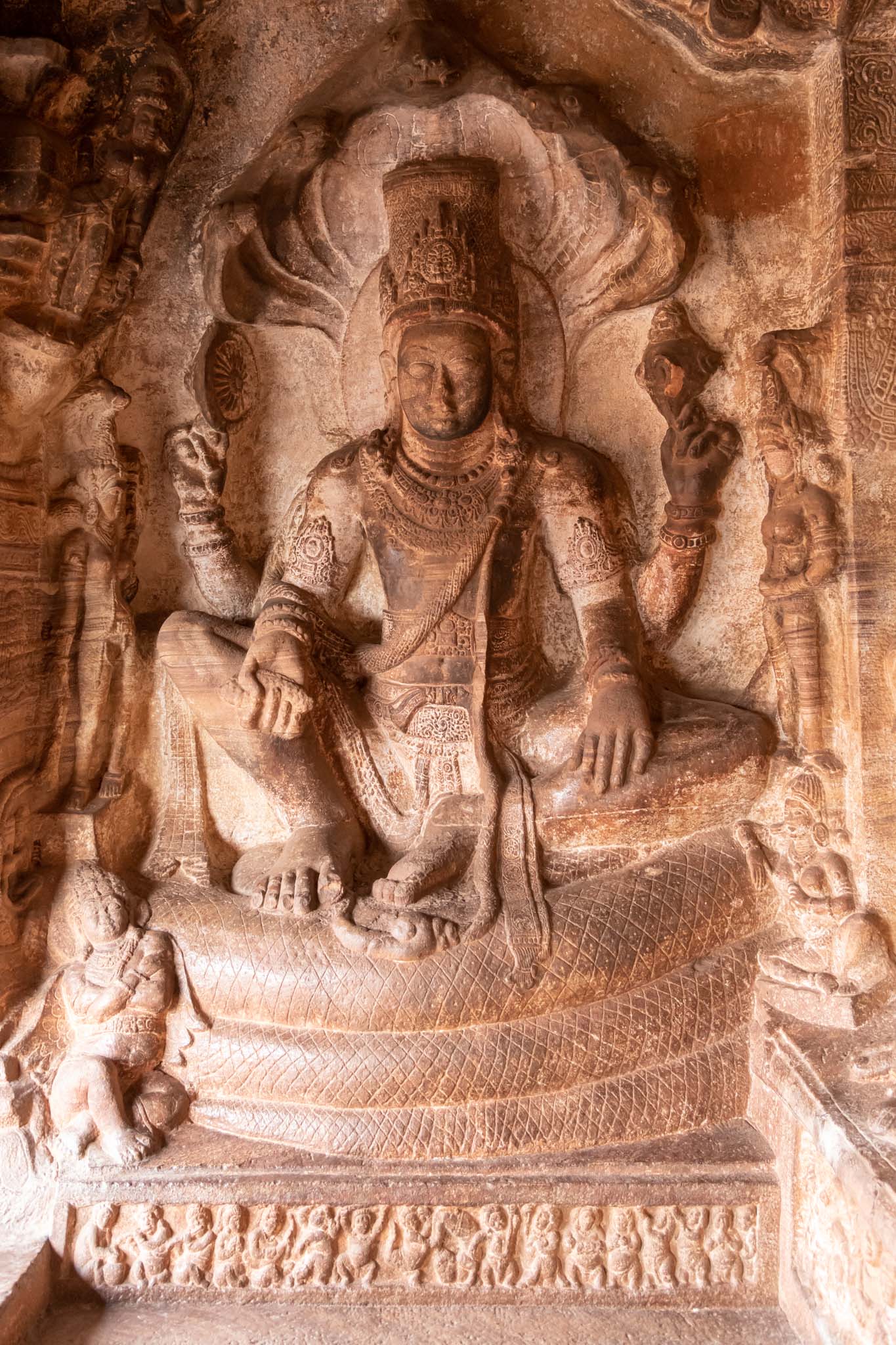
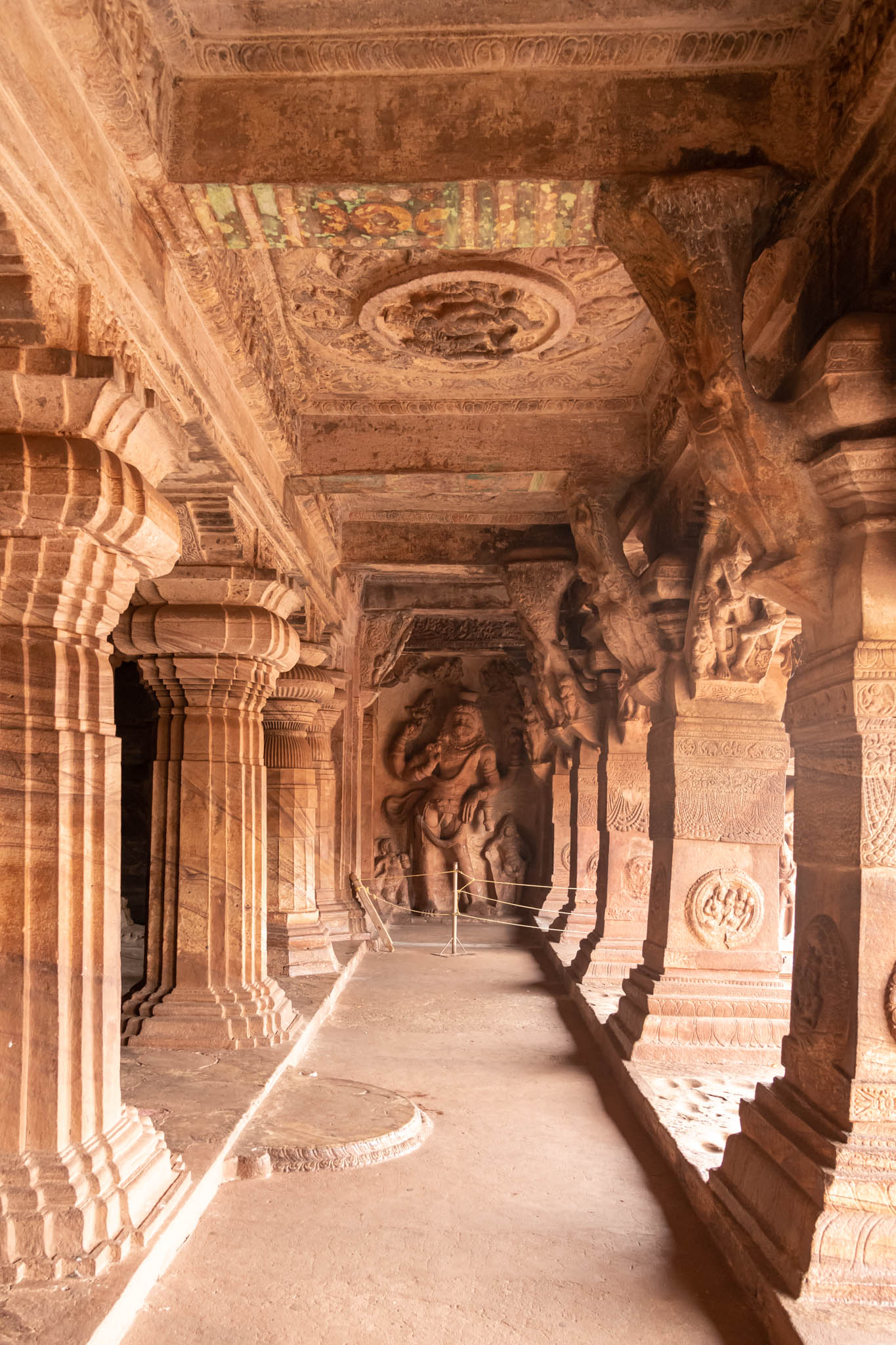
There are two very large, beautiful statues at each end of the corridor as we enter the cave; that of Vishnu seated on Seshnag (Anantha) and of Prasanna Narasimha at the other end. Supposedly, the pose of Vishnu sitting down on Anantha is very unique as he is normally shown as reclining on the coils of the snake. 

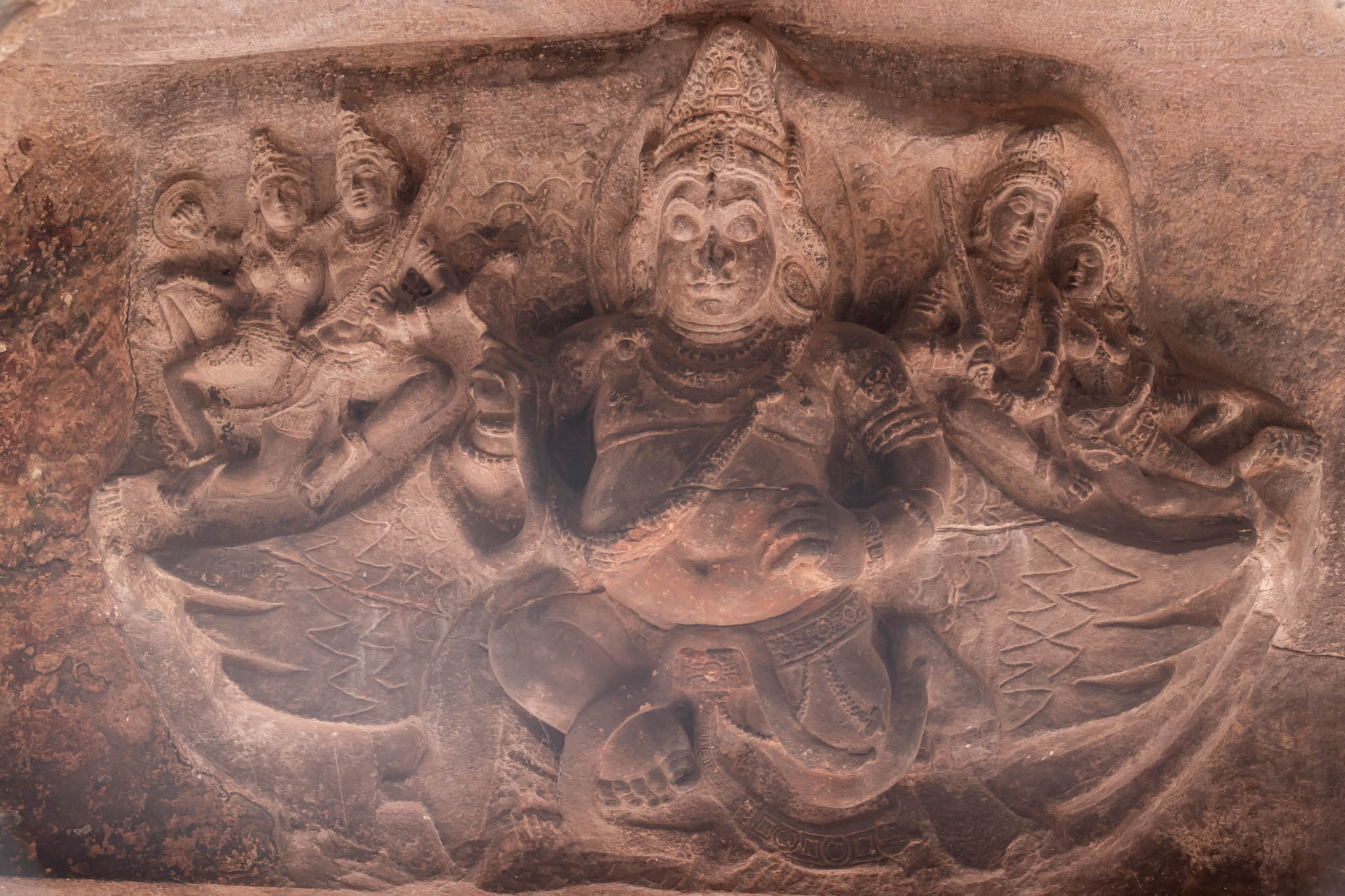
Vishnu seated on the serpent Anantha

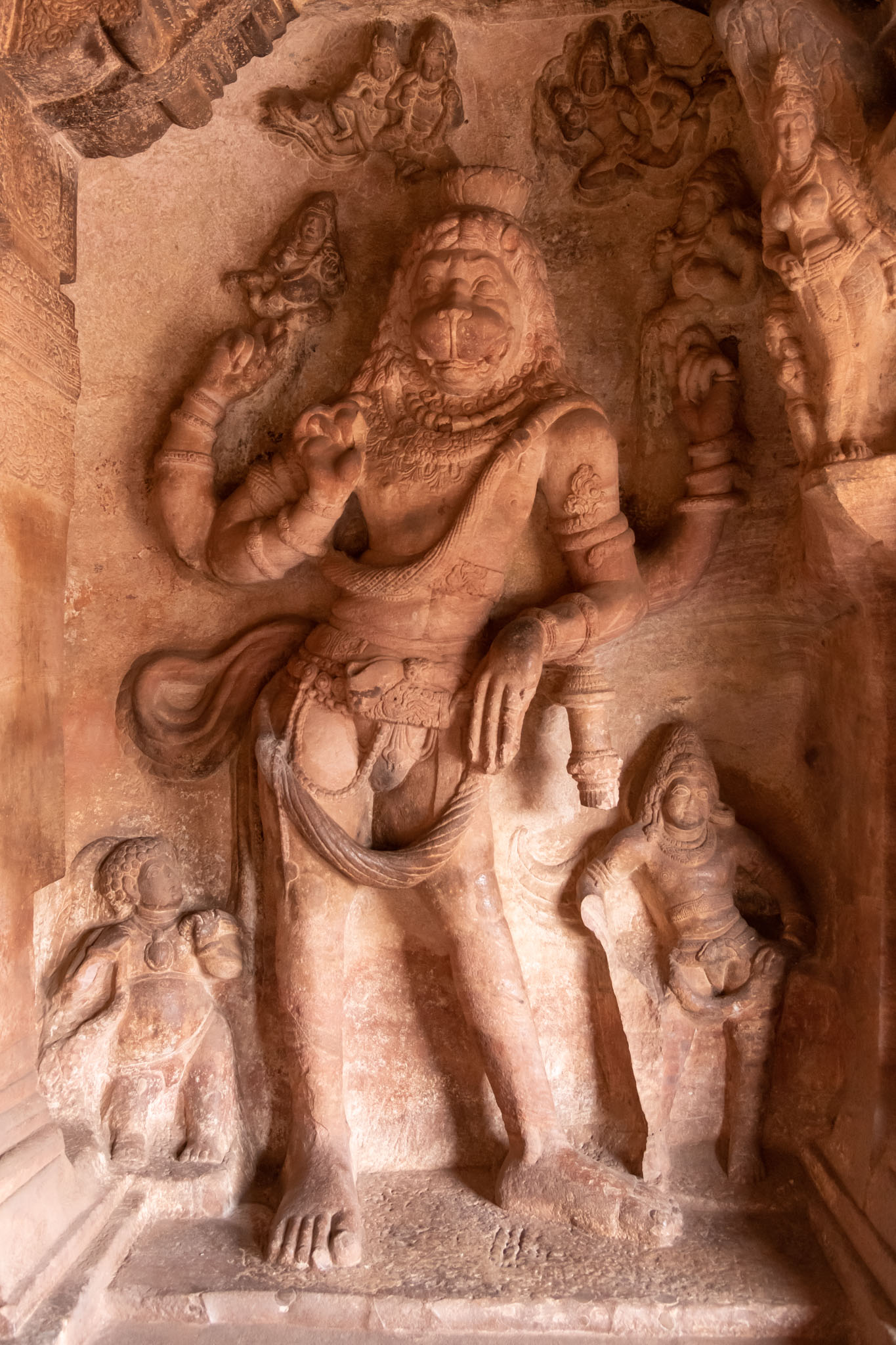
Prasanna Narasimha

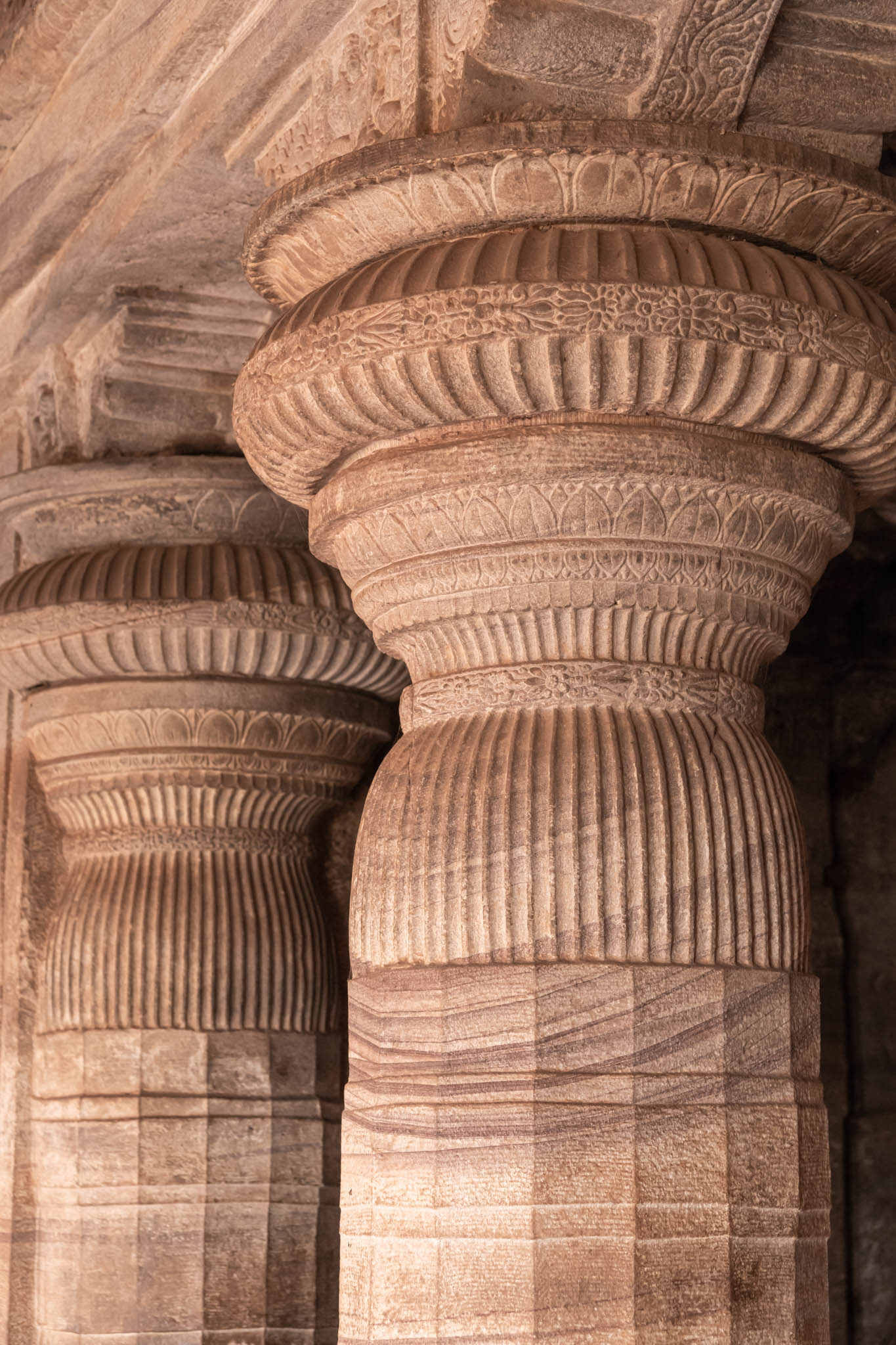
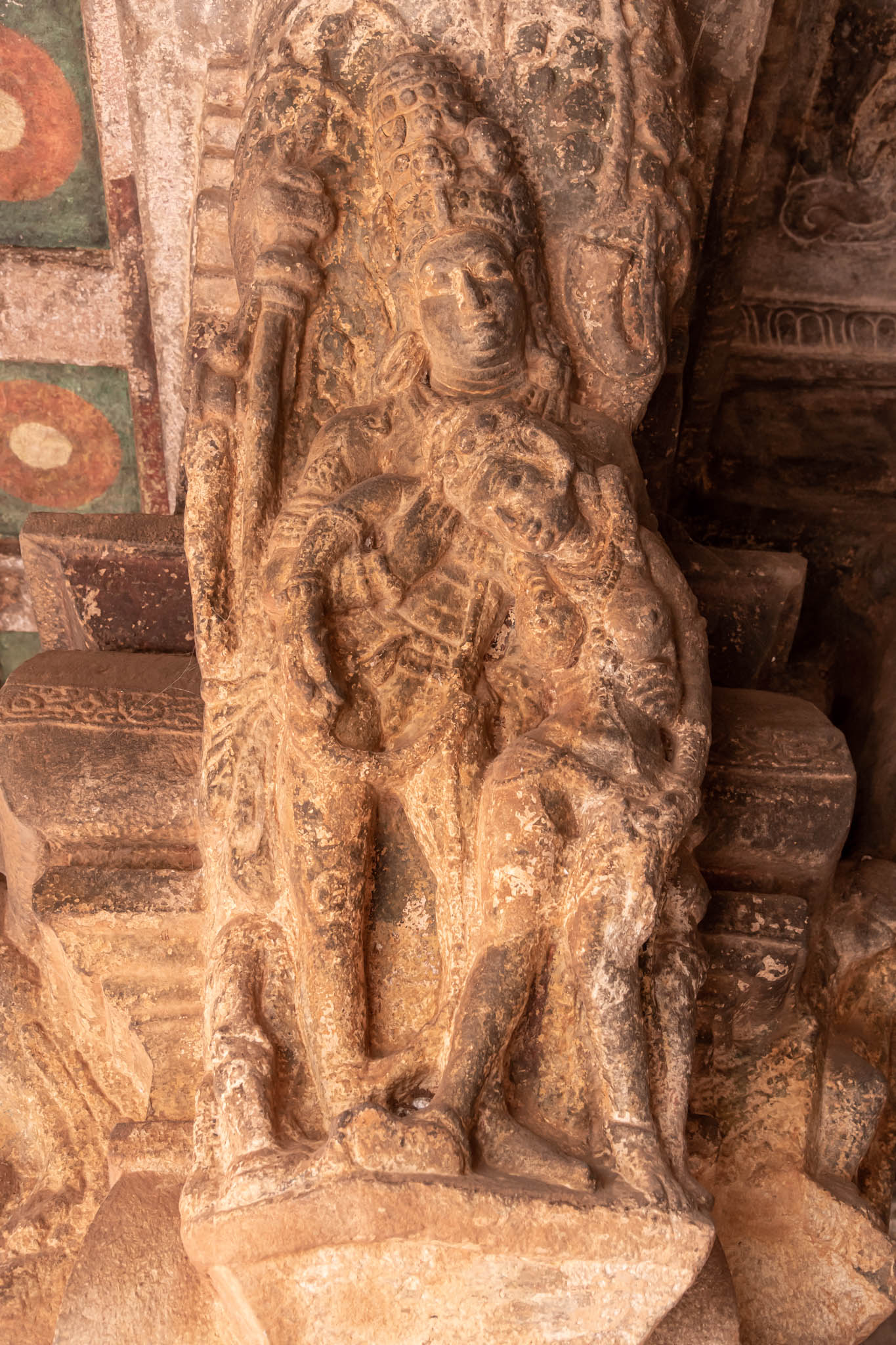
The quality of the work in this cave can be seen from the fantastic designs on pillars and also from the beauty of the statues. Some of the statues are carved out like stays to the ceiling on top of the pillars and you can see hollowed out spaces as well. They had even carved out some work on the inside of the awning of this cave as well. One can only marvel at the patience and the dedication of these sculptors. Each of these caves took more than 10-12 years to complete and I wondered at what would have been the motivation of kings to support this work over such a long period; especially when you consider that average lifespan at that time must have been around 50 years or so. Maybe it was a desire to leave something for posterity to remember them by. 

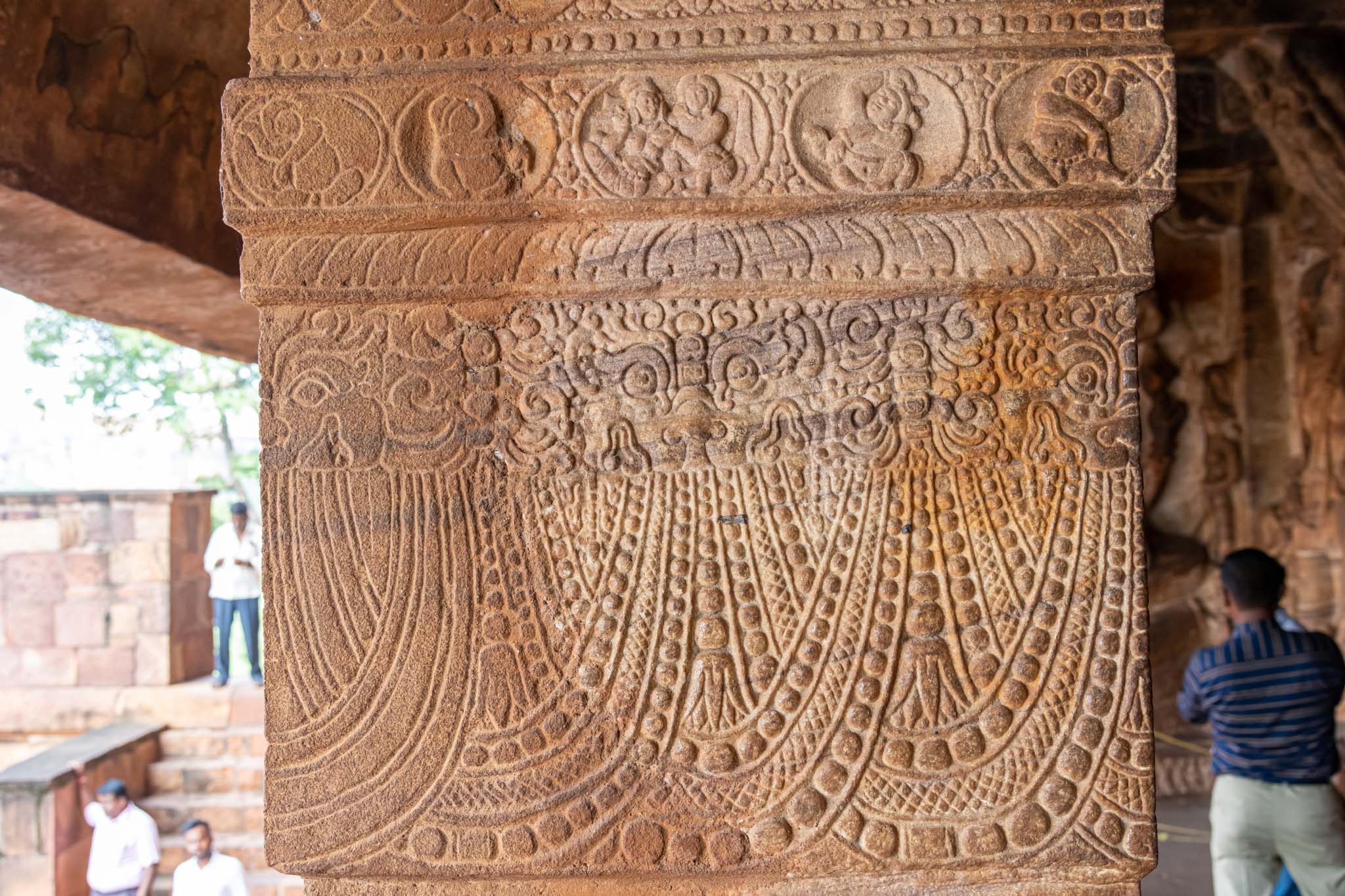
Ornate designs on pillars

Work on the awning

There is also one statue that is a kind of social commentary. Here a couple is shown in an inebriated state, particularly the lady. She has had too much to drink, her dress is falling off and she is vomiting, with a dog eating the vomit. This statue has been kind of damaged a bit and so I thought the guide was making the story up till I went to Aihole and heard the very same story from another guide there and saw the same work on a pillar inside a temple; that one is much clearer and the story is quite evident. This just goes to show that women drinking alcohol was common in ancient India and it is indeed strange and comical that the self-declared custodians of Indian culture are completely scandalised if they hear of any woman having a drink in modern India. I had read somewhere that what these fellows are peddling as Indian moral values are actually Victorian values and morality and I am inclined to believe that, given their general ignorance and biased interpretation of history. 

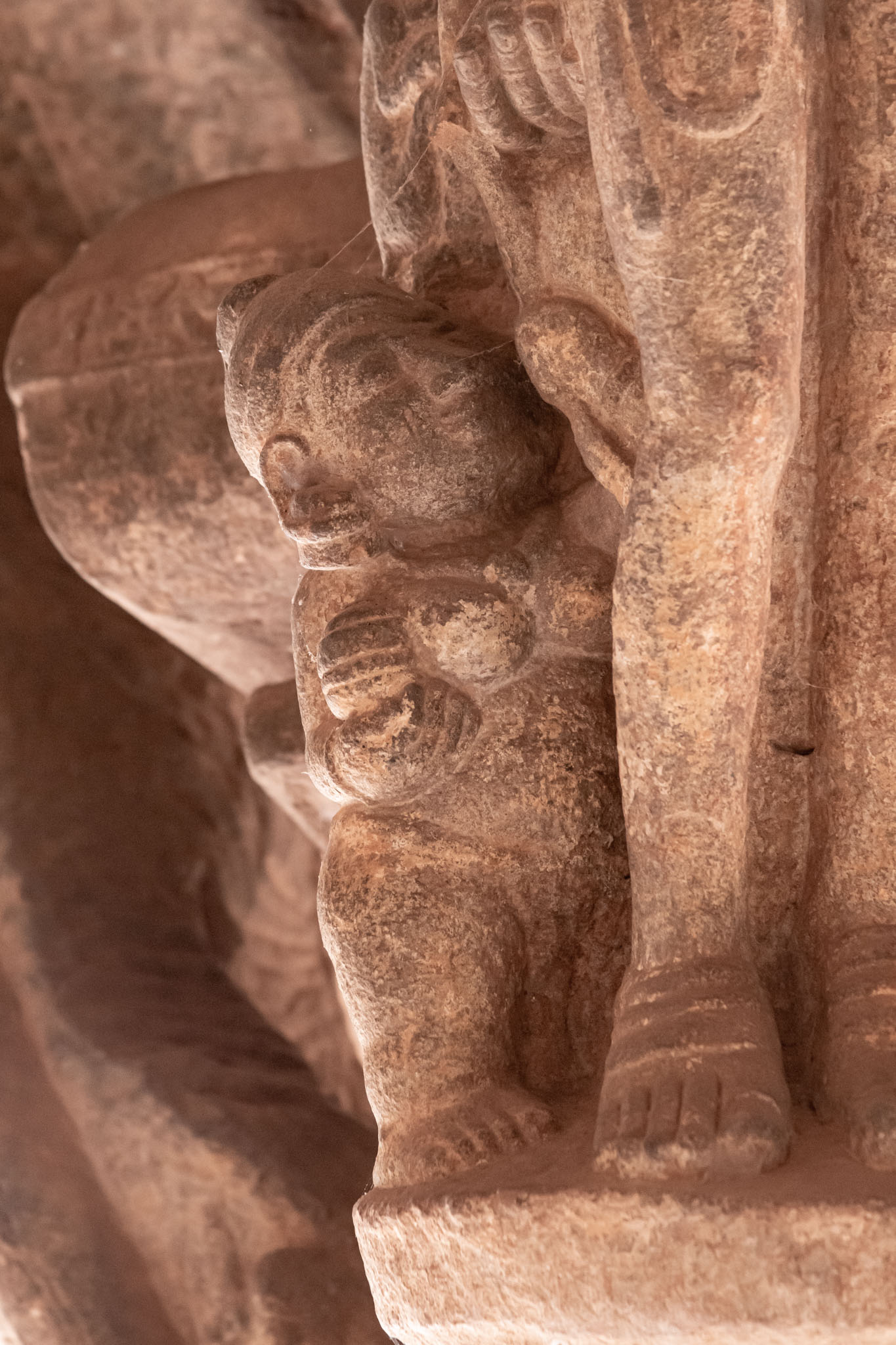
There is also a statue which plays a trick with the angle of view. When you look at the statue from one side, it is that of a dwarf.

The same statue when viewed from an angle behind the dwarf, looks like a monkey with the earpiece of the dwarf resembling the snout of the monkey.

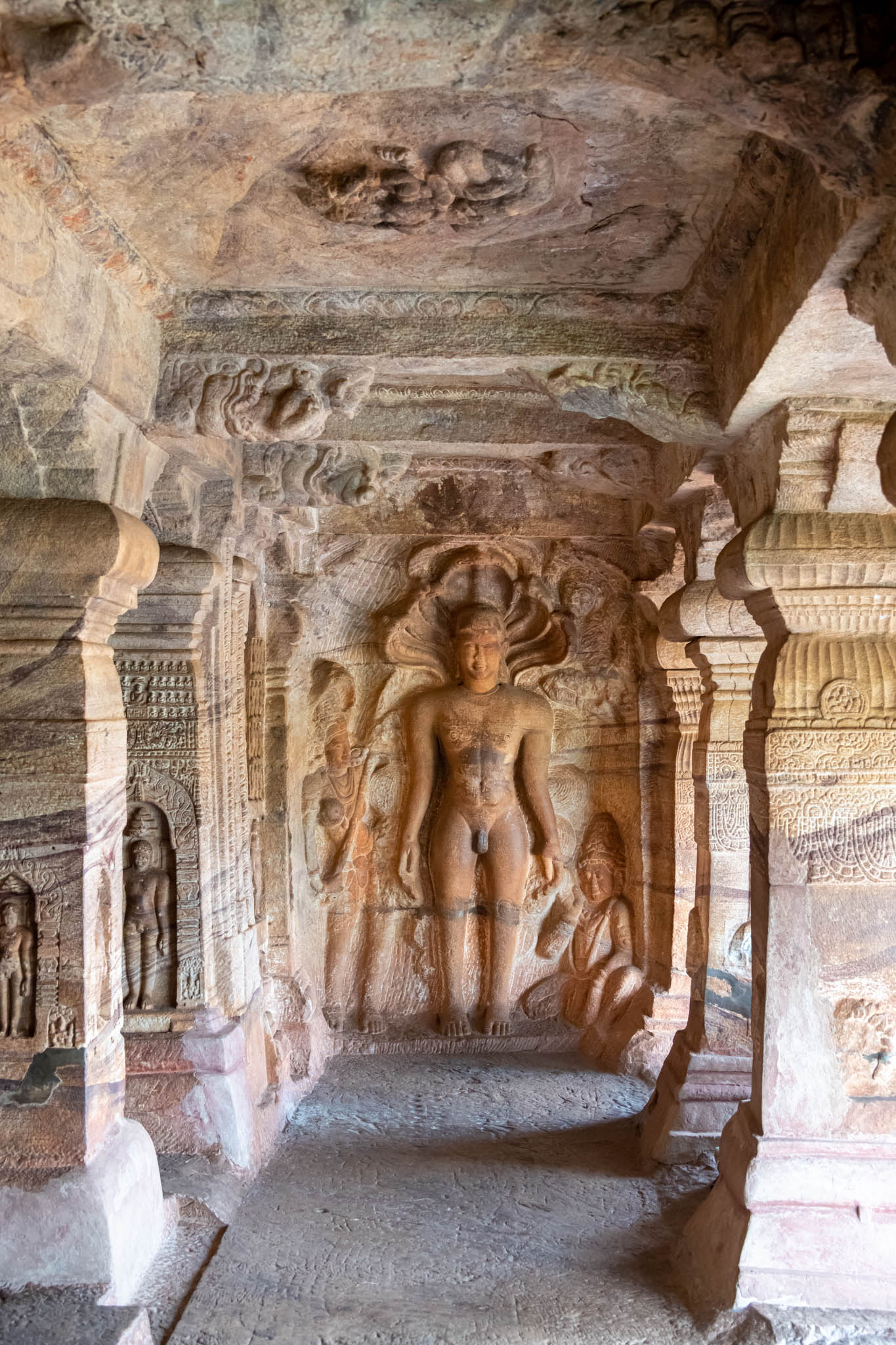
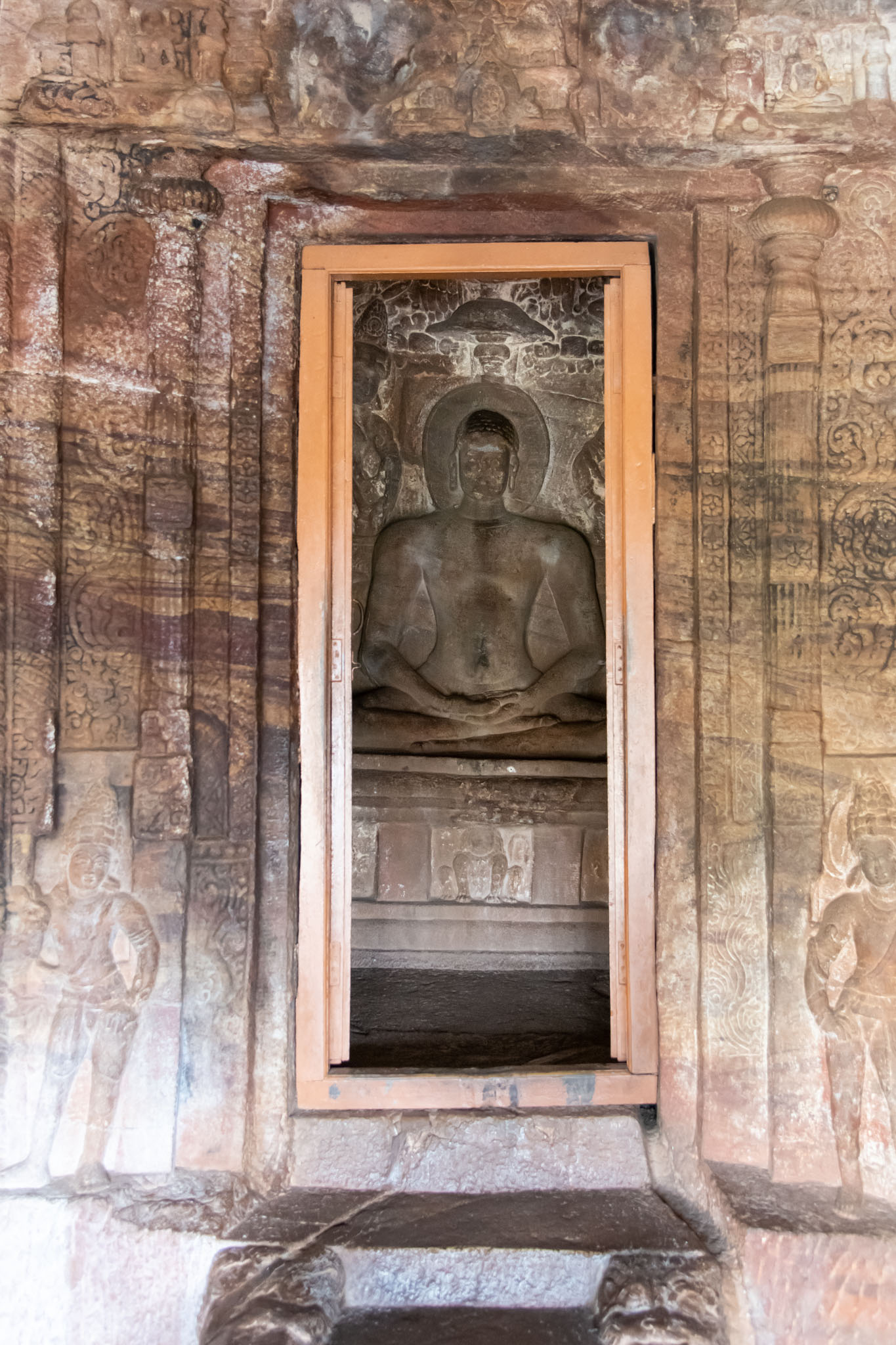
The last stop was Cave-4, which is kind of separate from the three caves. It seems that in olden times, a wall separated this cave from Cave-3. It is almost unfinished and there is not much by way of intricate designs here though there are some large statues.

Statue of Bahubli

Status of the twenty third Thirthankara

Idol of Mahaveera, the twenty fourth (last) Thirthankara, in the sanctum sanctorum 

I spent more than four hours at the cave, walking to and fro and gawking at all the work. The interiors of the caves were generally plain and most of the work was in the corridors. The beauty of Badami cannot be described in words, at the very least I am quite incapable of it. I was very glad of my initial visit early in the morning as it provided me an opportunity to immerse myself into the ambience without all the disturbance from large numbers of tourists that appeared after lunch. I would definitely recommend Badami and one should spend at least a day here, just to visit the Caves and the Fort. There are also other attractions like Mahakuta Temple and Banashankari Temple. I did go to Mahakuta Temple and that is quite nice too but it is no match to the wonders of the Caves. 

Moscow has been a very familiar name since childhood and one had heard about the Red Square, Kremlin etc. from a young age. In November 2019, I had an opportunity to spend a couple of days at Moscow. The fascination with the USSR and consequently Moscow, had started with some of the Soviet publicity books that I had read when I was young. Kerala, with its Communist roots, was always interested in the USSR and the stories of the October revolution, Lenin etc. were quite commonplace.

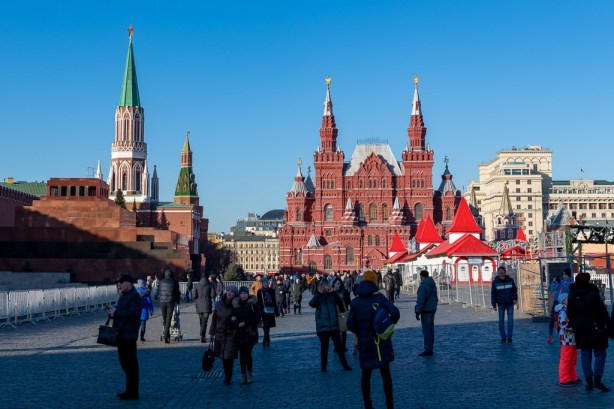
Naturally, my first port of call was the Red Square. Given the Communist history of Russia, my impression was that the origin of the name Red Square must have been connected somehow with the revolution. However, I understand this is not the case. This has been the main commercial square in Moscow since many centuries and it has been called so since 1662 or so. It separates the Kremlin (palace of the Tsars and currently of the Russian President) and the historic merchant area. This has been a very important location in Russian history and many ceremonial activities including coronation of the Tsars took place in the Red Square.

This rather large square borders the Kremlin on one side and the main attractions are the most famous icon of Russia, the St. Basil’s Cathedral, Lenin’s mausoleum etc. There is a very large department store (called the GUM) that occupies one side of the Red Square where the erstwhile commercial quarter was located. This store is more than a hundred years old, I understand.


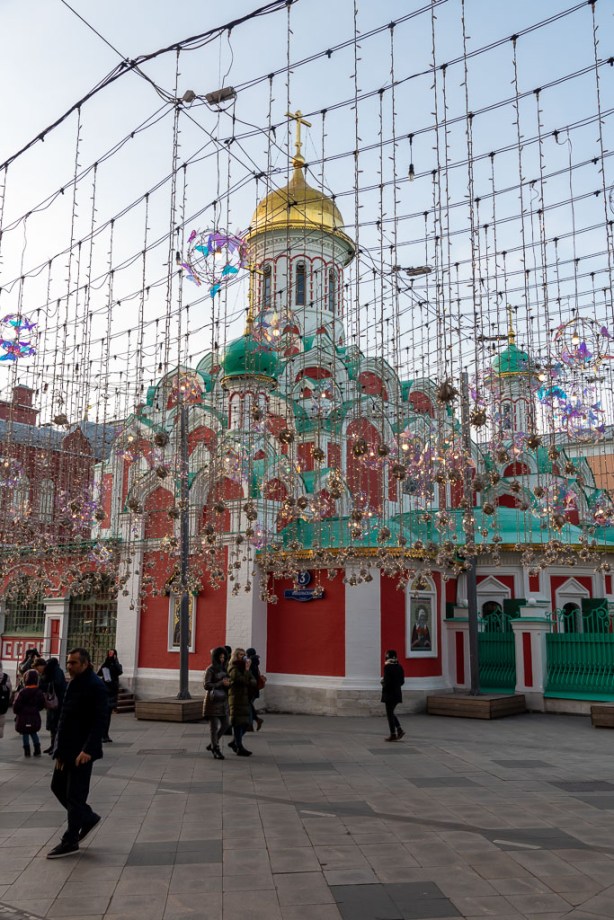
On one side of the Red Square is the Kazan Cathedral. After defeating the Polish army in 1612, Prince Dmitry Pozharsky entered the Kremlin through the Red Square and in commemoration of that success, he built this Cathedral and consecrated it in 1625. The original building was of wood and burned down in a fire in 1632 and was rebuilt using brick and consecrated in 1636. It was considered as one of the most important churches in Russia and on the anniversary of liberation of Moscow from the Polish forces, the Tsar and the Patriarch of the Russian Orthodox Church used to lead a procession around the Red Square. As part of removing religion from public life, Stalin ordered the demolition of the church in 1936 and a temporary building to host the offices of the Communist International was constructed on the site. After the fall of USSR, this was the first church to be reconstructed (1990-1993) and has been made to look like the old church.


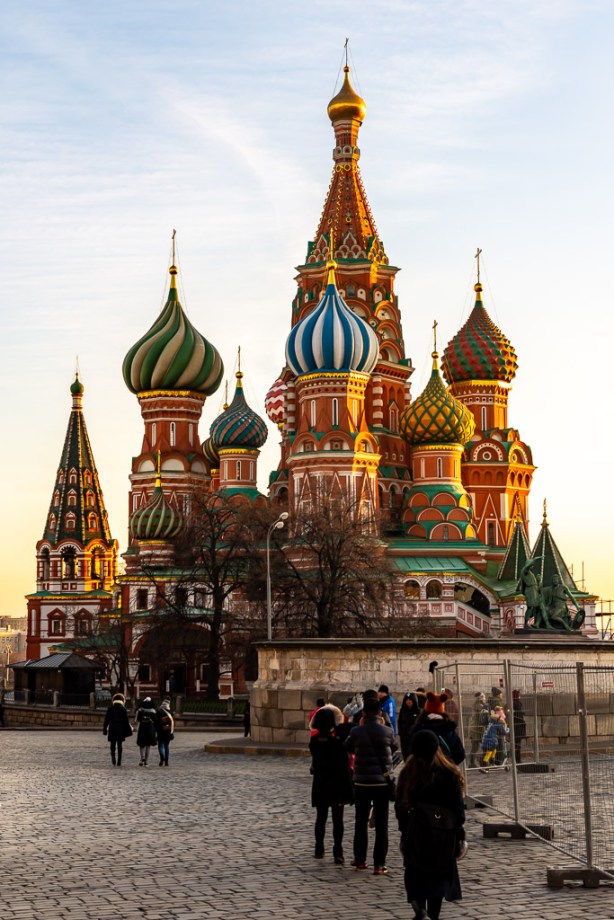
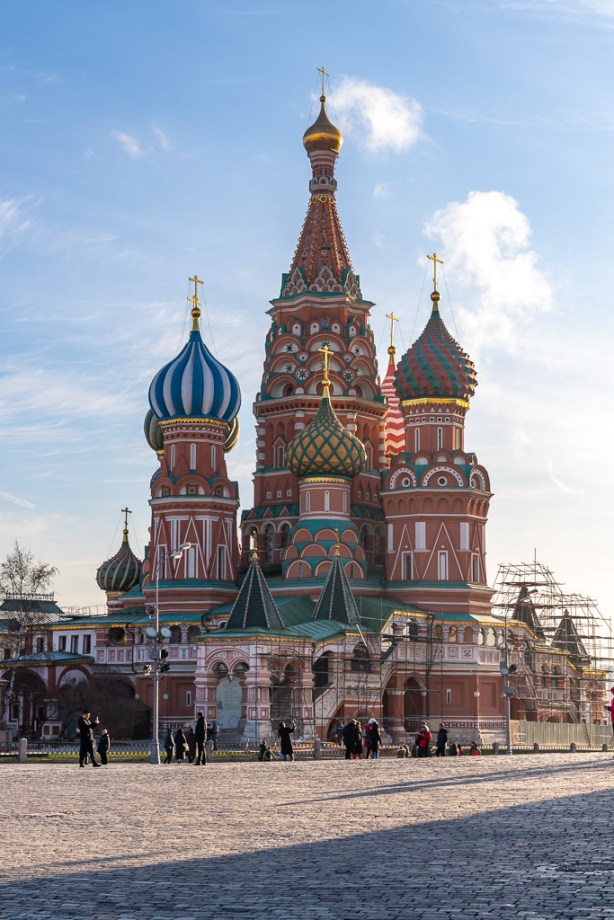
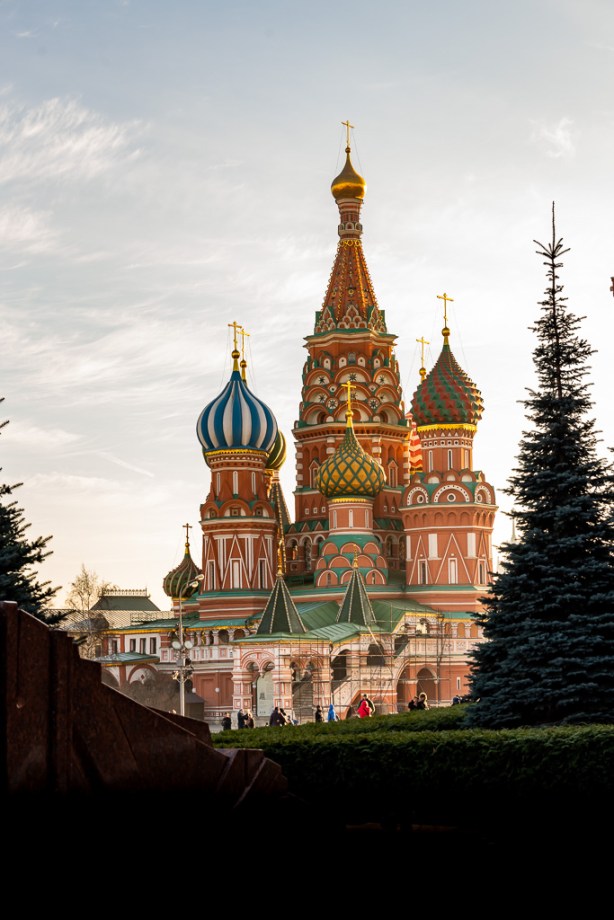
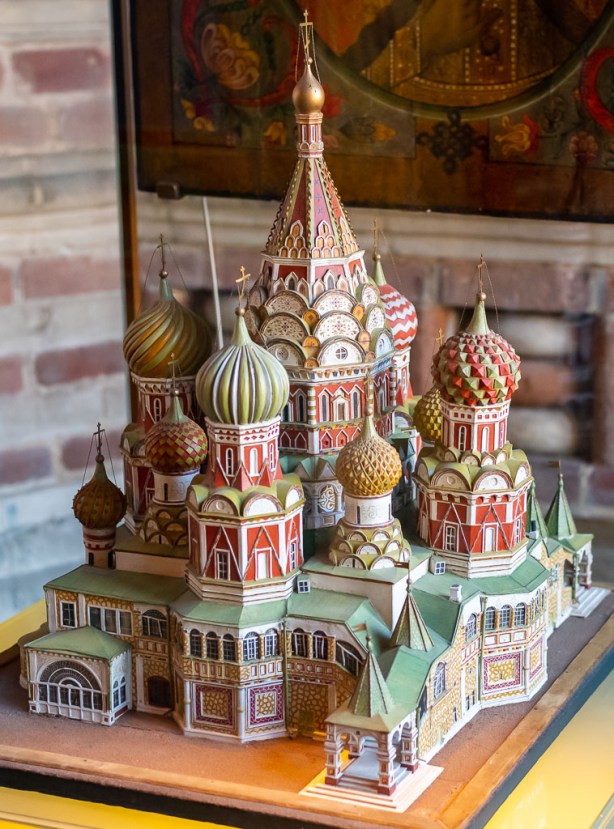
St. Basil’s Cathedral is arguably the most reproduced image from Moscow and is regarded as a cultural symbol of the country. It is now a museum. its original name was The Cathedral of Vasily the Blessed. Ivan the Terrible, the first Tsar of Russia (1547 to 1584), constructed this church to celebrate the capture of two cities – Kazan and Astrakhan. The construction took six years from 1555 to 1561 and it had nine chapels with eight chapels around the central ninth one. A tenth chapel was added later, in 1588, to honour a local saint named Vasily (Basil in English). In the Soviet era, this church was taken over by the state and converted to a museum and all religious activities stopped. After the collapse of USSR, some church services have been resumed since 1997.

This building has a very unique architecture and resembles a fire rising up to the sky. Supposedly, there is no other building with a similar architecture in Russia. I read somewhere that an old mosque in the captured city of Kazan may have been the inspiration for this architecture and to the untrained eye, the building does look more like a mosque than a church, with its massive domes.


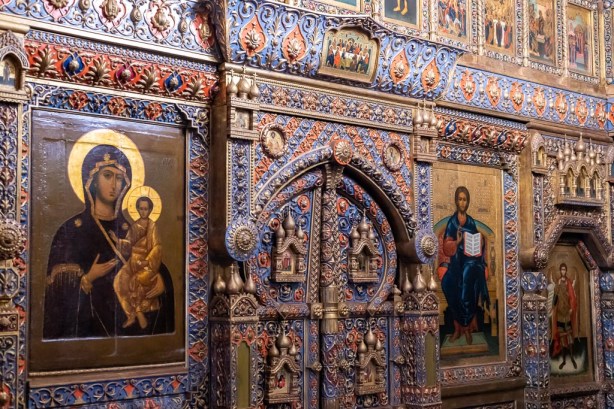
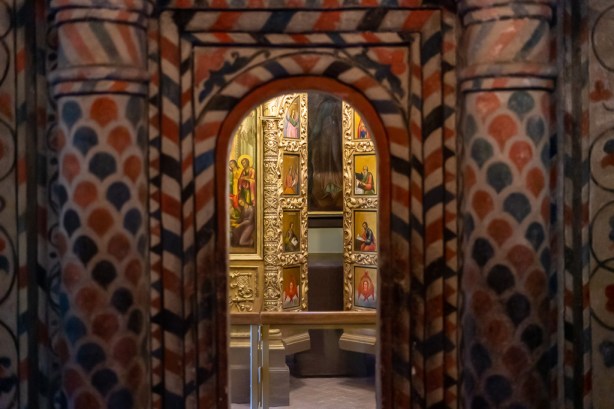
The interior of the Cathedral is very beautiful and richly decorated with icons, altars and nice paintings.


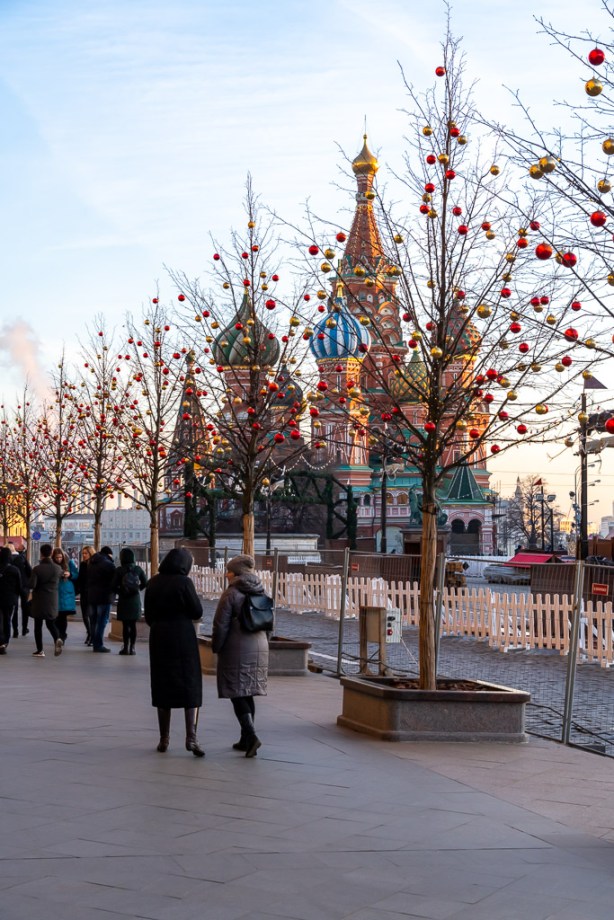
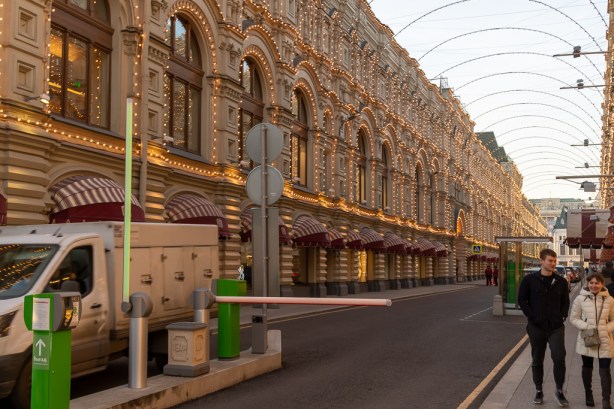
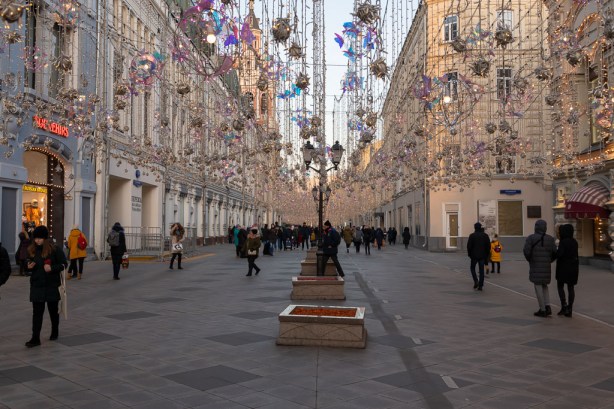
The GUM department store is a very impressive looking building and the roads outside were all decorated, possibly in anticipation of the New Year and Christmas (Russian Orthodox Church celebrates Christmas on 7th January).


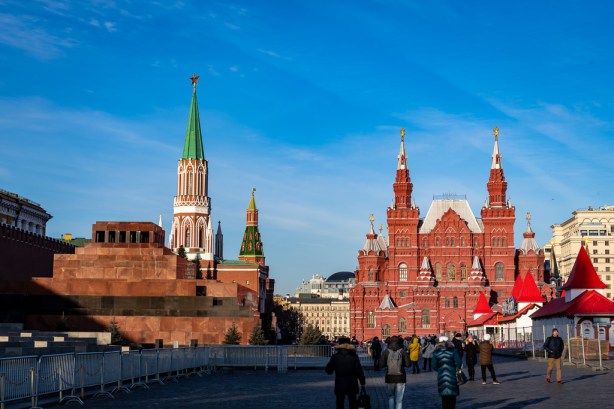
The next day morning, I decided to visit one of the most popular monuments in Russia – Lenin’s Mausoleum. It seems this monument attracts the highest number of visitors in a year. Lenin’s body has been embalmed and displayed here since his death in 1924; except for a brief period during the Second World War when the body was moved to a city in Siberia as it was feared that the Germans might capture Moscow. The mausoleum stands on one side of the Red Square; the square, squat red marble tiled building on the left side of the image below. When I arrived, there was a queue waiting for the museum to be opened; Mercury had fallen below zero and it was extremely cold, with a wicked wind, but people waited patiently.


After Stalin died in 1953, his body was also embalmed and displayed right next to Lenin’s. However, Stalin’s body was removed in 1961 as part of the de-Stalinization drive and buried in the Kremlin wall along with other leaders. Photography was not allowed inside the Mausoleum and so I could not take a picture of the body. It looks as if Lenin is sleeping on his back, with a blanket covering the lower half of his body. It looks very life like and you wouldn’t think almost a hundred years have passed since his death.

Two thoughts crossed my mind as I stood there looking at the great leader’s body. This was a man who had changed the world and made a new order of society and politics possible. John Reed, an American Journalist and Communist, was a witness to the October Revolution and he saw the whole event unfold, from close quarters. In about a year from then, he published his book “Ten days that shook the world”, which is an eyewitness account of the revolution. This was an unbiased account as it was published in 1919, before the people that came to power after the revolution had any opportunity to influence what was written. As you go through the book, it becomes very evident that the two people that made the revolution possible were Vladimir Ilyich Lenin and Leon Trotsky. It is also equally evident that Josef Stalin did not have much of a role in the revolution. In the whole book, he is just mentioned in two places and that too as passing references. From the two, the body of one lies preserved in all this grandeur as a sign of respect and gratitude of the state while the other, Leon Trotsky, lies buried in a small grave in a non-descript cottage in Mexico City; after he was murdered by the KGB agents sent by the usurper, Stalin.


The second thought was about the seeming absurdity of making a shrine out of a Communist leader’s dead body. In a strange way, I was reminded about the relics and preserved dead bodies of Christian saints. I am sure that the state benefits from the symbolism of Lenin’s dead body but somehow I felt it was not in keeping with what this great leader stood for. After all, he was the proponent of a philosophy which was rooted in logic and not symbolism.

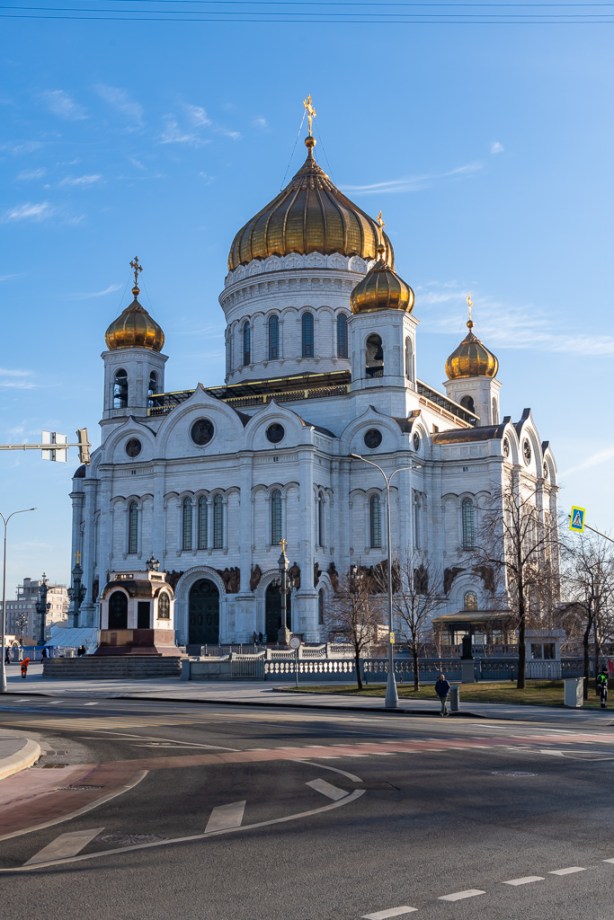
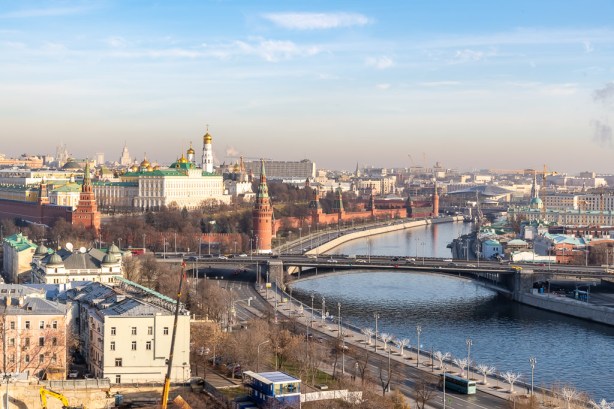
Next stop on the agenda was The Cathedral of Christ the Saviour. This church was built in the nineteenth century and was demolished in 1931 on the orders of Stalin. It was rebuilt between 1995 and 2000, after the fall of the USSR. It is an imposing building and stands right on the banks of the Moscow river. You can walk up to the terrace there are some very beautiful views of the Moscow city from there.


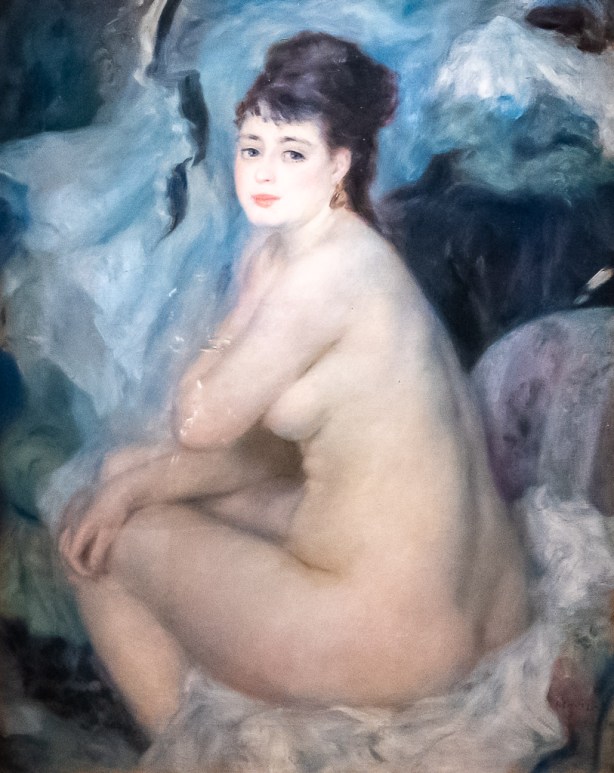
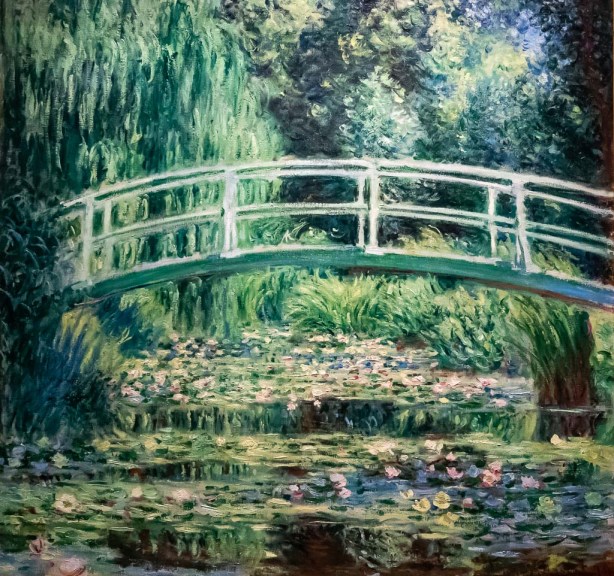
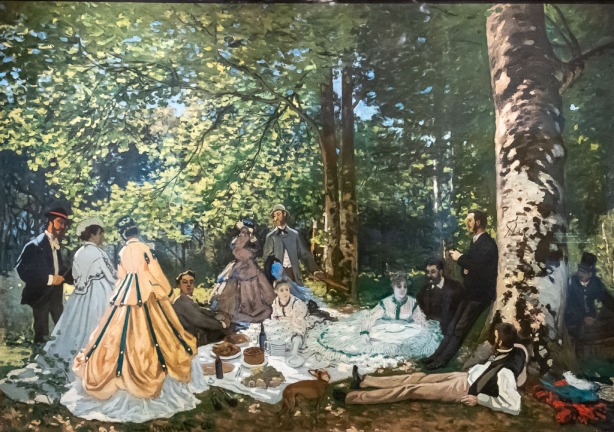
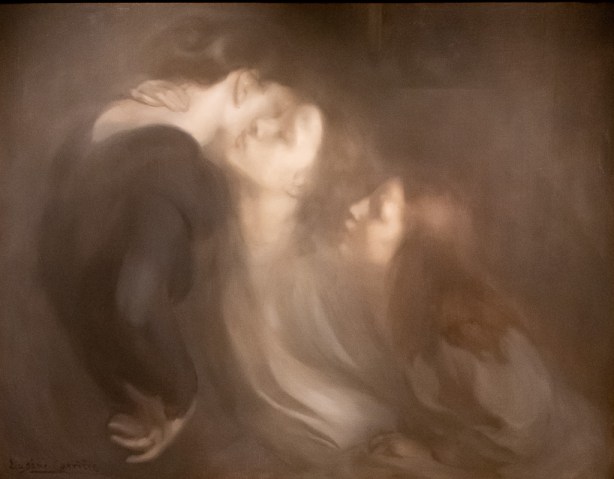
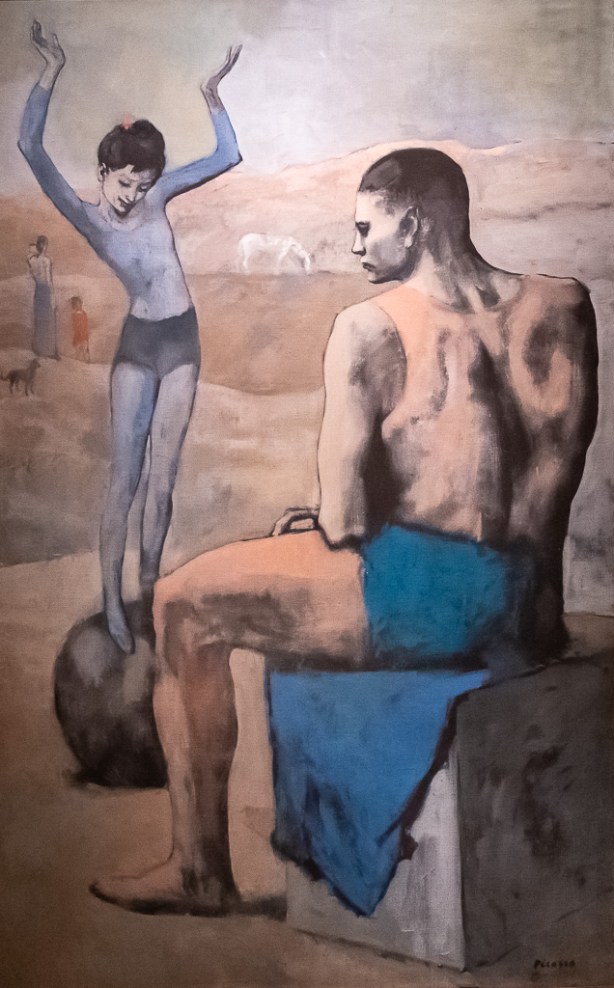
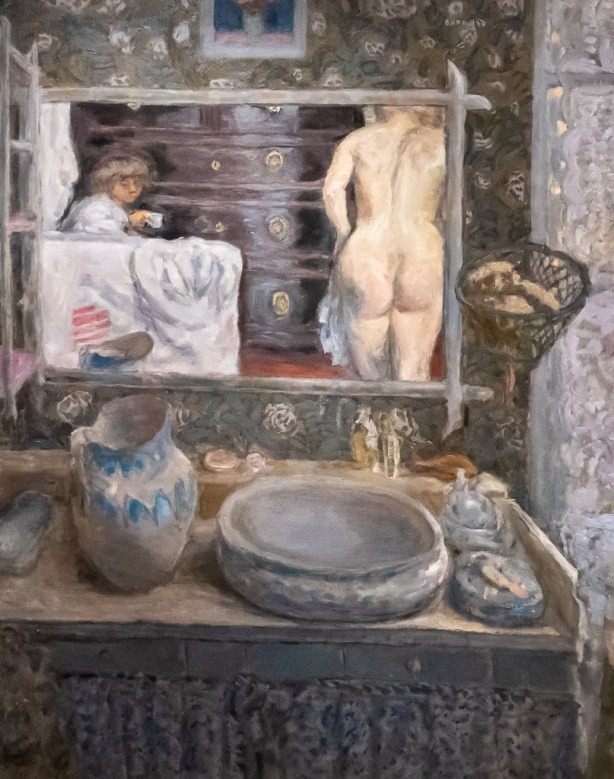
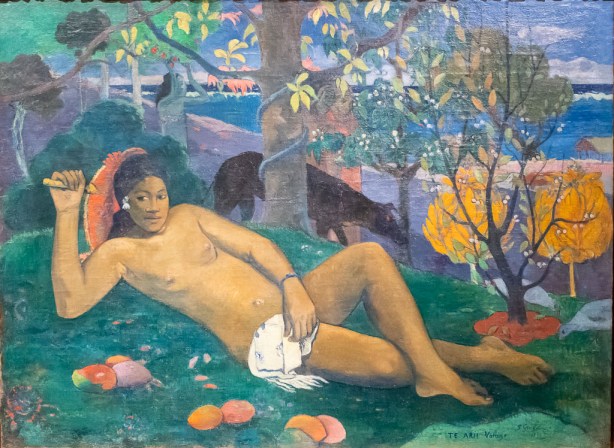
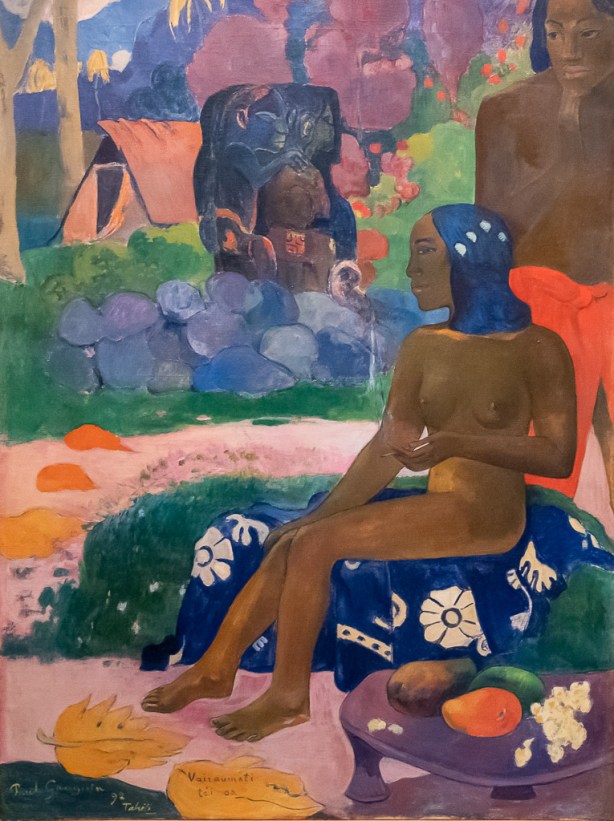
The Pushkin State Museum of Fine Arts is just a short walk from the Cathedral. It has the largest collection of European art in Moscow and is a visual treat. There were works by many masters like Van Gogh, Cezanne, Picasso, Monet, Gauguin etc.

Solomon and the Queen of Sheba: Hans Vredeman De Vries

View of the old market in Dresden: Bernardo Bellotto

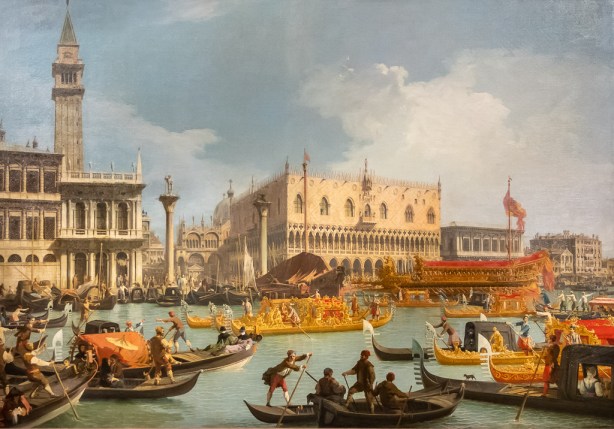
Bucentaur’s return to the pier by the Palazzo Ducale: Canaletto

View of the Grand Canal in Venice from the Fondamenta Del Vin: Michele Marieschi

The bridge across the Marne at Creteil: Paul Cezanne

Nude woman sitting on a couch: Pierre Auguste Renoir

White water lilies: Claude Monet

Luncheon on the grass: Claude Monet

A mother’s kiss: Eugene Carriere

Girls on the bridge: Edvard Munch

Young acrobat on a ball: Picasso

Spanish woman from Majorca: Picasso

Old jew and a boy: Picasso

Jaguar attacking a horse: Henri Rousseau

The muse inspiring the poet: Henri Rousseau

Mirror above a washstand: Pierre Bonnard

The King’s wife: Paul Gauguin

Her name was Vairaumati: Paul Gauguin

Gathering fruit: Paul Gauguin

What, are you jealous: Paul Gauguin

The ford: Paul Gauguin

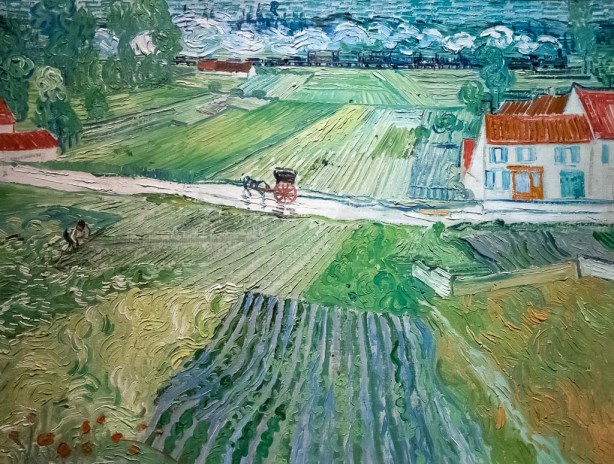
Landscape at Auvers after the rain: Van Gogh

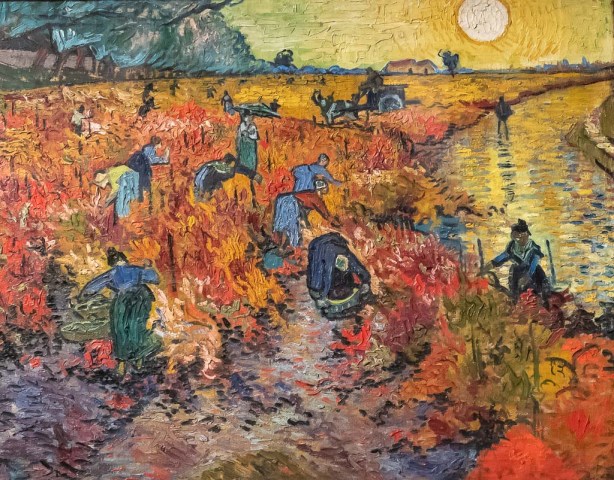
The red vineyard at Arles: Van Gogh

The prison courtyard: Van Gogh


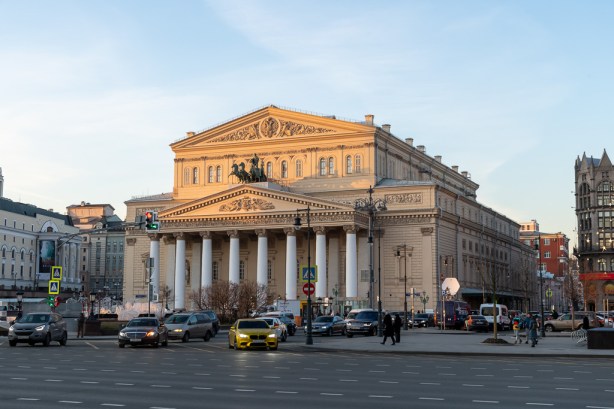
Bolshoi Theatre is a very well known Russian icon with the Bolshoi Theatre Company having been founded in 1776. The company operates in various cities in Russia and the building in Moscow itself is very well known and is even featured in the Russian One Hundred Ruble note. I was staying very near the Theatre and used the opportunity to watch a short performance. This was on one of the side stages and not the main one and was an orchestra. It lasted for about 40 minutes and was quite enjoyable.


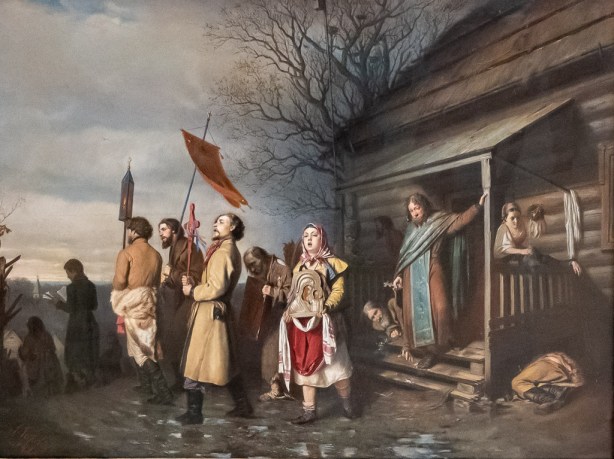
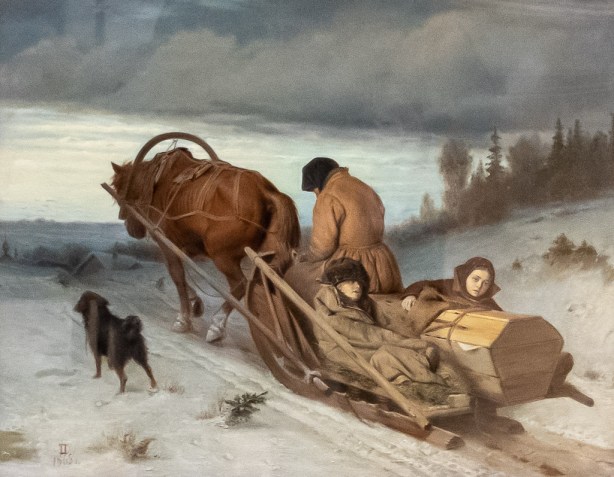
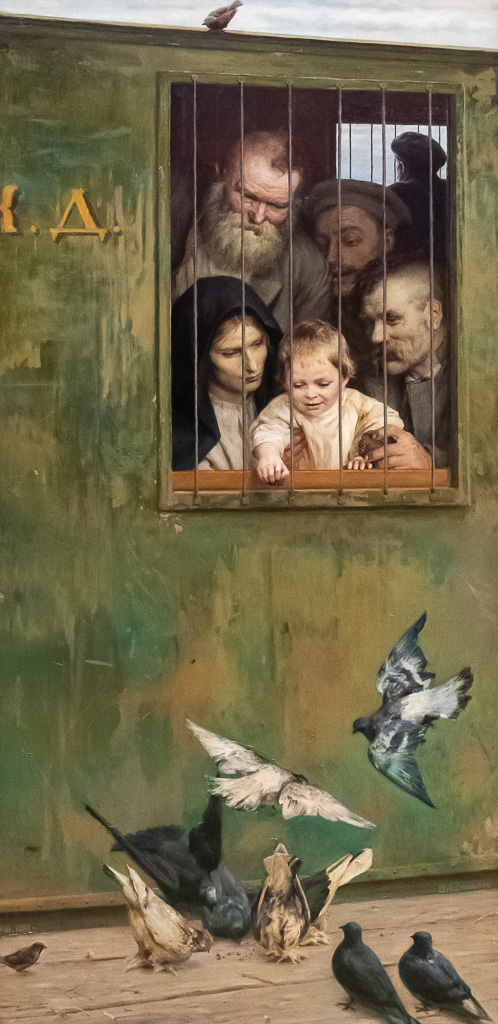
The State Tretyakov Gallery has the best collection of Russian fine art and was started by a merchant from Moscow by name of Pavel Mikhailovich Tretyakov in 1856. Having seen some works by Nicholas Roerich in the gallery in Mysore; I was quite keen to visit this collection of Russian art. I found that many of the works from the 19th Century had very relevant and interesting social themes; especially those by an artist named Vasily Grigorevich Perov. Interestingly, the Gallery did not have many works from the Soviet era; not sure why.


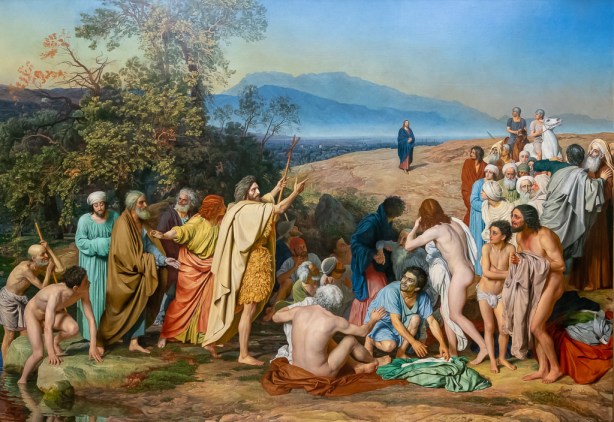
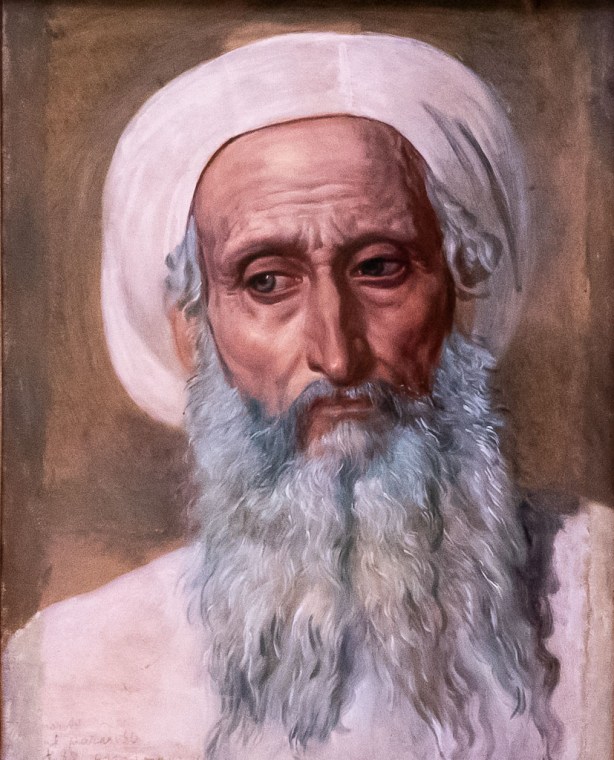
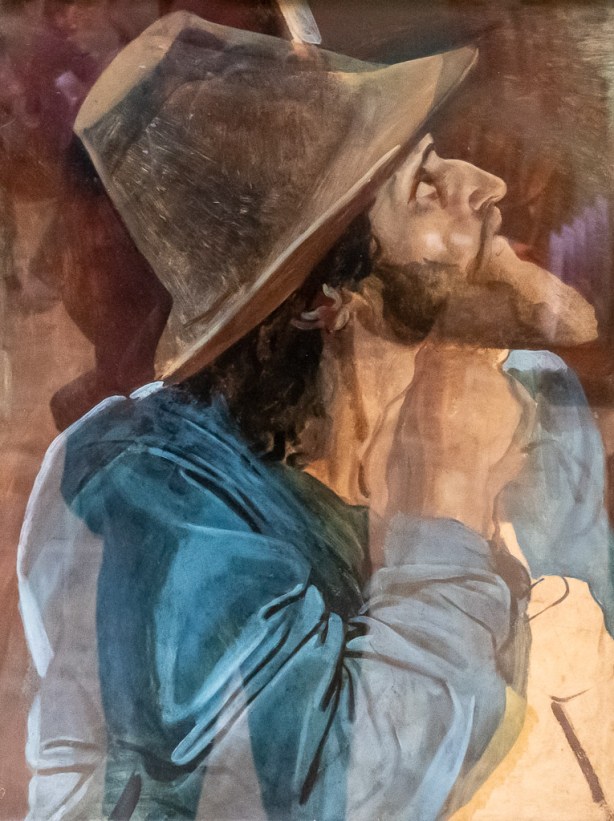
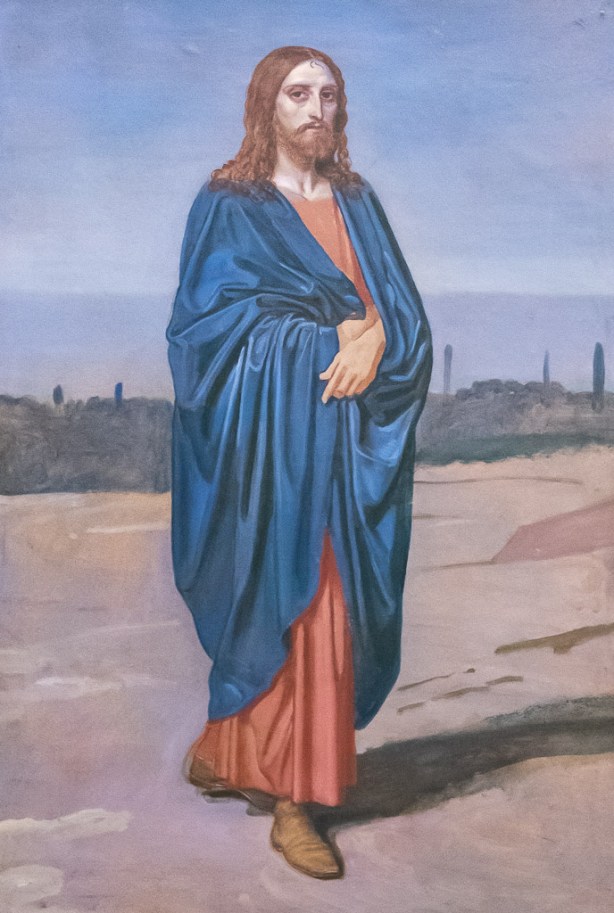
This painting is titled “The appearance of Christ to the people” by the artist Alexander Ivanov. It is a huge work measuring 5.40m x 7.50m and this was the most important work in the life of Ivanov. It took him twenty years to finish this painting and he died within a few months of finishing the painting. John the Baptist is the central figure in the painting (wearing an animal skin) and points to the Christ who appears in the distance. Ivanov has painted himself into the portrait as the wanderer with a staff, sitting right in front of John the Baptist. The artist made several small works, probably as studies for the painting, and these were also exhibited at the museum.


This piece by Konstantin Flavitsky is titled Princess Tarakanova and is based on the story of a young woman named Tarakanova from Italy, who claimed a right to the Russian throne. Catherine II lured her to Russia and imprisoned her in Petropavlovskaya fortress in a cell that was known to flood every time the waters in the nearby river rose. The painting shows a desperate Tarakanova standing up on her cot as the flood waters have reached almost up to the bed. There is no evidence of whether Tarakanova was indeed killed like this but the painting caused a lot of public outcry and Ivanov was later forced to announce that he had made up the subject from a novel.

I liked this painting (The Unequal Marriage by Vasily Pukirev) quite a lot and it seems it was received with a lot of enthusiasm when it was painted as it did not stick to conventional subjects used till then, but instead chose to show a social issue that was common at that time – old, rich men marrying young women who are unwilling, but are forced into the marriage. A young man, supposedly, the girl’s lover, looks on from the back.


Painting titled “Easter Procession in a Village” by VG Perov. I quote from the description provided by the museum: “In the early 1860s, Perov created a series of anticlerical paintings. Its main theme was the clergy that forgot their duty. A bored and drunken procession carrying icons and gonfalons is passing by the viewer. The peasants with half-closed eyes are wading towards a precipice as if they were blind. Their leader, a drunken priest, who has crushed an Easter egg underfoot, has abandoned them. Not far from him we see a woman holding an icon whose image is effaced. Farther off there is a poor man carrying an icon upside down. But the All-Seeing eye on the gonfalon is there as a reminder that these people won’t escape the Supreme Judgment. The dull landscape, dissonant movements of the participants in the procession and bleak dawn emphasise the ugliness of the whole scene. The painting was removed from an exhibition of the Society for the Encouragement of Artists in St Petersburg on grounds of it being an “immoral” work. Its reproduction in the press was banned, and P.M. Tretyakov was advised not to show it to visitors.”


This painting titled “Troika” by Perov was the one that touched me the most. It was painted in 1865 and in those days, peasants used to migrate to the city in search of work, because of extreme poverty and their children used to work as apprentices. Perov used three such children as his models in this painting. The boy in the middle was living with his mother and he had no father; they were very poor as well. Shortly after modelling for the painting, the boy contracted some disease and died. The mother was distraught and heart broken and she sold all her belongings and took the meagre amount she had to Perov and asked for him to sell the painting to her as she wanted to be able to see her boy whenever she wanted. By that time, Perov had finished the painting and it was displayed at the The Tretyakov Gallery. Perov took the mother to the gallery and showed her painting.

Funeral Procession: VG Perov


Yet another work by Perov that speaks about the social issues of the time: “Tea-party at Mytishchi near Moscow”. I quote from the description provided by the museum: “Ordinary on the face of it, the scene of tea drinking under the shade of a tree is transformed by Perov into an accusatory picture that deals with an acute social issue. The table turned cornerwise to the viewer with a samovar on it halves the small canvas, which is almost square-sized. The world of the painting’s characters also breaks into two parts: on one side, we see a fat, well-fed priest, on the other side – a poor old man and a boy. The impression of social drama is reinforced by the Order of the Hero of the Crimean War on the old man’s chest. At the same time, the idyllic background landscape and the circular rhythm of the painting’s composition embody the idea that justice and harmony lost should be restored in the world.”


This painting is titled “Landscape Steppe” and is by an artist named Arkhip Kuindzhi. This work was so very different from the other paintings and I was curious to note that it was painted between 1890 and 1895. I am not sure whether there were many paintings in this style at that time. I was reminded of a photo by Andreas Gursky, which is among the most expensive photos ever sold, having fetched a sum of $4.3 Million in 2011.


This work titled “There is Life Everywhere” by Nikolai Yaroshenko was yet another image that I liked a lot. I quote from the description provided by the museum: “ The topic of social contradictions was one of the most important for Yaroshenko. This painting was inspired by Leo Tolstoy’s story What Men Live By. The artist originally planned to title his work as Where There Is Love, There Is God. Prisoners have huddled up together at the window of a convict car to feed pigeons. The painting’s idea was to show humanity maintained in inhuman conditions. The central group reminds the Holy Family. Like many other Wanderers, Yaroshenko used parallels with the Gospel to enhance the social resonance of his canvas. “This speaks so much to the heart,” said Leo Tolstoy about this painting.”


This painting “Christ in the Wilderness” by Ivan Kramskoi immediately catches the eye because of the very desolate nature. I quote from the description provided by the museum: “The artist looks upon the Sacred history in the context of the issues of his day. Gospel themes and images served at the time as a way to express ideas of what was good and just. Christ’s personality was understood as the “perfect human being” embodiment; the life journey of a progressive person was a reflection of His earthly path. Kramskoi wrote: “…There is a moment in the life of every human being, who is created in the image of God however slightly or greatly, when they are in a quandary – whether to take the ruble and deny the Lord or not to yield a single step to the evil.” The painting took on a topical nature thanks to the resemblance of Christ’s pose on Kramskoi’s canvas to the pose of Fyodor Dostoevsky in the famous portrait by V.G. Perov. Both paintings were made in 1872 and both were shown at the very same travelling exhibition. Eternal, panhuman problems are the central theme of the painting.”


This is a huge work titled “The Princess of a Dream” by an artist named Mikhail Vrubel. It measures 7.5m x 14m and was painted in 1896 with the help of two others. It speaks about a love affair between Geoffroy Rudel and Princess Melisandre. Supposedly, Rudel heard about the beauty of the Princess and travelled across the sea to meet her. Unfortunately, he contracted some illness during his voyage and died at the time of their first meeting and with this, the Princess became a nun. I am not sure whether this is fiction or true story. I was not very exposed to Russian art in the past and Tretyakov definitely set that right. It was quite a beautiful experience.

Moscow has very wide roads and walking around the city itself is a pleasure. I was staying close to the Red Square and many buildings around that area were very impressive. There is some more to see in Moscow and two days were not enough. I hope to be back one day.


At the Albertina Museum in Vienna, I came across an exhibition of the works of an artist, whom I had not heard of earlier. Of course, that only points to my lack of familiarity with the art world and Keith Haring – the artist featured – is pretty famous for his work. The show was titled “Alphabet” and it was so named as Haring had developed a pictorial “alphabet” for his work. He was of the view that art is for the public and wanted everyone to understand what he was drawing about. For him, art was a political activity and that was very evident from his work.

Haring was born in Pennsylvania in 1958 and lived but a short time before his death in 1990 from AIDS related complications. Yet, within these 32 years, he achieved great fame as an artist and produced a huge number of drawings and paintings. He had his first solo exhibition when he was just 20 and had more than 500 exhibitions between 1982 and 1989.

He was always bothered about the treatment meted out to minorities and people who were “different” – he himself was gay – and his work reflected this. He was a bit ambivalent in his approach towards money and did not like the idea of making art so that they could be hung in galleries with the viewership limited to a few; however, he considered it important to earn enough money as well. He was very critical of capitalism and its impact and was well aware of its connection to racism and suppression. War horrified him and he was also against nuclear reactors as he was aware of the horrors of the Three Mile nuclear accident, which occurred near his hometown in 1979.

Legendary artist Andy Warhol was a close friend of Haring’s and he considered Warhol as someone who had beaten capitalism at its own game. Yet, he also considered Warhol as the consummate form of the artist as a businessman and that was not a position he appreciated. Haring tried to move away from being an artist for the elite and wanted to create art for the public. Mickey Mouse was one of Haring’s oft used motifs and his ambivalent position towards Andy Warhol might have been the reason for this painting.


At times, he collaborated with other artists and one of the first pieces in the exhibition was a miniature Statue of Liberty which he had made in collaboration with the artist LA-II (Angel Oritz). This work is considered to be Haring’s criticism of the American promise of equal opportunity for all – take note of the black bulb instead of the torch.


There were about 100 works in the exhibition and good many of those are reproduced in these pages.


He tried to develop his own pictorial language, which he wanted everyone to understand. He borrowed some of the common motifs like the Egyptian god Anubis and the Golden Calf. He also developed his own symbols like the dog, the radiant baby etc. The meaning of these symbols depended on the context in which they appeared. For instance, the dog could be a symbol of justice or protector but could also be an attacker. In his own words: “The dogs really were representational of human and animal. In different combinations they were about the difference between human power and the power of animal instinct. It all came back to the ideas I learned from semiotics and the stuff from William S Burroughs – different juxtapositions would make different meanings.” In the image below, we see the dog attacking a street artist and there is blood all around.


The Golden Calf is generally understood to represent idol worship and Haring used it to show mass hysteria and manipulation. I felt that Haring might have had a field day as an artist if he were to live in present day India.


He borrowed the happy Porky Pig from Looney Tunes and used it as a reference to consumerist society and the growing alienation from nature. In 1978, he wrote alongside a drawing: “Everyone knows where meat comes from, it comes from the store”.


The flying saucer was a symbol that Haring used to depict the other – those outside the “normal” contours of the society – and he considered that these others could strengthen and empower people and society.


He tried to communicate through imagery that could be more easily understood and produced a huge amount of drawings. He drew on paper, plastic sheets, tarpaulins; anything that he could lay his hands on. Most of it was about celebrating life, empathizing with the sidelined and the marginalized, protesting against oppression, consumerism, mass culture etc. Good many of this was in the public space, on walls etc.


In 1980, John Lennon was shot dead and Haring responded to Lennon’s death with the image of a man with a hole in the middle. In Haring’s own words: “Actually, this image of a man with a hole in his stomach came after I heard of John Lennon’s assassination…I woke up the next morning with this image in my head…and I always associated that image with the death of John Lennon”. This image may also be taken to symbolize the emptiness within modern man.


In his early days, he also tried the abstract language as shown in the painting below.


However, he soon abandoned this because: “The abstract paintings would not make any sense if they were painted in public space. It was first when I started to draw images which could be read as signs that I went into public space. Because these paintings made sense in the streets – all people, all languages could read them. After studying the theory of communication, information and drawing and how meaning speaks through signs and how this language – because that is what it is – works – I chose a primitive code.”


The radiant baby was another of Haring’s most used symbols. He considered babies were always connected with positivity. He said: “Babies represent the possibility of the future, the understanding of perfection, how perfect we could be. There is nothing negative about a baby, ever. The reason that the ‘baby’ has become my logo or signature it is the purest and most positive experience of human existence.” This statement immediately brought to my mind a passage I had read in the autobiography of Elie Wiesel titled “Night”. Wiesel was a survivor of Auschwitz and in the book he talks about how he witnessed live babies being thrown into fire by the Nazis, at the concentration camp. The contrast between how artists like Haring viewed and valued human life and how the fanaticism makes one such values was a telling point.


A light bulb as a motif for ideas.

Torture


A self-portrait

Haring was against organized religion and in his work, crosses were used by people to commit to murder or people lost their lives on them. “You can only help and encourage people to live for themselves. The most evil people are the people who pretend to have answers. The fundamentalist Christians, all dogmatic ‘control religions’ are evil. The original ideas are good. But they are so convoluted and changed that only a skeleton of good intentions is left.”


This painting has a mistake which turned out to be a major hit. When Haring was painting this on a wall, he made a mistake in painting the first eye too far to one side and realized that he was going to be left with a lot of unexplainable empty space. To get over the problem, he painted a third eye – his only intention was to fill up the space. He was later amused to hear about people interpreting the third eye as Haring’s allusion to surveillance, consciousness etc. He had meant nothing of the sort – a classic case of a work going beyond the creator once he or she was done with it.

In addition to the barking and the biting dog, Haring also used a form like that of Anubis. According to Egyptian mythology, Anubis (the dog-headed god) was entrusted with weighing of the heart during the judgment of the dead; thus controlling the fate of the dead person. Here is an image which alludes to the dance of death and how everyone is equal before death.


Haring considered his work to be political. He says: “Most of my political concerns and social concerns came from my life experiences. Partly being born in the late 1950s and growing up in the 60s and sort of being around that counter culture but not being able to participate. Definitely being very affected by that and being at an age at the time when I think I was most impressionable, like seeing the Vietnam War when I was ten years old, seeing race riots in television and reading Life magazine.”


Sometimes, human shapes are depicted with dotted bodies. This can indicate otherness – skin colour, homosexuality, illness such as AIDS etc.


For this painting, I found the note provided by the curator to be quite interesting. “The caterpillar is the actual feeding stage of the butterfly and has to shed its skin several times before achieving its final size. Only after metamorphosis does it transform into the butterfly, whose beauty solely serves the purpose of procreation and the fades. In Haring’s art the caterpillar thus stands for both transformation and metamorphosis and for greed and a craving for food, which is why in some of his works it is depicted as a monster. With a computer replacing its head, the caterpillar turns into a technological ogre. In Haring’s art computers and robots describe the prevalent fear of new technologies, the space age, Silicon Valley, and the potential control of machines over humans. As early as 1978 Haring gave much thought to the subject of computers and to what they mean for our daily lives: “The silicon computer chip has become the new life form. Eventually the only worth of man will be to service and serve the computer. Are we there? In a lot of ways we are.””. To me, it was amazing that he had thought of this man-machine conflict so long back.


The Golden Calf is replaced with the red monkey to warn about mass infatuation and hysteria.


Towards the end of his life, Haring was sure he was going to contract AIDS as several of his partners had died because of the disease. His art also reflected this preoccupation and danger of the monster.


In this work, a deadly monster is shown as grabbing its victims while offering its orifices in deadly invitation.


Between 1980 and 1985, Keith Haring started making drawing on the unused billboards in the subway. Such advertisement boards were covered with black paper and he drew with chalk on the black paper. He is believed to have made between 5,000 to 10,000 such drawings but most of these have been lost. This was an illegal activity and was he would have been arrested if caught making the drawing and so he had to work very quickly to avoid getting caught. He considered this as the perfect laboratory for him to experiment on the ideas he was thinking of. Soon, the public started noticing these drawings and started to carry them home as collectibles. This prompted Haring to stop this activity as he wanted his work to be with the public, and be accessible to them, than be in collections.


I have generally not been to appreciate this type of art, which looks quite undeveloped and primitive, almost like a child’s drawing. Yet, Keith Haring captivated me; maybe because of his stance and politics in his works, maybe because of what I could sense of him as an individual by seeing his art; maybe I was amazed that such type of art could earn such international acclaim in such a short time. I am not sure, but the fact remains that I spent a good amount of time looking at his work and felt good to know of Keith Haring, his life and art.

Yet another version of the Kochi  Muziris Biennale is around the corner and I suddenly remembered that I had not finished the note I had started writing about KMB 2014. So, here goes…

I had really enjoyed Kochi Muziris Biennale 2012 and it was with barely suppressed excitement that I waited for KMB 2014 to begin. The lead up to the event was very well done with lot of functions happening in Kochi. Unfortunately, I couldn’t attend any of those as I am based at Bangalore but one got all the information through FaceBook. This time, there wasn’t any controversy about whether we should have KMB at all and I was quite pleased with that. To me, this was an indication of the success of KMB 2012 and the public’s interest in the event. Hats off to Bose Krishnamurthy and Riyas Komu, the main organisers of KMB!

The show started on December 12, like last time and went on till March 29, 2015. The theme of the event this time was “Whorled Explorations”. The curatorial note spoke about how the show was about bringing in various elements connected with exploration and travel. So, maritime trade, conquests, mathematics, navigation, colonialism, globalization etc. have all found their way into KMB 2014. A few sentences from the curatorial note struck a chord in me: “…. like exaggerated extensions to gestures we make when we try to see or understand something. We either go close to it or move away from it in space, to see it clearly; we also reflect back or forth in time to understand the present. Whorled Explorations draws upon this act of deliberation, across axes of time and space to interlace the bygone with the imminent, the terrestrial with the celestial.”

I arrived at Kochi on the morning of December 29th and went straight to Aspinwall House, the main venue of KMB 2014. There cannot be a better location for the KMB than Fort Kochi with its wonderful buildings like Aspinwall House, Pepper House etc. These are just great locations that really add character to the event. You can really feel the difference when you go to Durbar Hall (which is also a venue of KMB), which is more like a conventional gallery; it just doesn’t have the character or ambience of locations like Aspinwall House or Pepper House.

In a repeat of KMB 2012, I could not understand the first installation at all. These were minimalist poems from an American poet – Aram Saroyan – but it was well beyond me. Actually, I was reminded of the candy “m&m” when I saw one of the “poems”.

dsc_0003

dsc_0009

dsc_0010

Next was a work by Mona Hatoum. When I saw her name in the exhibition catalogue, I had great expectations as I had seen one of her videos (Measures of Distance) at an exhibition at Bangalore and that had left quite an impression on me. The installation at KMB consisted of light bulbs laid out in a circle with a wires crossing each other and snaking out to the bulbs. While there was an element of visual attractiveness around the work, I could not connect with it. It somehow reminded me of Diwali lights!

dsc_0017

Next one that caught my eye was a series of 90 charcoal drawings by Madhusudhanan titled “Logic of Disapperance”. These show some historical figures with connections to some incidents as well and were quite interesting. I particularly liked an image with Lenin’s head the body being made up of the skeleton of a Trojan Horse kind of structure. With the military helmet thrown in, it looked to me to represent Stalin sneaking into power on the back of the Revolution led by Lenin and Trotsky. Interesting aside: In the book “Ten days that shook the world” written by American journalist and Communist John Reed who witnessed the Russian Revolution firsthand, Stalin’s name comes up only twice and that too as passing reference.

dsc_0029

dsc_0027

dsc_0039

It seems the word “journey” owes its origin to “a day’s travel” and there was a work by David Horvitz on this theme. This was a video installation running simultaneously on two mobile phones titled “The Distance of a Day”. The artist created this work by shooting a sunrise in Maldives while his mother shot the sunset in California at precisely the same time. So, at the same instant, sun is rising and setting and being watched by two people separated by distance but united by a bond. To me, this felt like the expression of how what is perceived as truth is a function of location. A sunrise is the truth for me at a given location whereas at the same time, it is the sunset that is the truth for someone else at a different location. If we abstract physical location to locations of the mind, the work achieves an even more interesting dimension.

dsc_0048

On the grounds of Aspinwall House, there was a large sized installation called “Backbone” by Shanthamani Muddiah. This was a long spinal column made of cement and cinder. It seems the artist likes work with charcoal quite a lot because of its connection with remnants of prehistoric times. While it was a interesting sight, I could not connect with the work.

dsc_0056

dsc_0064

Janine Antoni’s video installation “Touch” was riveting and I sat in the room and watched it for quite some time. The artist is from Bahamas and she had tied a tightrope in the seashore in front of her house and in the video, she is seen walking on the rope. The rope is interestingly positioned and so it looks as if the artist is walking on the horizon. I felt it connected well with the theme of KMB and man’s desire to reach the horizon which was forever slipping away. On another level, I felt that the work was about our desire to conquer what is essentially an imaginary entity.

dsc_0103

dsc_0106

It was in a pensive mood after watching our desire to reach the imaginary that I stepped into the next room, which had another video installation titled “Standard Time” by Mark Formanek. In this video, workers continuously modified wood pieces to accurately reflect the current time. This meant that they were at it each minute as time ticked by; seemingly an exercise in futility. The video was recorded over 24 hours and as I watched it go along with its absurd sequence, I was reminded of the rat race that most of us are engaged in.

dsc_0114

dsc_0115

Next was a room with paintings on large pieces of fabric that looked like the sails of ships. This was a work by Lavanya Mani titled “Travellers Tales – Blueprints.” The paintings and the shape of the fabric brought forth thoughts of voyages across seas. The link between colonialism and textiles was quite evident in this work.

dsc_0134

The theme of man’s progress or journey continues on to the next work that caught my interest, a triptych titled “Building a Home; Exploring the World” by Sudhir Patwardhan. The first panel shows the start of migration, perhaps the first long journey, as man started on his trek out of Africa. The second panel has images of Pieter Bruegel’s “Tower of Babel” and Vladimir Tatlin’s “Monument to the Third International” reproduced in a coastal landscape resembling Kochi. This was a depiction of man’s deepfelt desire to build and grow and the third panel shows the continued expansion and extension of the journey as we move to conquer space.

dsc_0141

Artist Nikhil Chopra held a live performance in one of the rooms of Aspinwall House. The performance lasted 50 hours and was about a colonial character named Black Pearl being incarcerated in a cell. He draws the sights he sees from his cell on the walls of the cell. The work was titled “Le Perle Noire: Le Marais”. I did not see the live performance but the cell, with its paintings, was available as an exhibit. I cannot clearly explain what I felt when standing in that room but it was somehow captivating.

dsc_0165

dsc_0151

dsc_0144

There was a very large (79 ft long) painting by NS Harsha titled “Punarapi Jananam Punarapi Maranam” depicting the universe as one continuous entity. The work itself was beautifully executed with very many interesting details. This one was a bit above me and I could not get a grasp of it.

dsc_0174

dsc_0175

dsc_0180

“Sea Power” is a work by Hew Locke that explores early stage of globalisation and its connectivity with sea voyages. While the images made out of plastic beads were interesting to look at, I did not feel any connect with the work.

dsc_0457

dsc_0451

Often what we see on the outside is not what is inside and there was a wonderful work like this titled “Background Story: Endless Xishan Mountain Scenery” by Xu Bing. This was an arrangement of old newspapers, twigs, straw etc., which when viewed through a translucent screen with back-lighting, replicated a landscape painting by Chinese artist Xu Ben who lived in the Ming Dynasty period. It was a painstakingly created work and fills one with awe. I guess one could read a whole lot of ‘internal-external” aspects into this work.

dsc_0489

dsc_0491

dsc_0493

dsc_0496

Africa is a continent with a lot of failed dreams; independence from colonial masters filled people with hope but slowly, these dreams faded as despot after despot ruled the newly independent countries. I have travelled to many such countries in Africa and have had conversations on related subjects with people there. Hence the work titled “Independence Disillusionment” by Kader Attia was something I could understand very easily. These 26 paintings are reproductions of postage stamps that were released around the time these countries gained independence. The dreams may have been Utopian but they were good dreams to have; but unfortunately, these countries wallow in significant poverty and even civil wars as the rulers continue from where the colonialists had left off.

dsc_0518

dsc_0522

dsc_0524

dsc_0526

dsc_0527

Artist Namboodiri is a familiar name from his illustrations that accompanied stories and novels in Mathrubhumi Weekly and I was pleasantly surprised to see a series of drawings he had created specifically for KMB, titled “Vara/Thira”. These were scenes of Kochi, its streets, houses etc.

dsc_0504

dsc_0505

dsc_0506

dsc_0503

Prashant Pandey’s work “Artha” is a huge diamond made up of 10,000 discarded slides that have blood drawn from various people including the artist. According to the artist, the work talks about the sacrifices made in the course of the colonial quest for wealth. To me, it immediately brought to mind the tragedy of “blood diamonds’.

dsc_0562

Punaloor Rajan had photographed many of the public figures in Kerala for a long time and these images and videos form an archive of sorts. Several photographs from this image had been bunched together and exhibited under the title “Perpetual Stills”. It was interesting to see the images of our familiar figures, many of whom have already passed on from this world.

dsc_0568

In one of the rooms a tent had been pitched – it was much like a tent used by travelling traders. This work by Francesco Clemente was titled “Pepper Tent” and was made of fabric painted by Clemente. The images inside the tent connect with trading and travel and to be inside the tent was some sort of an interesting experience. It was quite colourful and visually pleasing.

dsc_0580

Pepper House, as always, is a delightful place with a quaint nice café thrown in. In the courtyard, was a sculpture by NS Harsha titled “Matter”. Sculpture is often quite beyond me and this one was no different. It blended in well with the surroundings.

dsc_0197

dsc_0198

Pepper House was also witness to a performance-installation wherein a huge bell was lifted out of the backwaters and installed as a leaky fountain. This was Gigi Scaria’s work titled “Chronicle of the Shores Foretold”. The bell is a symbol of European colonialisation and it was installed with the help of the traditional labourers of Beypore – the khalasis. To me, this was kind of a depiction that colonization was possible only with the help of the locals and it seemed apt to have such an installation in Kochi which had a pliant King who bowed down before the British. However, the bell itself was leaking and so the idea of colonization was never a fully secure idea, as we have seen in history.

dsc_0261

I happened to look at the bell from a room in the first floor and it was an interesting sight from there. The frame reminded of the paintings of Murali Cheeroth.

dsc_0233waSumakshi Singh had created an installation titled “In, Between the Pages’ which is a 70 feet long maze made of scrolls hanging down. Viewed from a particular angle, these split images come together to form two pages inspired by a Sanskrit treatise on astronomy titled Surya Siddhanta and illustrations from a Dutch East India company manual, Hortus Malabaricus. It was quite interesting to walk through the maze as it felt as if one was being part of or inside the image itself.

dsc_0203

dsc_0217

dsc_0205

A very interesting installation that I found in Durbar Hall was Julian Charriere’s “We Are All Astronauts”. The artist collected mineral samples from all recognized countries of the world and made sandpaper from these samples. He then rubbed the surface of 13 found globes with this sandpaper till all the markings had been erased from the globes. The globes were then suspended over a table on which one can see the dust that resulted from the scraping. Does it mean that international interaction (scraping) will cause boundaries (markings) to fall away? Does it mean that there are no real boundaries even now because of the interplay of civilization and cultures? I found this to be quite an interesting installation.

dsc_0343

dsc_0349

dsc_0356

In one the other art galleries in Fort Kochi, there was an installation by Murali Cheeroth. It clearly brings out the challenge of the times we live in and I felt it was a piece of art that needs to be seen and understood by everyone in India. Murali had copied Martin Niemoller’s famous poem and inscribed it on glass panels.

dsc_0294

dsc_0296

One of the joys that go hand-in-hand with KMB is the chance to see various art works that spring up on the walls in and around Fort Kochi. That is a treat by itself and this time also there were many beautiful pieces of art that were quite interesting.

dsc_0194

dsc_0277

dsc_0389

dsc_0629

dsc_0634

dsc_0635

dsc_0640

dsc_0641

dsc_0642

dsc_0644

dsc_0643

dsc_0196

dsc_0388

dsc_0645

dsc_0646

dsc_0647

dsc_0648

dsc_0649

dsc_0653

dsc_0657

Yet another version of Biennale had gone by and it was definitely an improvement over the first one. This is indeed a wonderful event for Kerala and even the whole of India. Hope the 2016 version will keep the show moving ahead.


Last month, I found myself in Miami with a couple of days to spare. I was looking for something different apart from the beaches and entertainment parks of Florida and so, I decided to drive to the west coast of Florida and I chanced upon a town called Punta Gorda and dropped anchor there. Punta Gorda is a nice, small town right on the bay. About an hour’s drive from Punta Gorda is Sarasota and while looking through the images in TripAdvisor, a building in Sarasota caught my eye as it looked kind of out-of-place in Florida and I decided to go there. Further showed this to be the Ringling Museum complex and I set out in the morning on a beautiful sunny day.

DSC_0013

DSC_0025

I was not much aware of Ringling before the trip though I had heard of Barnum Bailey Circus. John Ringling was born into a family of seven brothers and a sister in 1866 in Iowa. He along with four of his brothers started the Ringling Circus and then they acquired the Barnum Baily Circus to become the largest travelling circus in the US and they called it the Greatest Show on Earth. John turned out to be the most famous of the five brothers and also ventured into areas like real estate development and eventually became one of the richest men in the world at the time. So, when I drove there, I was expecting to see the house of a rich circus man and spend some time in a leisurely manner.

The house stands on 66 acres of land and is built in the Venetian Gothic style and is named “Cà d’Zan”, which means House of John in Venetian dialect. The grounds are beautiful with many wonderful trees and small ponds.

DSC_0027

DSC_0031

DSC_0115

DSC_0224

DSC_0296

There are three main attractions to visit – the Circus Museum, Cà d’Zan and the Museum of Art. I started with the Circus Museum. First off, what struck my eye were a series of posters that were quite nostalgic. The Circus museum took me right back to my childhood when the circus was a rare occurrence and a visit was always a keenly awaited event. I think I have only been to the circus twice – it was a different world of amazing, hair raising acts and exotic animals. Of course, at that time, I was too young to realise that life for those performers was totally unlike the glittering visual they presented. Of course, in today’s world where visual treats and images are dime a dozen, the circus has lost out. It is no longer possible to hold interest and cause excitement and amazement through such acts as trapeze or motorbike riding within a globe or jeep jumping or a parade of wild animals. To me, the circus represented an era gone by. Such were the thoughts that flashed through my mind as I walked through the museum. The third face in the poster below is John Ringling.
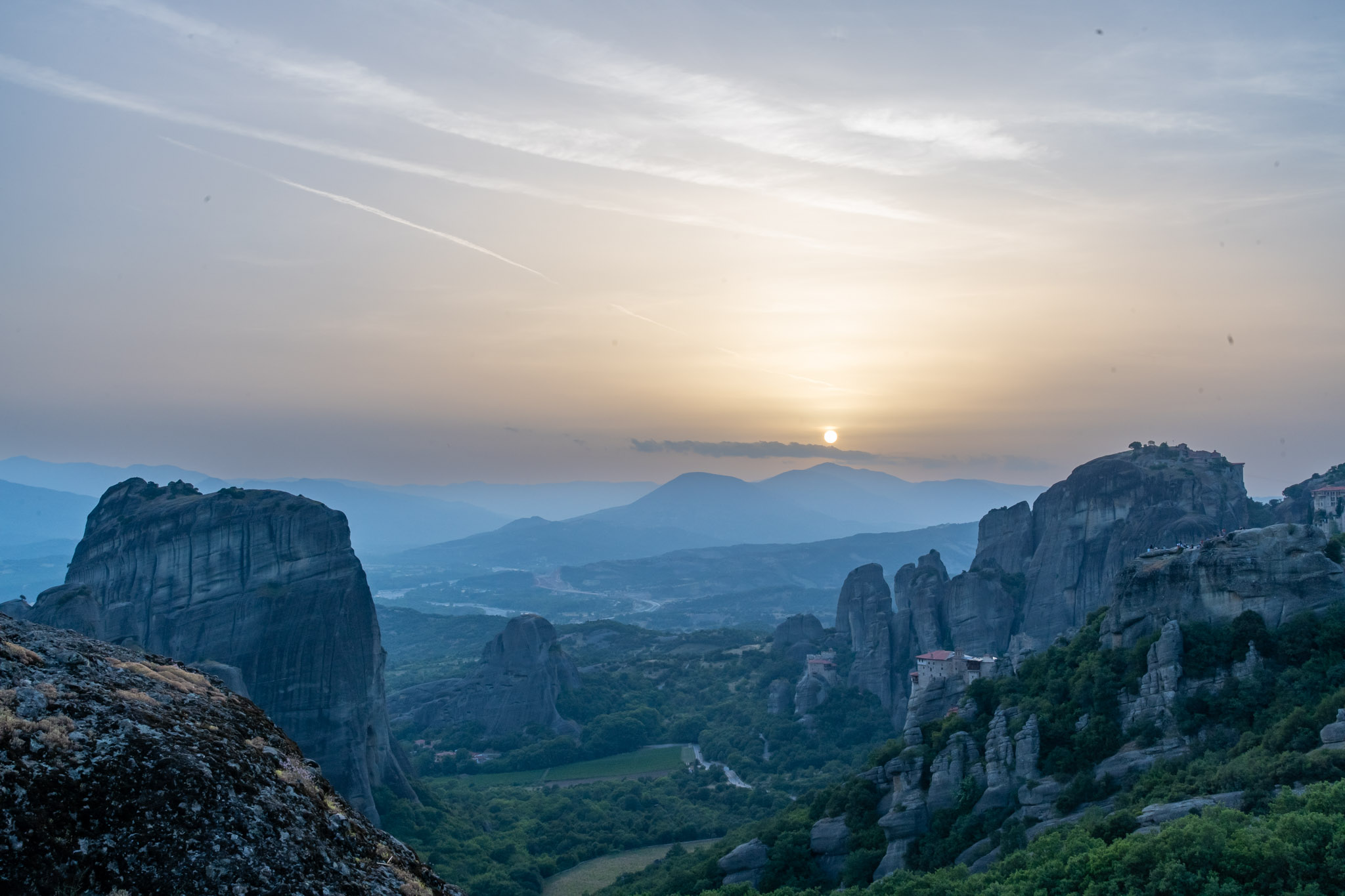
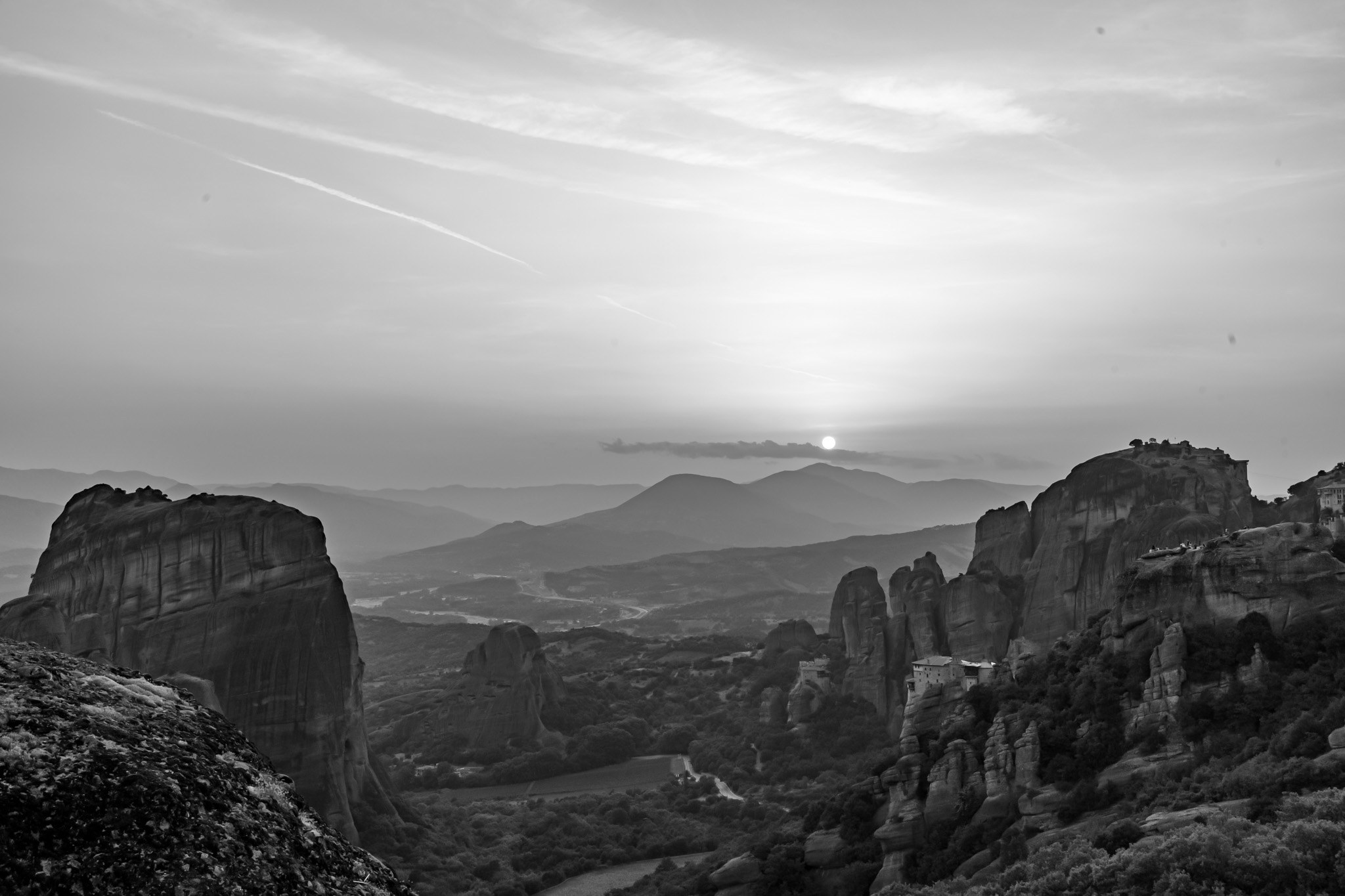
DSC_0220

DSC_0037

DSC_0041

DSC_0043

DSC_0045

DSC_0046

Perhaps it was this foresight that the circus would soon die out which caused the artists and sculptor Howard Tibbals to create a miniature replica of the Ringling Bros. and Barnum & Bailey Circus, which was the largest circus in the world at the time. This replica is available for view in the Circus Museum and is indeed a grand sight. Till then, I had no idea of the scale of size of this circus. I was thinking of something slightly bigger than the “Gemini Circus”, the whole of which fitted into 3 or 4 trucks. What I saw at the Tibbals exhibit was a circus that owned trains so that it could transport itself to various palces. The “Big Top” or the performance tent had three rings, four stages, a hippodrome track and the show lasted two and a half hours with about 800 artists participating and it could seat 15,000 people! The show was so large that it owned trains that were used to transport all the material, animals and people. The logistics behind the whole show must have been amazing. I read that the Big Top consisted of six centre poles, seventy four quarter poles, one hundred and twenty two sidewall poles, five hundred and fifty stakes and twenty six thousand yards of canvas and what was amazing was that they could erect this tent within four hours!

DSC_0064

DSC_0074

DSC_0078

DSC_0081

DSC_0082

DSC_0096

There is also an exhibition of some of the real objects that were connected to the show like a human cannon, various cages used to transport animals and the private rail coach (named Wisconsin) that the Ringlings used when they travelled along with the circus.

DSC_0217

DSC_0193

DSC_0199

DSC_0204

DSC_0205

DSC_0207

Cà d’Zan was finished in 1927 and looks quite beautiful. It sights right on the sea and there are steps leading to the water. The interior is quite rich and ornate with all the conveniences that the time provided.

DSC_0114

DSC_0121

DSC_0122

DSC_0130

DSC_0131

DSC_0146

DSC_0155

DSC_0161

DSC_0165

DSC_0175

DSC_0179

After a leisurely lunch at the café, I strolled across to the Museum of Art. Till then, I was thinking of the whole affair as the house of a very rich circus man who had an interest in art and nothing much beyond that. However, I soon got to know that this tale had some other interesting angles. John Ringling and is wife Mable wanted to build an art gallery to build up an awareness of art and culture in the people of the locality. It was not meant to be a museum for the viewing pleasure of a few rich people but was meant to bring the masters to be available for the public. The museum was set up with twenty one galleries and John Ringling gifted this museum with more than 400 art pieces along with an endowment of $1.2 Million to the State of Florida upon his death in 1936. There were works from masters like Peter Paul Rubens, Paolo Veronese, Diego Velazquez, Giambattista Tiepolo, Lunas Cranach the Elder etc. In the courtyard is a 19th century replica of Michelangelo’s David.

DSC_0229

DSC_0231

Peter Paul Rubens: Meeting of Abraham and Melchizedek

DSC_0237

Lunas Cranach the Elder: Cardinal Albrecht of Brandenburg as Saint Jerome

DSC_0241

Piero di Cosimo: Building of a Palace

DSC_0246

Paulo Veronese: Rest on the flight into Egypt


DSC_0248

Franceso del Cairo: Judith with the head of Holofernes


DSC_0249

Antonio de Bellis: The flaying of Marsyas by Apollo


DSC_0251

Jan Davidsz de Heem: Still Life with Parrots


DSC_0274

Peter Paul Rubens: Flight of Lot and his family from Sodom


DSC_0280

Peter Paul Rubens and Osias Beert: Pausias and Glycera


DSC_0282

Giambattista Tiepolo: Glory and Magnanimity of Princes


DSC_0287

Robert Henri: Salome


DSC_0262

DSC_0272

John Ringling was one of the richest men in the Roaring Twenties and like many of his peers, he too thought that the good times would continue for ever. However that was not to be and the Great Depression arrived. Ringling suffered huge financial losses and he lost his wife Mable also in 1929. When John died in 1936, the man who was once the one of the world’s richest men had a princely sum of $311 in the bank! What struck me was that he had managed to fight his creditors for many years and hold on to his house and the art museum with its priceless works and finally willed it to the state so that all could benefit from it. John Ringling, obviously, was no ordinary circus tycoon.