21 May 2012

As it often happens, the places that are the closest are often the ones that are farthest! This has been so with me, in the case of Tippu’s Fort which is located at Palakkad. Palakkad is but 15 Kim’s from my hometown, Chittur, but I have never visited the fort after my schooldays; which, admittedly, was way back. So, I had decided that I would make it to the fort this time around when I went to Chittur.

The fort has been restored quite recently and some of the ramparts that had fallen down have been rebuilt. It dates back to medieval times and was renovated by Hyder Ali (Sultan of Mysore) in 1766, when he was invited there by the king of Palakad to help against an invasion threatened by the Zamorin, the king based in Calicut. Hyder took advantage of the opportunity, realizing the strategic significance of Palakkad. The fort changed hands a few times between the British, Hyder Ali and his son, Tippu Sultan till 1790. The British controlled the fort from 1790 onwards and used it as their base. Even today, the fort is known as “Tippu’s fort” even if Tippu held the fort only for a few years and was not the one that built it. When I thought about it, I was happy that there were at least some monuments left as remembrance for this brave and patriotic son of India.

I have felt that Tippu Sultan has often been sidelined and his role in history underplayed, by vested interests. He was one of the very few kings in South India that realised the threat the East India Company and the British posed. His wars with the British have been well chronicled and even though he succumbed in the end, he remained a thorn in the side of the mighty British for many a year and that too when all the rulers of the neighbouring kingdoms had meekly surrendered, out of cowardice and for personal gains. He had the vision of free India and fought for it, ultimately giving his life. As a true hero, he fell in battle, fighting till the very end.

Yet, he is painted as a religious fanatic, one who was only interested in converting Hindus to Islam. No matter that the first sight that greets you as you walk into his fort in Palakkad is a Hanuman temple – one of the most powerful Hindu gods. This temple is a big favourite with devotees even today. It also does not seem to matter that the very famous Srirangam Temple stands within Tippu’s fort and stronghold at Srirangapatnam and I cannot imagine that it would have been a huge effort for him to mow it down. It is obviously of no significance that it was Tippu that sent money to help the Kanchi Mutt after that Hindu monastery was ransacked by the Hindu Maratha rulers. The list goes on and I am just writing what I have seen and heard and by no means am I an expert. I am sure that his armies would have raped and plundered as is the wont of victorious armies but then, which victor has ever held his forces back after a battle? Even today, in our “cultured” ways, the spoils of war go to the victor.

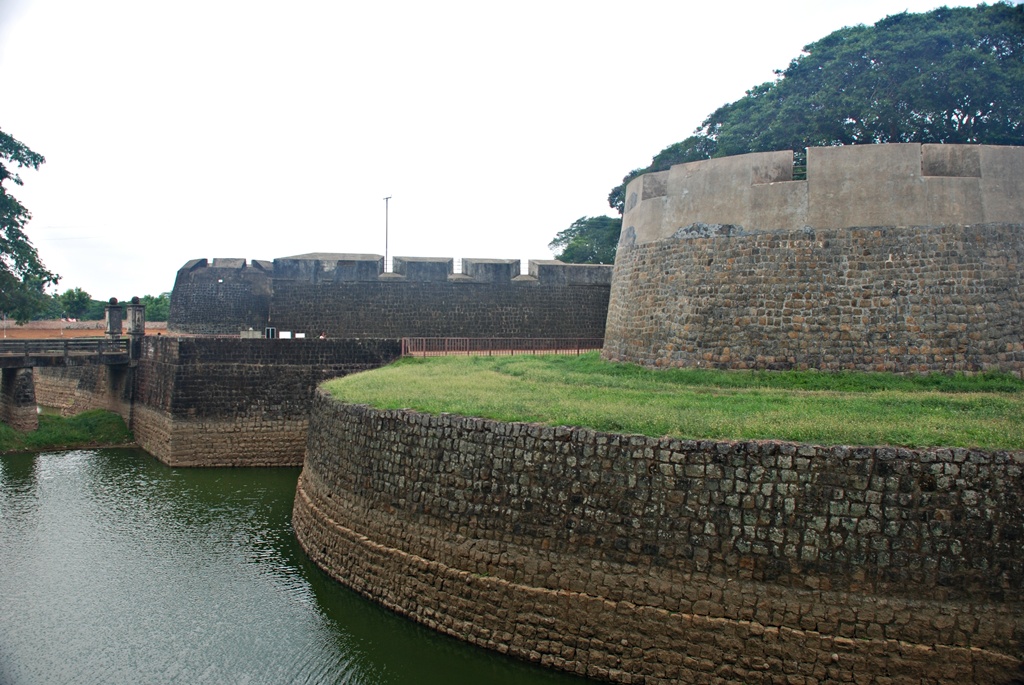
The fort itself stands on a small hill and there is a large moat surrounding it. In my childhood, I had heard stories that only Tippu’s horse could leap over the moat and when I looked at the size of the moat, I realised that it was just that, a story, given the size of the moat.

There is very little water in the moat today and you enter the fort through a small bridge.

The fort itself is very functional and is built with large granite boulders and limestone. It is of rhomboidal shape shape and has seven bastions with very thick walls. There does not seem to have been much effort spent to make it beautiful in any way. At the main entrance, I saw some decorations on the wall above the door and that was pretty much the only decorative piece I saw in the entire fort.

As you enter, on the right, there is a small idol of Hanuman set into the wall. This has now become a very famous temple and there were many devotees even at mid-morning, when we went in. I was not allowed to photograph the temple itself, in keeping with the recent form of intolerance which denies entry to non-Hindus to temples. I also noticed that the temple itself had a “saffronised” look with the imagery and colours used and even with name of Ram, written in Hindi. Perhaps this is a good indication of who controls this temple and I felt one could easily transport this temple to North India and it would fit in there very well.

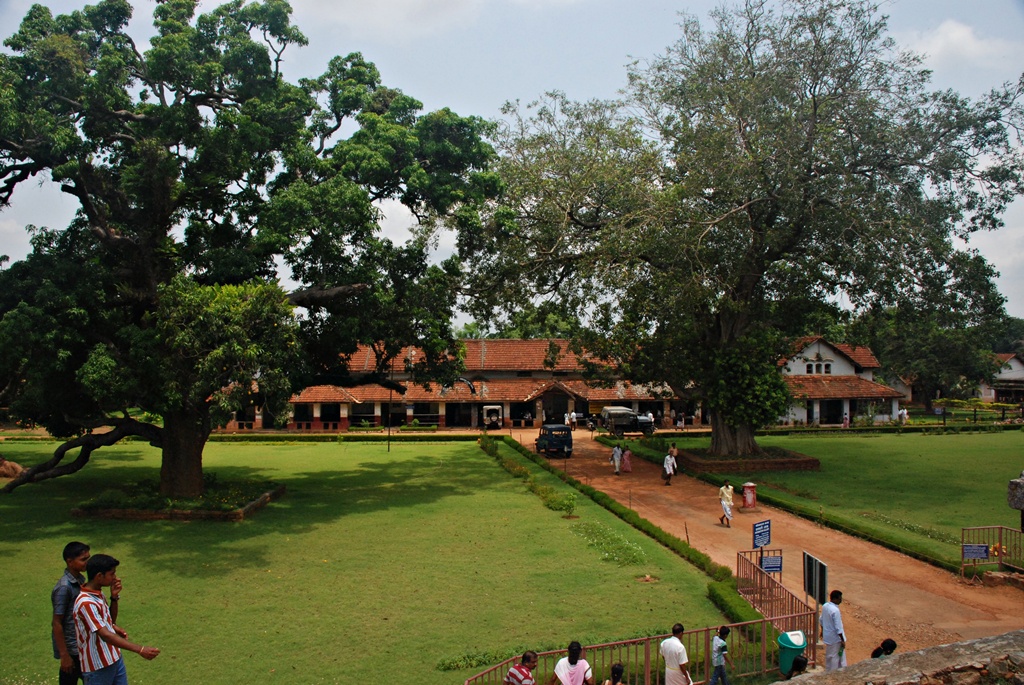
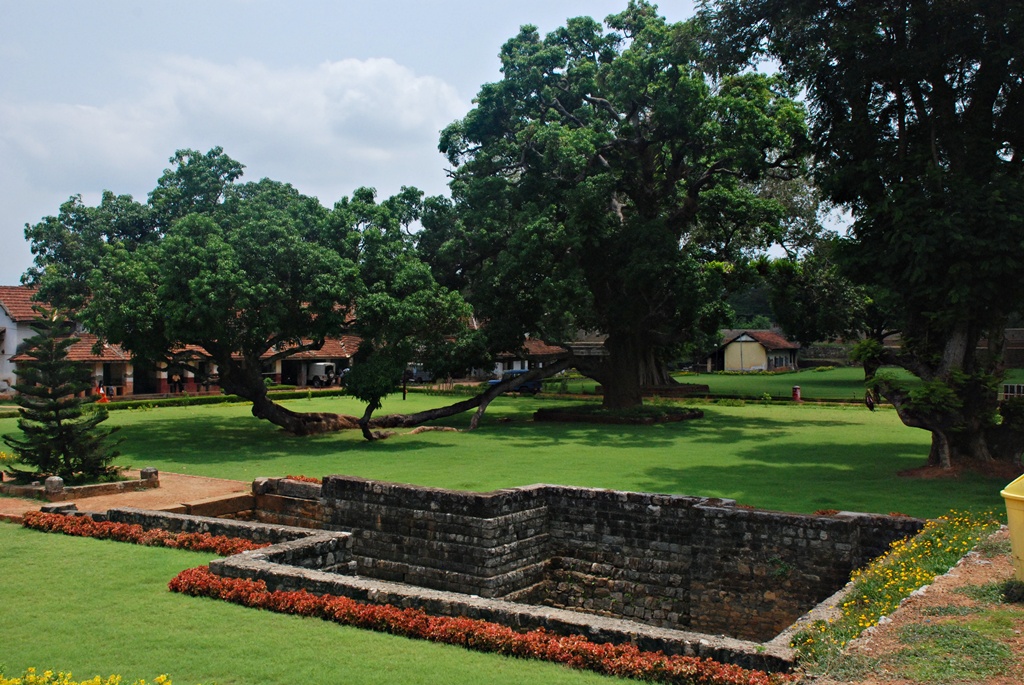
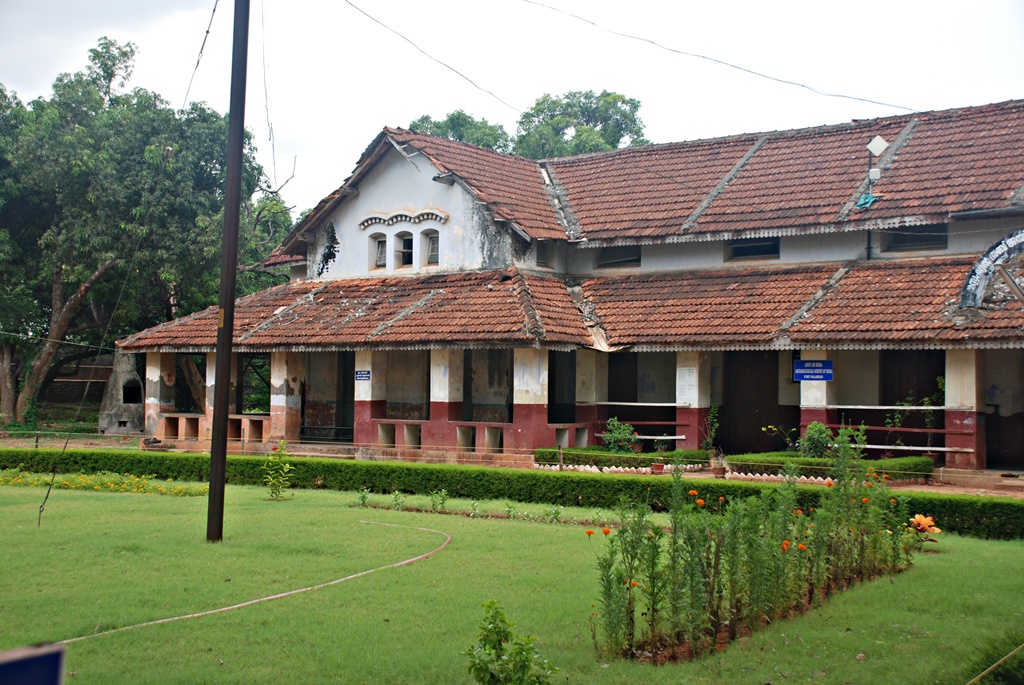
In the centre of the fort, there are a few buildings and this must have been where the people that stayed in the fort lived. The buildings do not look as old as the fort and must have been constructed during the times of the British. There is a very well maintained lawn with a couple of large trees.

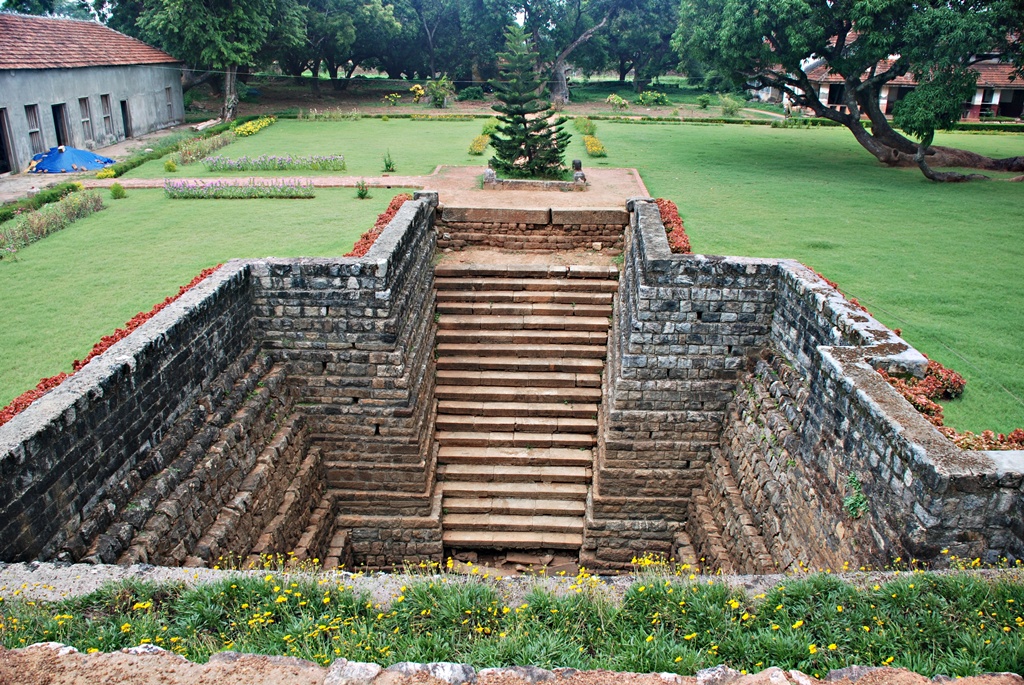
There is also a stepped well on one side of the courtyard and I learnt from the Information Centre that this well was dug later.

The Information Centre is hosted in an interesting stone building with 28 pillars, which was also constructed later. Unfortunately, there is not much information provided about the fort or the battles that were fought there or the people that lived there. There are some photographs of the restoration and of other places of tourist interest in Kerala.

One of the buildings houses a jail and that was of personal interest to me as my father was imprisoned here for two weeks in 1961 when they were agitating for the implementation of the Land Reforms Act in Kerala. I guess the jail must have been in the same old shabby condition even 50 years back.

There is a walkway that takes you around the wall of the fort and there were some good views all around. One could see that the fort offered a very good defensive position. I was quite disappointed that there were no markings or indications of any of the places of interest within the fort or any details provided about its history. There is a small board at the entrance with a few lines on it but that hardly does justice to the place. It was equally disappointing that there was no mention of Tippu or Hyder or anyone else that lived there. But, the people of Palakkad still honour that valiant son who was the first to rise against the British in South India and call it Tippu’s Fort…..


I started off a little before lunch in the Jeep and the destination was the Pegasus camp about 60 km away from Bangalore. This was the first time that I had dared to take my 1967 model Jeep outside the city since I bought it. So, it was with some apprehension that I set off and it looked others too had the same apprehension as Sandhya kept calling me in between to check whether all was fine. In the end, I felt I should have been more confident of the Jeep – it was a smooth drive all the way through. Driving on the countryside with a Jeep, which is partially open is so much more fun even in the summer. You felt a bit more in touch with the surroundings and not cocooned.

The camp is in the middle of nowhere with the nearest village being a small one called Kallukote. I have always been struck by how pronounced the change is between Bangalore and the rural areas surrounding it. Just 50 km off Bangalore and you are in real rural heartland. Probably I feel this more because in Kerala there is not that much difference between cities and the rural areas.

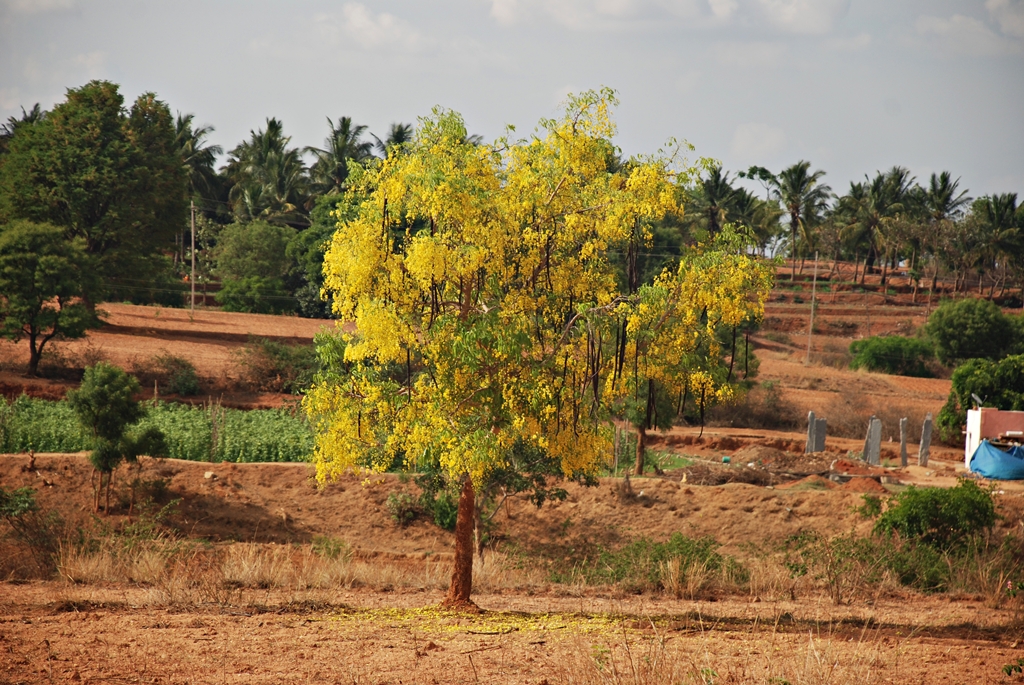
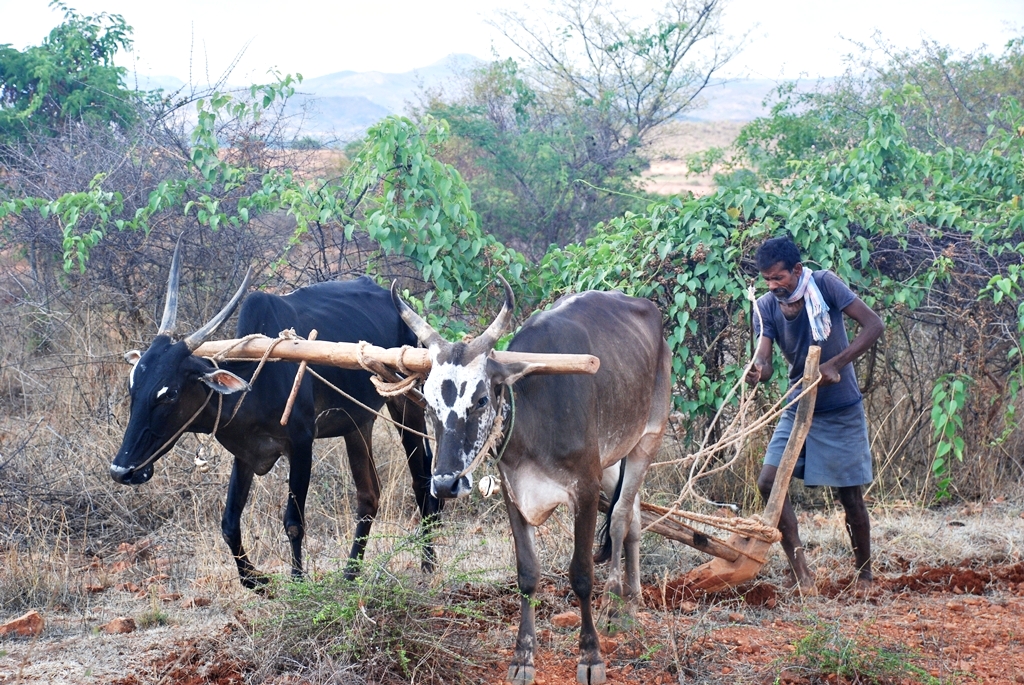
I was driving along in good cheer and stopping to take photographs once in a while. The land looked well irrigated and most of it was under cultivation. It was good to see land being put to good use and not being barren. As I stopped for one such photo break, I saw a sight that I had not seen since early childhood – a man ploughing his land using bullocks. He was kind enough to allow me to take photos of him. His name was Vasanthappa and he said he grows maize in his fields. It was quite amazing that within 50 km of one of the largest cities in one of the largest economies of the world, a man was still ploughing his land using a technique which was centuries old. I guess a tractor must have been beyond his means.

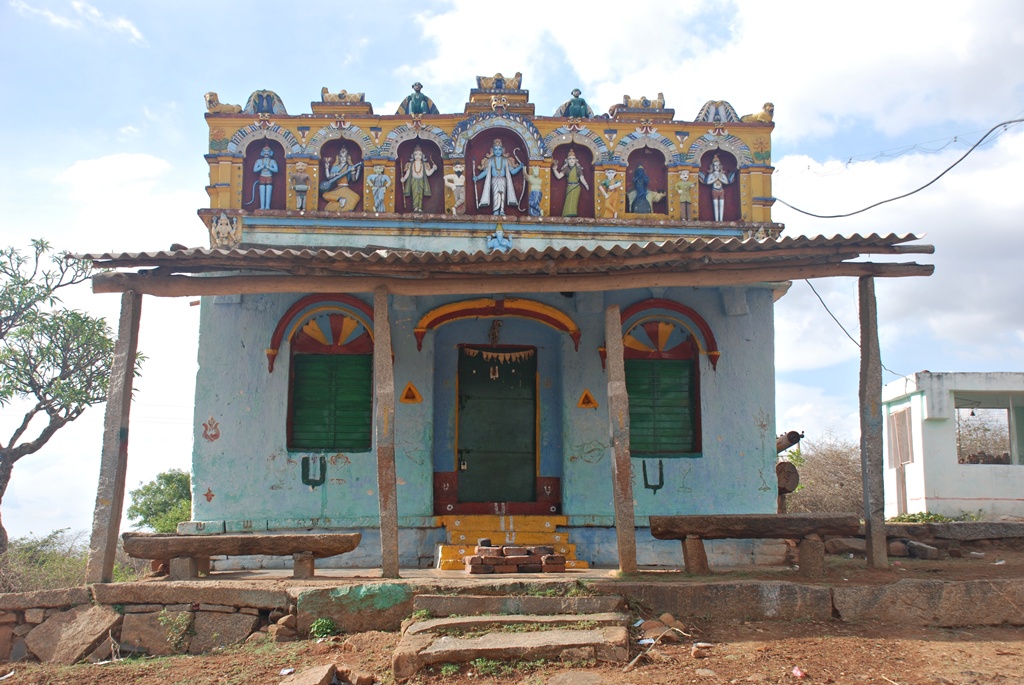
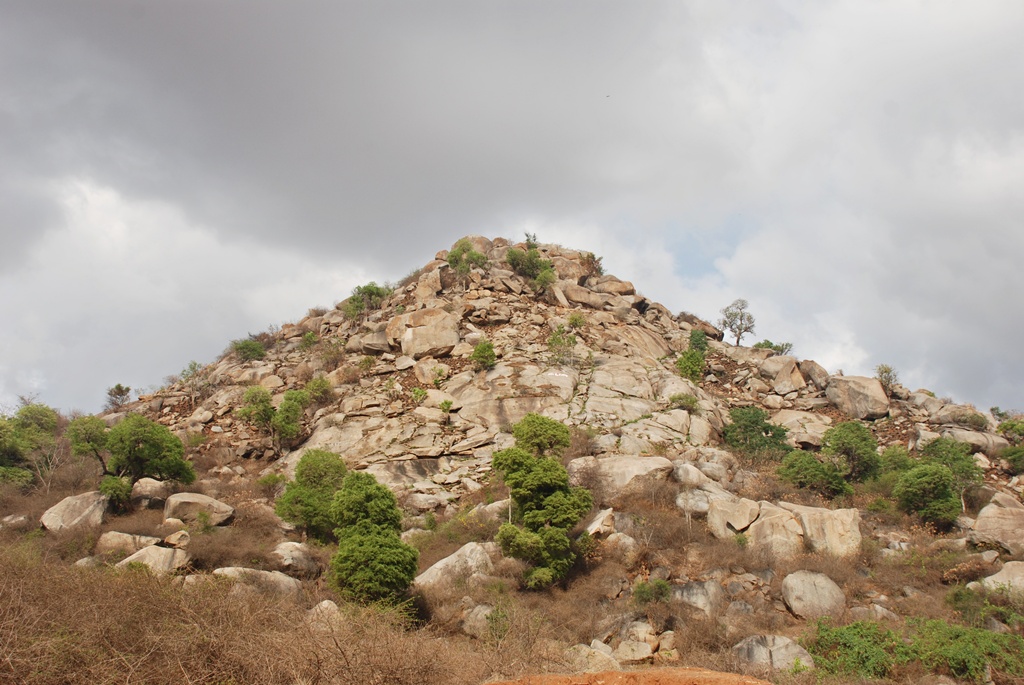
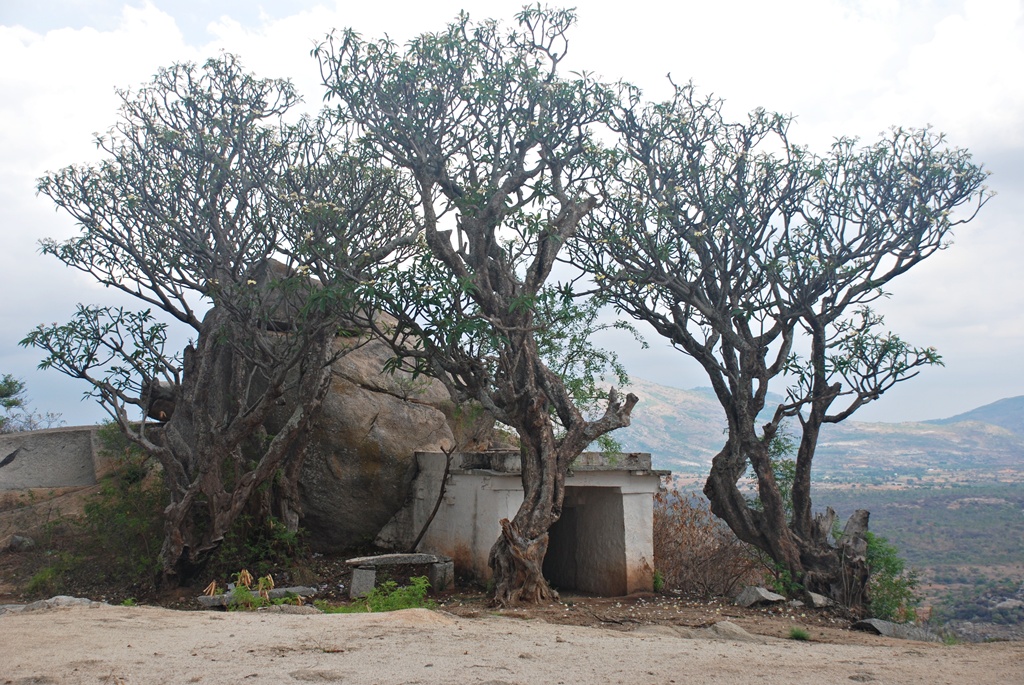
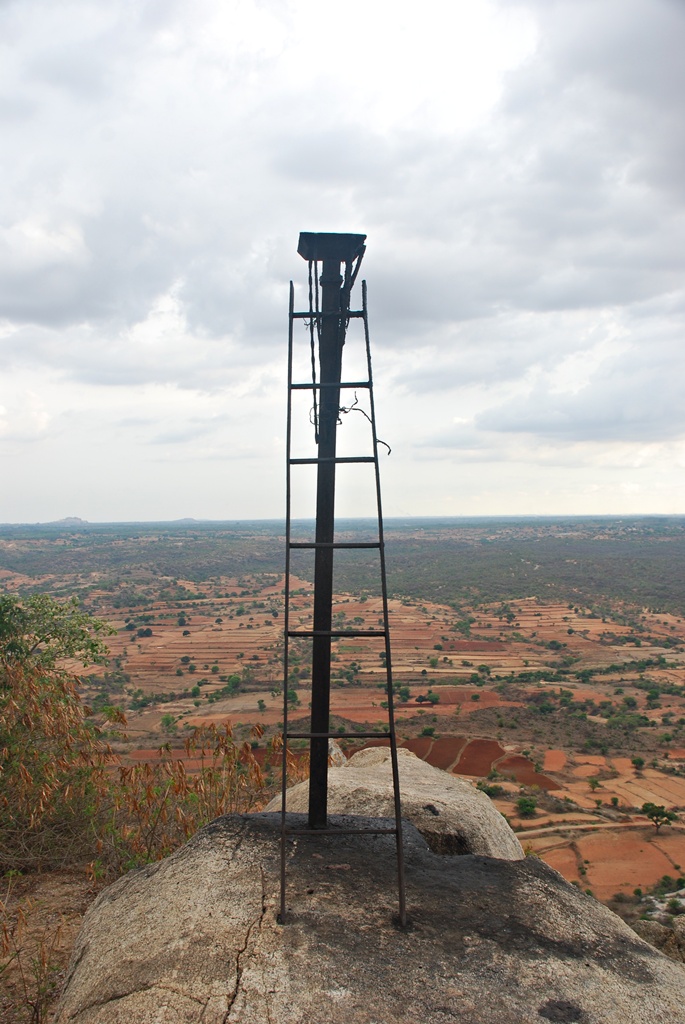
Very near the camp is a Lakshmi Narasimha temple and there is a medium size hill (about 700-800 ft high) right beside it. There was a villager standing near the temple and he told me that they had another temple right on top of the hill. He showed me a post right on the top where he said a lamp was lit on particular days. I was curious and wanted to go up the hill.

So, I went to the camp, freshened up and came right back. There was a rough, rocky road cut into the hill side and my Jeep would have gone up that track, steep as it was. However, since I have no experience with such riding and as I was aapprehensive of causing some damage to the vehicle, I parked it near the temple and proceeded up the hill on foot. As I started walking, I realised that I was alone on the hill. It was a bit of an odd feeling, it was so silent and still all around. The path was reasonably easy, though a bit steep and I was at the top in about 20 minutes and what a sight it was!

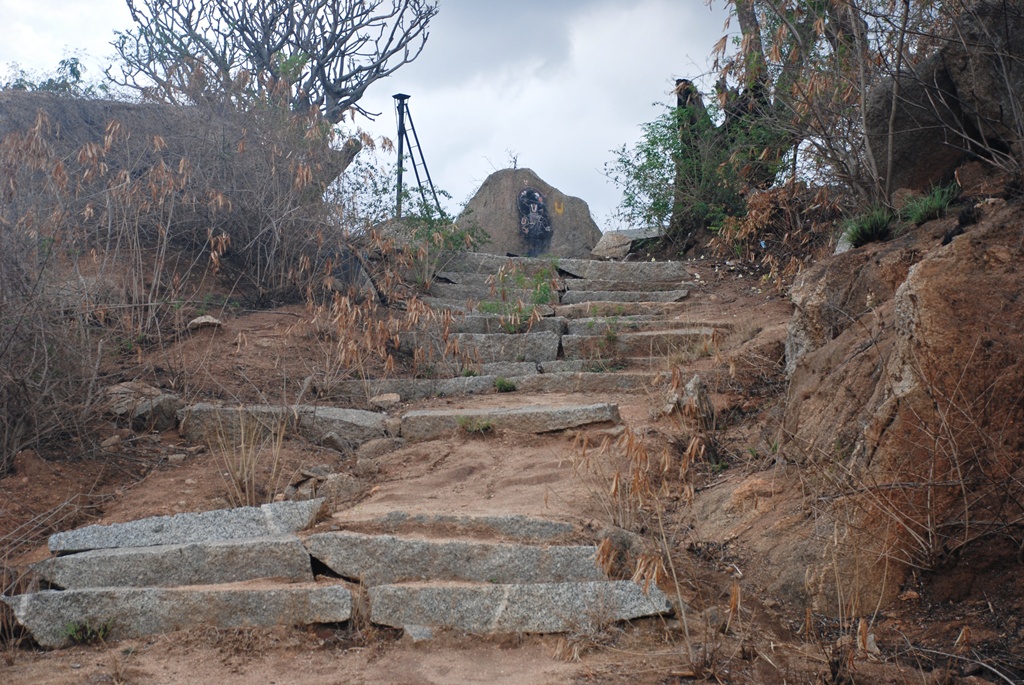
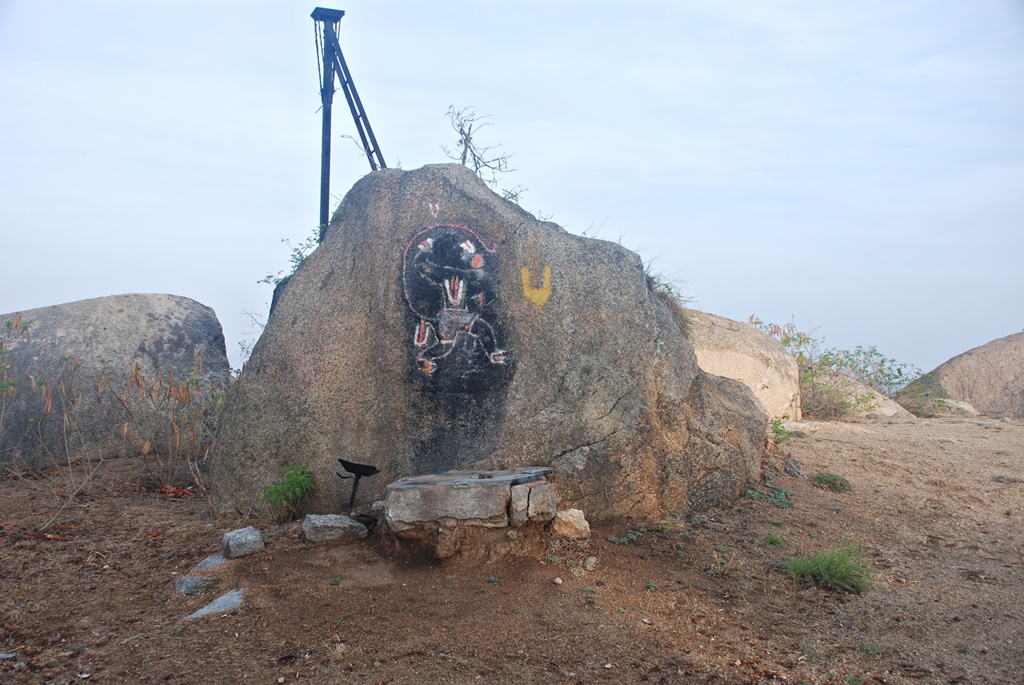
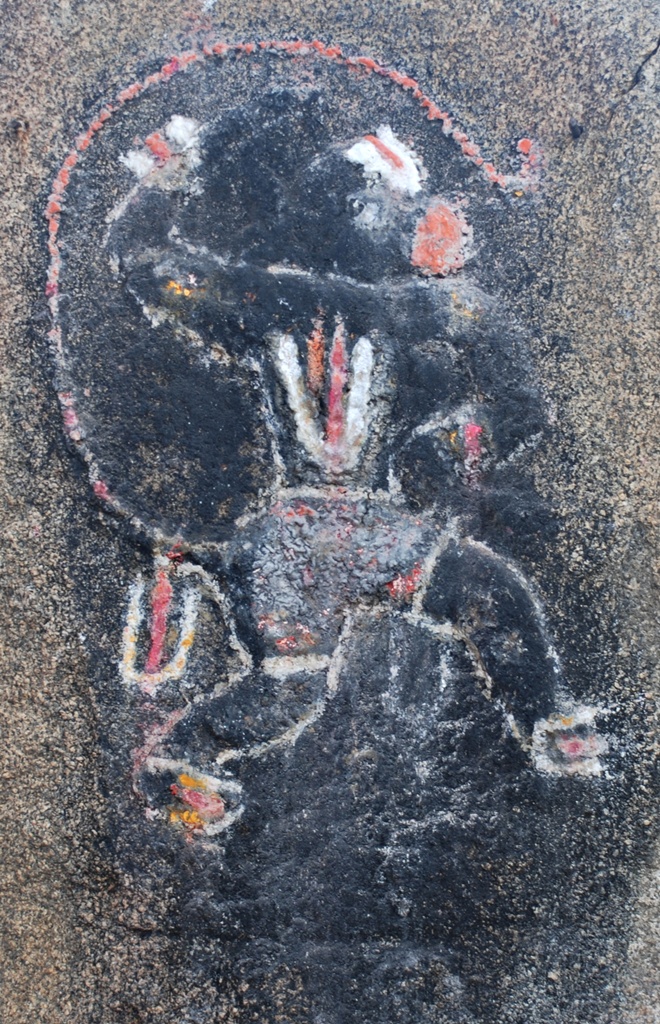
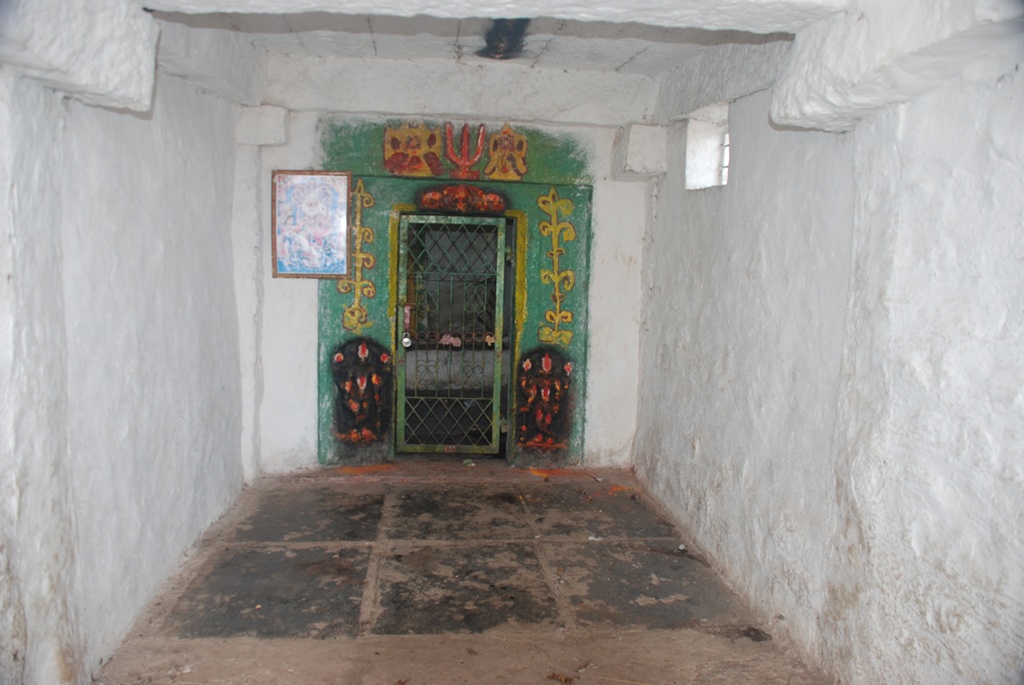
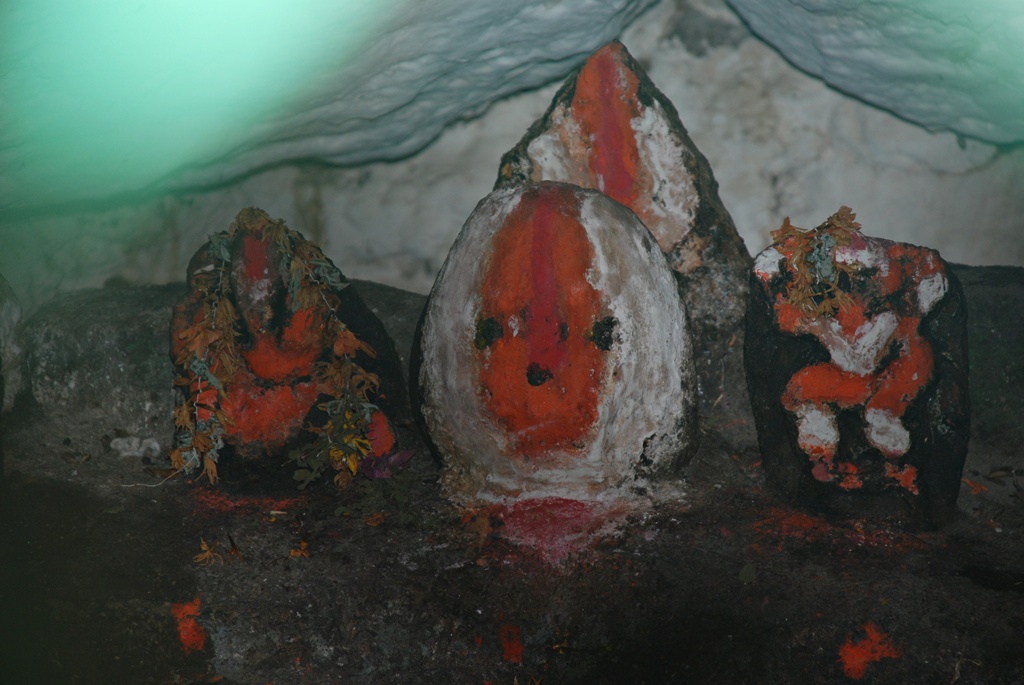
The temple itself was a very small but what attracted me more were the steps that led up to it and a drawing of Hanuman done with charcoal or something like that, on a rock. The image, the steps and the tree beside it all combined to provide a nice ambience. The highlight of the whole experience was, of course, the simplicity of everything. Simple lives, simple beliefs, simple temples, simple gods…..

The post that the villager had shown me was driven into a rock and was almost at the highest point.

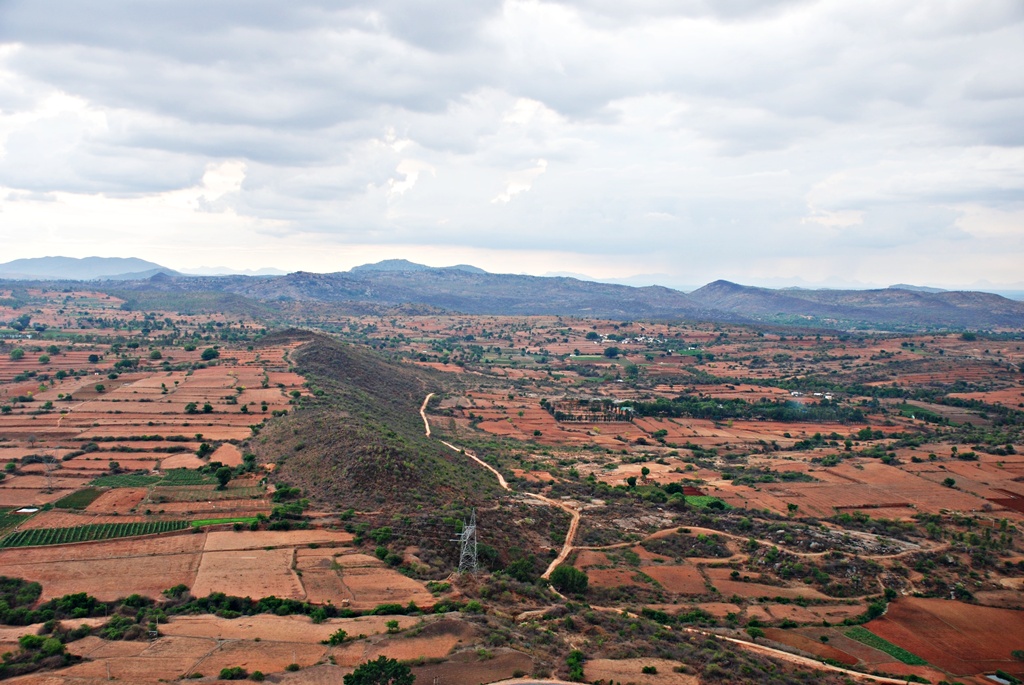
The views all around were fantastic with majestic hills looming in the distance. There were many small villages to be seen but most of it was agriculture land.

I sat there for sometime absorbing the stillness and the quiet. It actually takes effort to get used to that. One is far more comfortable with all the noise that one is surrounded with, in the city. It was a bit eerie to think that I was all alone on that hill. It was a very nice feeling and needless to say, was the highpoint of the day. I will be back here soon….

15 March 2012

It was a bright day awash with sunlight when we landed in Brunei (or more properly, Brunei Darussalam), which is located on the north western tip of the island of Borneo. This was a my first trip to this country, one which had made me curious for a long time because of its much talked about wealth. Bandar Seri Begawan is the capital of the country and is a small town and so we reached the hotel very quickly from the airport.

Brunei was once a much larger country, which also included the provinces of Sabah and Sarawak which are now in Malaysia. It was ruled by the British as a protectorate and became a free country in 1984. It is now ruled by the Sultan and its rich petroleum resources have made the Sultan one of the wealthiest men in the world. The population is around 400,000 with more than half of the population living in the capital. Brunei is considered a developed country and ranks fifth among the countries of the world when measured by GDP per capita.

I had a couple of hours free between lunch and dinner meetings and decided to take a walk around town. The hotel was smack in the middle of town and so access was easy. My first impression of the city was that it looked like a mini version of Kuala Lumpur with smaller buildings and lesser crowds; possibly the language being Malay also contributed to this feeling of similarity. There were good many cars on the roads but very few people. In fact, I got a feeling that there are more cars in BSB than people; later, I was told that Brunei ranks first on number of cars per capita (but a quick look in Wikipedia puts Brunei in the 8th spot). I shudder to think what this must be doing to the environment. However, one has to also admit that they have done a very good job in maintaining the green cover in the city and one could see trees everywhere.

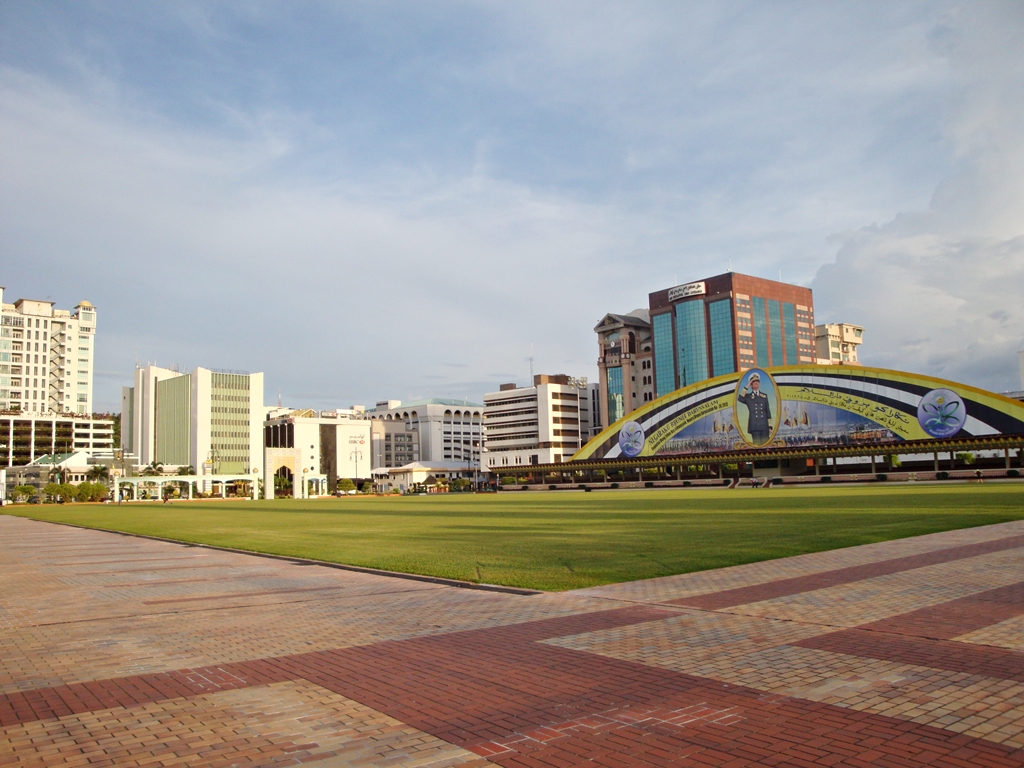
The city itself was very clean and it was a pleasure to walk around. The first location I got to was the Independence Square. This is where official functions are held and it is bigger than a football field. There is a lovely grass field in the centre and I saw a few people using the facility for catching up on their exercise.

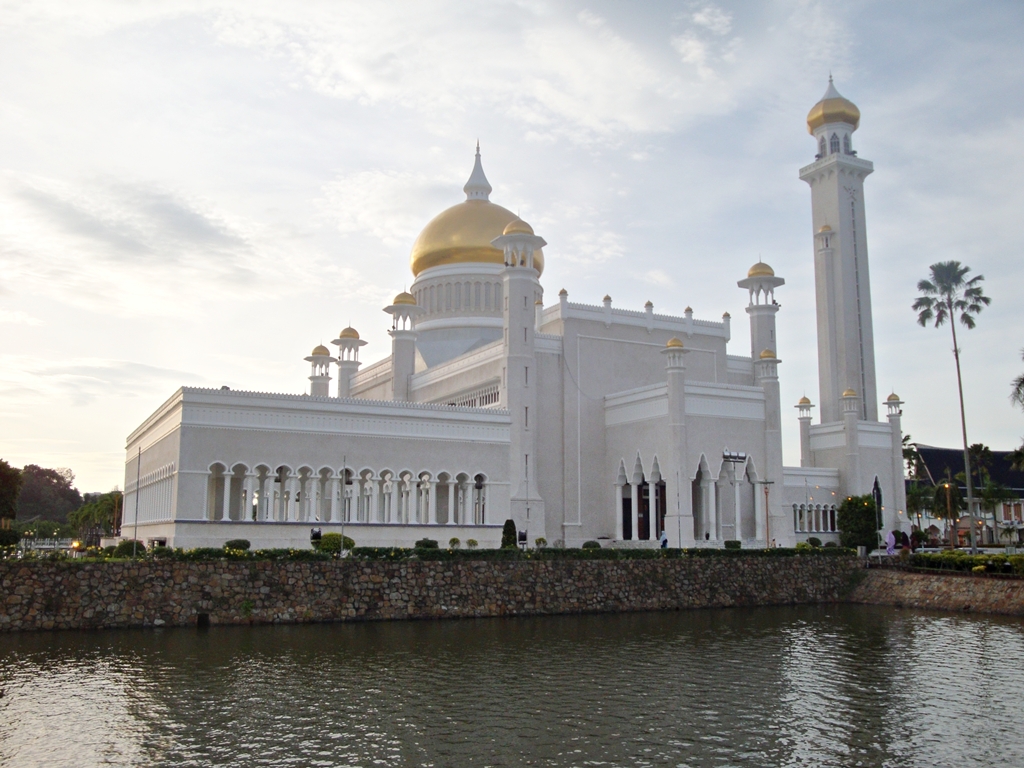
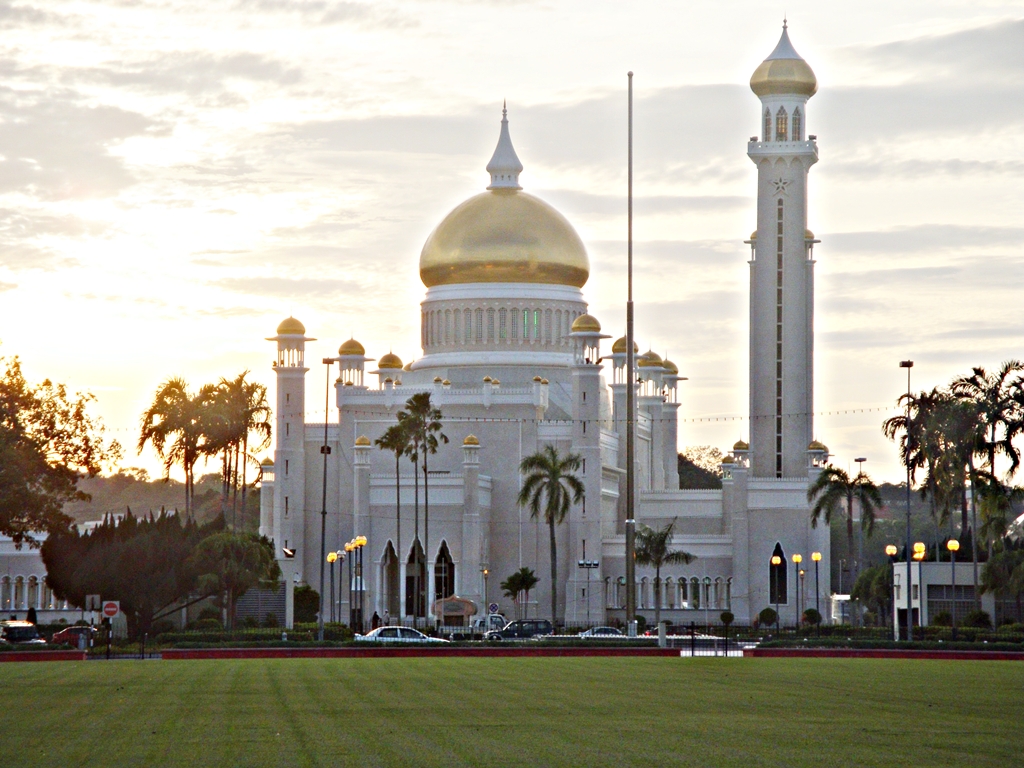
A short walk from there brought me to the Omar Ali Saifuddien Mosque. This is named after the 28th Sultan and the hotel web site claimed it to be one of the most magnificent mosques in South East Asia. Unfortunately, I could not go in and take a look as it was closed to tourists on Thursdays and Fridays. The mosque does look quite beautiful from the outside.

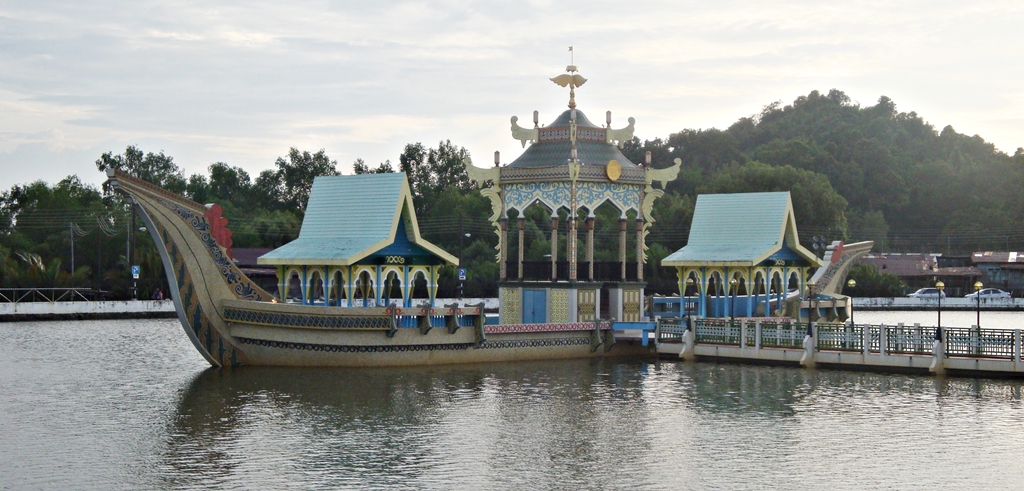
Alongside the mosque is a lagoon and on it is a replica of a 16th century barge and there is a walkway between the mosque and the boat. It looked quite beautiful and I was curious about why there is a boat attached to a mosque but I could not ask anyone and so that remains unanswered.

My hotel was situated right next to a small canal and when one crossed the bridge, there was a market selling various items such as vegetables, fruits etc. I had noticed this when I set out from the hotel and had planned to visit it on the way back. On the way back, I popped in there and was surprised to find that most of the stalls had closed down even if it was still broad daylight. Even as I walked through the market, no one made any effort to sell anything to me; I mean even the stalls that were open. There were some water taxis available from near the market and they offered to take me to the Water Village, which, it seems, is called the Venice of the East. I was a bit suspicious of this claim based on what I had read on the internet and so declined the offer.

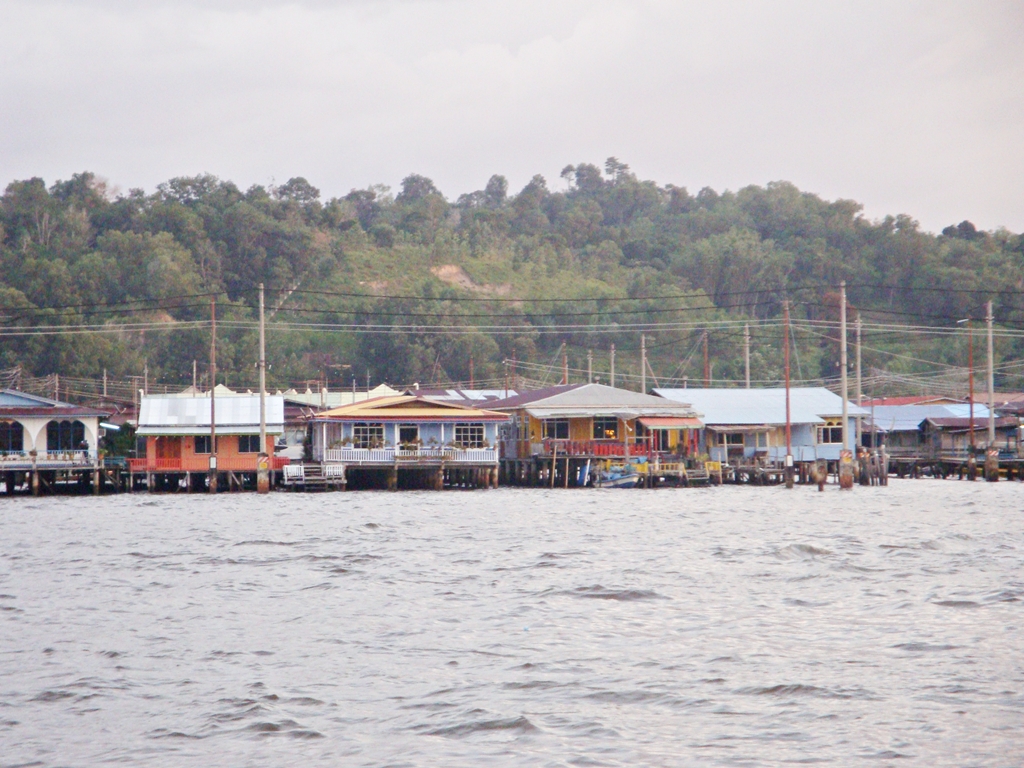
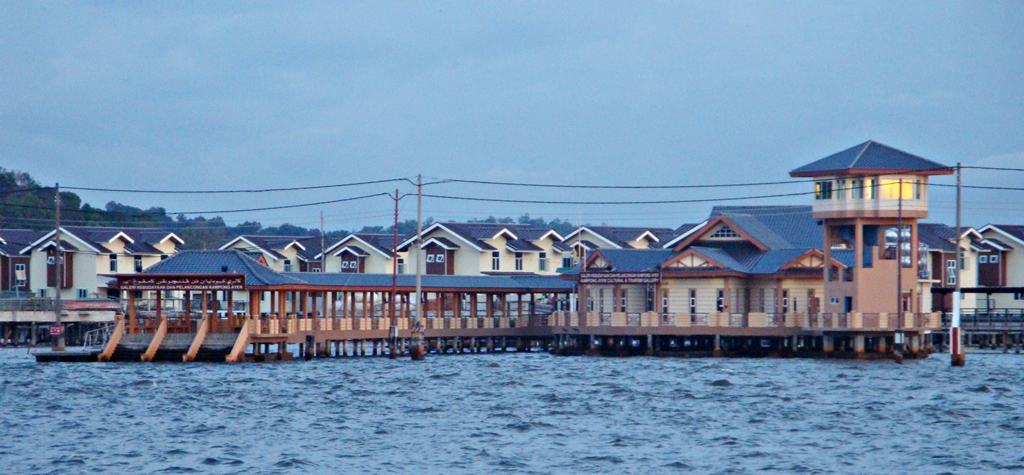
I wandered around a bit more and came to what seems to have been the old customs house and a jetty. The water village (called Kampong Ayer) was visible across the lagoon and it consists of small shops built on stilts. It reminded me of the sea village I had seen in Phukhet, but that was on a much larger scale than this.

By this time, dusk was setting in and I strolled back to my hotel. There were still many other points of interests like the National Mosque, Museum etc. but those will have wait for another day and another trip.

One point that struck me about the city was that it was very quiet and relaxed. There was no hustle and bustle and nobody seemed to be in any hurry. Everyone seemed relaxed and contented. Later on, when we went out to dinner with our host, Chin Toon, he told me that he found the quality of life in Brunei to be superb. He is a Malaysian businessman but likes the life in Brunei as it offers him “the best balance between work and family”. I could understand his point perfectly and anyone that visits Bandar Seri Begawan would have no difficulty in agreeing with Chin Toon.


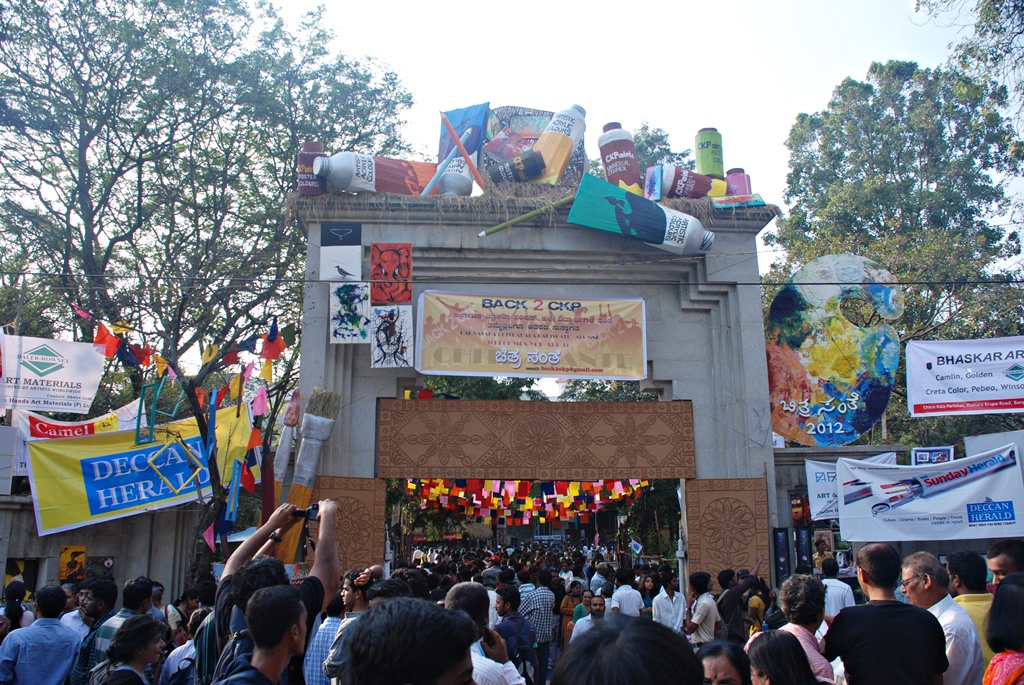
Art is often the preserve of the elite and most art related organizations also continue in that vein; but the Karnataka Chithra Kala Parishath (CKP) strives to be different by organizing an event called “Chithra Santhe” every year. A literal translation of Chithra Santhe means Picture Market and CKP calls it “Art for All”. This is the ninth such event happening at Bangalore. While we had heard about this a couple of years back, we had never visited it and so we were determined to go this time.

The event itself lasts for just one day and is organized in the road (Kumara Krupa Road) where CKP is located. The road, which is about a kilometre and a half long, is closed off for the day and art works are exhibited on pavements on both sides of the road. This road, incidentally, is where the Chief Minister has his official residence and it is all the more impressive that they manage to hold this event here.

The first thing that struck me as we arrived at Kumara Krupa Road was the crowd. The road was quite packed and I could well believe the press report that I had read in the morning which had said that the organisers were expecting around 200,000 people to turn up. There were people everywhere – some were buying, some just looking or some posing for portraits. I could also see some people with cameras. The most important aspect I noticed was that the crowd consisted mostly of ordinary people and not the elite or intelligentsia; so the event seems to have met the objective of the organisers.

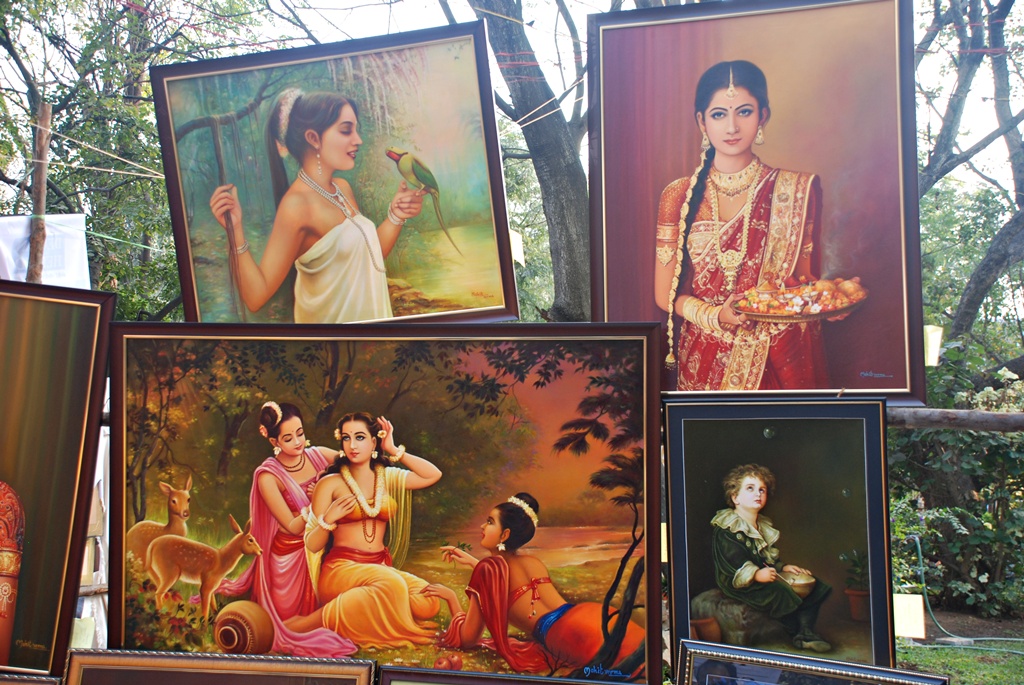
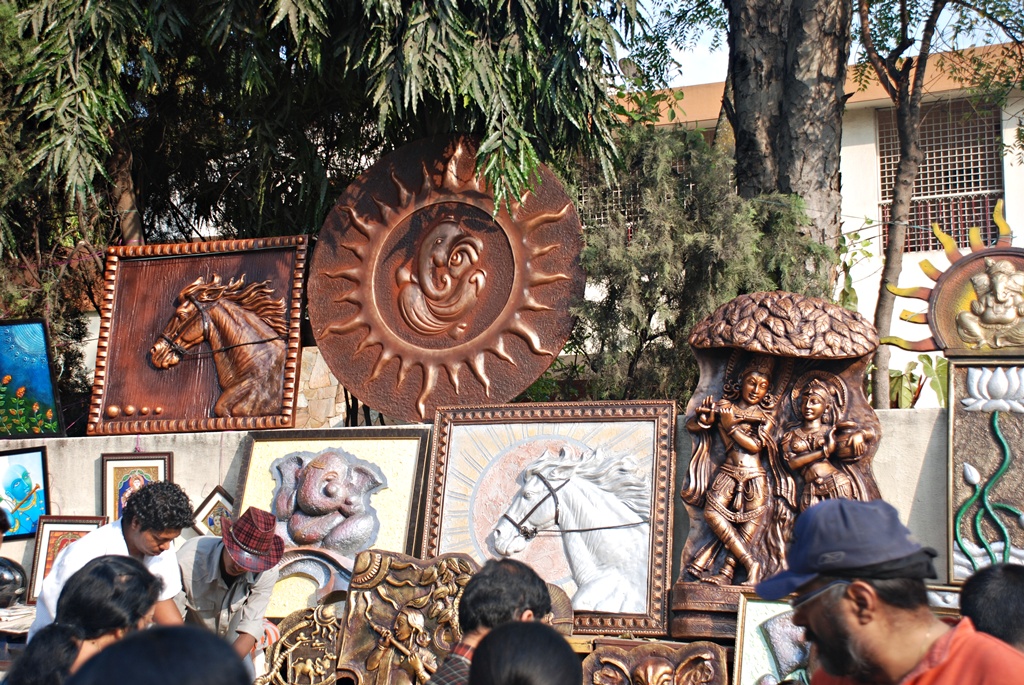
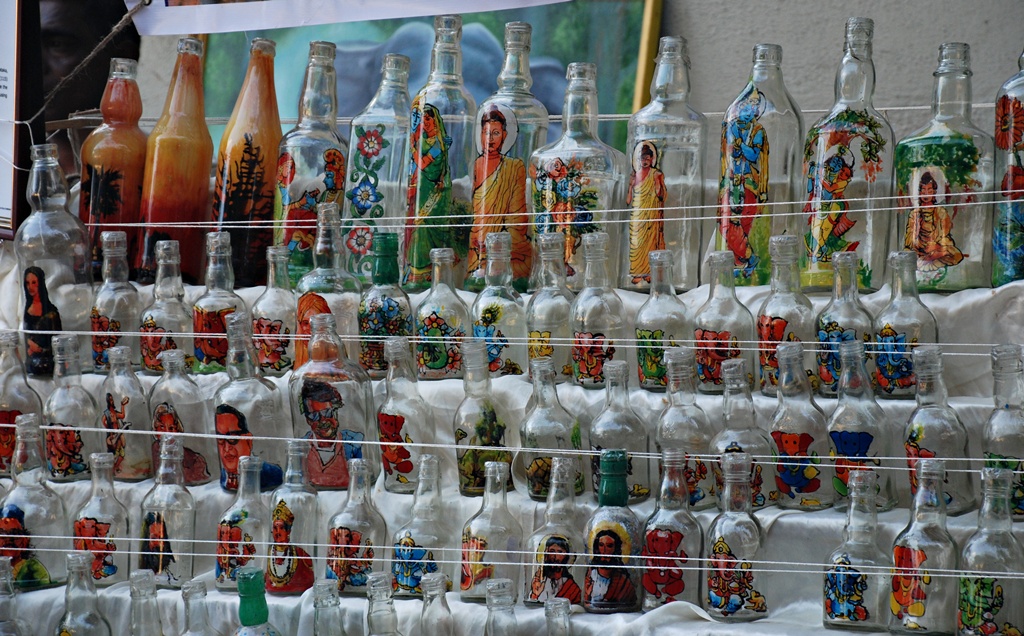
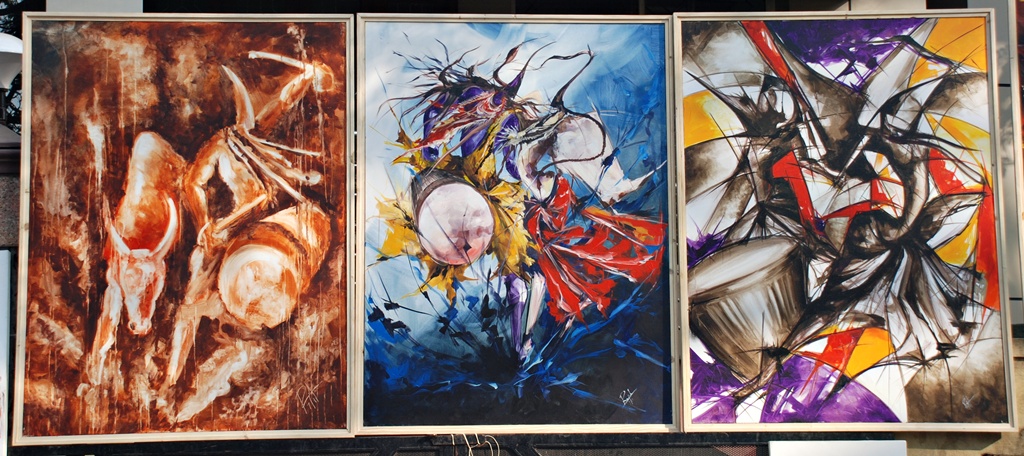
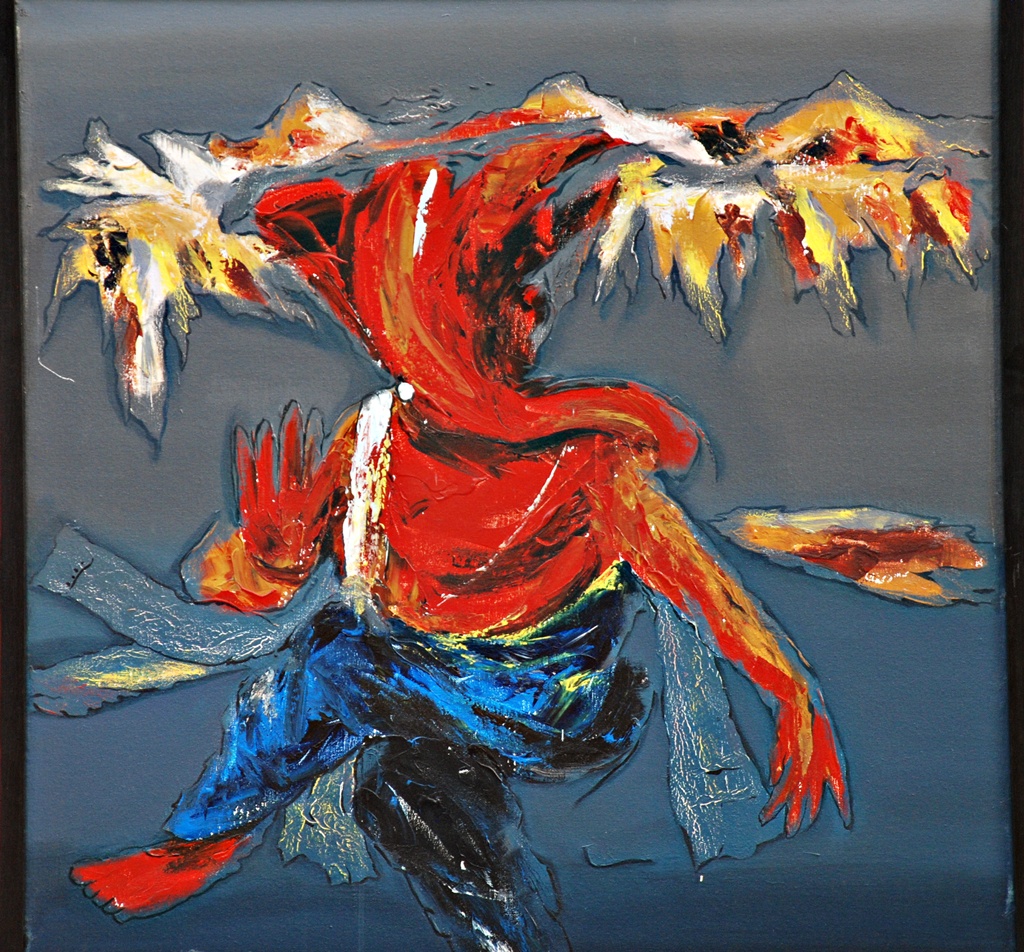
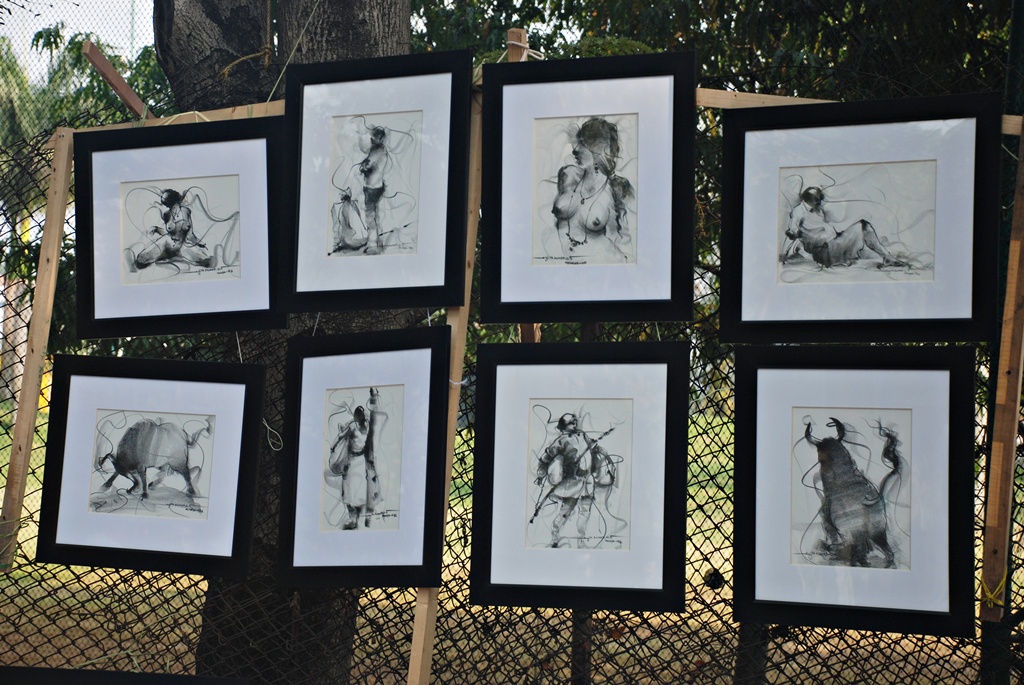
The whole event was a riot of colours and was dominated by paintings. There were some handicraft items as well but those were very few. The paintings themselves were of many different types with sceneries and life-like depictions making up for the bulk of the works on display. An interesting item was a display of bottles with paintings on them. There were works from 800 artists or so and many seem to have come from places outside Karnataka as well. Sale prices for the paintings were very varied as well with a range from Rs. 300 to 75,000.

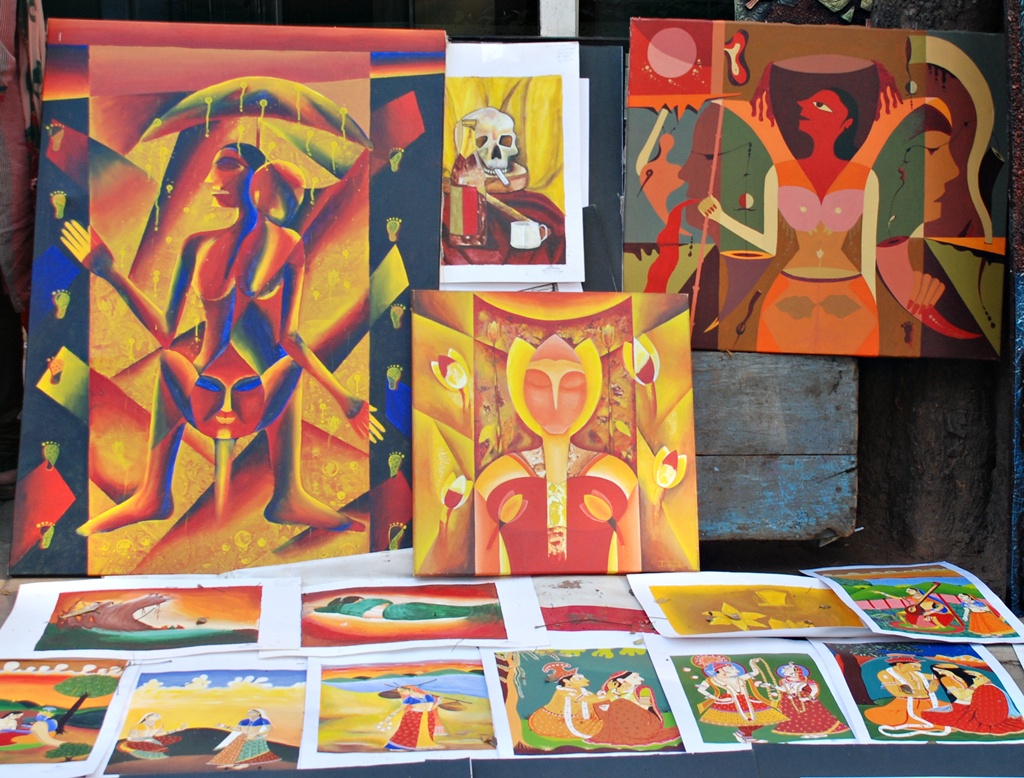
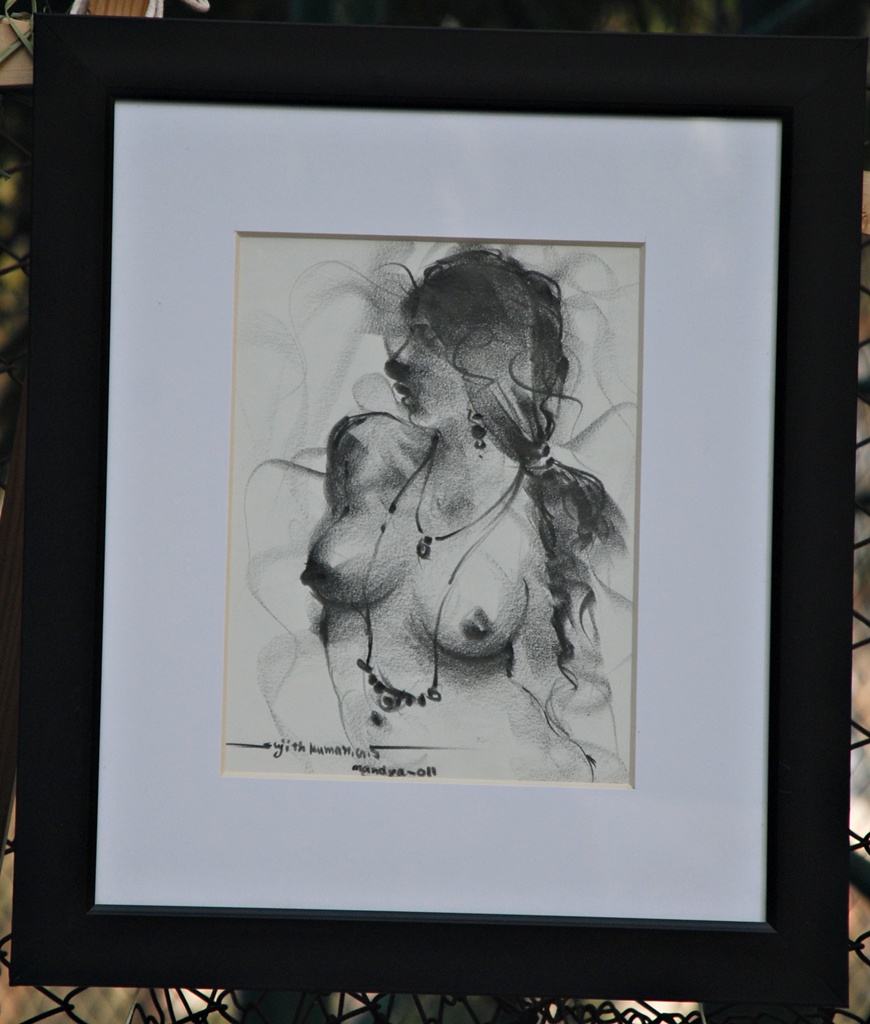
There were some abstract works also on display and some of them were quite eye catching. In particular, I like some pencil drawings and a couple of paintings – some of the themes were quite bold indeed.

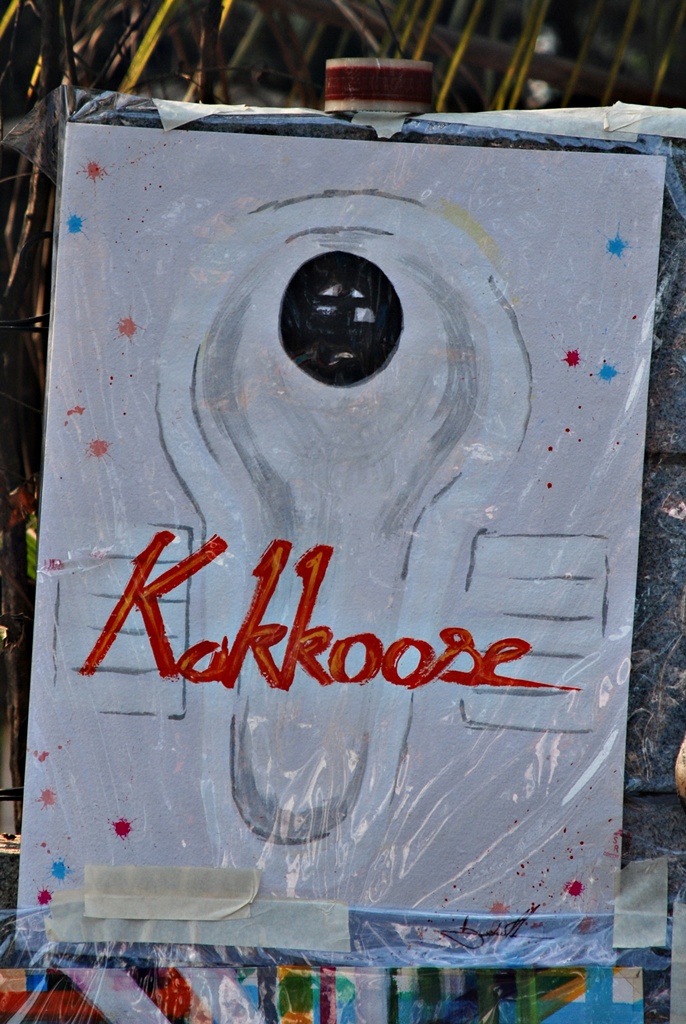
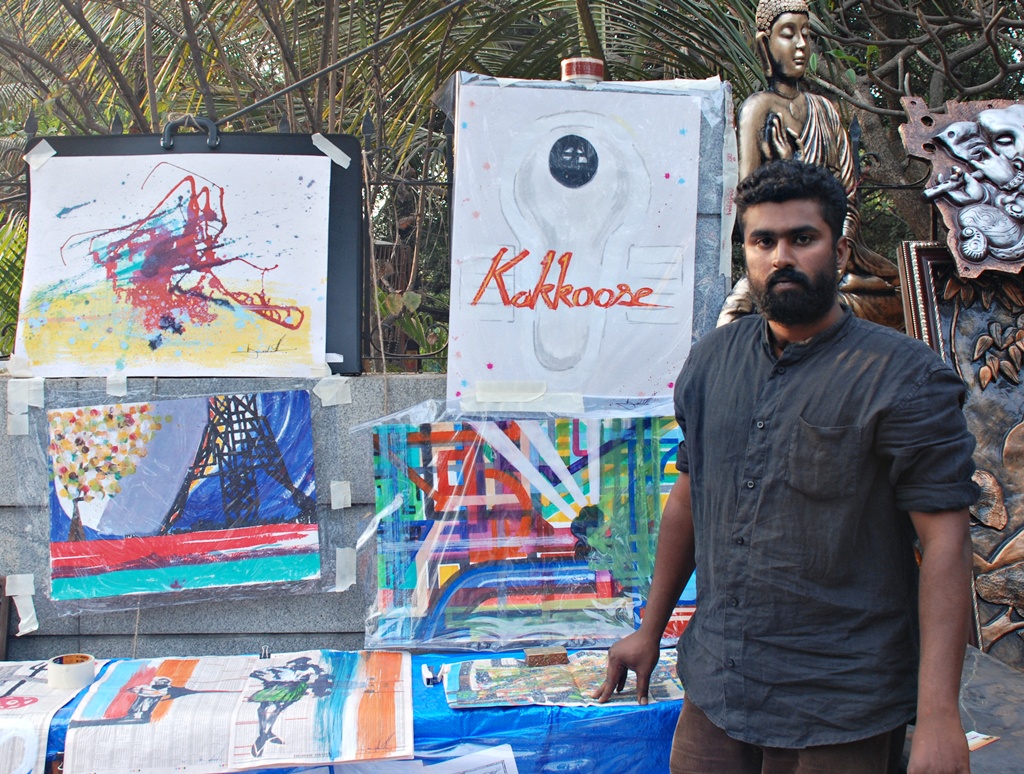
One artist and his work stood out and I had a brief chat with him. His name was Bharath and what caught my eye was that his work was quite different from all others. The most prominent piece was the painting of a toilet and that reminded me of Duchamp’s work. I asked Bharath about the idea behind the painting and he said that he drew it today morning as he wanted to “shock” the spectators that come for the event. He had not heard of Duchamp’s exhibition of the inverted urinal and if he is to be believed, this is original thought from him. Another painting he had was done on a page of “The Economic Times” and this was done because he found it interesting that a businessman could use it to check his stocks while a street vendor could use it to pack “pakodas”. Brief as it was, I enjoyed the conversation with him.

Overall, the event was quite enjoyable and Sandhya and I left with a sense of satisfaction after spending a couple of hours. This initiative from CKP is quite commendable and I hope they keep this up!

24 December 2011

The ride from airport to the hotel was uneventful, but for me feeling worried about Bharath. He had hurt his leg a few days back and it had developed an infection. The leg had swollen up since we left Bangalore and he could hardly walk. It looked like we would not be seeing any sights even if the weather gods permitted. At the hotel, we consulted a Doctor and she did some work on Bharath. Later we went to the beach, the sea was very peaceful and the waves quite gentle. The beach was very clean and the sand nice and white. It was quite nice to lie down on the beach chairs and listen to the sea.

25 December 2011

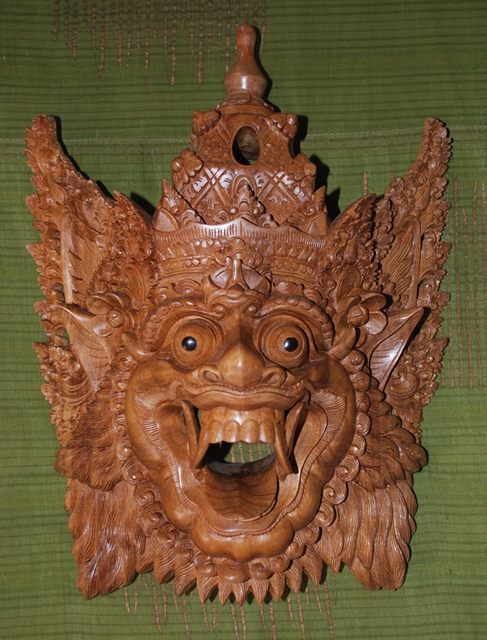
After yet another consultation with the Doctor, we set out mid-morning to take in some sights. The first stop was a shop that sold handicraft items. Most of items were from Hindu mythology but many had rather demonic faces, even the likes of Hanuman and Varunan. The workmanship was quite intricate and I liked some of the stuff there. After some tough bargaining, I bought three masks.

The scenery in Bali is very much like Kerala with greenery all around, especially as this is the rainy season. There are very many small temples all along the road, which resemble the small “kavu” in Kerala. It seems there are more than a thousand temples in Bali and the predominant religion is Hinduism. Rice is cultivated throughout and one felt right at home while driving around.

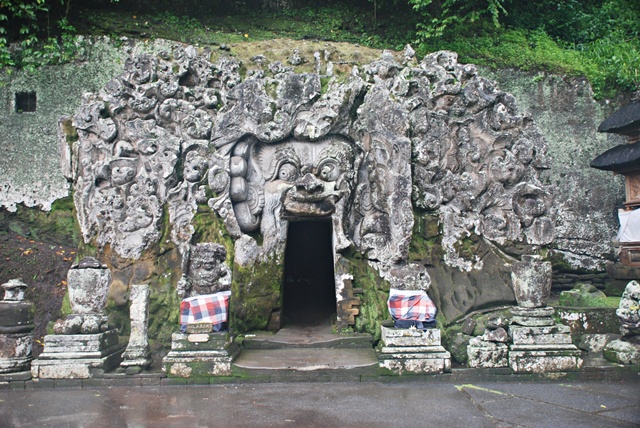
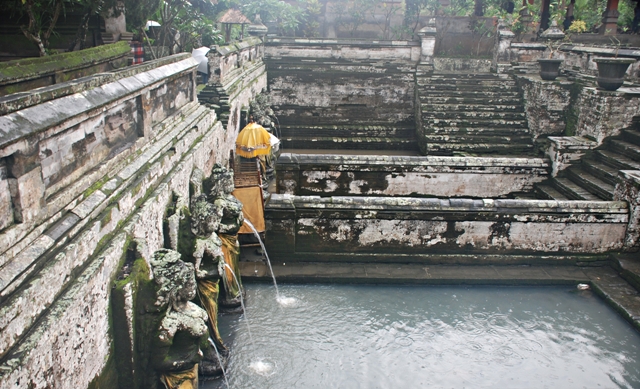
The next stop was a temple called Goa Gajah, where we arrived amidst a drizzle. This is a temple which is about 1100 years old and the main god here is Ganesha. It is set into a small cave.

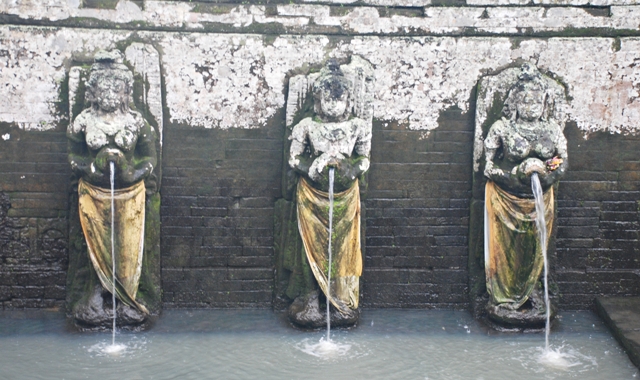
In front of the cave, there is a small pond like the ones we have in temples in South India. On the side of the pond, there are seven statutes that sprout water, called Saptha Ganga. One of the statues has fallen down.

The opening into the cave is carved out in stone and the guide was of the view that the five fingers of the “Dwarapalaka” symbolised the five tenets of Hinduism that one is supposed to believe in – God, Karma, Moksha, Nirvana and Reincarnation. However, I must admit that this was the first I had heard of such tenets in Hinduism. The entrance to the cave opened out into a slightly large rectangular cave, with Ganesha at one end and the tri-murtis (Shiva, Vishnu & Brahma) at the other. There is also a small alcove for one to sit in and meditate. An interesting point was that the tri-murtis were symbolised by three sivalingams and this is the first I am seeing Vishnu and Brahma represented in such form.

A few steps further down, we got to a small stream which had swollen up because of the rain. We crossed the stream and went up to another temple, this one being dedicated to Buddha. It seems that Buddhism and Hinduism co-exist in Goa Gajah with Balinese people considering Buddha as an incarnation of Vishnu. I do not recall seeing this in any location in India. Could it be because Adi Sankaran never got here to concretise the divide between the two religions? The guide showed us the spot where a big statue of Buddha had stood once; it has fallen into the stream now.

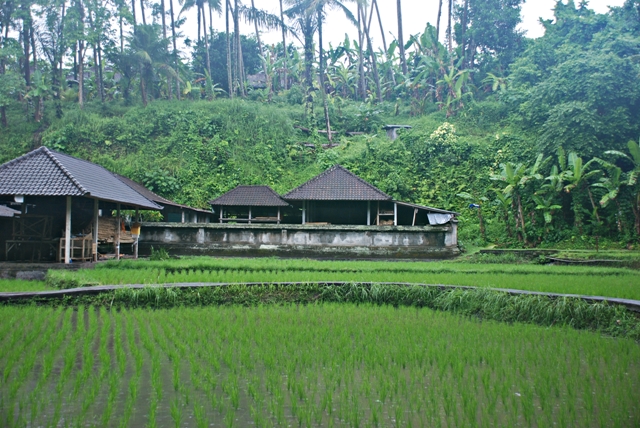
We were then led back through a paddy field back to the front side of the temple. The guide said that they took three crops a year from these fields. The whole setting was very much like what you find in any farm in Kerala.

As we were leaving, I noticed that some devotees had left some offerings for the gods. The offerings themselves seemed very nature friendly as the containers were made of materials like palm leaves. The temple and surroundings were very clean and I noticed that there was no pollution from plastic anywhere – a far cry from the temples in India. I wonder whether the temples are so clean because they are more of tourist locations than places of worship. But then, Bali itself is quite clean overall; so it must have something to do with the people and their civic consciousness.

The rain had strengthened by then and we dropped our plans for any further visits and drove back to the hotel. Spent another quiet evening by the beach, looking up at stars and clouds. There were also some fireworks going off because of Christmas and those looked very nice as they went up over the sea.

26 December 2011

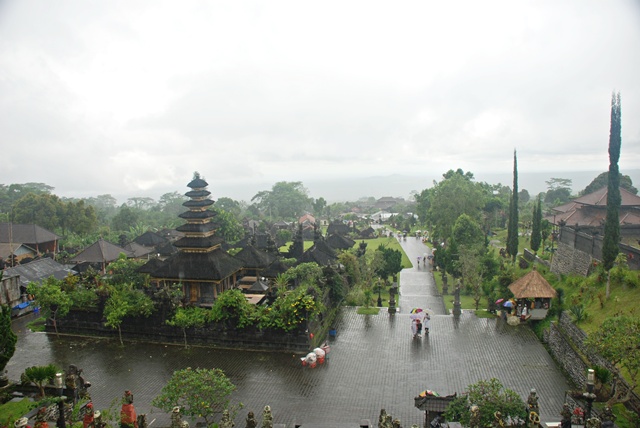
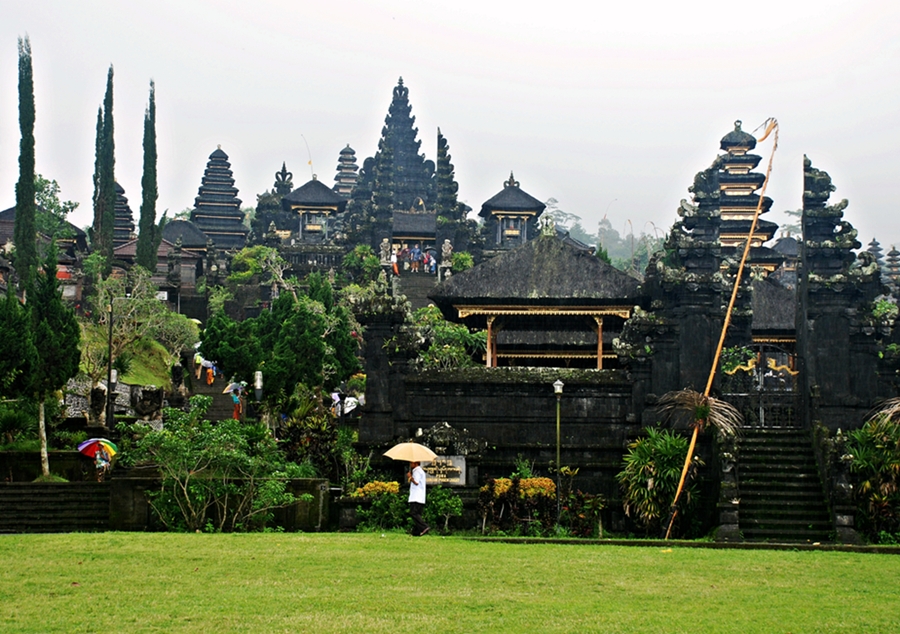
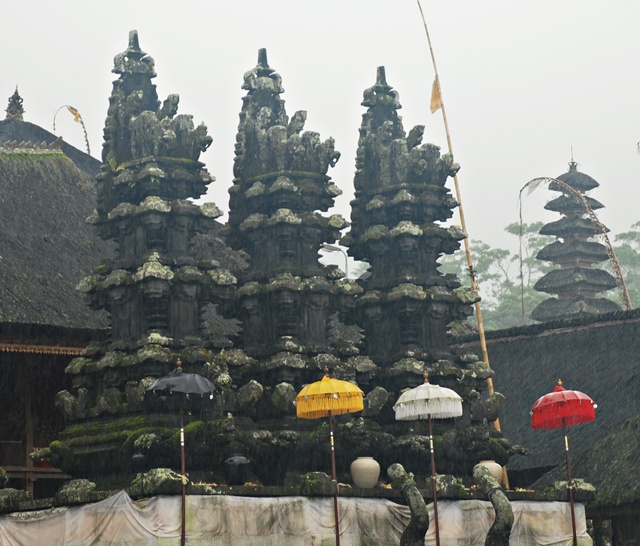
Bharath’s leg was in much better condition and so we set off soon after breakfast – our destination being the most important temple in Bali, called Pura Basakih. This is called as the “mother temple” and is the most revered. Yet again, rain was on when we arrived at the temple. This was a pity because the sights are quite beautiful and the temples have very ornate carvings but photography was difficult in such weather. However, the overall visual effect was quite nice with misty hills in the background.

This is a very large temple built in the 8th Century and is built on a hillock. It covers an area of more than four acres and is in fact a complex of about 55 small temples (Wikipedia says 22). One came across a very interest concept of a Supreme God called “Sayang Viddhi”; it seems this Supreme Being is above the tri-murtis. Pura Basahih had Sayang Viddhi and tri-murtis as the main deities. the temple is beautifully made with very ornate carvings, statues etc. the courtyard itself was very neat and when we arrived some worshippers were making some offering to the gods and our guide said they called this as “thirtha yathra”.

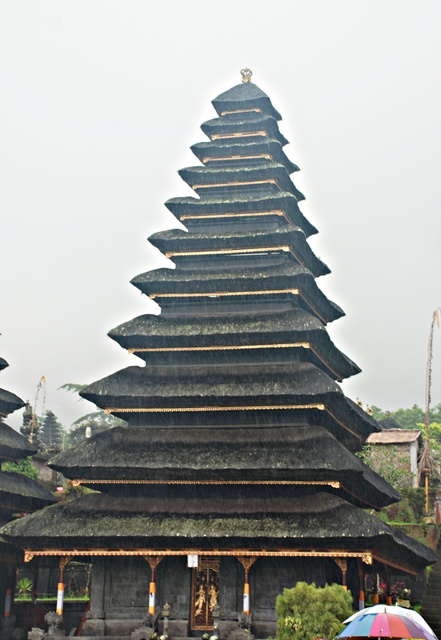
The structure of the roofs of the temples resembles Chinese Pagodas. It seems such construction is called “Meru” in Indonesian language. These can have multiple, odd numbered tiers and most important temple, that of Sayang Viddhi, has nine tiers, with those of Shiva, Vishnu, Brahma etc. having lesser numbers. In Bali, Shiva is associated with Fire, while Vishnu is associated with Water and Brahma with Air.

The ills of Hinduism like the caste system seems to have to made its way across the seas and in the complex, we could see temples dedicated for the four castes. Some others like blacksmiths also have their own temples. Another interesting point that I noticed was the presence of large umbrellas like the ones used in Kerala to decorate elephants when they are taken out in a procession. I could not see any elephants and for some reason I felt that elephants are not part of the tradition here.

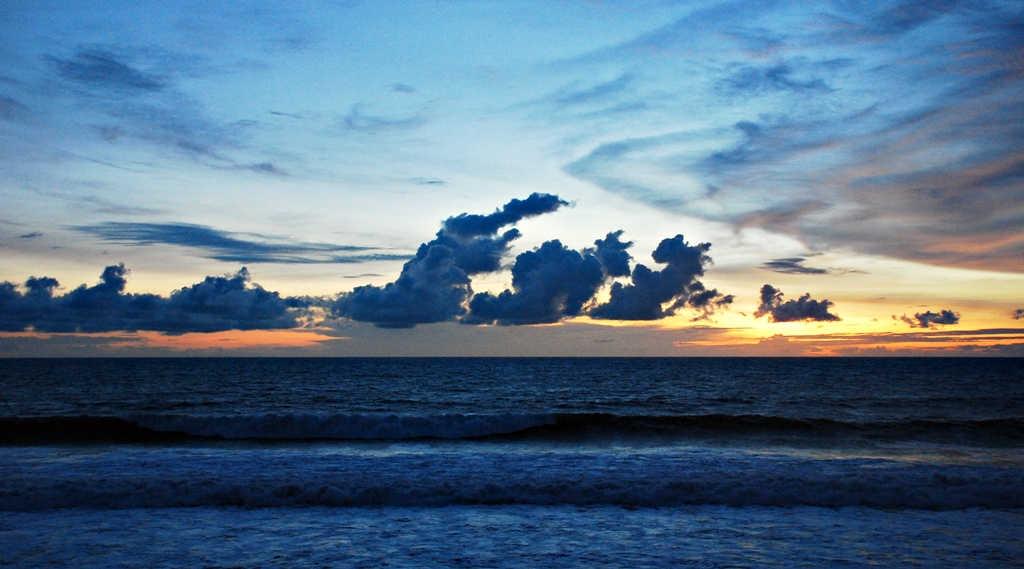
I had read that the sunset over a temple called Tanah Lot is a very spectacular sight and we planned to cover that in the evening. Unfortunately, the drivers in Bali seem to have a very relaxed view on time and so we arrived a bit late. The driver had said it would take us forty five minutes from the hotel whereas it took us almost double that time. While we could still catch the sunset, we missed the temple. The scene itself was quite fantastic and we watched it from the terrace of a restaurant.

There is also a small temple which can accessed through a natural bridge over the sea. I am not sure how long the bridge will last as the sea has hollowed out a good portion of the supporting structure. The main temple, Tanah Lot, can only be accessed during low tide as the crossing gets flooded during high tide. We had arrived at high tide and so we could only see it from a distance and that too in the dark. This would be a great place to walk around and then sit down and have a quiet drink while watching the sun go down. So very peaceful and serene.

27 December 2011

The people in Bali seem very friendly and genuinely service oriented. I was woken up in the morning by an SMS from the driver we had used for the two days, apologizing for not being on duty that day to take us to the airport and wishing us a safe journey back home. This was a followed by a call from the Doctor who had examined Bharath the first day, asking whether he is fine and again wishing us a safe journey. I was very pleasantly surprised as this was not something I had expected at all. Overall, Bali is a great place with lots to see and experience. We could not do any justice at all this time because of the weather. Bharath and I both felt that we need to come back with Sandhya and spend at least a week here. Till then….

26 October 2011

I got into Amsterdam little bit after lunch on the 26th. I was in town to meet with a customer and because of the flight timings  I had some time on my hands, which I planned to use for some exploration of the city. After finishing off a bit of work, I set off to walk around the city. My hotel was in the city centre and so most places were accessible by foot. My last visit to the city was a quick one in 2001 and since then, I had heard a lot about the city.

As most big cities, Amsterdam also started out as a small settlement on the banks of a river called Amstel. In its heydays, Amsterdam was a big commercial port with the city flourishing in finance and diamond trades. It seems that the first ever stock exchange in the world was the Amsterdam Stock Exchange and it was set up by the Dutch East India Company. It does not exist independently anymore as it has merged with the Euronext exchange. Amsterdam has also been overtaken by London and other cities on the business of finance.

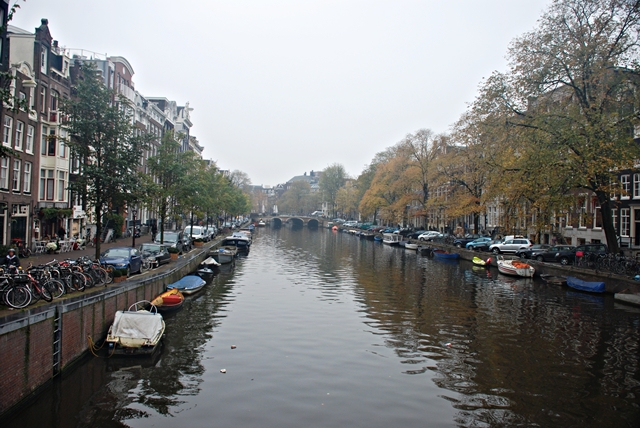
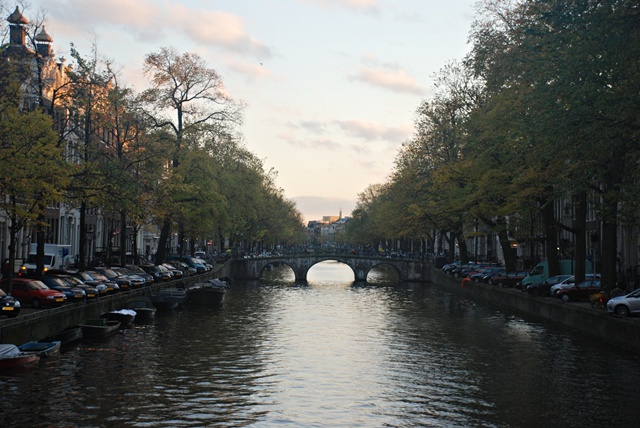
Today, the most significant feature of the city is the canal system. This dates back to a city planning activity undertaken in early 17th century and was mostly meant for transport. In the city centre, you cannot walk for more than 10 minutes in any direction without hitting a canal. However, I found that the canals are not used much for transport these days as the road system is very well developed with trams and other public transport available freely. I mostly found leisure craft plying on the canals unlike Venice, where the canals are more or less the only form of transportation. However, the canals in Amsterdam still do seem to have an all pervasive presence, which makes it difficult for one to think of the city without the canals.

Another aspect of Amsterdam is that this is a city that is more tolerant of the vices – it sells soft drugs like cannabis in it’s coffee shops and prostitution is legal. I was looking for my afternoon cuppa and wandered into one such coffee shop but only to realize that this one was more interested in selling cannabis than coffee. So, I finally ended up having coffee in a bar. The red light district in Amsterdam is quite famous and is a sight in itself with women framing themselves in full length glass windows. What was most striking was that people seemed to take these things in their stride; I found many homes and even a large church in the red light area, almost shoulder to shoulder with an establishment engaged in the oldest trade.

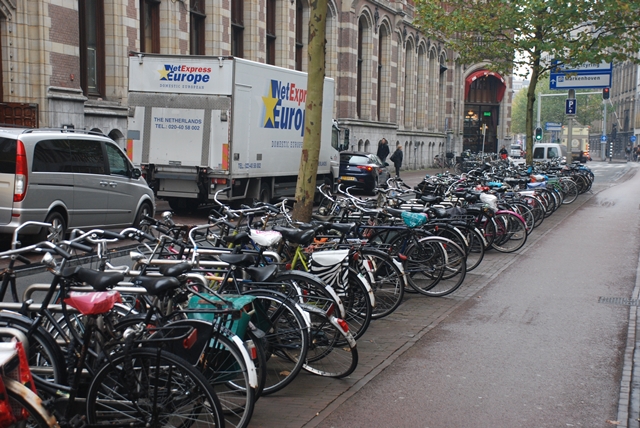
Another interesting point is the mode of transport that most people seem to rely on – bicycles. Anywhere you look, you see a lot of bicycles and it looked to me that a good many use bicycles for their daily commute and they looked like real “work” bicycles which looked very functional unlike the fancy machines used by people in other cities. I was tempted to hire one and ride around but the fact that I was not clothed warmly enough restricted me.

I spent the evening wandering around the city and ended the day with a nice dinner. The city was very picturesque, especially as the sun started going down.

27 October 2011

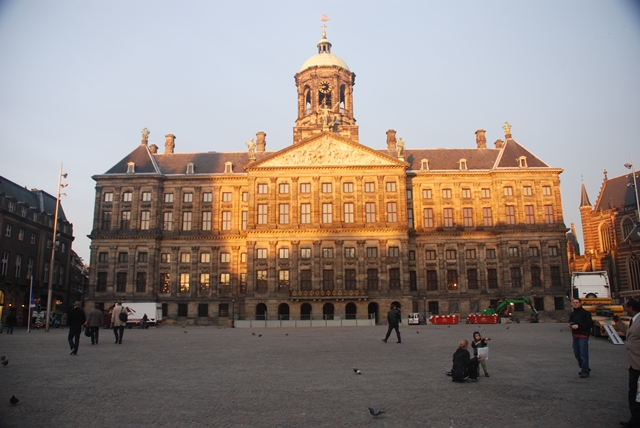
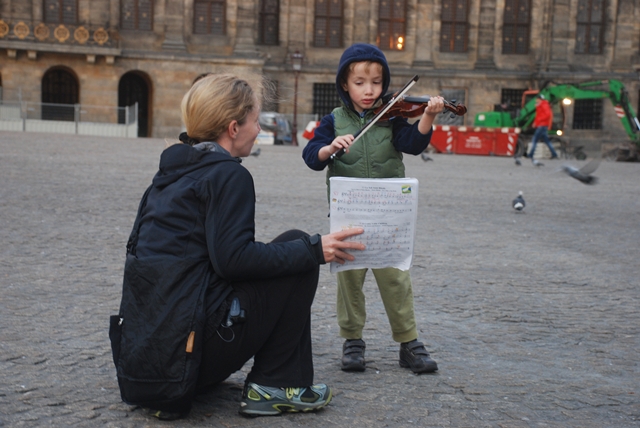
I went out for a stroll early in the morning. By early in the morning, I mean around half past seven but it was still dark. By and by, I arrived at a square near the palace, called Dam Square. The square was empty but for a lone construction worker and a mother and child. The kid was very young, probably six or seven, and playing a violin standing on the square while the mother was holding up the musical notes for him to see. There was no one listening or watching them. I was somehow taken up this and took a picture of the boy with the violin. Soon, another chap walked up with a camera and he also seemed impressed by the spectacle. The violin case was open in front of the child and both of us put in some coins. The other photographer said that this would probably be ice cream money for the kid. They seemed well off and did not seem to need the money. I was wondering what the mother was trying to teach the child. Could it be that every job has its own dignity and there is nothing wrong in taking money for entertaining people or that this was one method for him to earn a living as he grows up or to take away his fear of playing in an open square? Overall, I found it quite intriguing.

It was around five by the time I finished my meetings and I went to visit Anne Frank House. Anne wrote her world famous diary while hiding in this house. She lived here from 1942, when her father decided they had to go into hiding to save themselves from the Nazis, till 1944 when they were betrayed by an unknown person and taken into custody. There was a reasonably long line to enter the museum and I guess that itself is testimony to what a young girl achieved. Anne was a dreamer and she dreamt of making a mark in the world even when she spent her time cooped up inside a small house with no windows. I had read her diary and what had come through were her hopes about the future and her fervent belief in mankind, despite what she went through. To see the conditions in which she lived and then relate that to her diary was indeed touching. She must have been an extraordinary person or could it be that those extremely difficult circumstances made her more mature than her years? She started her diary when she was thirteen and was captured when she was fifteen. So, what we read are the musings of a youngster in her early teenage, yet some of the observations she made were far beyond her years. In particular, one of the most important statements that I remembered was how, despite everything she suffered, she still believed in the innate goodness of man. May be the diary was the companion she missed. It comprises of a series of letters addressed to “Kitty” and in one place, she says: “When I write I can shake off all my cares. My sorrow disappears, my spirits are free!” I could not but feel overawed and to an extent depressed as I walked through the rooms.

Photography is forbidden in the house and so I could not take any pictures. There are several quotes from Anne’s diary posted on the walls and also some replicas of the conditions in the house when they lived there. Anne’s father (Otto Frank) had foreseen the danger that Nazis posed as far back as 1933 and moved to Amsterdam from Frankfurt to escape the clutches of Hitler. However, he could not escape his fate as Holland fell to Germany in 1940 and in 1942 Otto Frank decided they had to go into hiding to escape deportation to concentration camps. He built a secret apartment behind his office and that is where the family hid till they were captured.

I find that individual tragedies often help to understand the depth and viciousness of events like Holocaust better and Anne’s diary is one such. She kept the diary and thought of publishing it after the war got over and had dreams of becoming a writer and a journalist. She wanted to live on even after her death and had hoped her books would help her achieve that. The diary was discovered by a friend who had helped the family and she gave it to Otto Frank when he (being the only survivor in the family) came back from the concentration camp. I doubt whether so many people would have read the diary had Anne been alive but the cruel, unjust dashing of a few young dreams made the world take notice. These are the sort of books that influence the world and I felt truly enriched to have been in the building where it was written.

28 October 2011

My flight was after lunch and so I had a couple of hours in the morning and I decided to visit the Van Gogh Museum. This museum has the largest number of Van Gogh’s works. While the paintings themselves were not as famous as what I had seen at some other museums, it was when I visited this museum that I got a better appreciation of Van Gogh. He lived only for 37 years and was a painter only for 10 of those; yet he finished more than 2000 works. The museum had also arranged his works in a chronological order and so one could appreciate his development as an artist.

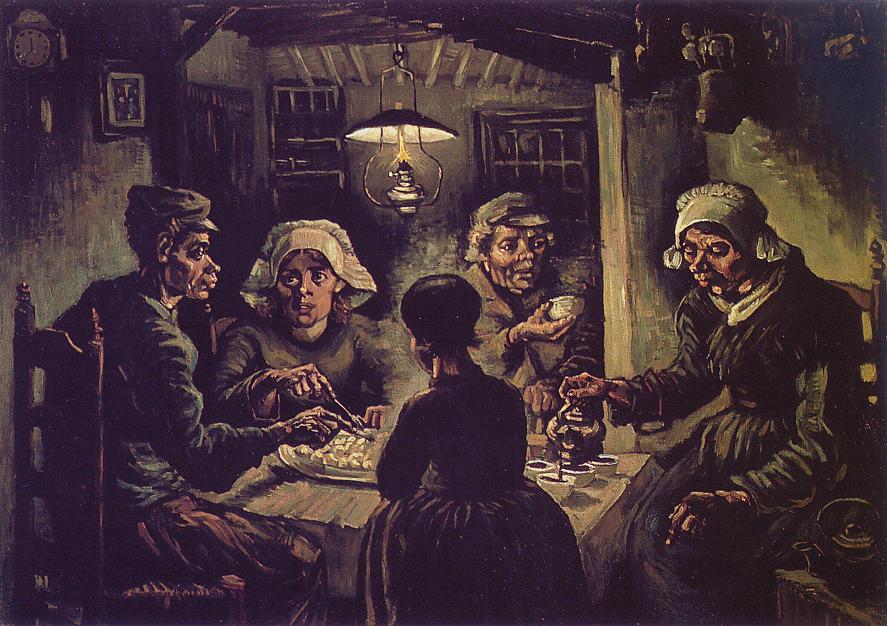
In an era when most artists were taken up by the gentry and such “beautiful people”, Van Gogh was intent upon painting farm labourers and actual scenes from life as he saw them. His first famous work was “The Potato Eaters”, which was painted mid-way into his artistic career and the subject was a poor family even though he expected to sell the painting in the Paris art market. The museum does not allow photography and the image (Potato Eaters) given below is downloaded from the Internet.

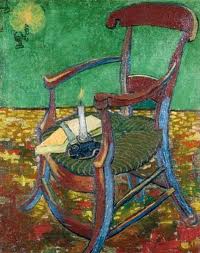
Van Gogh was quite obsessed with painting and that was why he was able to produce such a large quantity of work. However, he was also unstable in mind and was given to bouts of mental breakdowns. It was fascinating to look at the paintings knowing that the man was going through a tormented existence while he was painting those. Many of the paintings had hidden stories and meanings; for example, there is a painting of a chair which is supposed to represent another famous artist Paul Gauguin (image given below, downloaded from Internet). However, I could make that out only with the help of the audio guide.

Overall, it was a very good experience to go through his works and be witness to the evolution of the artist and the anguish of the man, which ended in his suicide.

Unfortunately, my time in Amsterdam ran out and I had to leave without visiting many other attractions like National museum, may be another time, another day!

16 May 2011 

We bid goodbye to the fantastic Castel Monastero in the morning and drove into Florence to catch our train to Venice. Once again, the GPS proved to be totally inadequate in the city centre and after going round and round in circles for about half an hour, we finally ended up at the car rental place. The journey to Venice was once again through the superfast train and it took us only two and a half hours. The scene we saw as we stepped out of the train station in Venice stopped us in our tracks. The steps from the train station ended at a canal and boats were plying up and down like cars on roads. There was no road or sign of any car. We secured a boat taxi and stepped in and that was when I felt I had to capture this in the camera. To my utter dismay, I discovered that I had left my camera in the train. Fortunately, a member of the cleaning staff had found the camera and was bringing it to the lost and found office when I got there. We had been warned against the pickpockets and other petty thieves in Italy who thrived on the tourists and here our experience was totally the opposite.

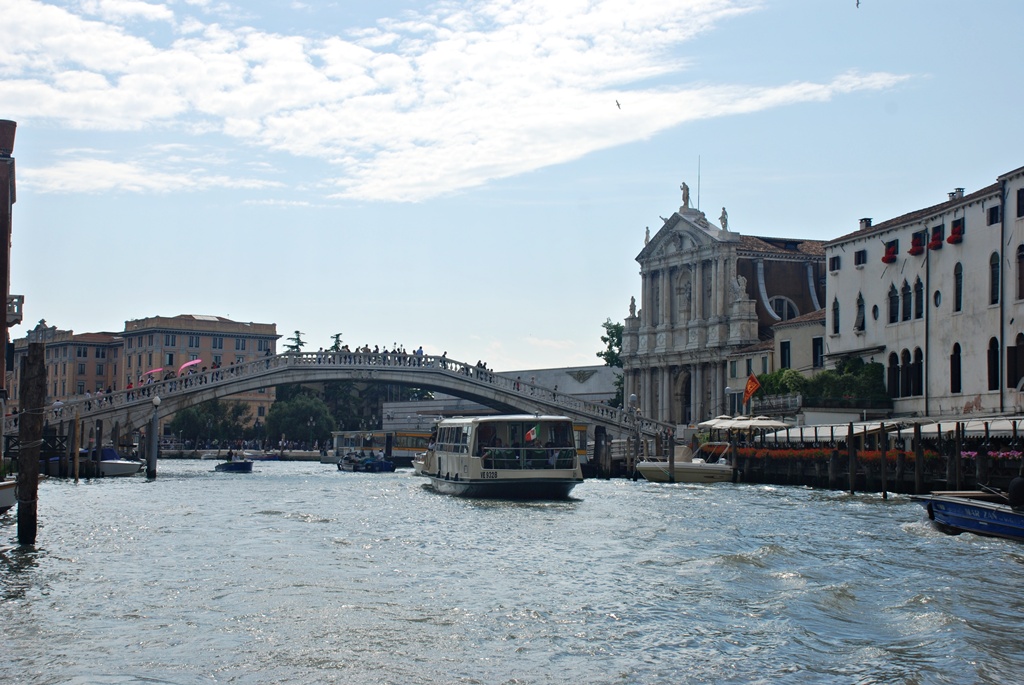
I have never been to a city where the transport is totally by waterways. The city is built on 117 islands connected by 400 bridges over 150 canals. There are no roads in the inner part of the city and everything is being transported by boats, be it goods or people. We were amused by speed limits, one way signs etc. In due course, we arrived at the doorstep of the hotel. Most of the journey was on the Grand Canal. The skill with which the drivers manage the boats is simply amazing – there are many narrow canals which require good level of dexterity to navigate. All along the Grand Canal one could see some really beautiful buildings.

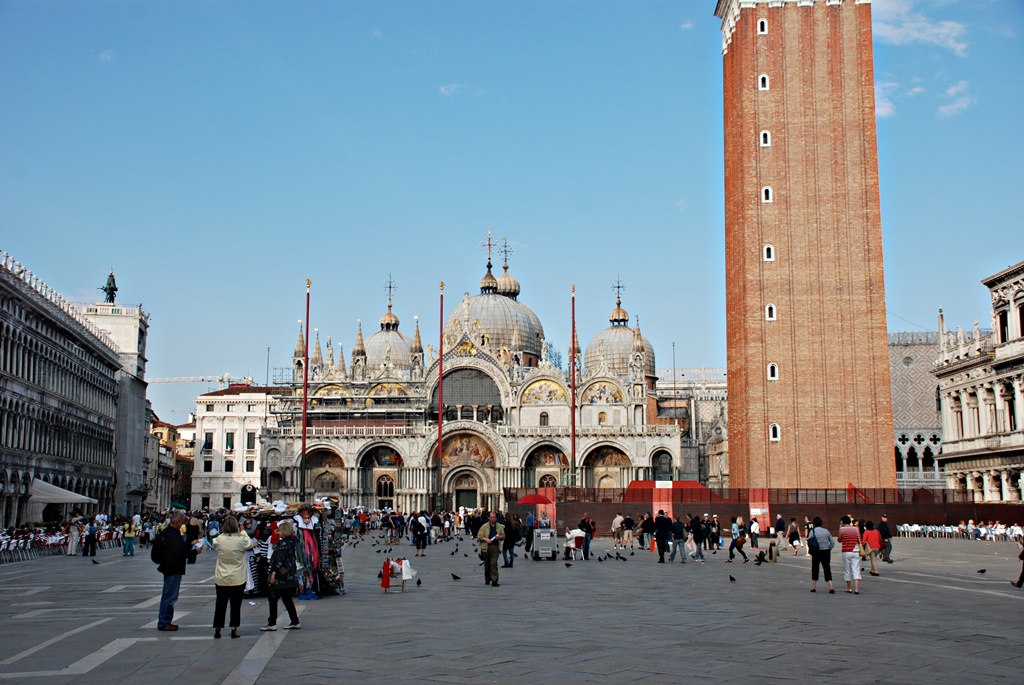
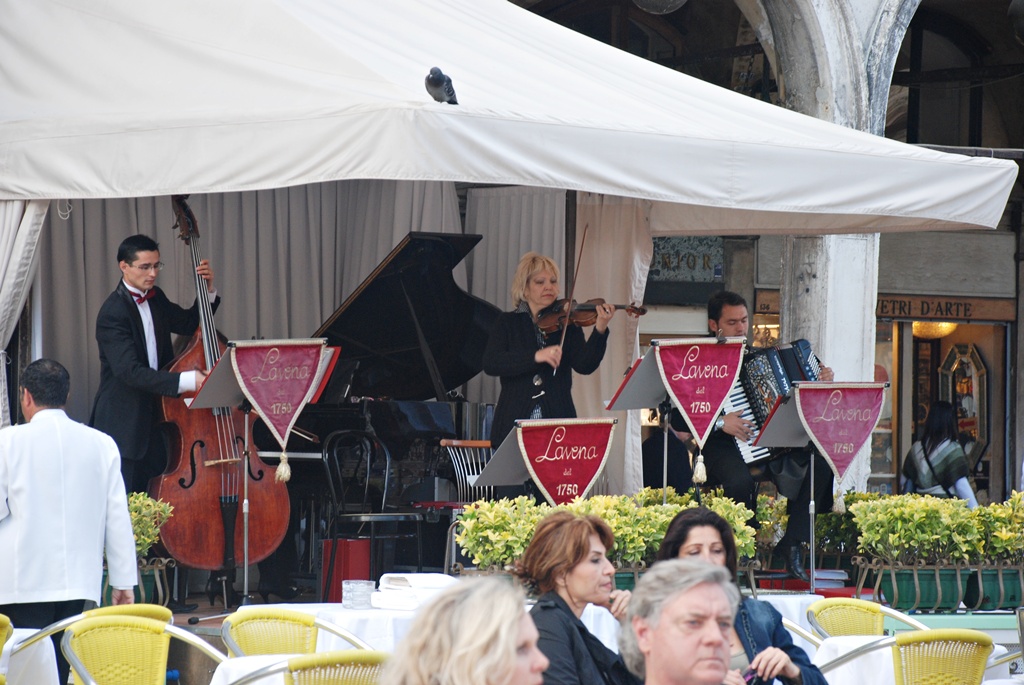
Our hotel was quite close to the main square of Venice – Piazza San Marco. Napoleon described Piazza San Marco as the “finest drawing room in Europe”. It is indeed a very beautiful square with the Basilica di San Marco dominating one side of it, with a tall clock tower beside it. There are many cafes with live music along the square and the whole place seemed to pulsate with an abundance of energy as people continued to pour in as the evening wore on. The square sure seemed to have some special attraction that drew people in.

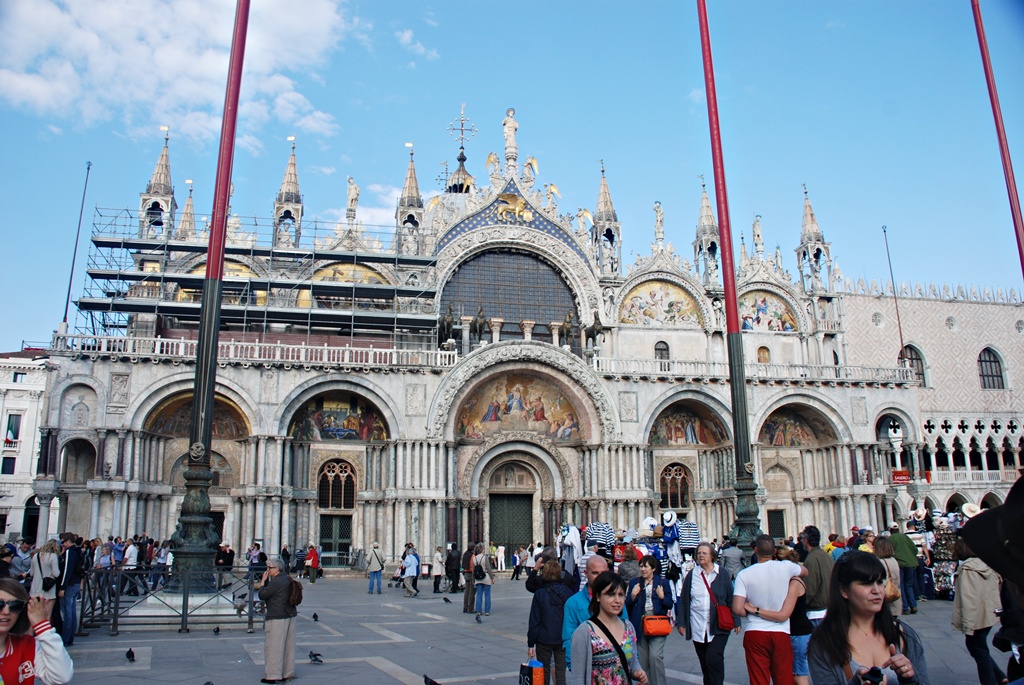
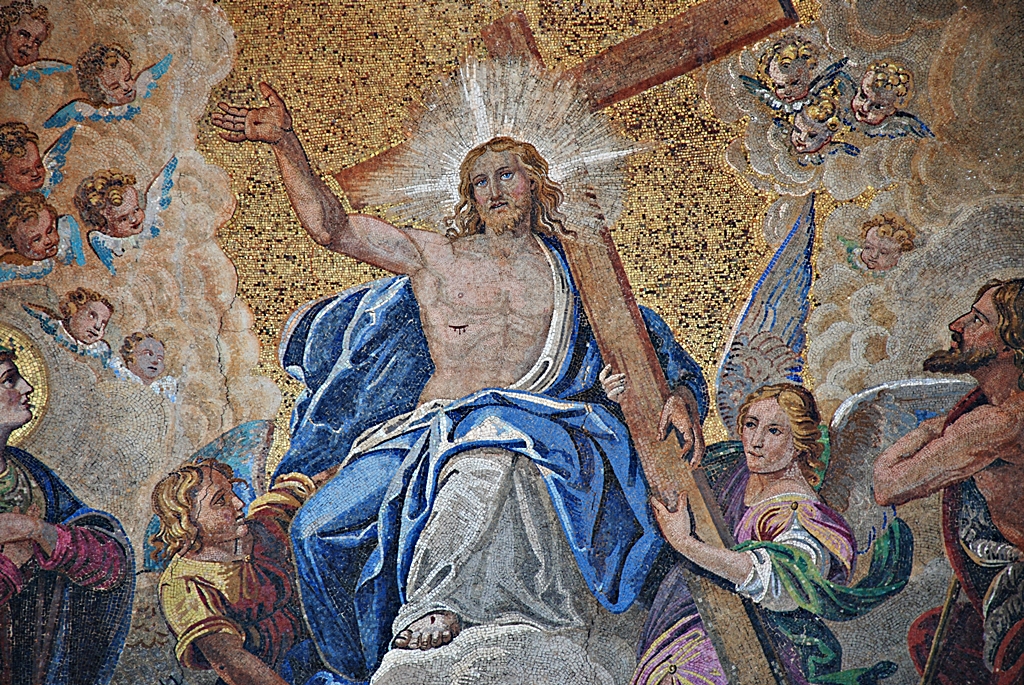
Basilica di San Marco is the pride of Venice and its claim to fame happened when some Venetian merchants stole St. Mark’s body out of Egypt in AD 828 and brought it to Venice. They also adopted St. Mark’s winged lion as the city’s symbol. Venice felt that it was an equal to Rome as it had its own Saint and so the authorities did not heed Rome’s call to shun all Pagan symbols. Hence, one can see many Greek statues and such on the façade of the church. There is also a very nice fresco above the entrance to the church and it looked quite attractive – I think there must have been some restoration work done on it.

In the evening, we went in search of the lone Indian restaurant in Venice and it was a great feeling to walk through the narrow lanes, some of which were just 6 feet wide. We passed by the famous Rialto Bridge and paused to take in the views. There are a lot of restaurants on the Grand Canal near the Rialto Bridge and I was surprised to hear snatches of Hindi as we passed by. On closer inspection, I found that many of the waiters in those restaurants were Indians and they were talking to each other in Hindi. The restaurants were serving Italian food and so we continued on our journey towards Indian food.

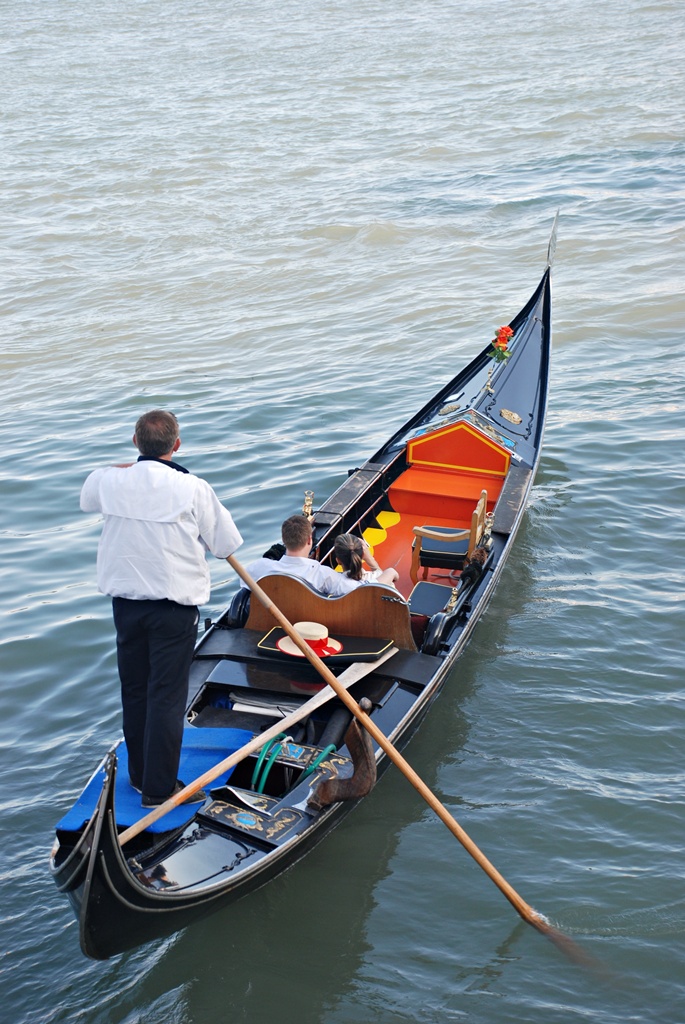
All along we saw people taking rides in colourful gondolas. This is supposed to be a very romantic thing to do in Venice and the boat men do also sing songs on request. Not being the romantic type, we passed on the ride.

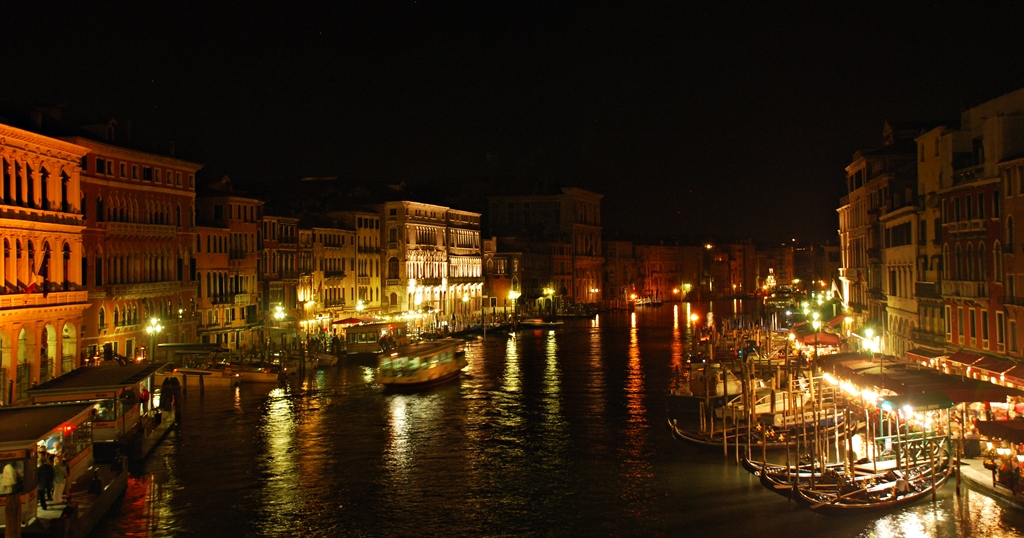
On the way back, night had fallen and the city had taken on a special charm in the night. I got a beautiful shot from the Rialto Bridge by balancing the camera on the handrail.

17 May 2011

Venice is very famous for its glass making skills since the last ten centuries or so. In the thirteenth century the then Doge (Duke) of Venice ordered that all glass making facilities be moved out of Venice, as he feared that fire accidents could break out and destroy the city. That is how Murano shot into prominence as all glass making workshops were moved to this island, which is just a short ride from Venice. Another thought behind moving all glass making skills into a small island was to ensure that the secrets and knowledge did not leak beyond Venice. The masters were not allowed to leave Murano and had to stay there all their life. As a form of compensation, they were allowed to marry the ladies of the upper class families in Venice and this must have been very prestigious as these families had special privileges.

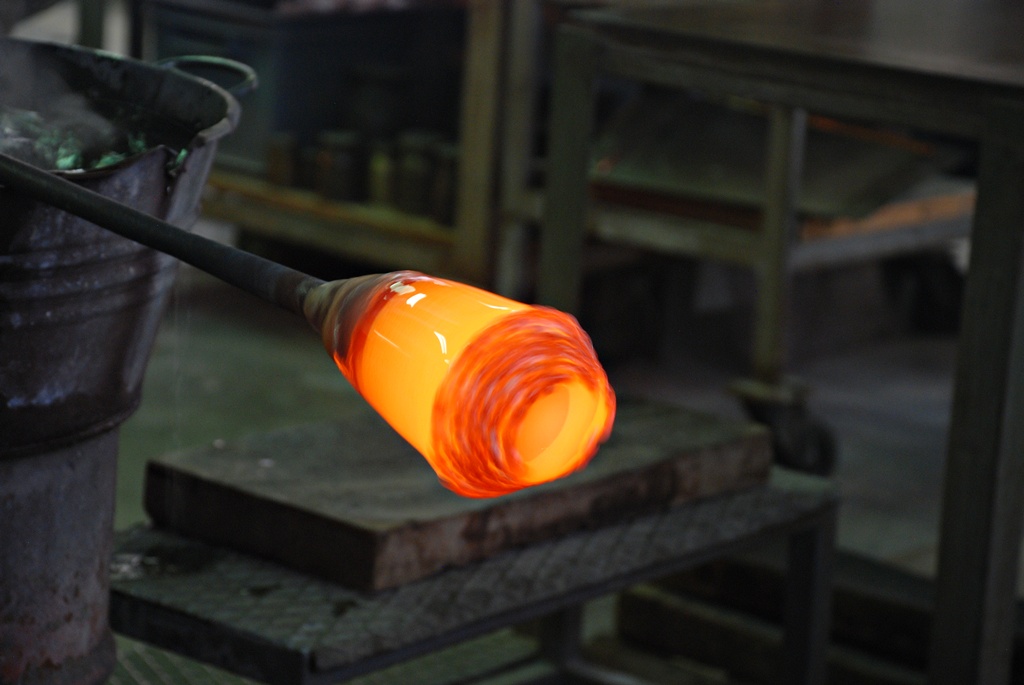
Murano glass is very well known all over the world today and they still use the techniques used centuries ago. We were warned against cheap imitation from China that pass off as Murano glass. We set off in a boat to Murano and visited a glass making workshop. A master demonstrated his skill and showed us how a small vase could be made. I was quite amazed at how malleable glass became when heated to high temperatures.

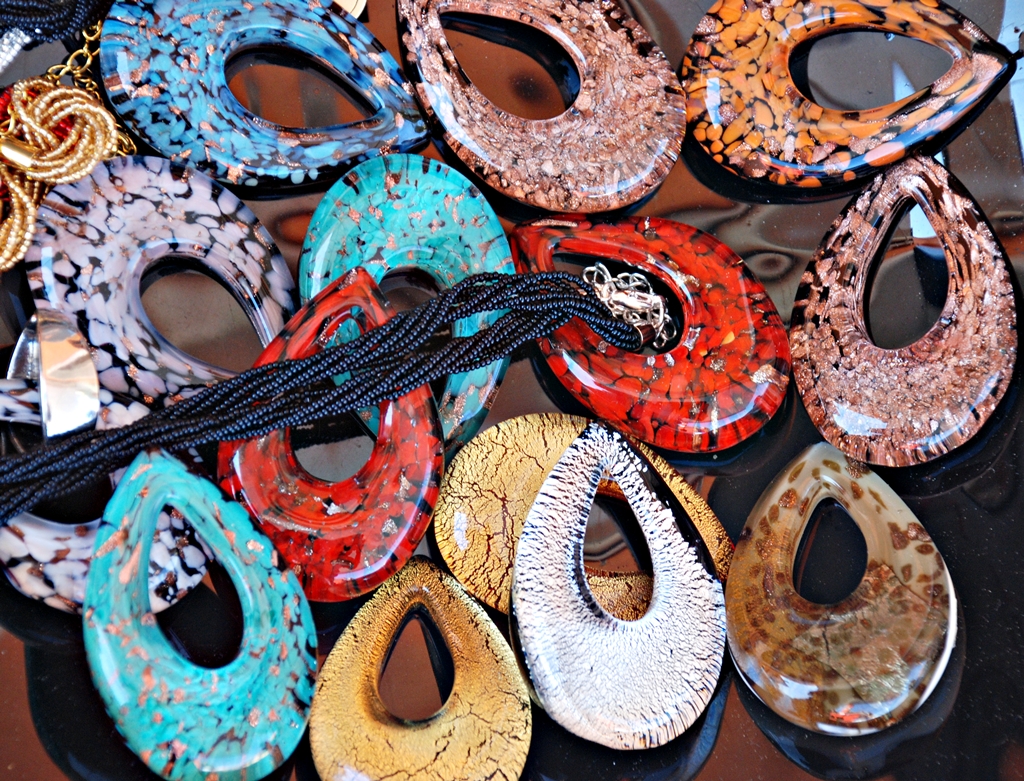
The workshop had a showroom as well, which had many beautiful pieces and they were actually pieces of art and priced as such. They did not allow photography as they were afraid of Chinese imitations. Jewellery made of Murano glass is quite attractive and was on display all over the island.

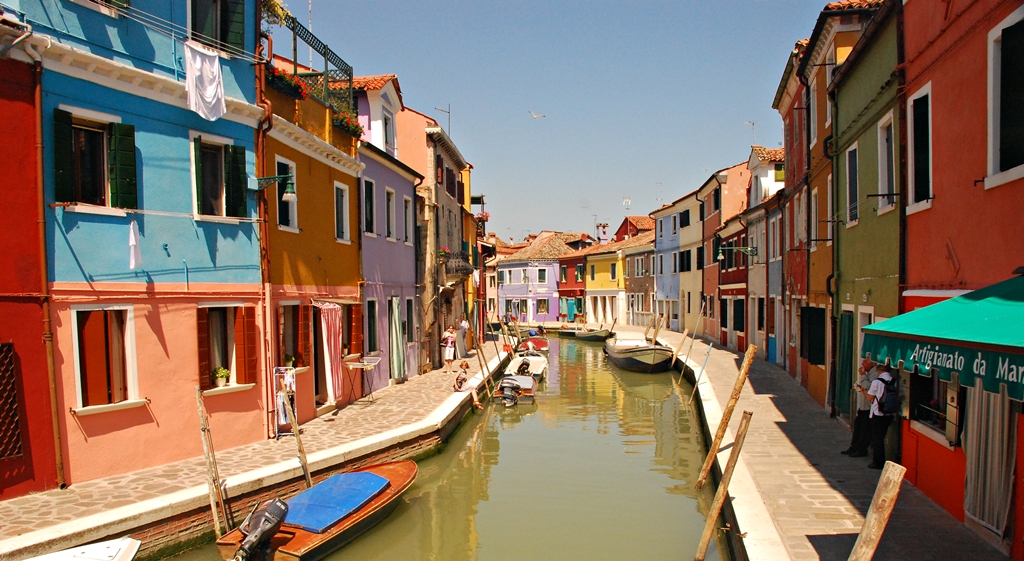
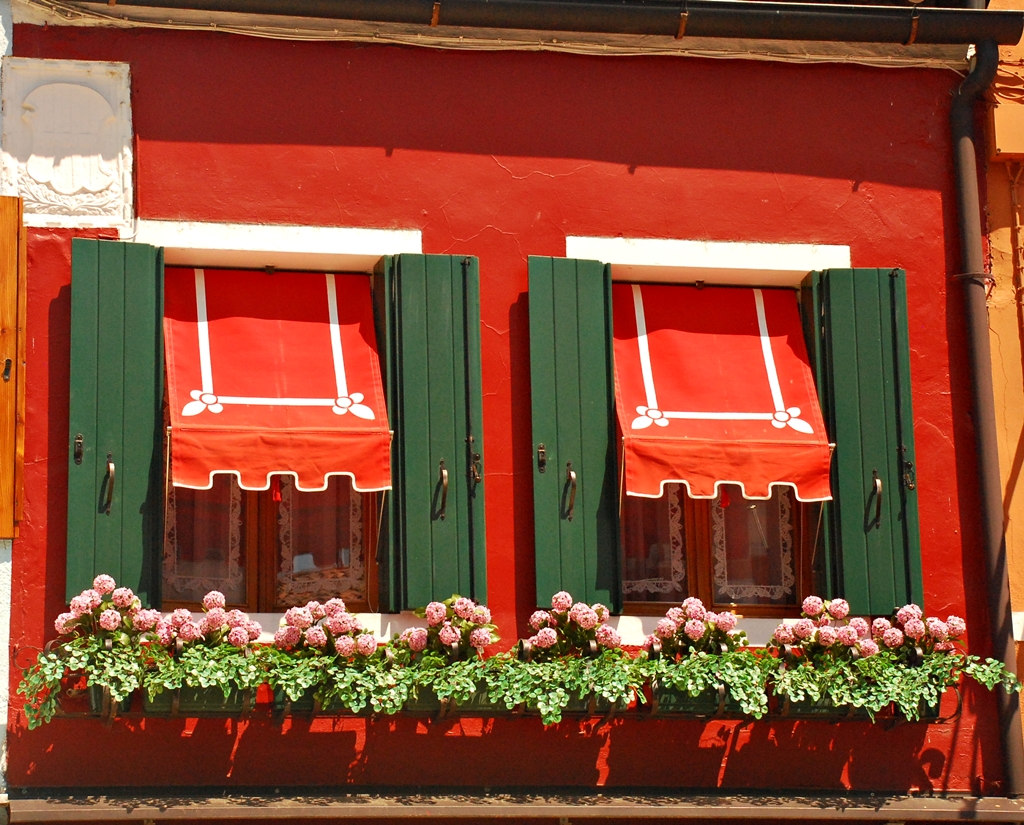
Our next port of call was Burano and we went there by public transport boat. Burano is known for its brightly painted little houses, which make the island very colourful. It was indeed very beautiful and I got a couple of nice shots. Burano is also known for its lace making skills.

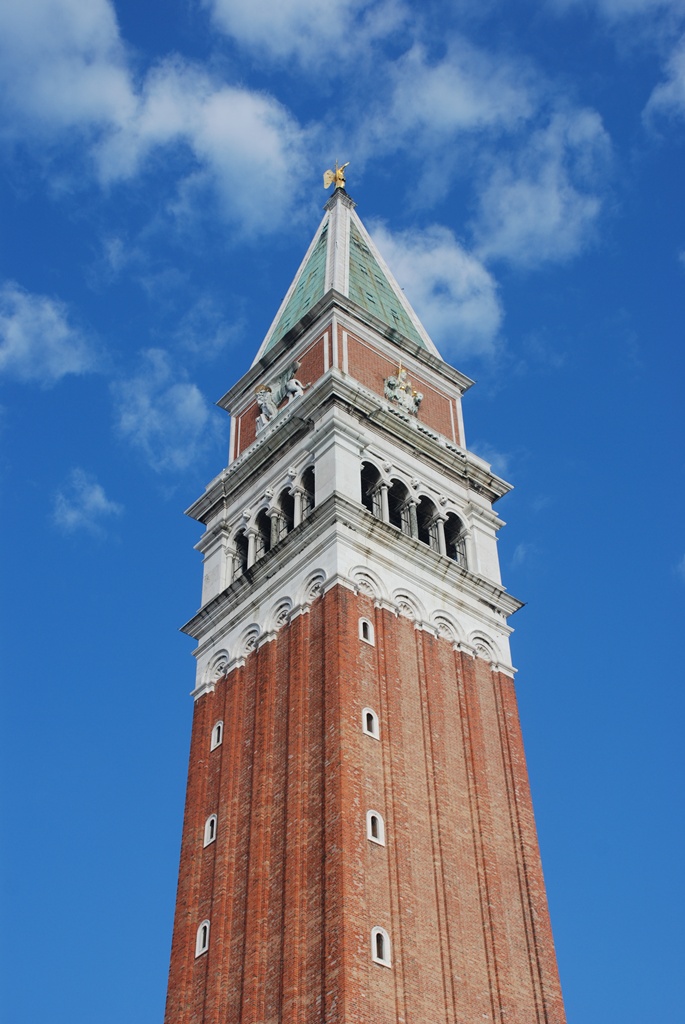
After Burano, we went back to Venice and Piazza San Marco. On the square, is the very tall clock tower, which goes up to a height of 100m. It was originally built in AD 888 but has been rebuilt twice, the last time being in 1902.

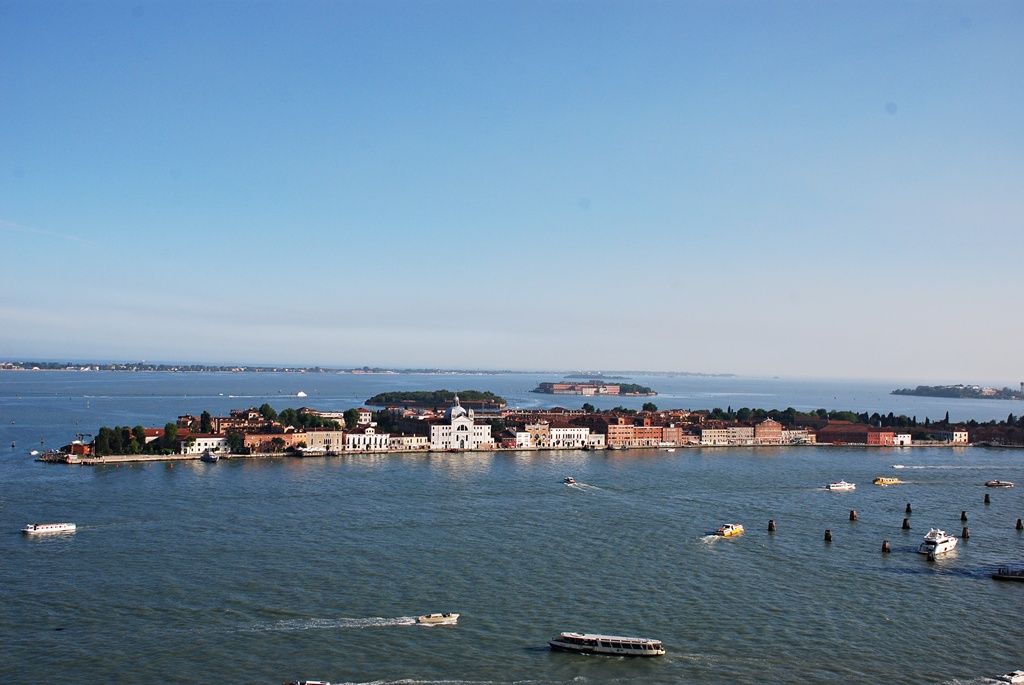
A lift takes you up to a height of 60m and that is high as you can go. From that position, there are great views of Venice, especially as you look out to the sea.

In general, I have felt that punishments in medieval Europe were of a rather barbaric nature and that was borne out here too as I heard that they used to hang cages from the side of the clock tower and hold prisoners in those cages. Another comment I heard was about the Doge – the Doge was the ruler of Venice and hence powerful, but it seems that there are there are only two monuments that show the Doge. In both, he is shown as kneeling before St. Mark, the patron saint of Venice; another way of depicting that he is a public servant. I was profoundly impressed by this point that rulers in those medieval days had such an insightful approach – especially in those days when the practice was for rulers to have themselves painted and sculpted and to make grand monuments. This shows that they truly believed that they were servants of the city. The Doge’s palace is to one side of the square and did not look like an imposing building. Hence I had decided not to visit it but this comment made me change that and I penciled that in for the next day’s itinerary.

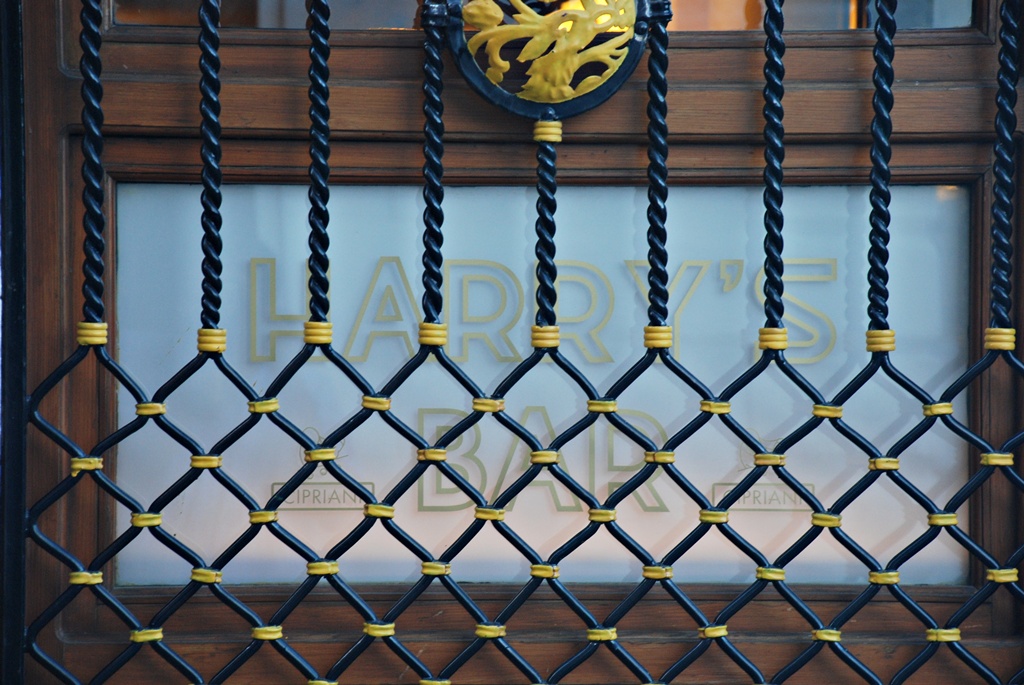
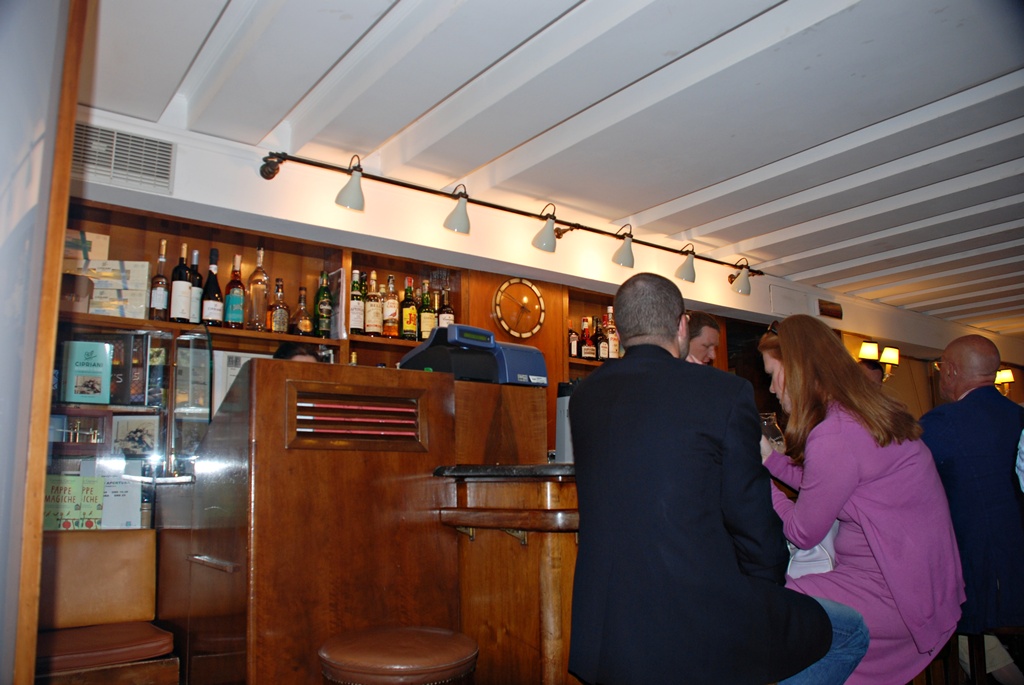
Venice was one of Ernest Hemingway’s favourite cities and he is said to have frequented a bar called “Harry’s Bar”, which is just a few minutes’ walk from Piazza San Marco. He wrote portions of his book “Across the river and into the trees” here and the bar itself finds mention in the book. This aroused my interest in the bar and I decided to visit the place, especially as that novel is a favourite of mine. I located the place without much difficulty and spent a quiet half an hour in there, thinking of Hemingway and his books. I do not know what is special about this bar but there must be something as it is also rumoured to have attracted some other famous personalities like Marconi, Alfred Hitchcock, Charlie Chaplin, Baron Rothschild, Aristotle Onassis, Woody Allen etc.

18 May 2011

Venice was a republic from the eighth century till 1796 and had deep democratic traditions. Citizens from prominent families formed what was called the Great Council, which had more than 400 members. Only members of some certain families could be part of this council and the names of these families were registered in the “Golden Book”. There was another book called “Silver Book” which held the names of families that could make it to the Golden Book and when the city had some financial woes, some families were promoted, in exchange for tidy sums of money which they had to pay to the city! A senate was chosen from within this council and there were about 100 members in the senate. The Doge was chosen from the senate and held the office for life. There was also a council of ten that was chosen from the senate to help the Doge in day to day administration. The democratic traditions were very evident and they also had a legal system, which was based more on common law than on royal law.

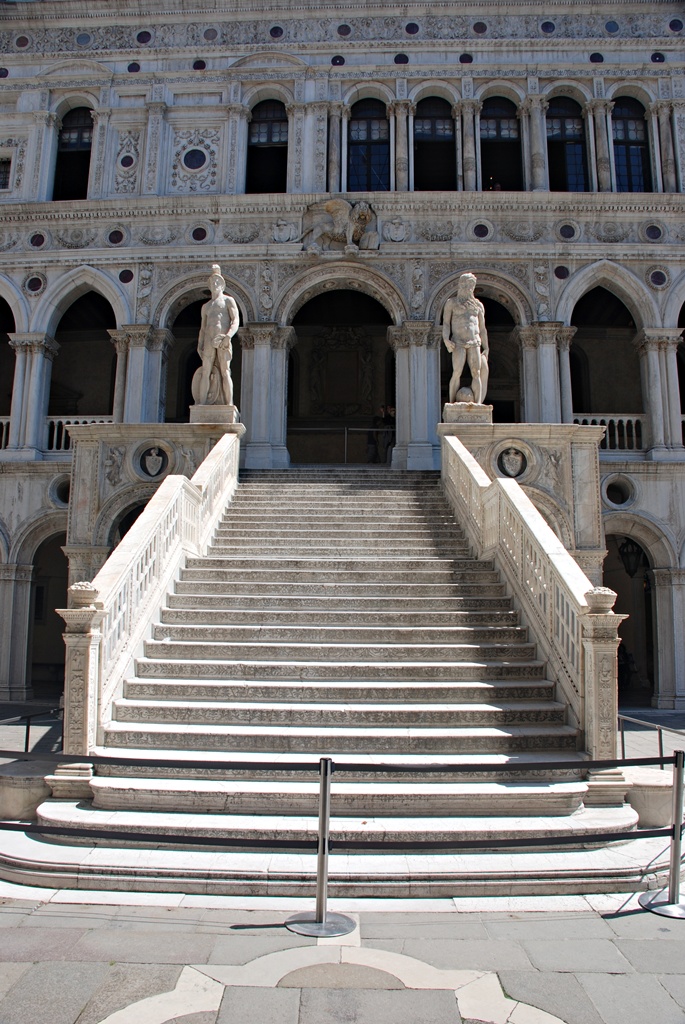
The Doge was deemed as a public servant and public offices like administrative offices, courts, prison etc. were all attached to his palace. The palace itself was not very impressive.

When we went inside the palace, we found the place rather bare. On enquiry, it turned out that the Doge had to bring his own furniture when he was elected to office and so the family used to take back the furniture once the Doge passed away. The art works in the palace clearly showed the great pride and love that Venetians had for their city; Venice was shown in many paintings as Venus with kings and others bowing before her. Venice thrived as a republic for about 1000 years and had a very powerful navy which allowed it to rule the seas. Gradually, its power declined and the city was ravaged by plague two times. The last Doge dissolved the council and resigned from this position when he found that he could not defend Venice against the military might of Napoleon.

That was our last visit and the end of a very enjoyable trip. Italy is truly fantastic and I felt that there is much more to explore and experience. May be I will be back!


12 May 2011

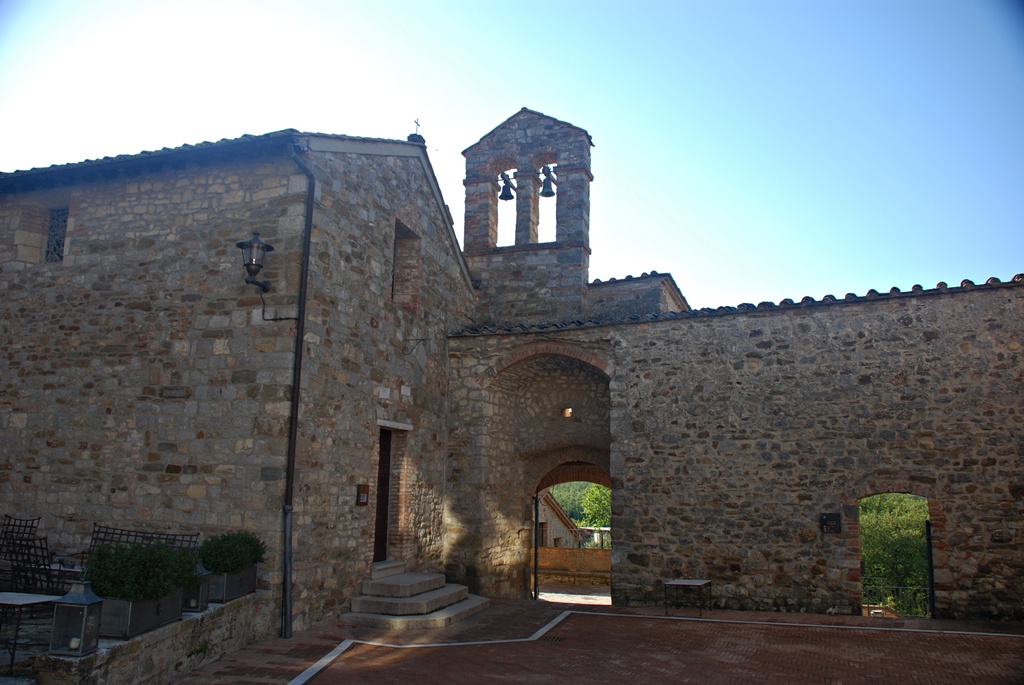
We left Rome around mid morning and caught the fast train to Florence. The train journey was quite comfortable and we got to Florence just after noon. I had organized a rental car for our stay in Tuscany and we were soon on our way to our hotel in the heartland of Tuscany. Needless to say, there were some challenges with GPS initially and my mistake in selecting the “Short route” option instead of the “Fast route” one resulted in the drive taking an hour more than was actually needed. However, we passed through some great countryside and the views were just stunning. The Tuscan countryside is full of green, rolling hills. In due course of time, we arrived at our hotel. The hotel turned out to be a medieval monastery building, which has now been converted. We were a bit tired that day with the train journey and the longish drive and so decided to take it easy and just spent time around the hotel.

13 May 2011

We set out for Pisa in the morning and yet again, I took the scenic route and so it was a fairly longish drive to Pisa. The views were quite breath-taking but I could not take any photos as the roads were quite narrow and I felt content with just soaking the ambience in. One point I noticed was that many of the hill tops had a lonely house or fort or some structure of that nature. May be these were houses of landlords or forts of chieftains. In any case, it was quite an interesting sight.

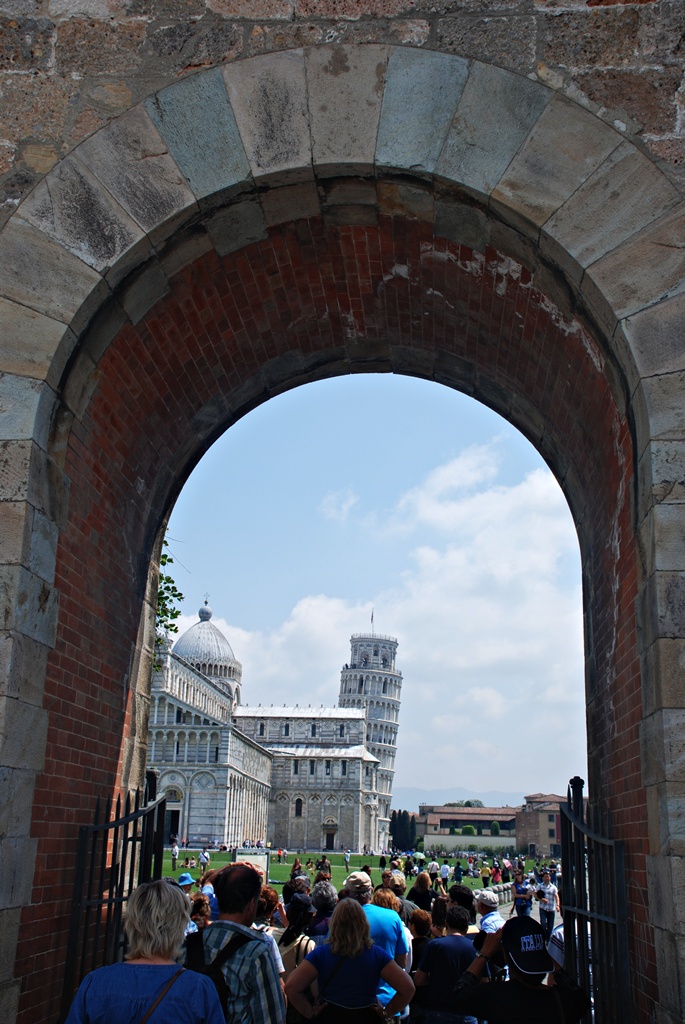
We arrived at Pisa round noon and went to see the Leaning Tower. It is in a complex with a cathedral, which houses the body of a saint. The first view as you glimpse the tower through the arched entrance to the complex is quite stunning. I had seen many pictures of the Leaning Tower before but somehow, the sight caught me by surprise. May be it was the brilliant white structure set on a wonderfully green lawn at its best on a nice day; I don’t know what. I tried to capture the sight in my camera but I was not able to do justice.

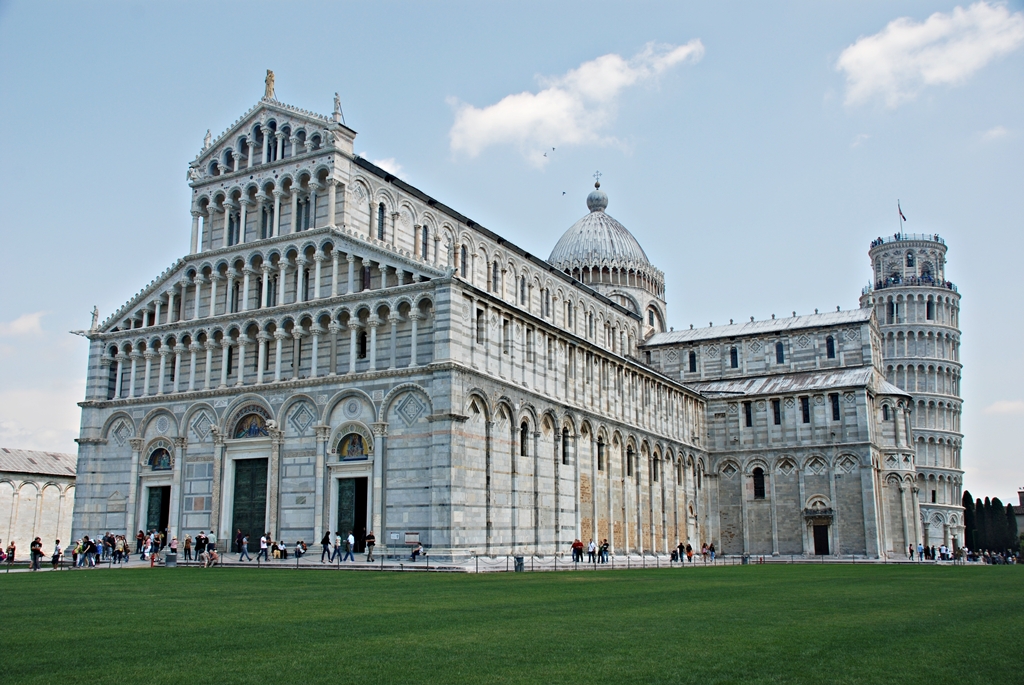
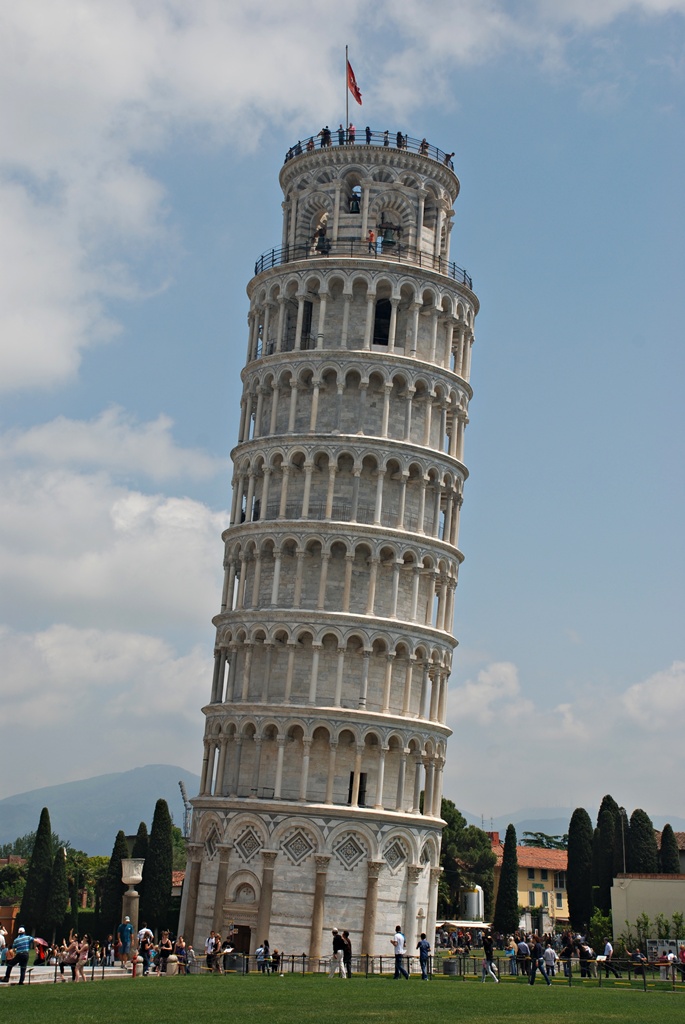
The cathedral and the tower are both in white stone and marble and the detail on the structure is amazing. The tower was planned as an independent bell tower for the cathedral and work stared in 1173. The soil in Pisa is not very stable and the design did not adequately compensated for that fact as the foundation was only three metres deep. As a result, the tower started to sink soon after construction started and it tilted to one side. Work was abandoned after construction reached three floors. The tower stayed in that condition for about seventy five years. After that, architects added four more floors on top of the three floors and tried to compensate for the tilt by building the floors to be shorter on the downward leaning side, with the result that the tower became curved. There was repair work done on the tower between 1990 and 2001 and that corrected the tilt from 5.5 degrees to 4 degrees. Authorities believe that the tower is safe for another 300 years. On the tall side, the tower has a height of approximately 57 feet and it reduces by about a metre on the short side.

We went to the cathedral first. The patron saint of Pisa, St. Ranieri, is buried here as well as Henry VII and Pope Gregory VIII. I also read that there are also some relics like the remains of three saints (Abibo, Gamaliel and Nicodemus) and a vase used in the Feast of Cana, where Jesus performed his first miracle of turning water into wine. We did not see these relics as we were in a bit of a hurry, as we had booked a slot to go up the tower.

Visitors are let into the tower in batches and one felt the angle as soon as one entered the ground floor – you have to be conscious about not going to one side. The climb is rather steep and stairs got narrower and narrower as one went up; at some places there were not even enough space to pass another person. There is no lift and I could not but wonder what the situation would be if one were to break or sprain a leg at the top. There are some interesting views from the top (especially of the cathedral) and once can also see the huge bells installed on top, the largest of which weighs more than 3,000 kg – getting that up must have been an effort. Pisa is the birthplace of Galileo and he used to conduct many experiments on gravity by dropping objects from the top of the tower, as the tilt allows a free fall. As I was climbing the stairs, I was wondering how many times Galileo would have gone up those very steps; I guess he would have been physically fit!

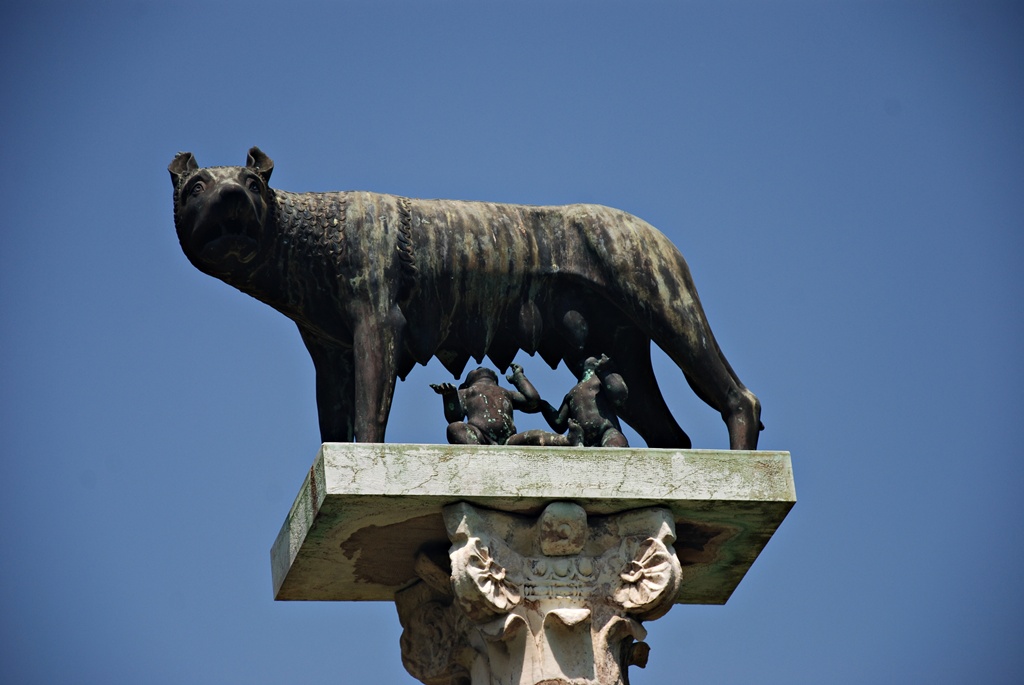
In the compound, there is a pillar with the statue of a she-wolf suckling two young children. This is the legend behind the founding of Rome. It is said that twin children were born to a priestess, through a relationship with Mars. In those days, priestesses were supposed to be virgins and so the king ordered that the children be killed to erase all evidence and they were abandoned in a forest (or set adrift according to some versions). They were found by a she-wolf who took care of them. These twins, Romulus and Remus, killed the king when they grew up and later had a fall-out amongst themselves and that ended with Romulus killing Remus. Romulus brought together some tribal settlements and founded the kingdom of Rome (Roma) in 753 BC and became the first king. I was intrigued to see this statue that related to the founding of Rome in this faraway city of Pisa; all the more so when you consider that all these city states were constantly warring with each other before the founding of modern day Italy.

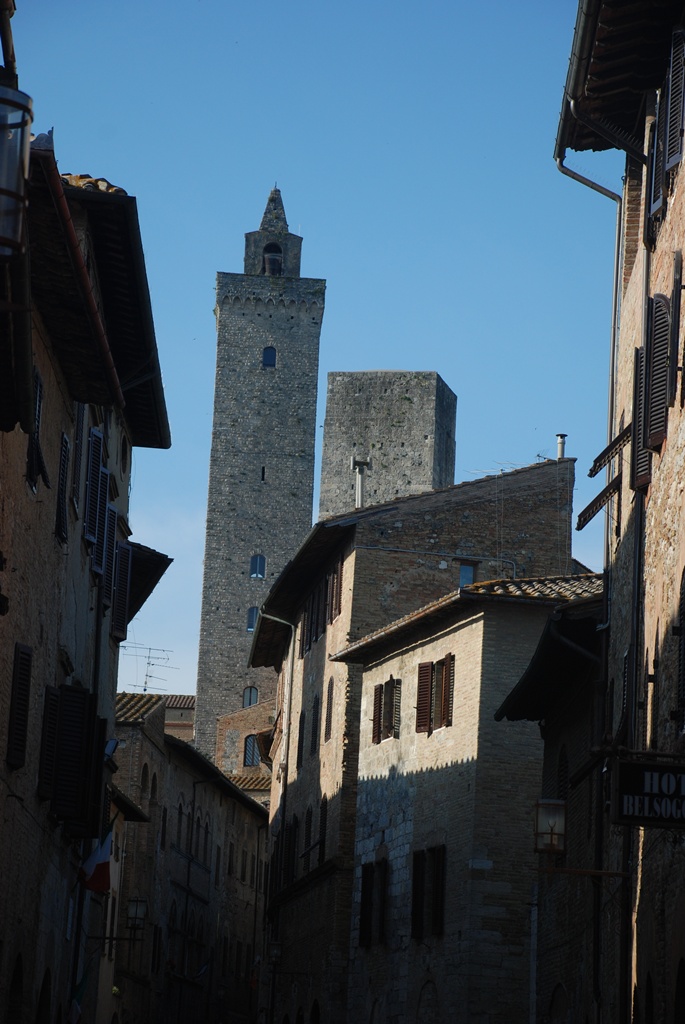
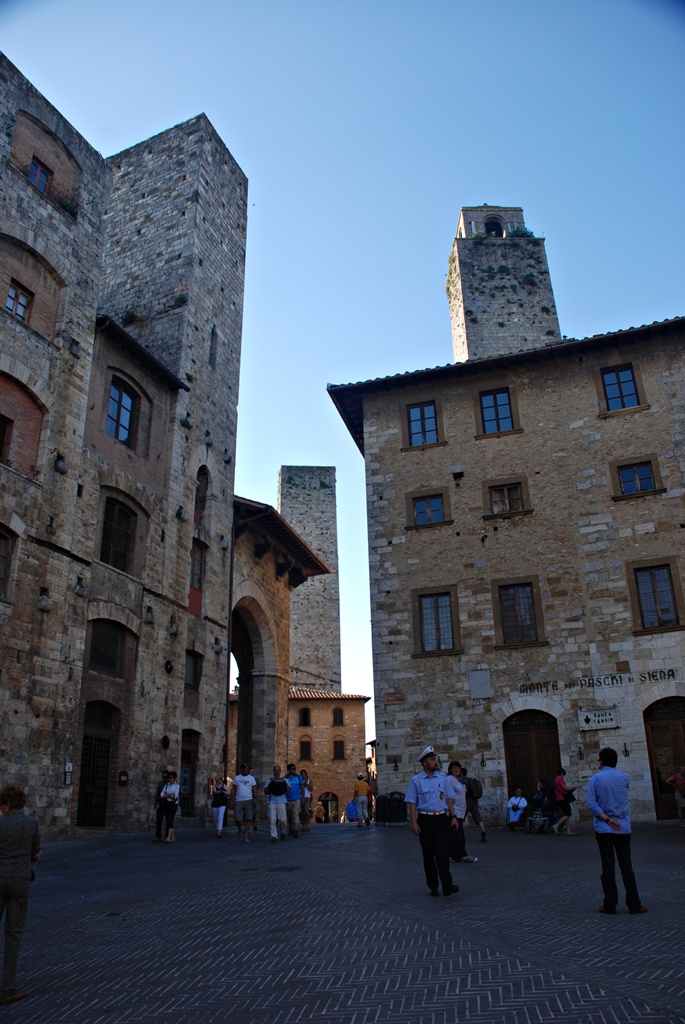
Next stop on the way back was the very picturesque and old town of San Gimignano.  This town has a population of about 8,000 people today and has its origin as an Etruscan village. Etruscans were the ancient tribe that dominated most parts of Italy and were quite a force in 8th century BC. The town derives its name from a bishop who supposedly saved it from Attila the Hun. The most interesting aspect of this small town is the presence of many towers that look like skyscrapers from afar. Most of those were built in the 13th century by rich families in a garish demonstration of their wealth. The town itself has many narrow, delightful streets that lead into a wonderful square with a well in the centre. We spent some time there drinking coffee on the square and wandering through many nice shops that seemed to have quite fascinating collections of porcelain.

14 May 2011

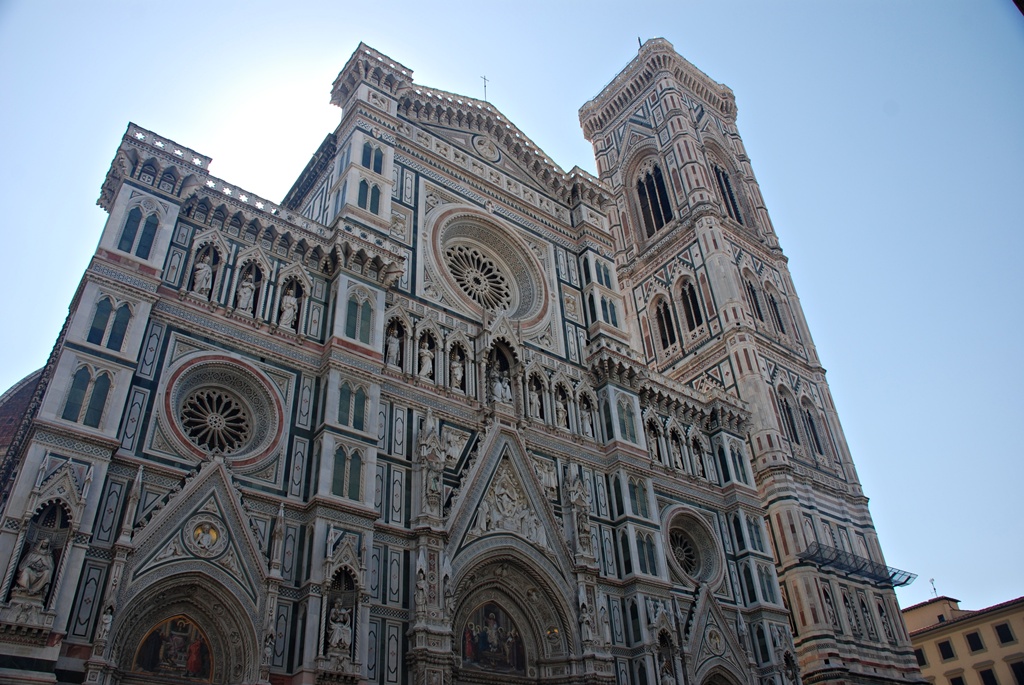
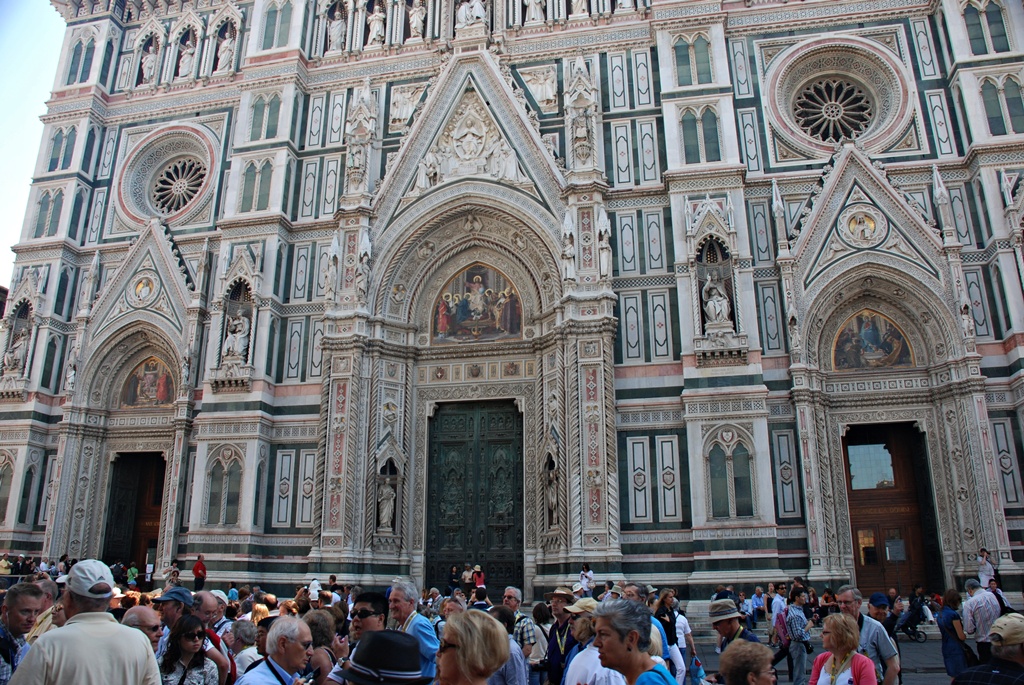
We set off for Florence in the morning. I was a bit apprehensive of driving in Florence as I had read about the no entry zones for visitors’ cars. The GPS was not very helpful as we got to the city centre and I soon found myself in some narrow streets and hit the dreaded no entry area as well. However, there was a very helpful policeman there who directed me to some parking. Our plan was to visit the Duomo and the Uffizi. According to the Lonely Planet, the Duomo (Cathedral) in Florence is among the “Big Three” in Italy, the other two being the Colosseum and the Leaning Tower.

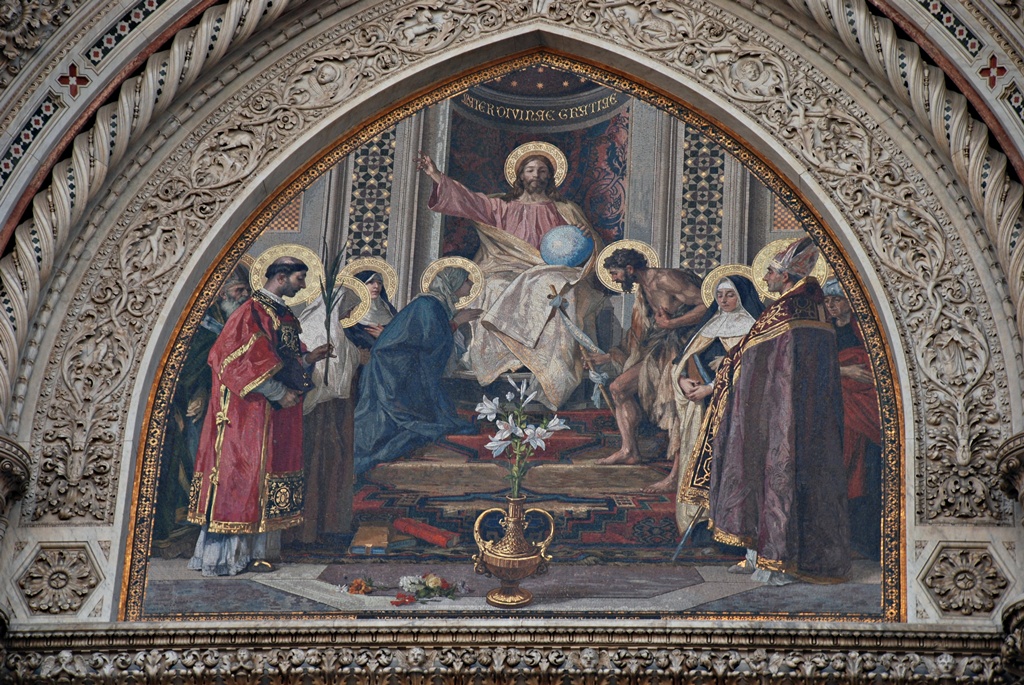
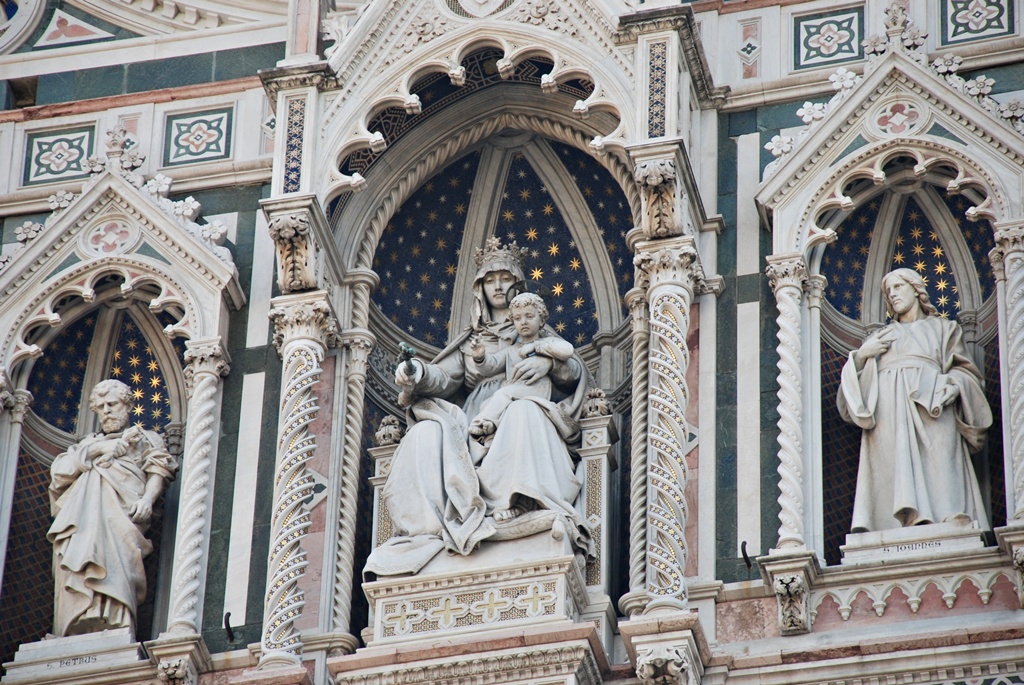
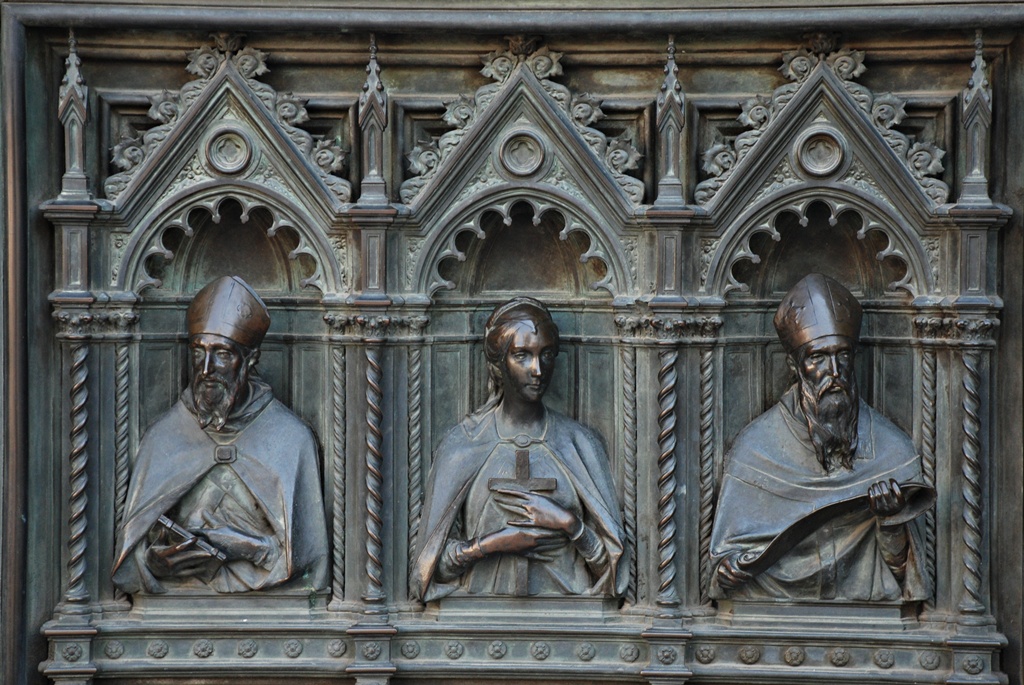
The Duomo is quite imposing and the work is very detailed indeed. The effort that has gone into the sculptures, frescoes, door panels etc. is quite amazing. However, I felt that the guidebook was overrating the Duomo as I felt that the one in Milan is more impressive. It may well have been the sensory overload that we had been subjected to in the days just gone by! The walls of the Duomo are done in pink, white and green marble and do present a nice view.

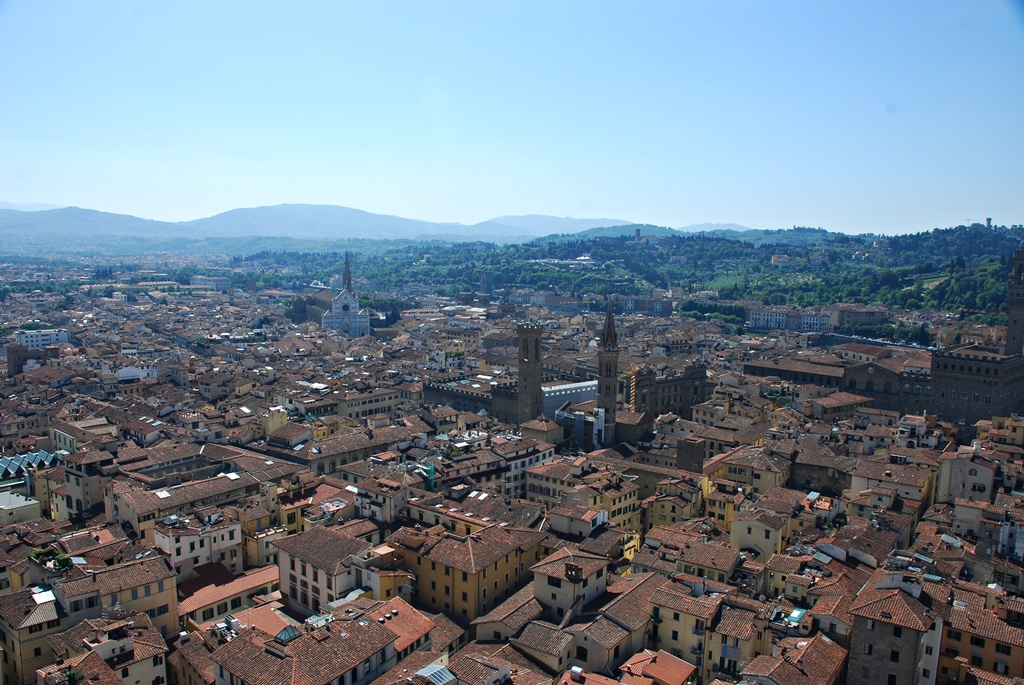
There is a very tall bell tower right next to the Duomo and you can climb on to the top, if you are willing to put in the effort of going up 414 steep steps. Of course, you soon forget the effort of the climb as you get to the beautiful views at the top.

We spent some time walking around the square and then proceeded to the Uffizi Museum, where we had made a reservation. The Uffizi was first built to house various administrative offices (Uffizi means office in Italian) but was later converted to hold the private collection of the wealthy Medici family. The last member of the Medici family bequeathed the collection to the city of Florence in 1743, under the condition that the collection would stay in the city of Florence. There are more than 1500 items in this gallery, which occupies about 50 rooms. The focus here is on the Tuscan masters and personally I found that the museum is a bit overrated, possibly because I was expecting something on the lines of Louvre or the National Museum in London. The works are arranged in chronological order to reflect the evolution of various movements like Renaissance, Mannerism, Baroque, Neoclassicism etc. Needless to say, we did not spend the four hours in Uffizi that the guidebook had suggested.

As we stepped out, we ran right into a parade of old cars and Ferraris; they were part of a 1000 mile race. This was possibly the highpoint for Bharath and we stood there for twenty minutes or so, watching those gorgeous cars roll by.

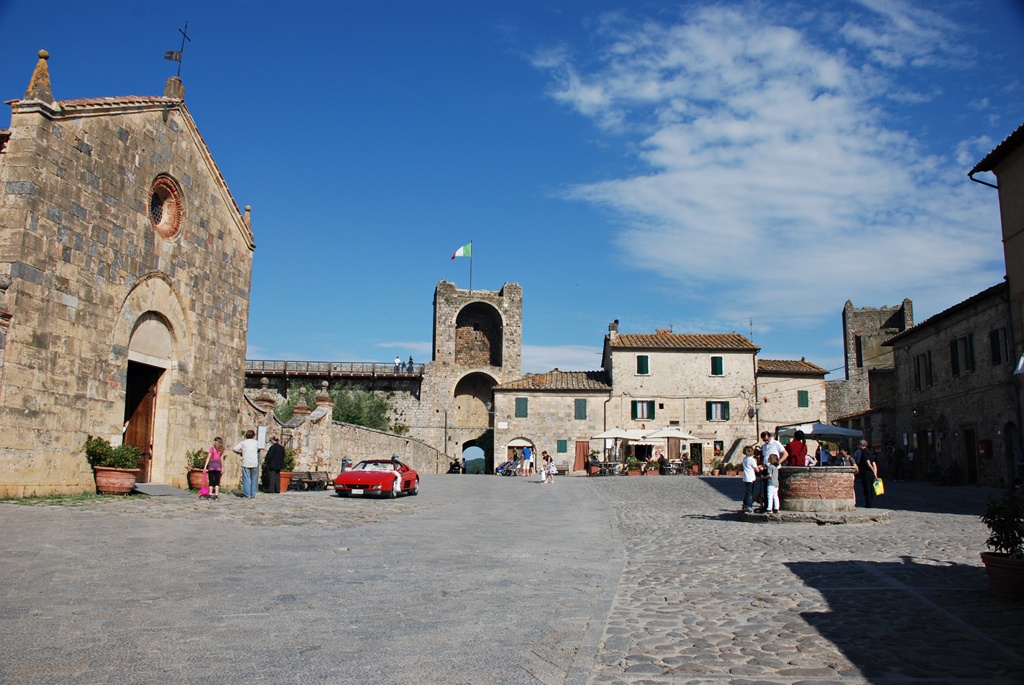
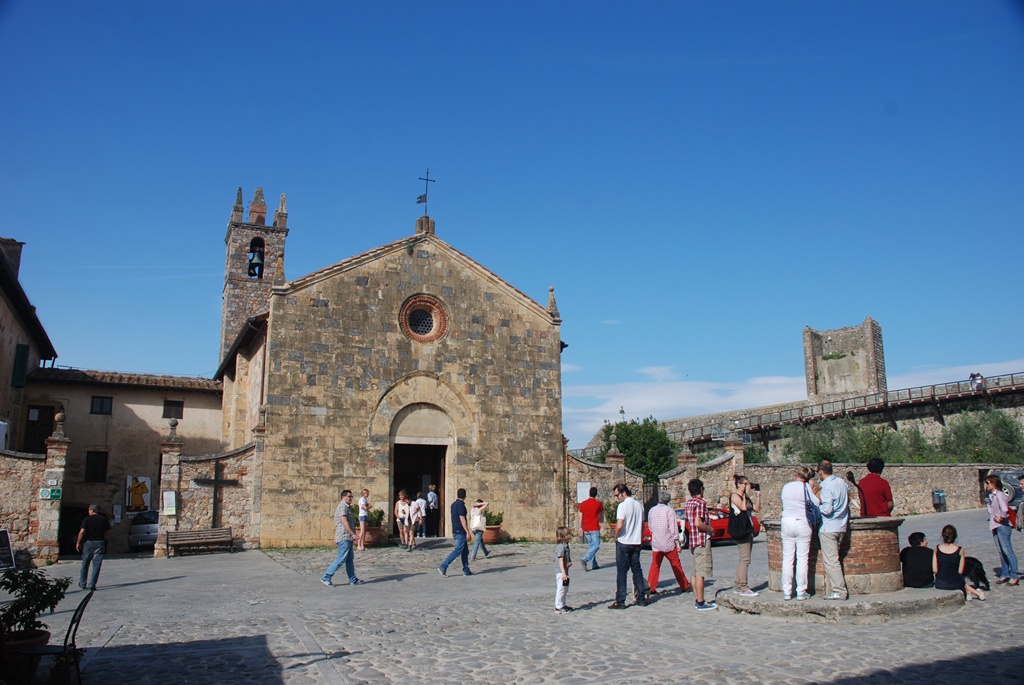
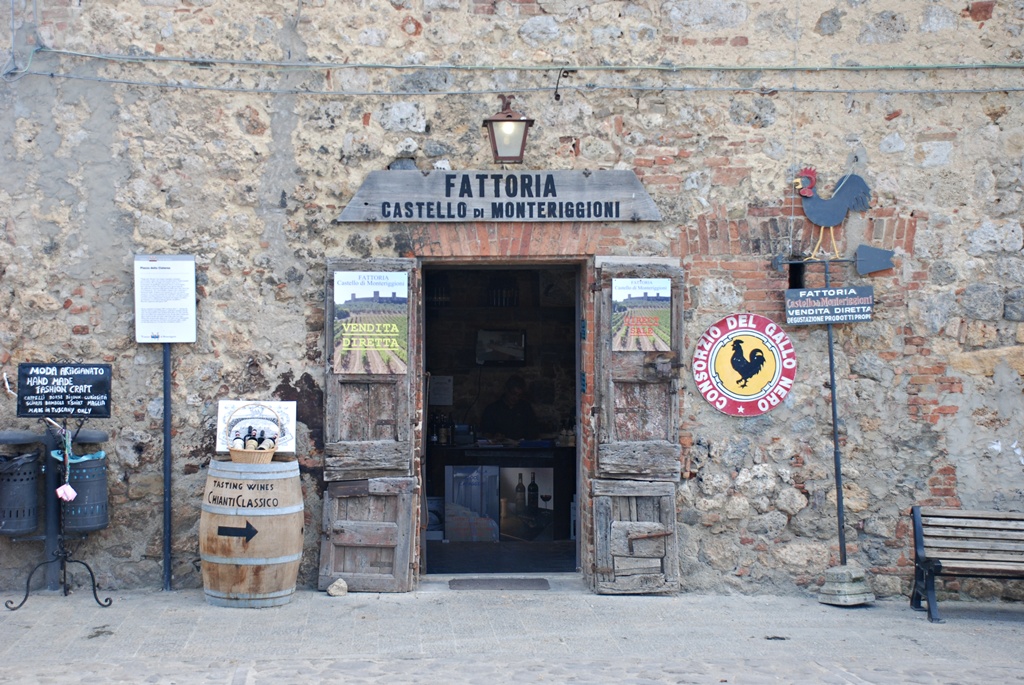
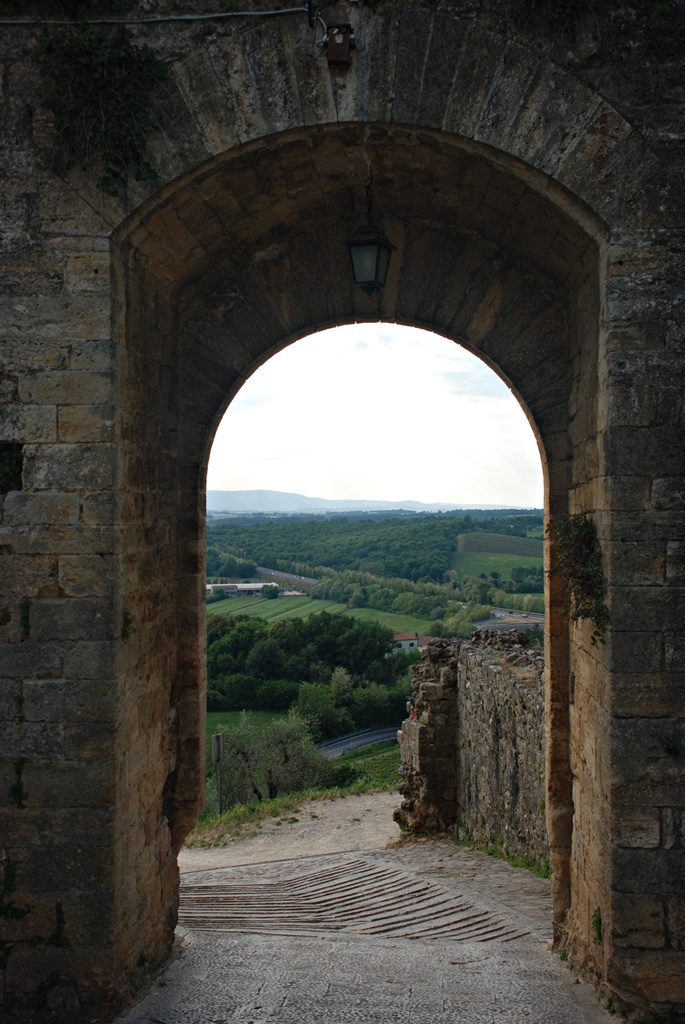
We had been driving on the very same highway the day before and had noticed a small town called Monteriggioni and decided to drop in there on the way back; especially as we could not see this in the guidebook or the GPS. It turned out to be a very beautiful village with the mandatory square and three or four small alleys; with a wall running all around it. It was possibly the house of a large landlord and there is a church and a boutique hotel there now. The square had a nice café and we spent some time there. There was a wedding going on in the church and so there were a fair number of visitors in the place. We sat around for some time, taking in the fantastic views. I found myself sitting next to an old man and I tried to communicate with him but sign language could help me only in understanding that he lived there. I wonder how it would be to spend your days in a place like that, where time seems to stand still.

15 May 2011

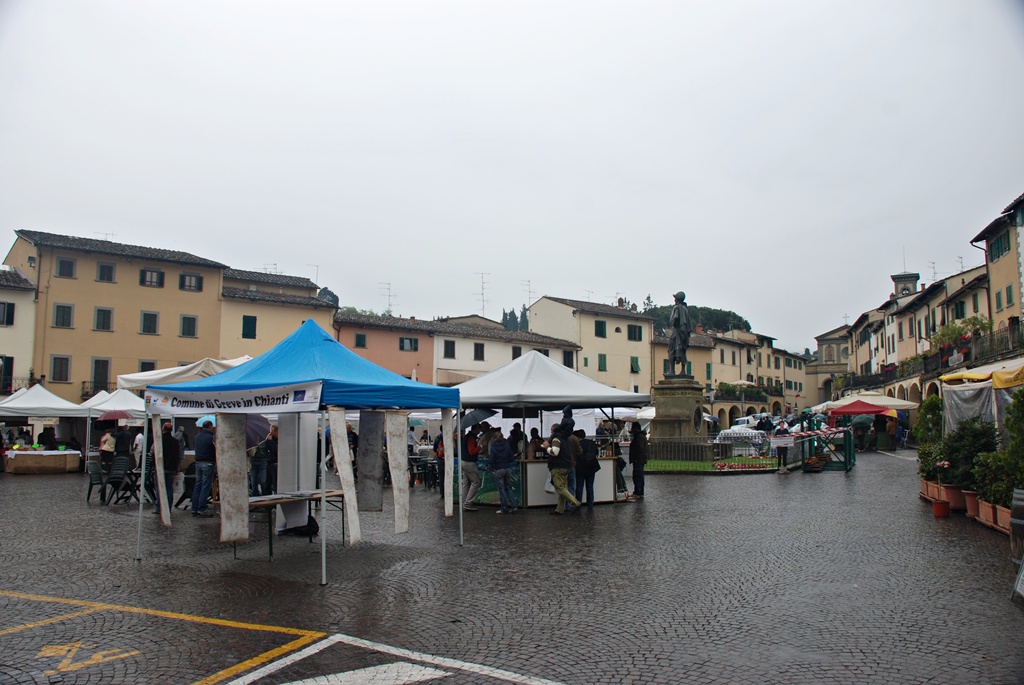
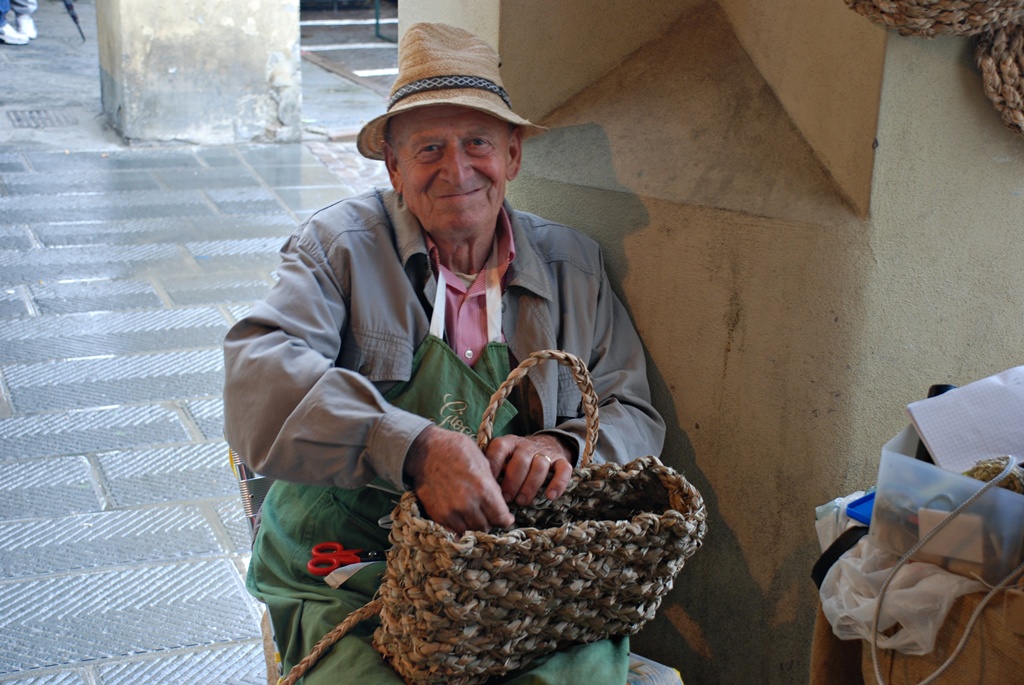
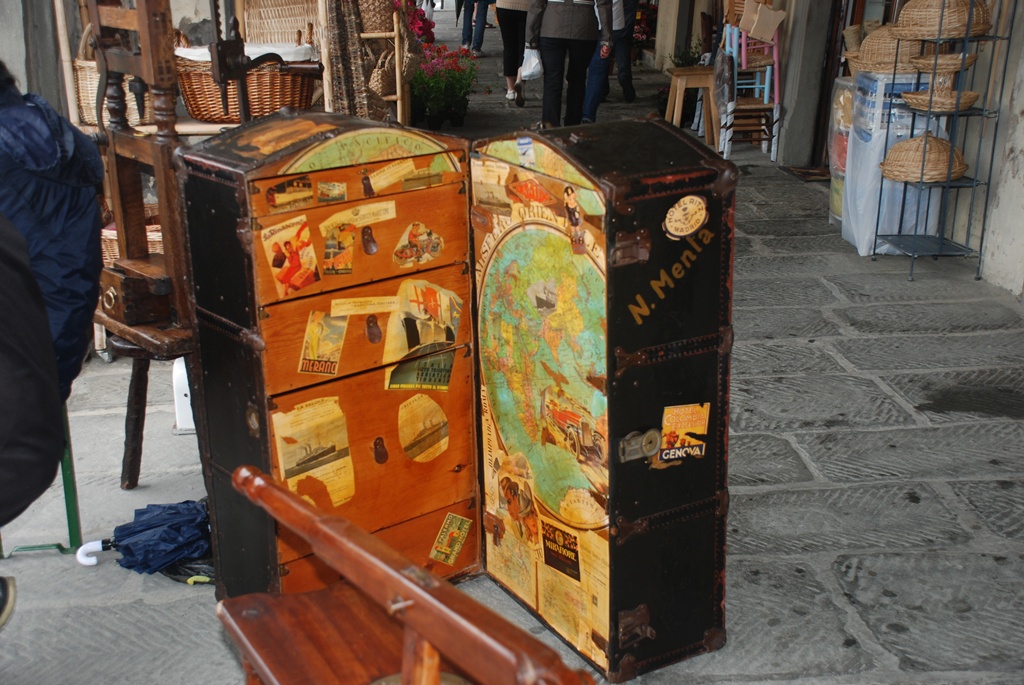
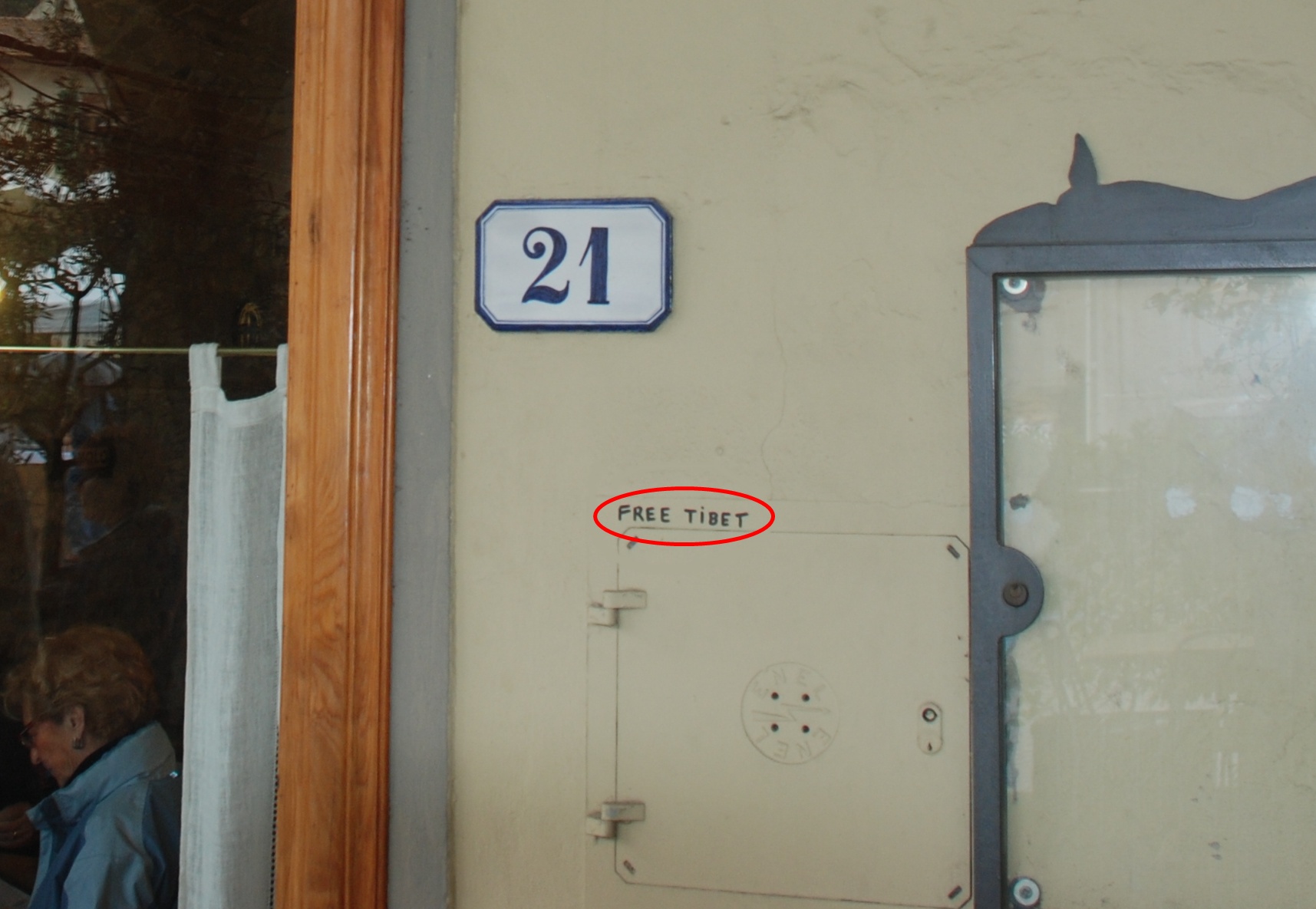
Tuscany is very well known for its wines as it is home to the very famous Chianti Classico. Unfortunately, it turned out to be a wet day and that put paid to a lot of our plans. Our first stop was Chianti in Greve and that turned out to a very nice and small town. It was a bit cold and wet but the market around the square seemed to be doing well. There were many interesting things for sale in the square including some very old suitcases, telephones etc. I also found an old man making baskets out of some sort of grass or bamboo. He was happy enough to pose for a photo. While walking around the shops in the square, I noticed some graffiti asking for Tibet to be liberated. Some agonizing soul must have scribbled that in a moment of deep frustration.

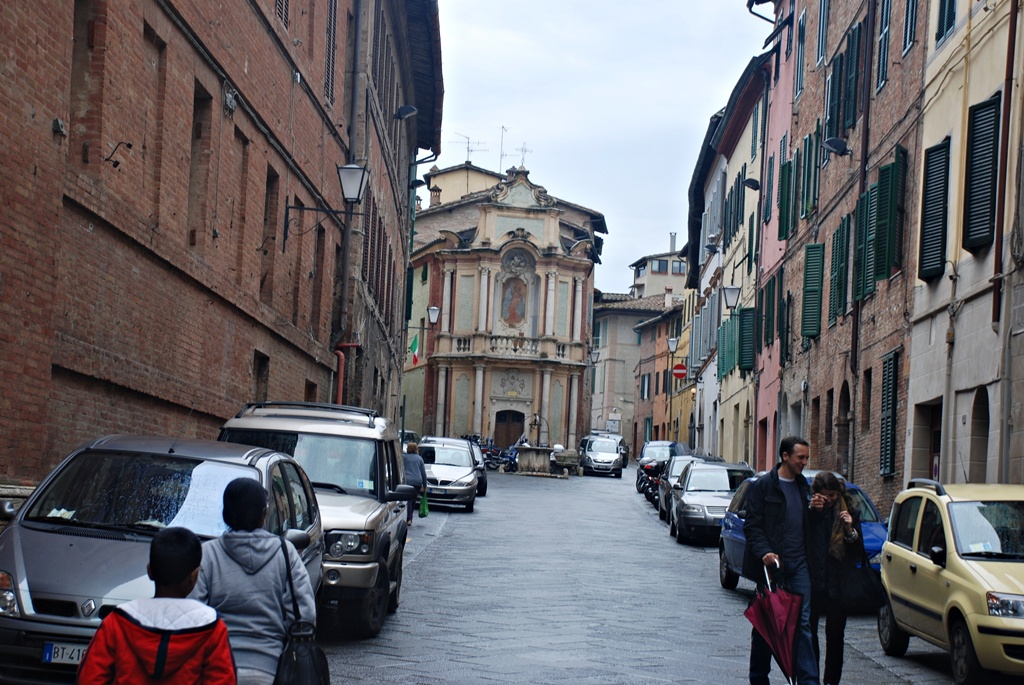
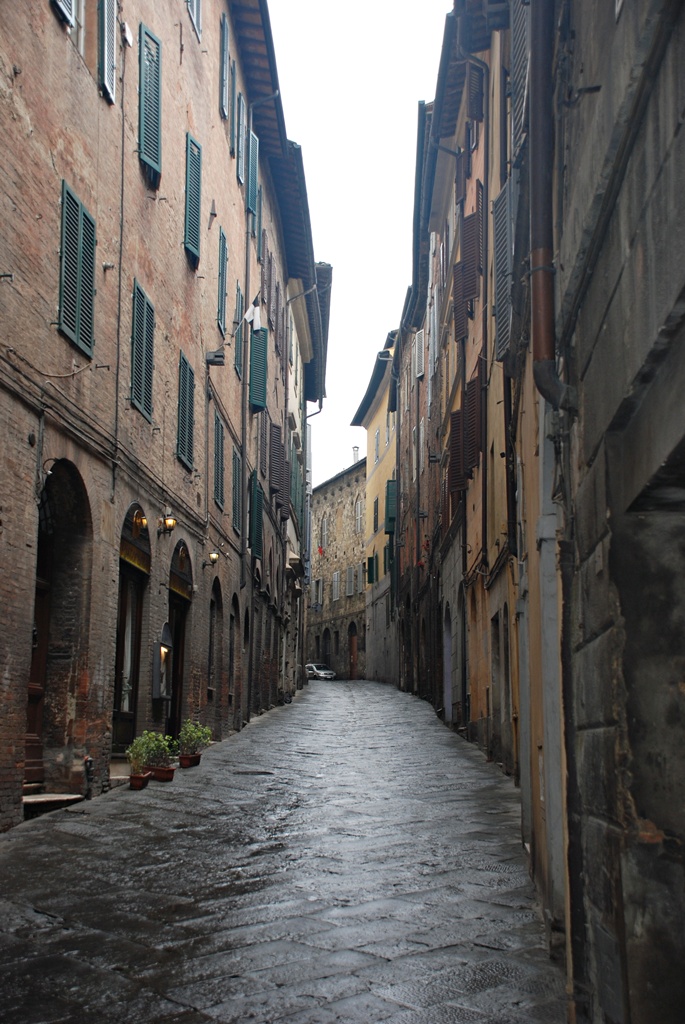
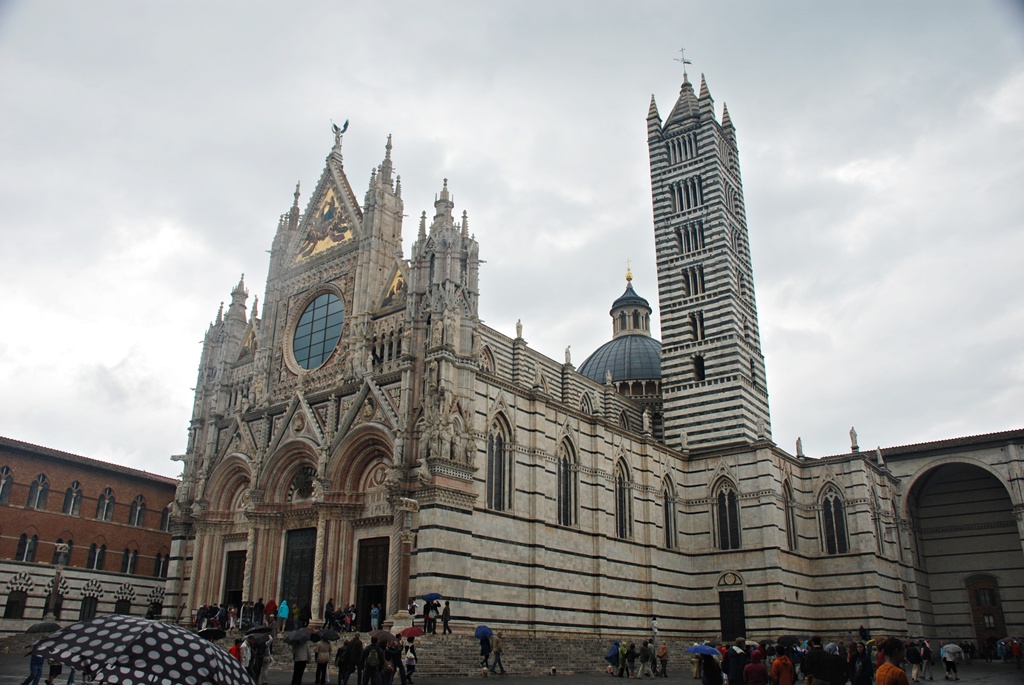
Next stop was the famous city of Siena. This is a fantastic walled city with fabulous buildings, streets with old world charm and a great square. The cathedral is also very beautiful. Unfortunately, it was quite wet and so we could not really see the city.

I had read of a wine called Brunello and wanted to look it up and that meant a visit to a town called Montalcino. The rain had hardened by then and we drove through a raging storm to Montalcino. The drive was worth it as I got to taste the 2004 vintage Brunello in the shop and that turned out to be excellent; even I could appreciate the difference in quality between the 2004 and 2005 vintage.

09 May 2011 

Italy had always been a draw since my very first official trip there. The combination of history, culture and art makes Italy a great vacation destination. After much planning and waiting, we flew out of Bangalore early in the morning and reached Rome late in the evening, after transiting at London. We were quite tired by the time we reached our hotel as we had been travelling for the whole day; even though I have to say that the taxi driver tried his best to inject some excitement into us by living up to all I had heard about the driving skills of Italians. I must say that I found myself in full alert when this guy was just ten feet behind another car at a speed of 140 kmph but soon got used to it.

10 May 2011

We got up bright and early as we had planned a full agenda and were trying to squeeze in Rome and Vatican within just two days. Given the history of the city, that is quite a difficult task. Rome was once the centre of the civilized world and evidence of that is to be seen everywhere in the city. Italy was actually a collection of warring cities and Rome gained prominence by around 500 BC by winning many important wars. They set up a democratic form of governance, which was based upon a Senate which was elected from the people and then the Senate elected two Consuls from within the members of the Senate. Membership in Senate was for life whereas the Consul was for one year and could not be re-elected. They had a concept of emblazoning monuments and civil buildings with the initials SPQR which stood for Senatus Populusque Romanus (Senate and People of Rome). Quite obviously, their democratic traditions were very strong; of course, the rich and the powerful did get privileges and they controlled the Senate and the Government but even then to think they had such a form of governance 2500 years ago, with the foresight to put in a clause that one could be a Consul only for one term, is quite amazing. Probably, they understood the maxim that absolute power corrupts absolutely. In any case, the ambitious Julius Ceasar put an end to the Republican dreams of Rome. Ceasar had been growing in power because of some of his military victories and he wanted to be the supreme ruler without the restrictions imposed by the Senate. In those days, the Roman army was forbidden from entering the city and had to stay beyond the river called Rubicon – this was probably to minimize the interference of army in government. Ceasar crossed the Rubicon with his army in 49 BC (and hence the idiom “crossing the Rubicon”, which means crossing a point of no return) and that was the end of Rome as a republic. A group of Senators led by Brutus, rebelled and assassinated Ceasar in 44 BC but that was in vain as emperors continued one after the other.

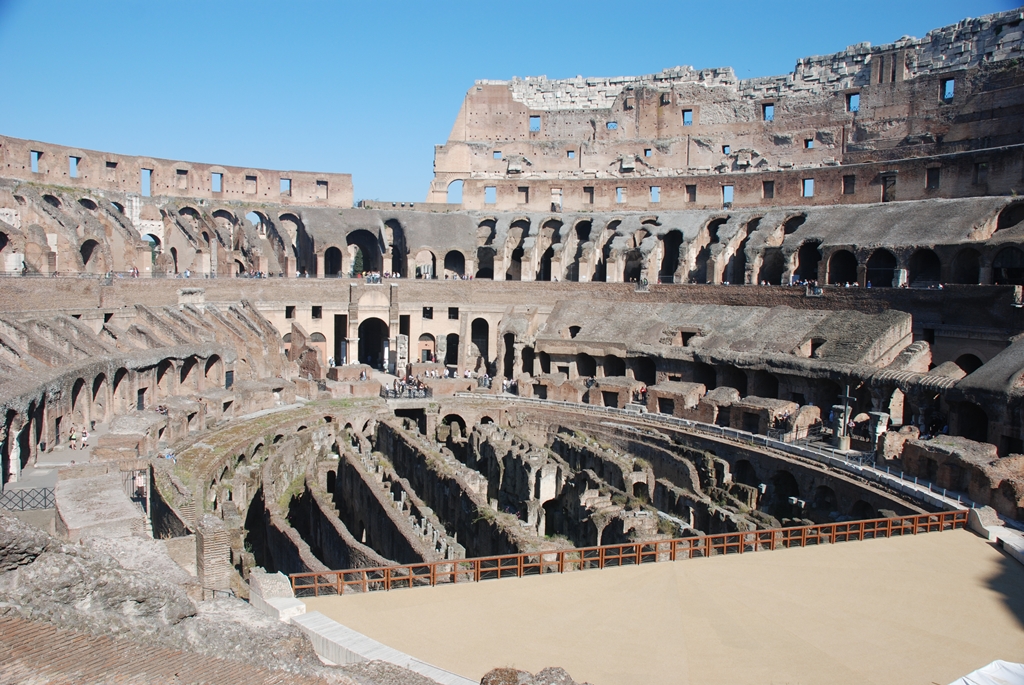
These Emperors understood that they needed to keep their subjects entertained and engaged and so they built huge sporting arenas, the most famous of which – probably because it is still around – is the Colosseum. The Colosseum had a capacity of about 40,000 to 70,000 people and had 80 arches for people to enter. It was in the shape of an oval and had many levels of seating with the most important seats being closer to the action.
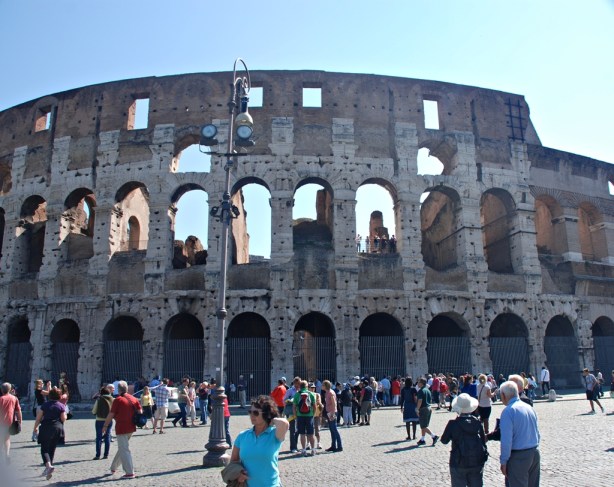
The floor where the gladiators fought was made up of wooden planks with sand spread over it. Under the floor, was a complex of rooms, cages for animals etc. These animals were brought up using a sophisticated system involving pulleys.
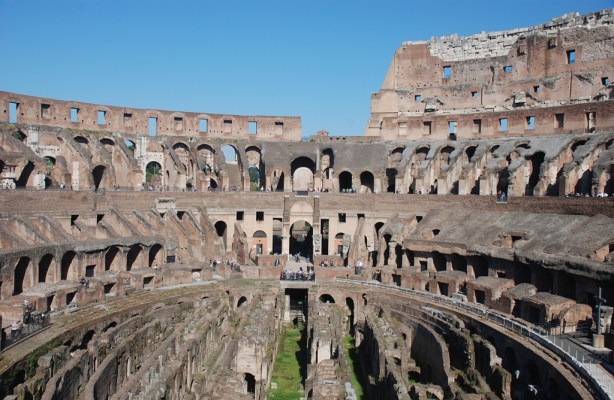
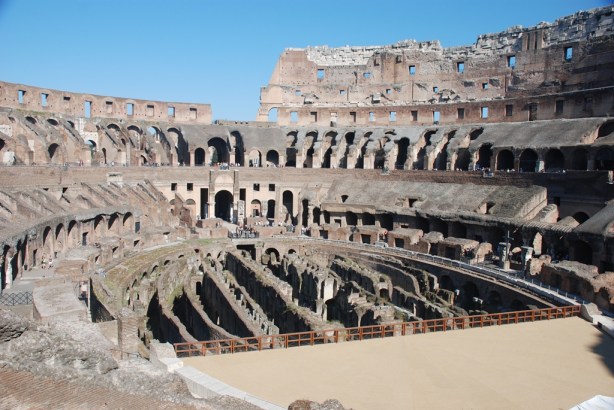
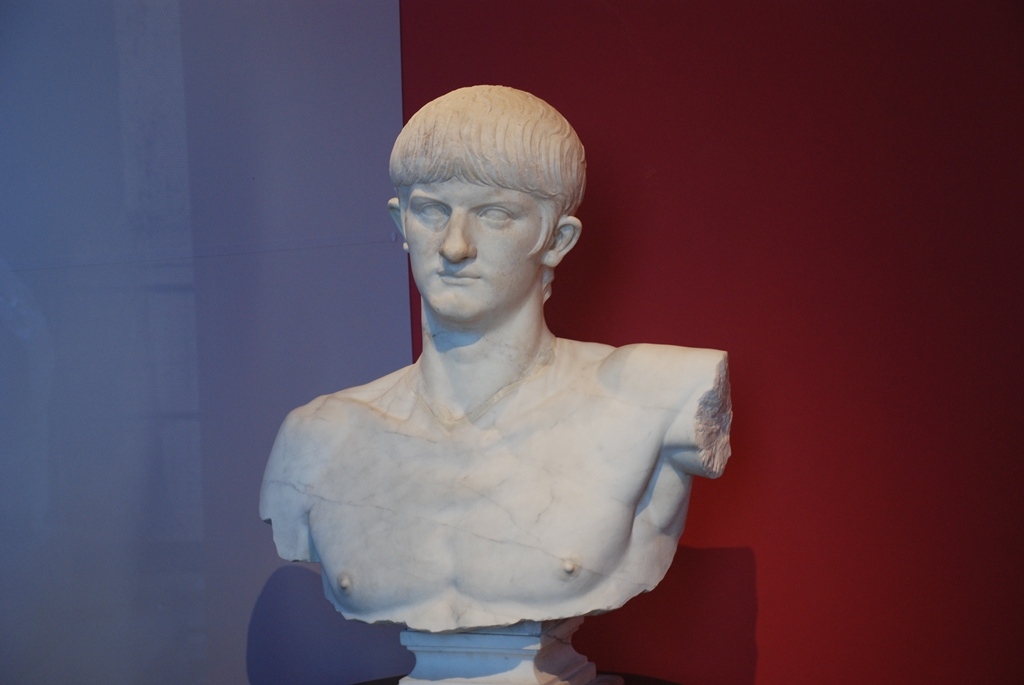
Today, the floor is completely destroyed as is the South side of the outer wall. The outer walls were 187 feet high and the arches in the higher levels were all filled with statues. There was also a bust of Emperor Nero inside the Colosseum.
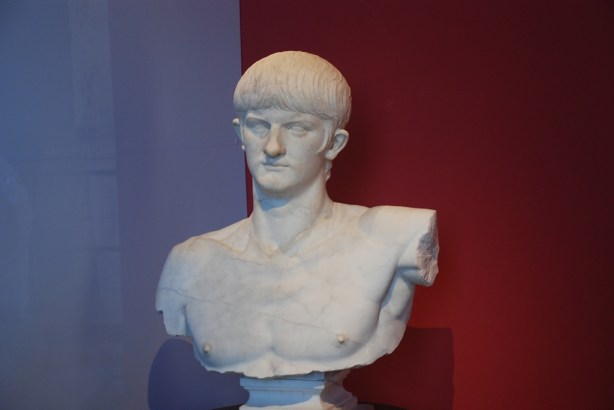
After the Colosseum was shut down in the sixth century by the Christian emperors, it fell into a state of disrepair and it was used as a source for raw material for other projects. So, all the statues, marble etc. were ripped out and reused.

The Colossuem is proof of the engineering skill of the Romans. They seemed to be more adept at practical matters like building palaces, temples, houses, markets, sporting arenas, aqueducts etc. and not very advanced on arts, philosophy etc. The population of Rome in 100 AD was estimated to be 1.2 Million (it is 3 Million today, after 2000 years) and they had a stadium, Circo Massimo, which could seat 240,000 people!

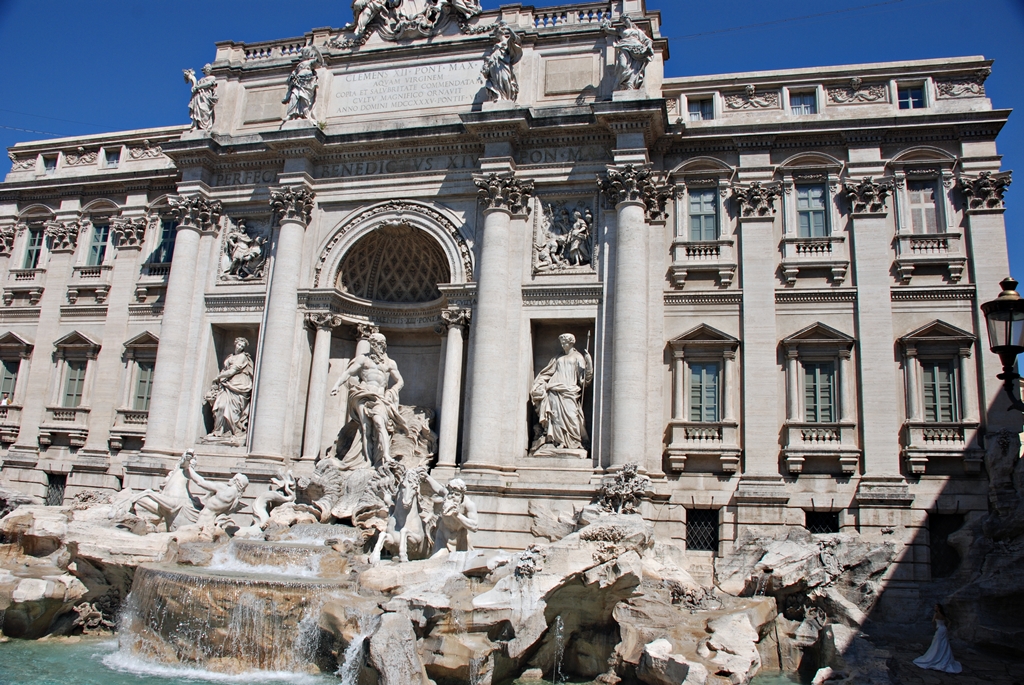
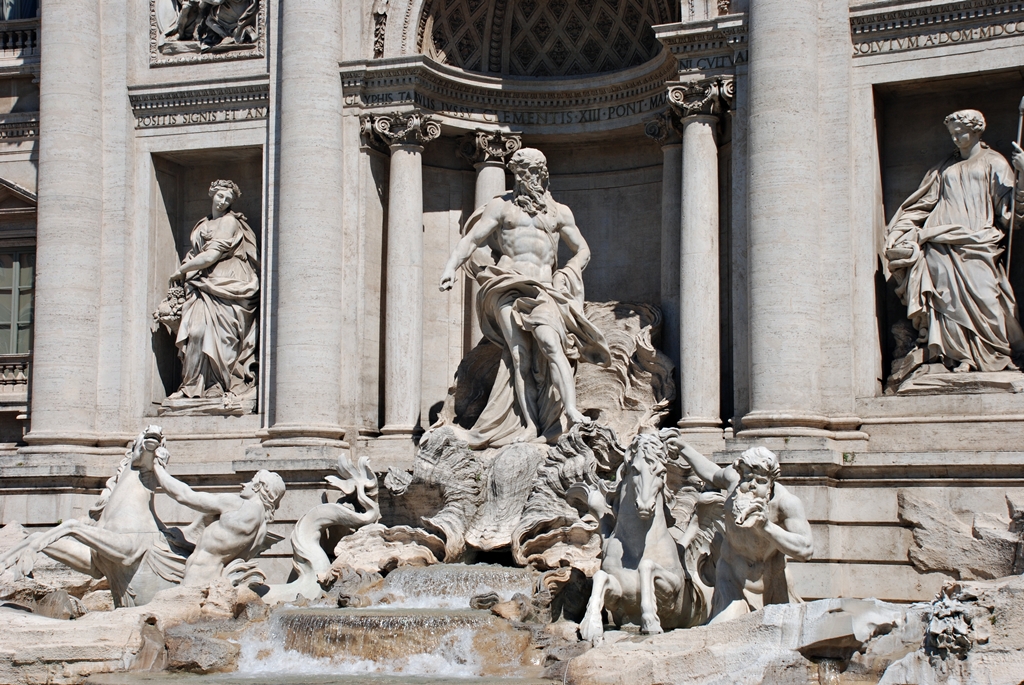
Next stop was Trevi Fountain (Fontana di Trevi), the most famous fountain in Rome. Fountains were a feature of Rome while the empire was still functioning and were fed by many aqueducts. After the fall of the empire, many of the fountains and aqueducts fell into disrepair and it was only in 15th century that several projects were started to make these functional again. Trevi Fountain gained its name from the simple fact that it is at the junction of three roads. The idea for a fountain was conceived to mark the termination point of an aqueduct that brought water to Rome. After the aqueduct was repaired, a famous sculptor of those times, Bernini, was commissioned to redo Trevi Fountain but he did not finish it as the Pope, who was the sponsor, passed away. It was later torn down and rebuilt by another architect but some of the Bernini designs are still there. The fountain is very beautiful and is a must visit item on every tourist’s list. The water looked very clean and I guess it is possibly drinkable. There is a belief that if you toss a coin into the Trevi Fountain, you will return to Rome and many coins were seen inside the fountain. I read that the total money collected from the fountain in an average day is Euro 300!
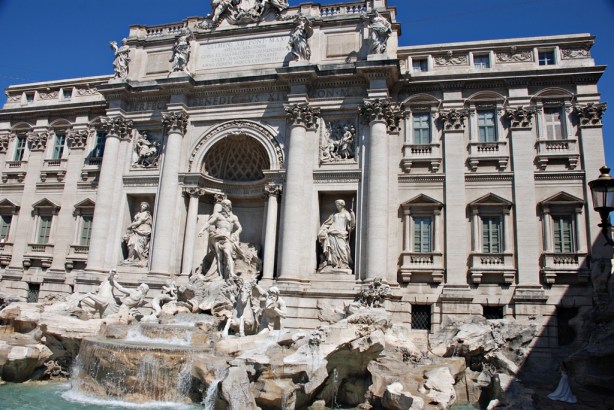
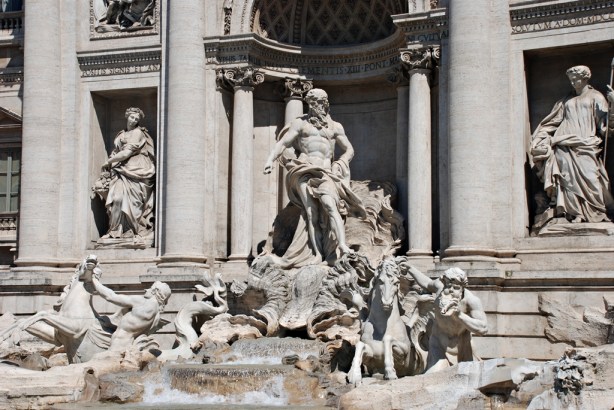
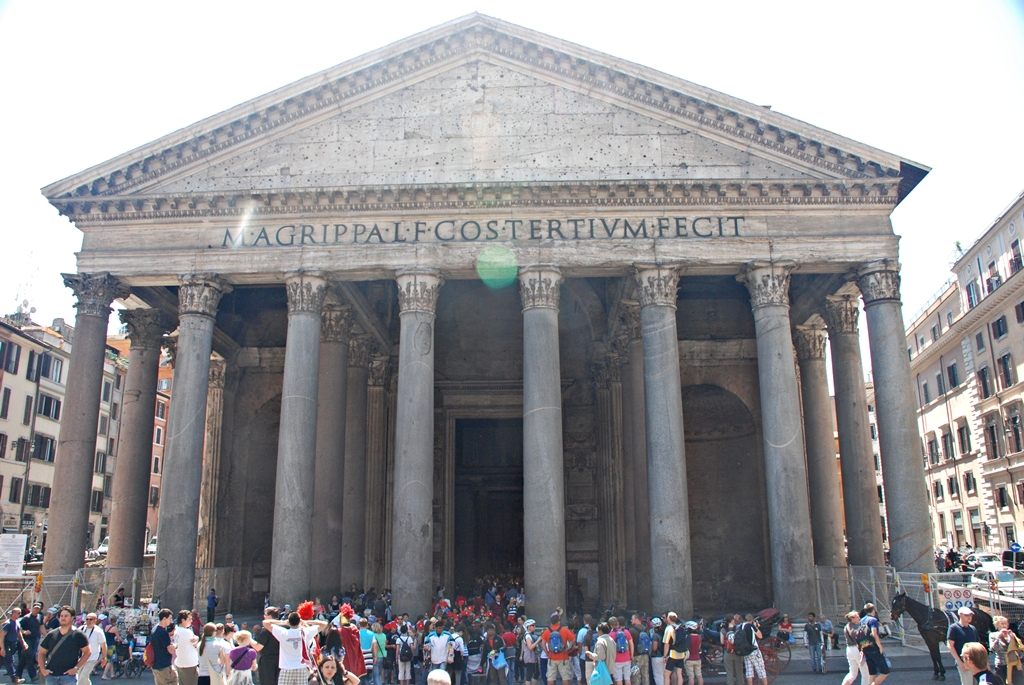
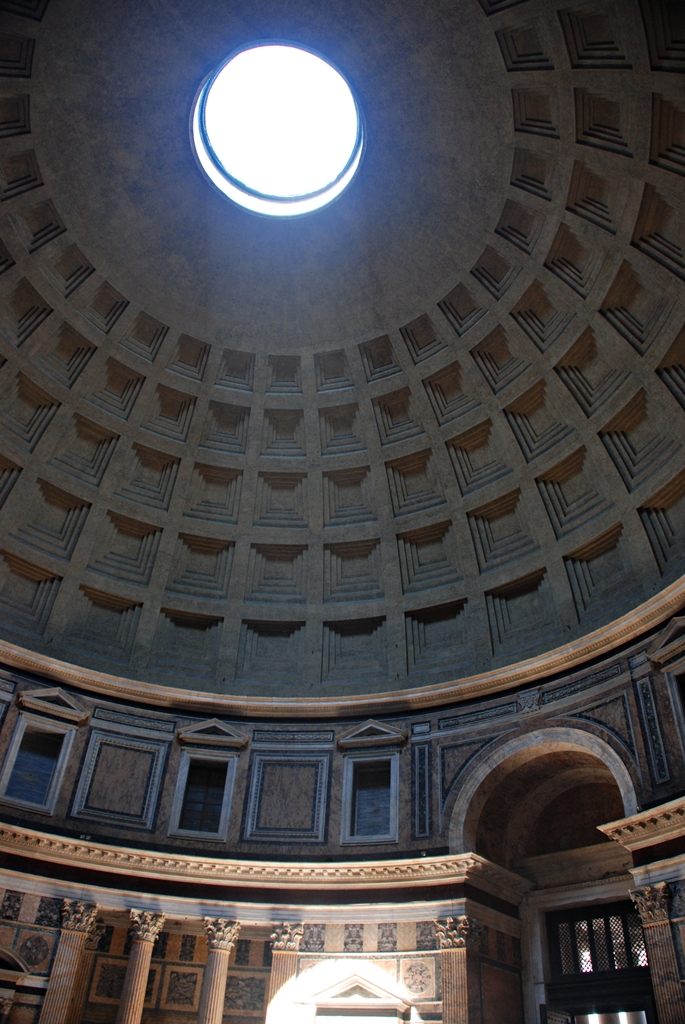
From Trevi, we strolled on to the Pantheon. The ancient part of Rome is not very large and you can walk to most attractions. Pantheon is the oldest building in Rome, which is still quite intact. It was commissioned by Roman statesman Marcus Agrippa but it was ruined and later rebuilt in its present form by Emperor Hadiran around the year 126 AD.
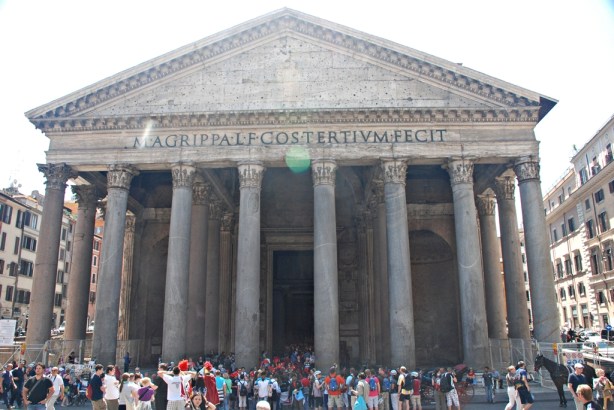
It was meant as a temple for all the seven gods of Rome and hence called Pantheon. It is a very large circular room with a dome at the top; the dome is finished in concrete and has a hole in the centre. The hole at the top lets in sunlight and particular positions of the light that comes through the opening marks the days of summer and winter solstices.

It is the largest dome in Rome and has a diameter of 43.5 metres at the base, which then reduces to about 9 metres at the top. It is said that Michelangelo visited the Pantheon many times when he was rebuilding the dome at St. Peter’s Basilica and he was so impressed by the dome at Pantheon that he built the dome of St. Peter’s to be smaller than the one at Pantheon. The dome is built by using heavier materials at the bottom and thinner materials at the top – the base is about 6 metres thick and then falls to less than 2 metres at the top. The walls are made with handcut bricks and the columns are made of marble imported from Egypt.

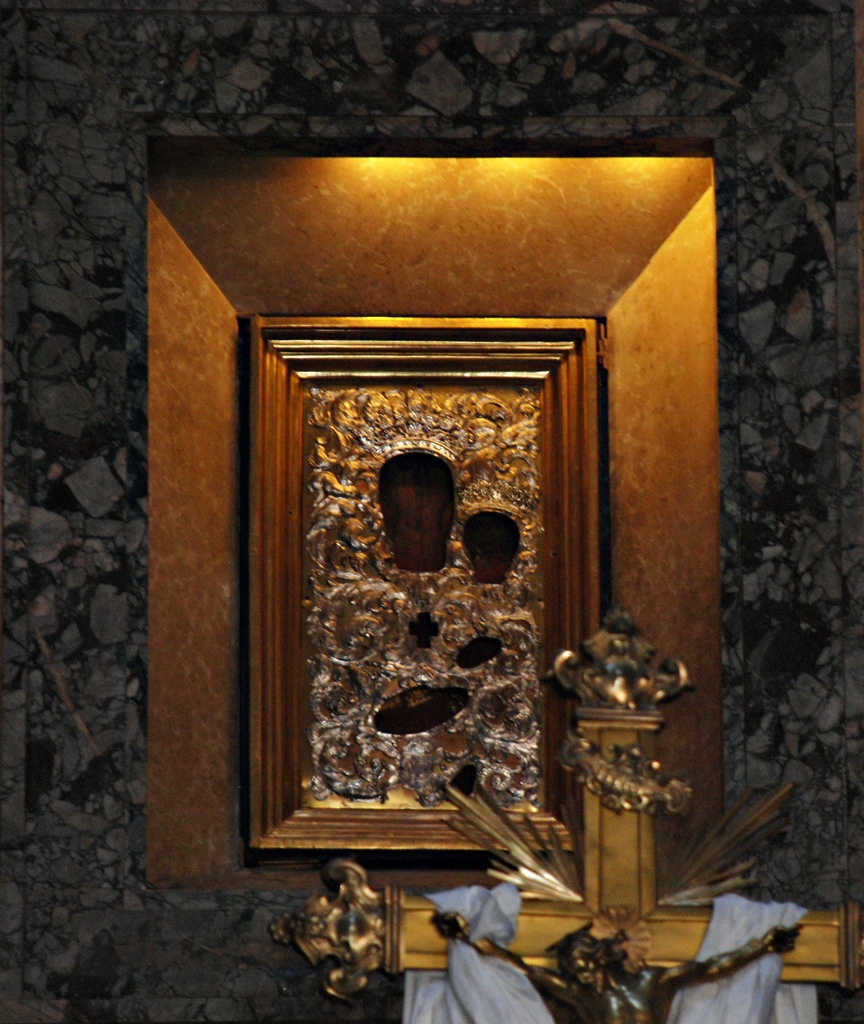
In the seventh century, Pantheon was donated to the Pope Boniface IV and that marked the transition of Pantheon into a church – it is now the church of St. Mary and the Martyrs. There are many illustrious personalities buried in the Pantheon – this is a consistent theme with churches wherein they seemed to bury dignitaries in churches. The tombs in Pantheon include those of the great artist Raphael, first king of unified Italy, Vittorio Emanuele II etc. Raphael’s tomb has a statue of the Virgin and the Child and it seems Raphael had specifically asked the sculptor to make the statue for his tomb, before his death.
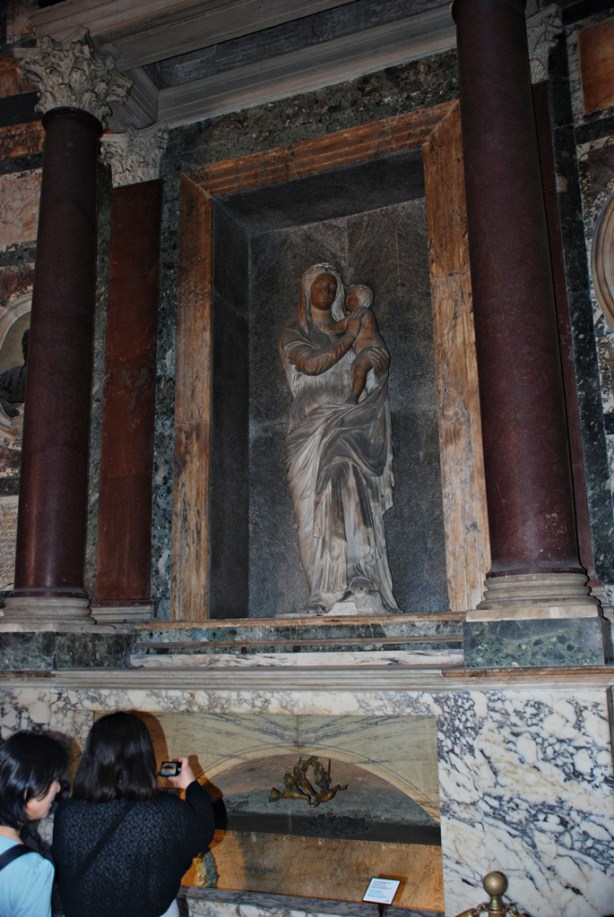
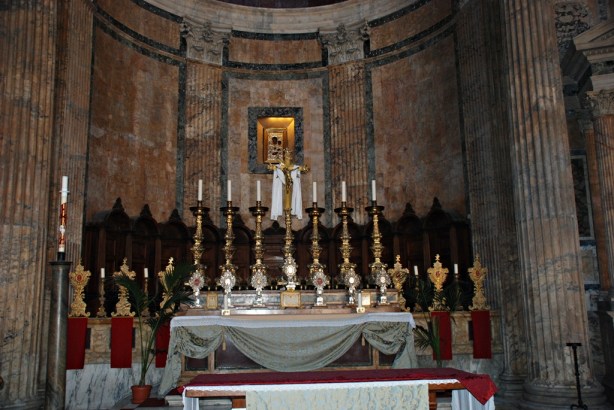
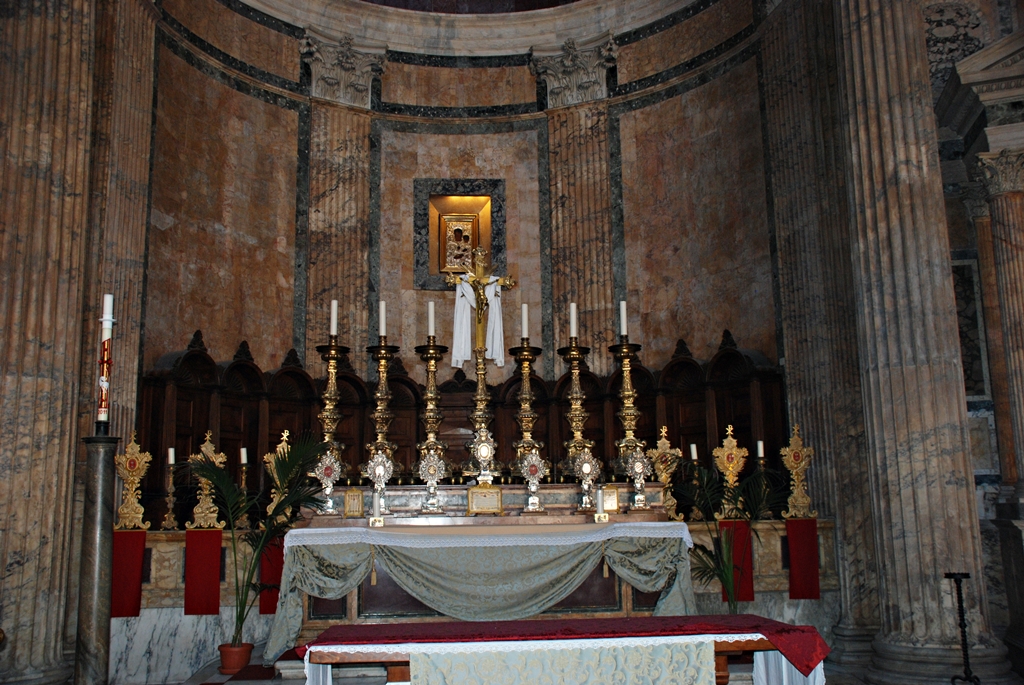
There are several important art pieces within the Pantheon including a 15th century statue of Christ on the Crucifix by Michelangelo, a 4th century image of the Virgin and the Child etc. The altar at the Pantheon is also an impressive sight.
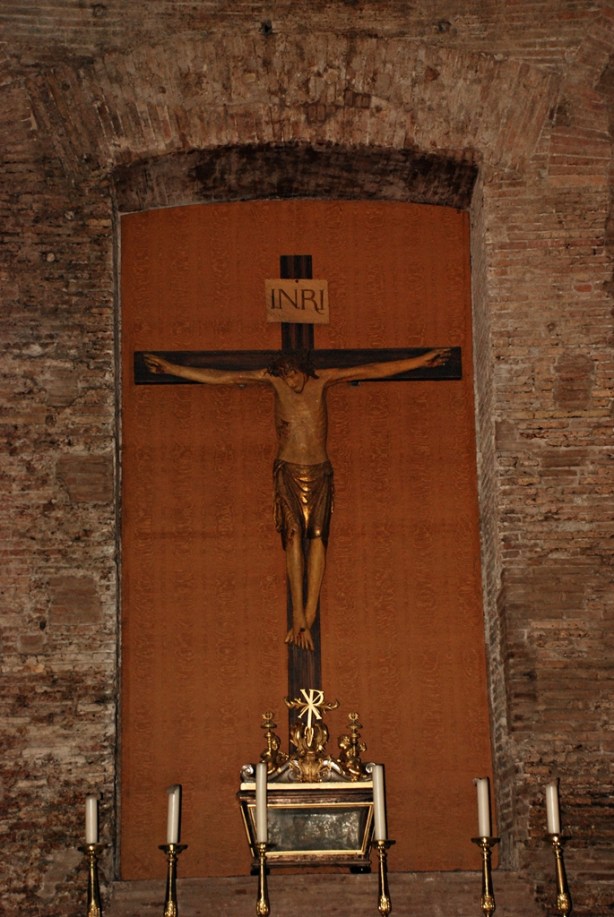
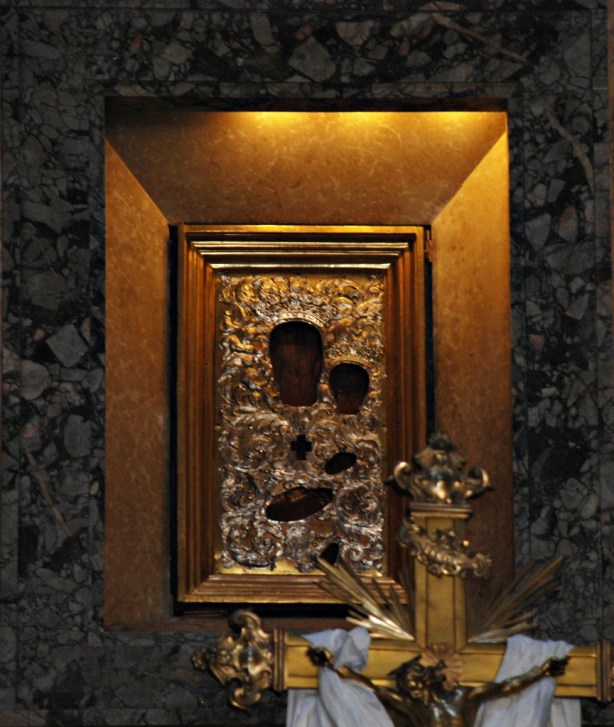
We then proceeded to a 4D movie show, which was based on the history of Rome. This was a kind of cheesy thing to do but it did give a quick 20 minute perspective, in an enjoyable format.

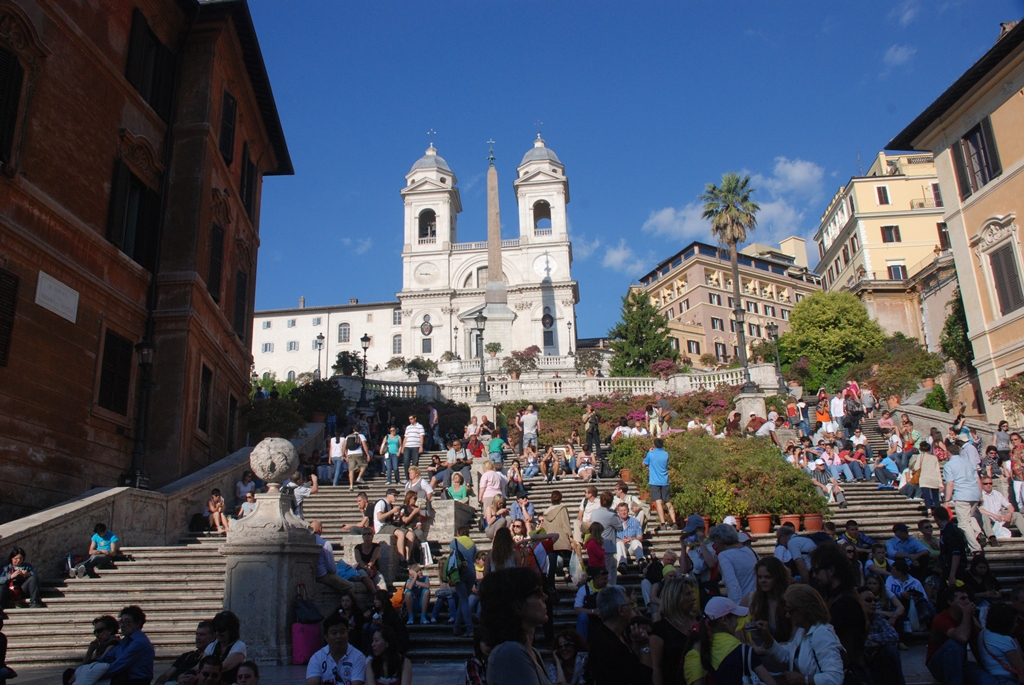
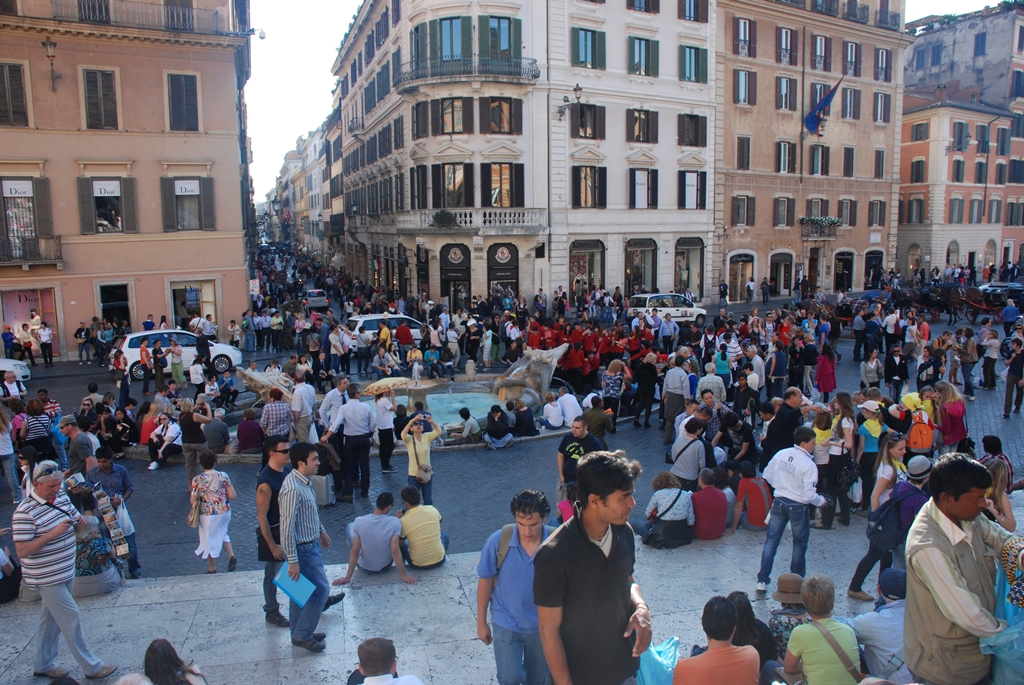
After a brief rest, we proceeded to the Spanish Steps. This is the widest staircase in Europe and was built in the 18th century to connect Spanish embassy at the bottom of the steps with the church at the top. The embassy is in a square called Piazza di Spagna. This is a grand staircase and seems to attract a lot of people that visit the steps and the piazza for meeting and spending time together. Italy is full of these small squares that have a significant role to play as public spaces. I was quite impressed by this concept, may be because I was used to such public spaces when I was growing up. In our cities today, we are cooped up and there are very few public spaces and malls and shopping centres are taking over as poor substitutes. We saw many such squares throughout our stay in Italy, in all cities and small towns and people seemed to throng these places in the summer evenings. In the piazza, right next to the steps is the house where the poet John Keats lived and died.
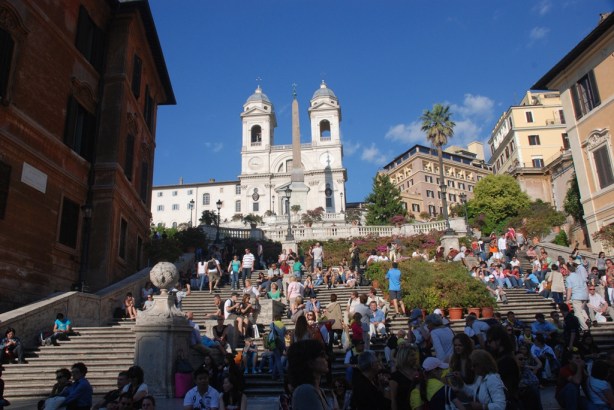
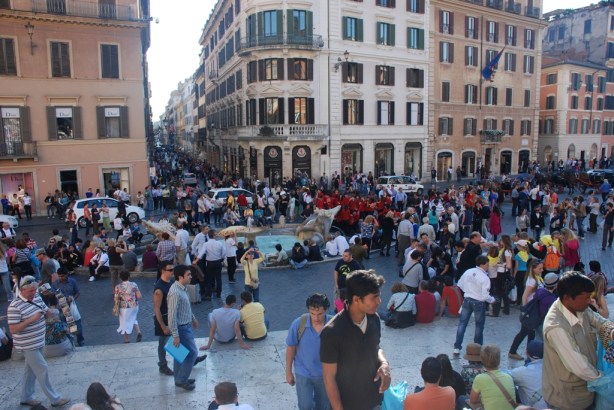
There is a nice little church on top of the Spanish Steps and we went in for a quiet look. A service was in progress as we went in and I was most surprised to see that the dresses of the nuns and the priests resembled the Arabic traditional dress (dish-dash), quite a lot. May be there is a connection somewhere.

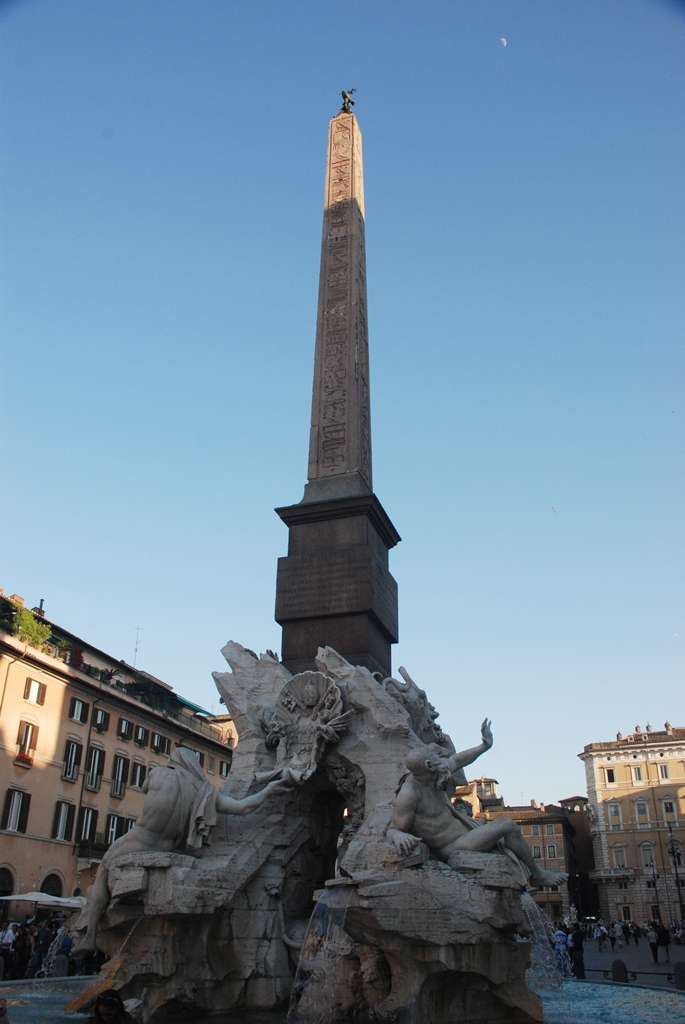
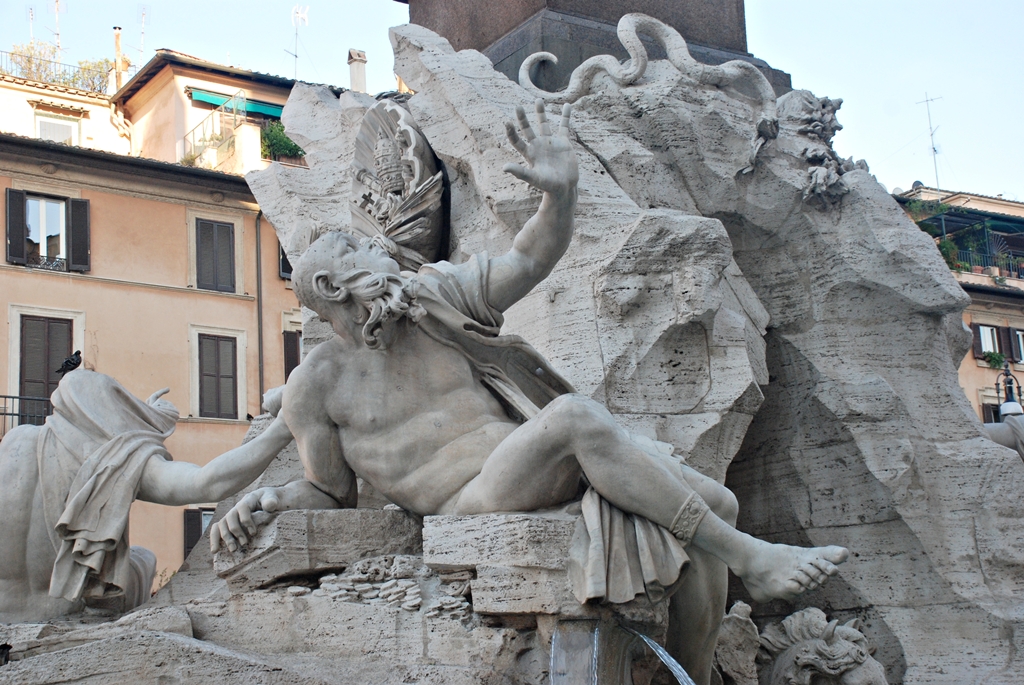
The last stop of the day was Piazza Navona, another one of those delightful public spaces. This was a circus (stadium) before and was converted to a square in the 15th century. The most important feature of Piazza Navona is the Fountain of the Four Rivers (Fontana dei Quattro Fiumi) by Bernini. The fountain has a basin as a base with a rock on it and an Egyptian obelisk that rises from the rock. There are also four river gods depicted on four sides of the rock. These rivers were supposed to represent four continents to which the Roman Catholic Church had spread – Ganges representing Asia, Nile representing Africa, Danube representing Europe and Rio de la Plata representing America.
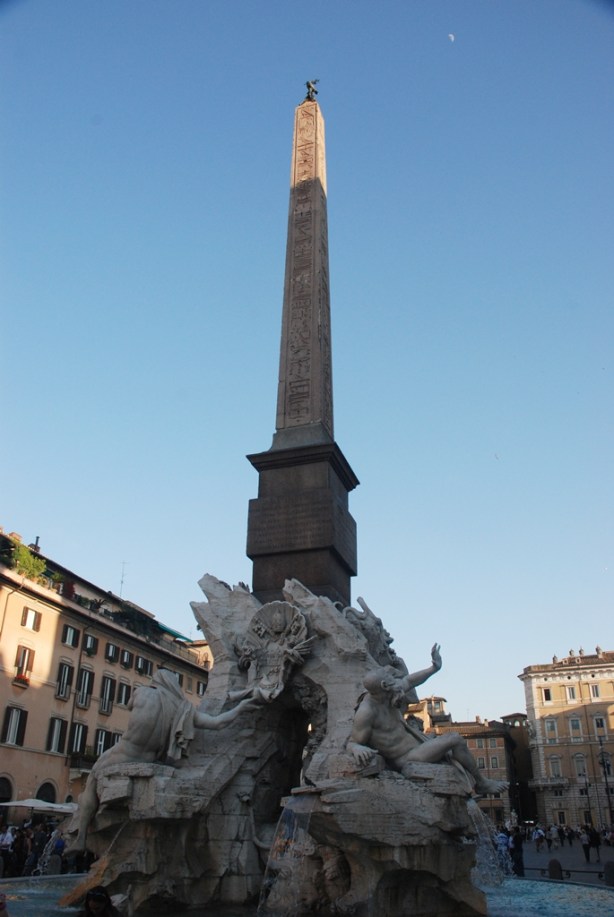
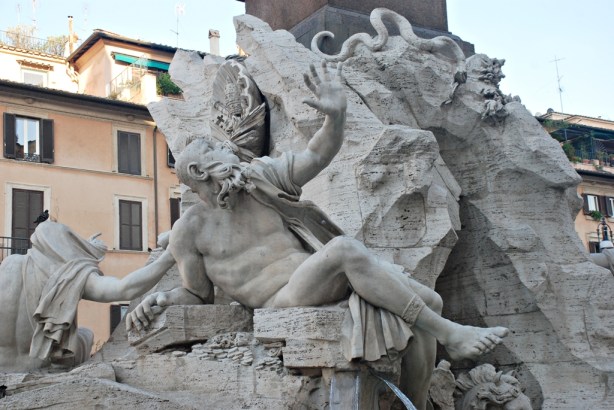
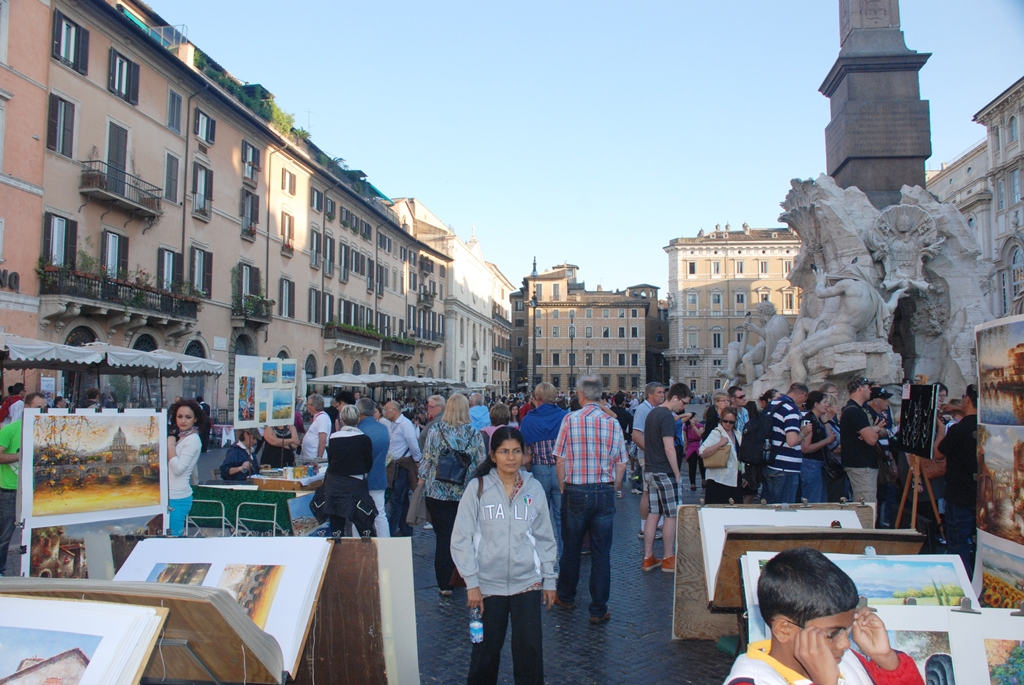
This square was also filled with a lot of people with many artists displaying their wares and some playing music. Overall, the atmosphere was quite fun filled and enjoyable. We sat down at the piazza for some time and right next to us, an old man was singing Italian songs and his wife sat next to him. People were donating money to the couple. Even though the music did contribute to the ambience, one could not but help feeling sad for the old couple.
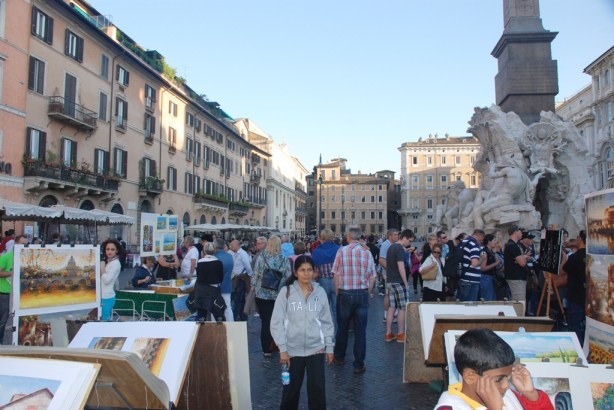
11 May 2011

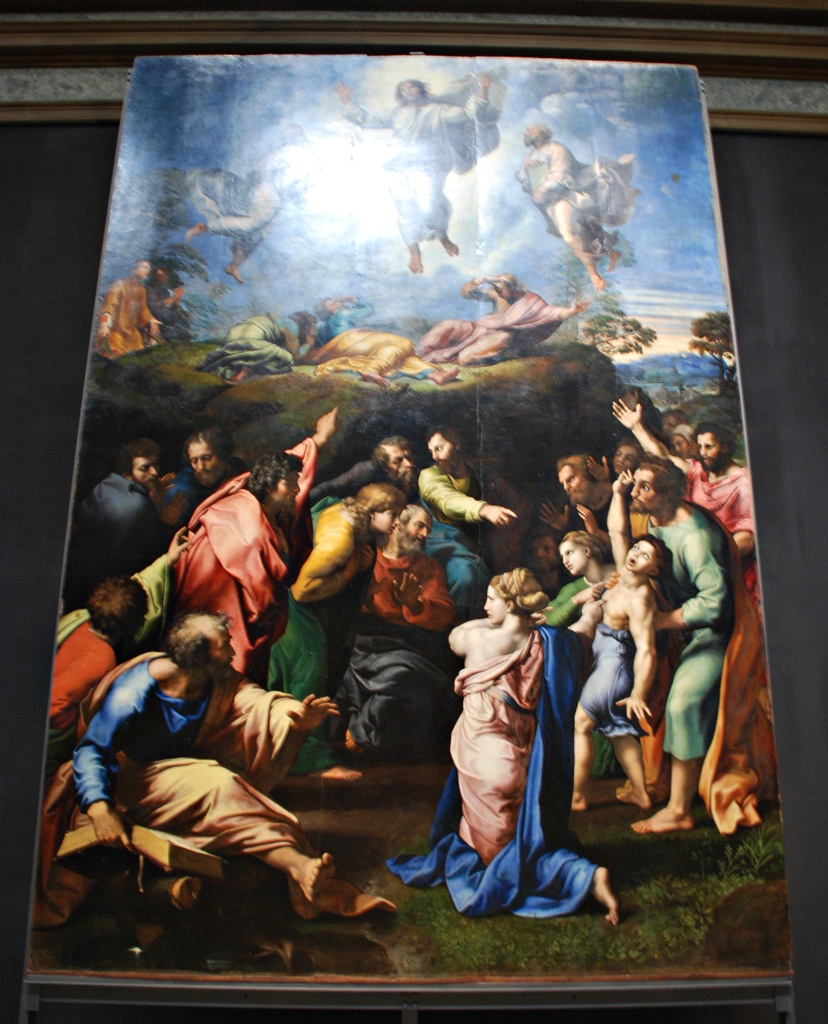
We had made a booking for Vatican Museums for 9 am, as I was afraid of the possibility of a long queue. The advance booking saved us and we got in rather quickly. As you walked into the museum, the first thing that hit you was the vastness of the place. There was no way one could do justice to the place in a couple of days, let alone the couple of hours we had allotted for it. There are many, many art pieces here from various masters that Vatican acquired over the years. The lighting was not conducive to good photography and in Sistine Chapel, photography was not allowed at all.  Raphael had done a lot of work in Vatican and his last painting “The Transfiguration” can be seen here. Raphael was very a prolific artist and had produced many works and achieved great fame, even if he lived only for a short time (he died when he was thirty seven). In fact, in his sarcophagus, it is inscribed “Here lies that famous Raphael by whom Nature feared to be conquered while he lived, and when he was dying, feared herself to die.”
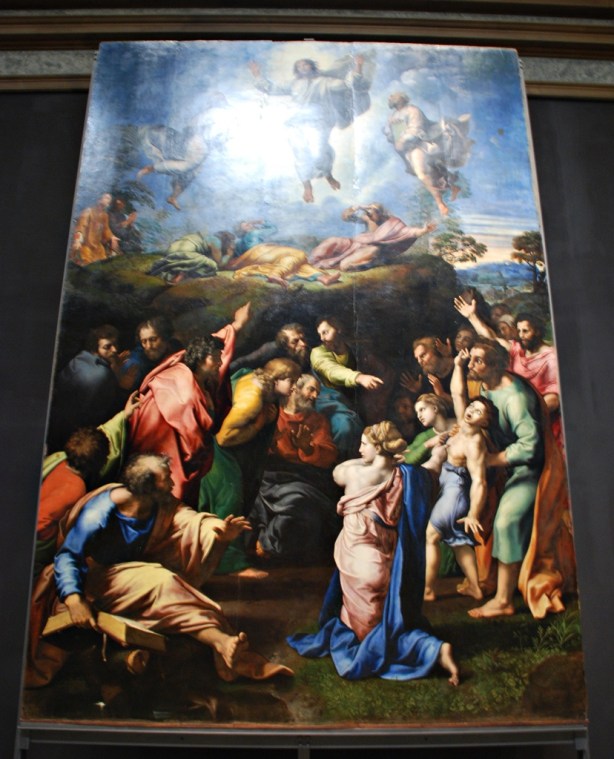
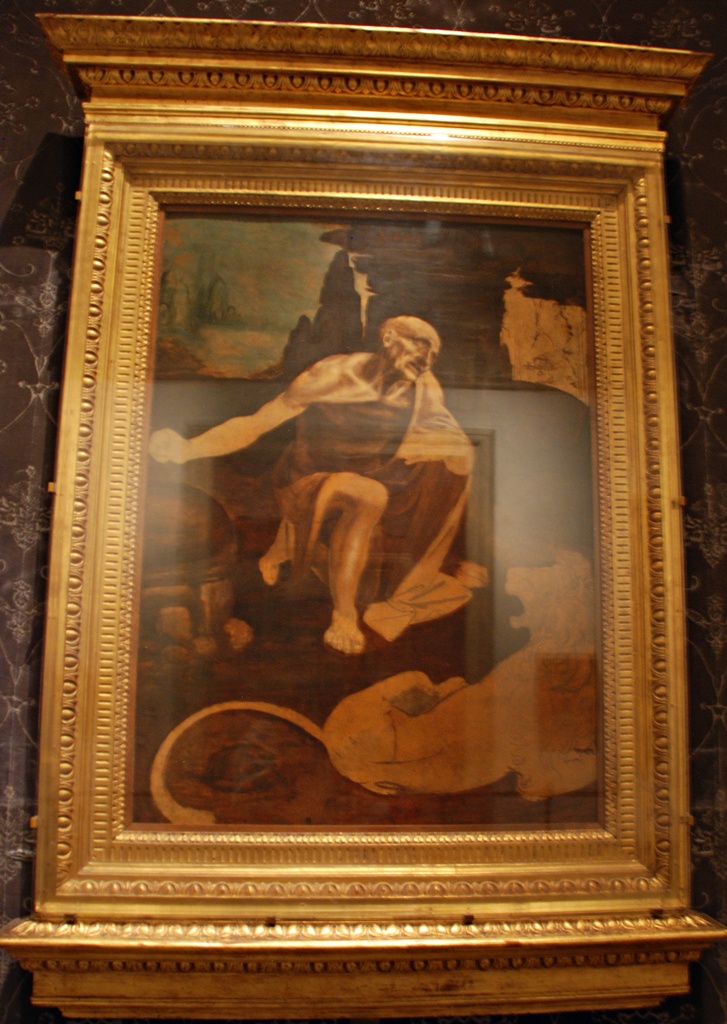
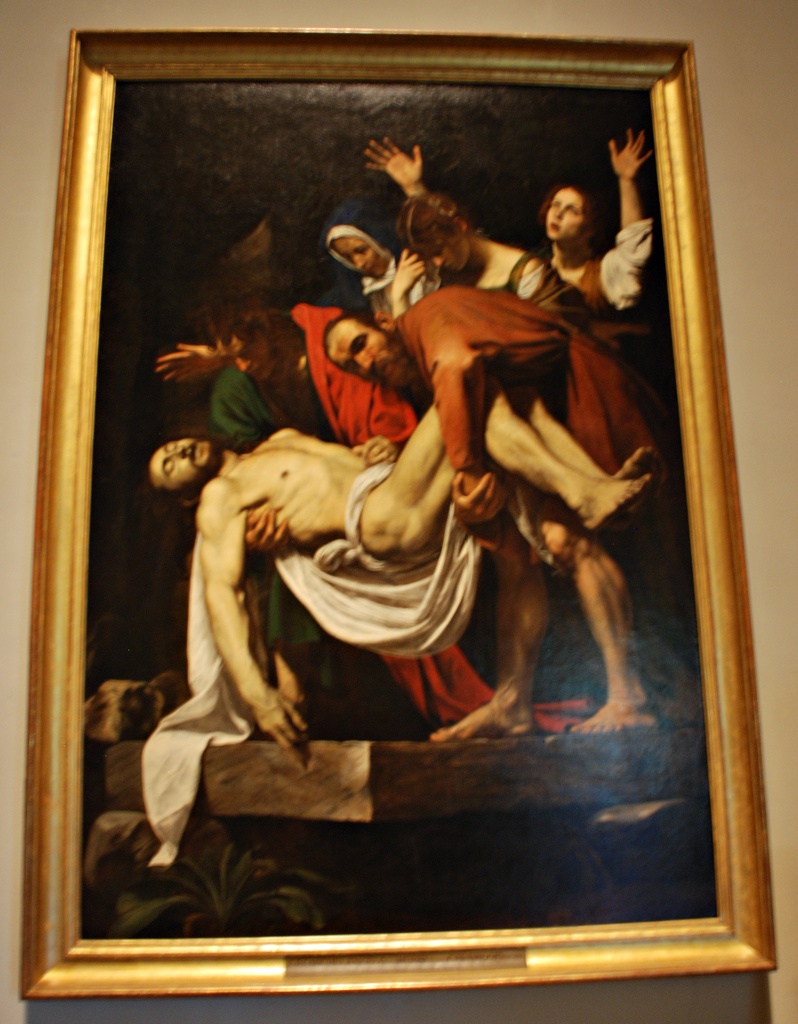
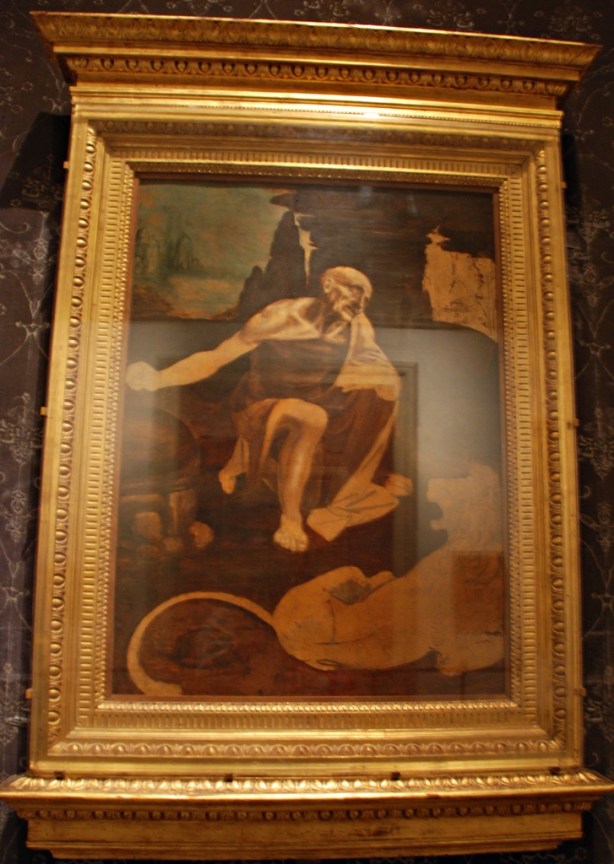
We saw an early work by Leonardo da Vinci and a painting by Caravaggio. As you see more and more art, one starts to appreciate the difference in the works of the masters but there is still a long way to go.
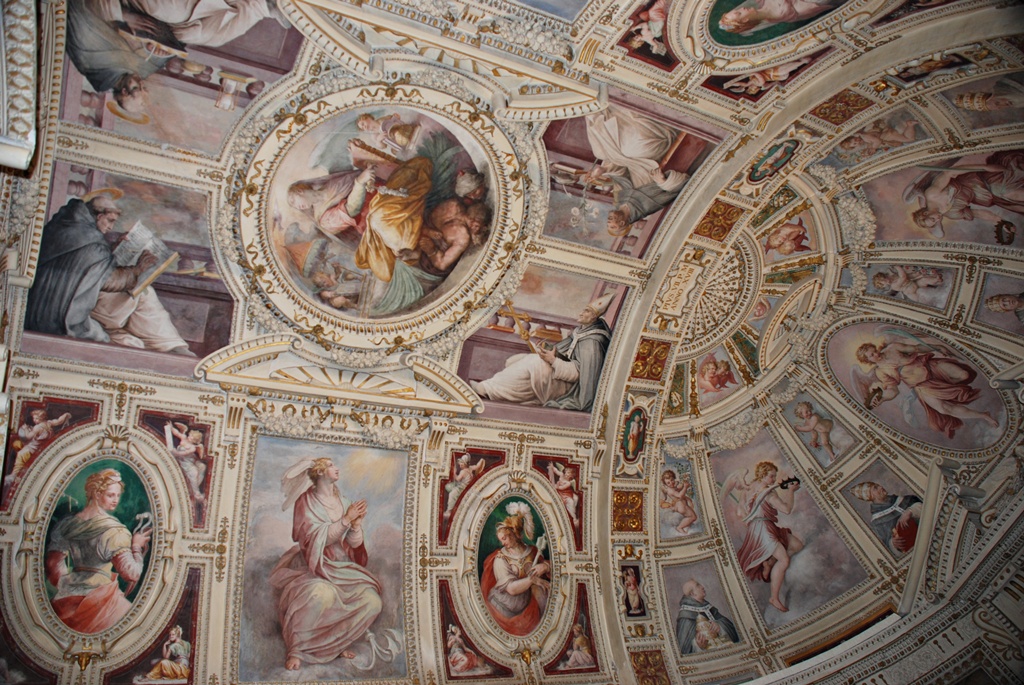
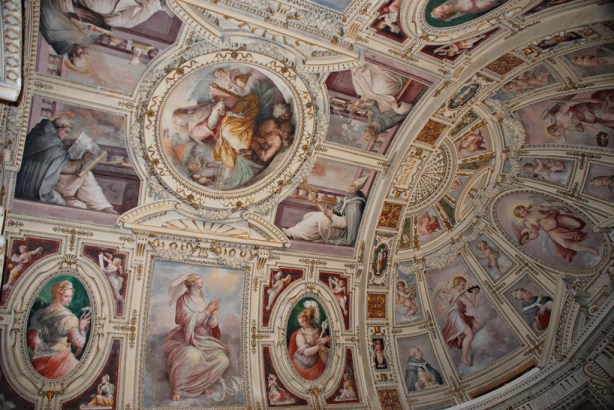
Ceilings of most rooms were painted with scenes from the Bible. The works were rather intricate and I could only wonder at the effort and time this must have consumed.
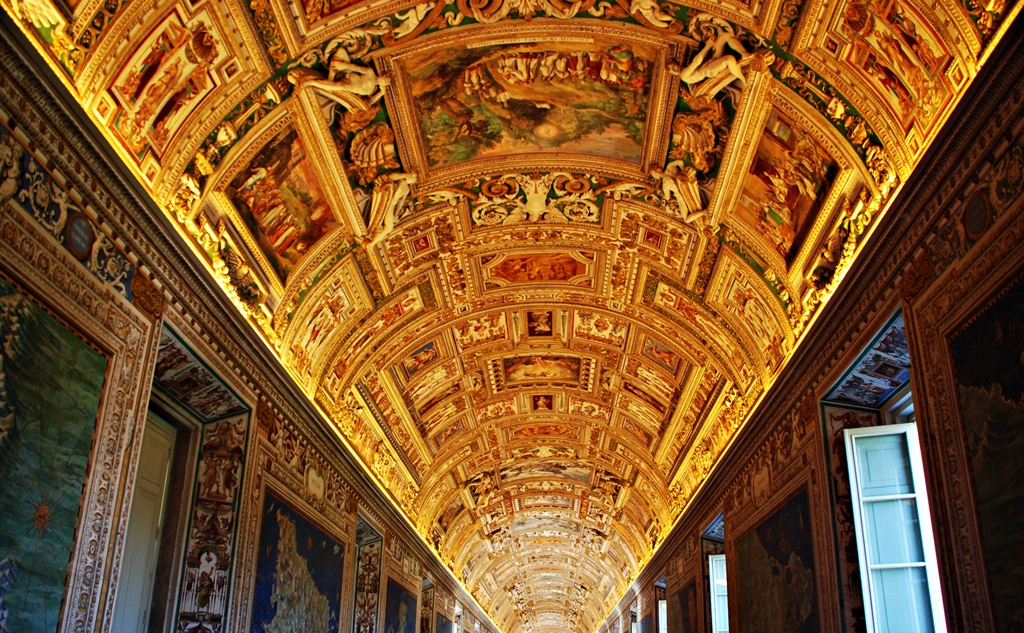
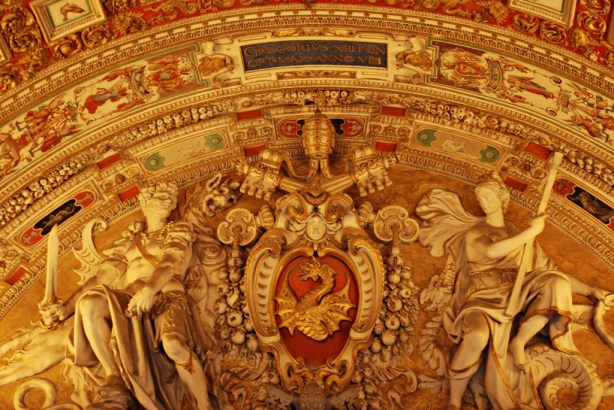
We did a whirlwind tour, pausing to take in views of some of the more important works. At some point we passed through the Gallery of maps, which had a splendid, ornate ceiling with rich carvings.

The most important attraction here is the Sistine Chapel. Sistine Chapel is well known for Michelangelo’s fresco “The Last Judgement” and this is considered as one of Michelangelo’s best works. After the Chapel was built, the walls were painted by famous artists like Botticelli, Perugino etc. Originally, the ceiling was a night sky scene but later, Michelangelo was commissioned to repaint the ceiling; a job that took him four years to finish. In the ceiling, he has captured the creation of Adam, the Original Sin and their punishment in the work named “Genesis”. It represents nine scenes from the book of Genesis: God separating Light from Darkness, Creation of the Sun, Moon and Planets, Separation of Land from Sea, Creation of Adam, Creation of Eve, Temptation and Expulsion of Adam and Eve from the Garden of Eden, Noah’s Sacrifice, The Flood and the Drunkenness of Noah.

Twenty three years later, he returned to start work on another fresco – The Last Judgement. This was planned on a grand scale and occupies the wall behind the altar, rising to the ceiling. The Pope chose the subject as a kind of warning to the Catholics to stay committed and not stray from the line of the Church, by depicting the grisly things that awaited them should they do so. It took six years for Michelangelo to finish this painting and it is said that the work was a matter of constant friction between the clergy and Michelangelo. The painting was done in a style unconventional at that time with Christ being shown with a muscular body (like that of Adam before he committed the Original Sin), angels were shown without wings etc. and that led to a lot of criticism. To make matters worse, many figures were naked but Michelangelo refused to make any changes. It is also said that he tried to bring in Pagan symbols into the painting, much to the chagrin of the Pope. He even painted some resemblance of one particular priest that criticized him and showed him as the judge of the underworld. After Michelangelo’s death, the painter Daniele da Volterra was commissioned to cover the genitals of the nude figures and he seems to have done that job well. Michelangelo’s work is so outstanding that one hardly notices the other masters like Botticelli. I must say that I was awe struck by the patience and need for perfection of a man willing to spend six years on one painting.

Sistine Chapel is where the Papal Conclave is held. After the Pope passes away, the Cardinals meet here to elect a new Pope and they are locked in till they elect a new one. Overall, the Vatican Museums look very rich and lavish and I started to get a sense of why this is so. Any visitor to Vatican will be awed by the splendour and wealth and I am sure that helped the Pope to extend his power by reinforcing faith. Most ordinary people would feel good to be part of something so obviously rich and powerful.

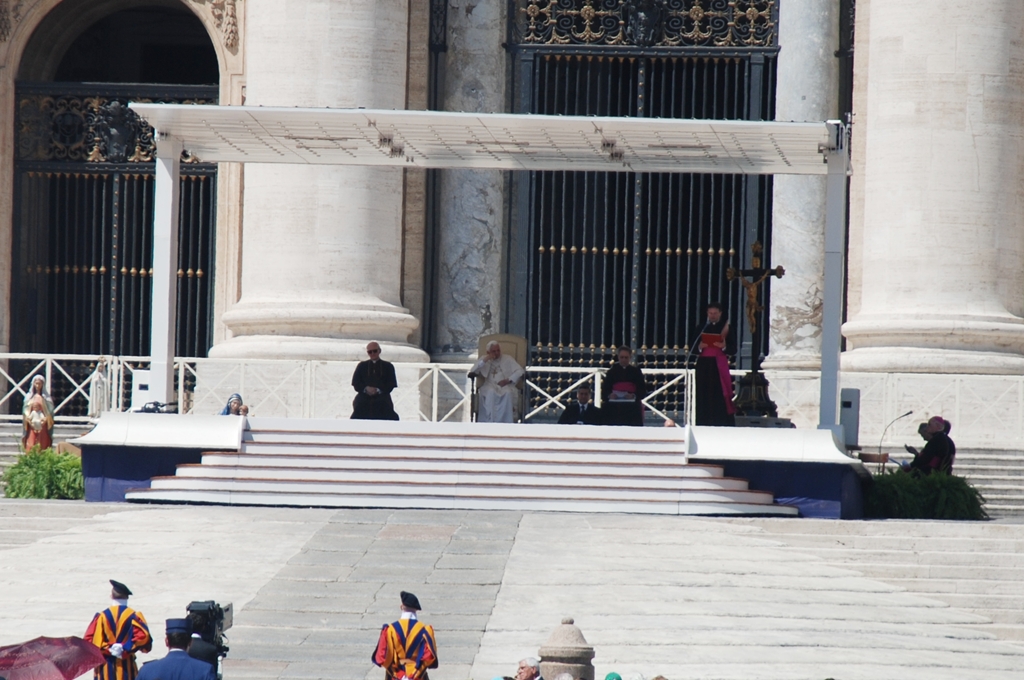
Every Wednesday, the Pope meets people at the St. Peter’s Square from 11 am and we landed smack in the middle of that when we exited the Vatican Museums. Some sort of a function was going on there with the Pope speaking at times along with some other priests. There was a huge gathering to witness that and they were all sitting patiently under the rather hot sun.
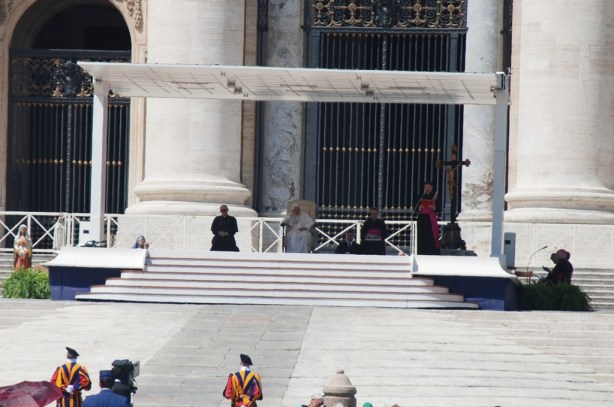
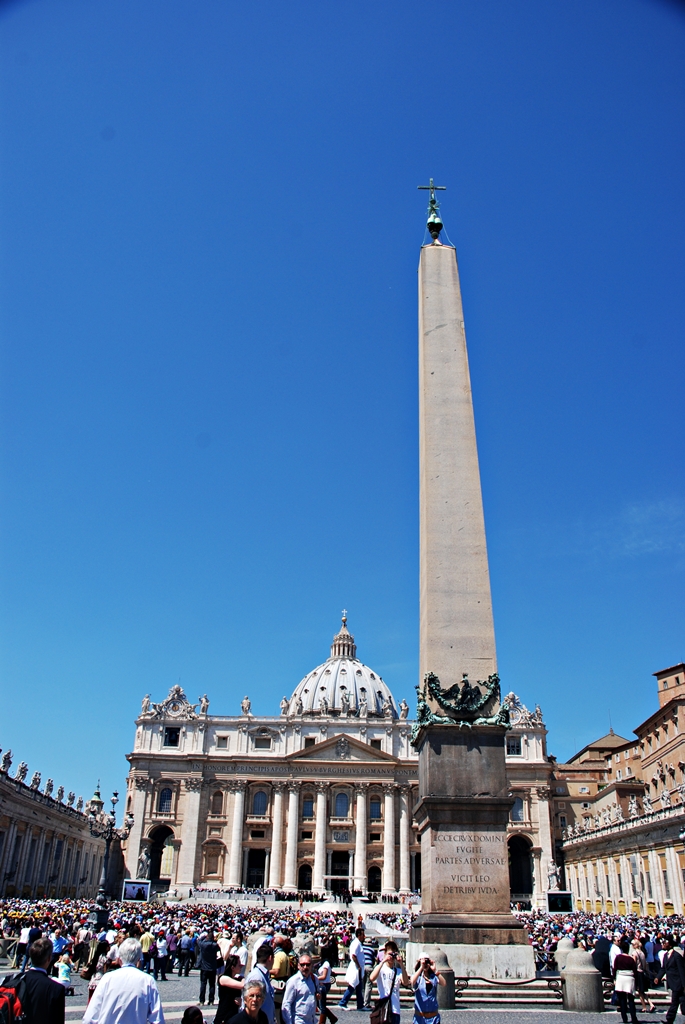
The square is very large and can easily hold tens of thousands of people. There is an obelisk right in the middle of the square and is supposed to have been used by Nero in one his circuses. The Egyptian obelisk seems to have been a favourite of the Roman Emperors.
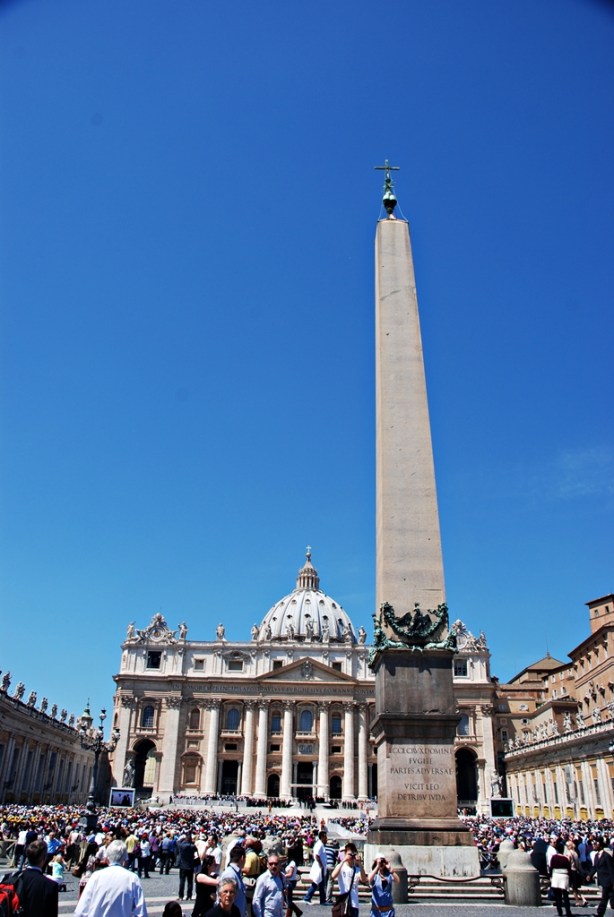
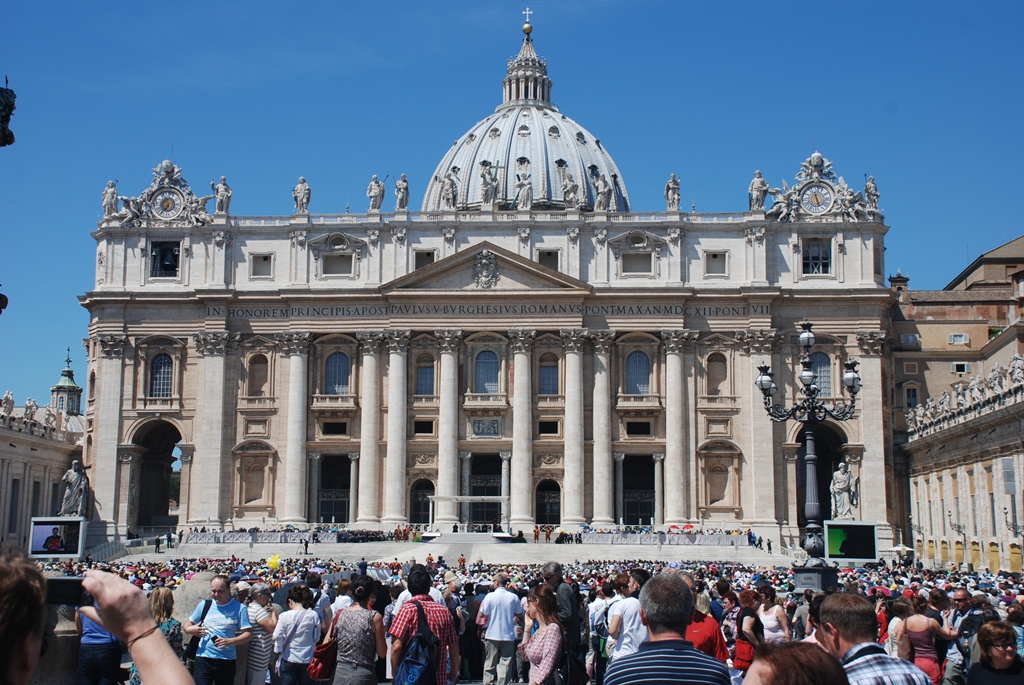
The facade of St. Peter’s Basilica is very impressive and has an interesting story behind it. St. Peter, who is considered to be the first Pope, was persecuted by Nero. It seems that Nero blamed Christians for the famous fire in Rome though some stories say that he had started the fire himself to bring down some old buildings so that he could start making better ones. Unable to face the persecution, St. Peter left Rome and on the night that he left Rome, he had a dream. He saw Christ going to Rome and he asked him “Domine, quo vadis?” (Lord, where are you going) to which, Christ replied that he was going to Rome to be crucified a second time. St. Peter got the message behind the dream and went back to Rome and he was duly crucified, killed and buried at Ager Vaticanus, a stadium of Nero. The first Christian Roman Emperor, Constantin, built a church here in the 4th Century in St. Peter’s memory. The church fell into disrepair after sometime and a restoration project was started in the 15th century and it took 150 years to complete. Many well known sculptors and architects were associated with the Basilica but the one that is most credited is Michelangelo, who rebuilt the dome.

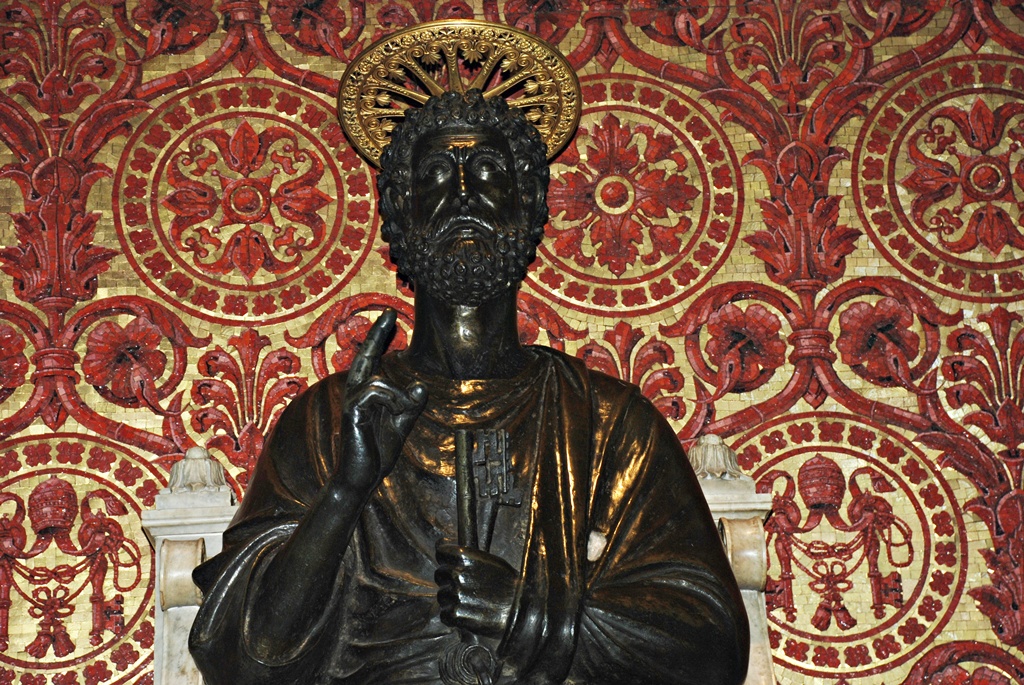
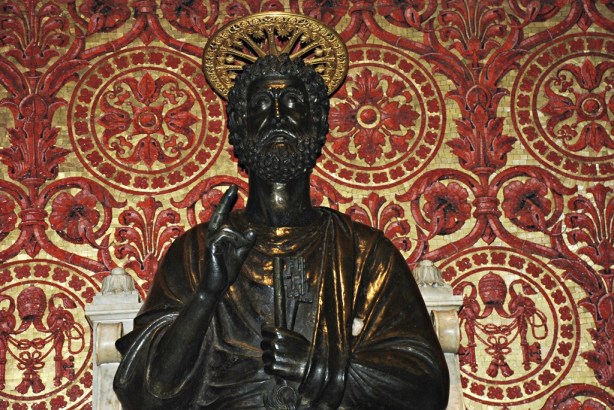
St. Peter’s Basilica is the second largest church in the world but it is not a Cathedral as it is not the seat of a Bishop. There are a lot of frescoes and paintings in the Basilica and it also has a small museum that holds various treasures, including a relic with a piece of the original wooden cross on which Christ was crucified. St. Peter’s bones are buried in the Basilica and there is a statue of St. Peter and he is holding the keys to heaven in his hand. The suggestion of a physical gate to heaven, which is locked and the keys held by a Saint seems to be an effort to convince people that there is indeed a heaven and entrance is strictly regulated. Christianity seems to have many such material aspects in its practice, possibly because it is a relatively new religion.
There is also a statue of the Virgin and the Son, depicting the scene of Christ being brought down from the cross. Mary looks younger than her Son as she is supposed to have never aged as she never committed any sin, including the original sin. Possibly, Christ looks older because he had taken on the sins of all mankind. Unfortunately, the light inside the Basilica was very dim and I could not get any decent photo of this statue.

An interesting point that I heard was about the altar facing east and supposedly, this was to show that even the Rising Sun bows to Christ, the Son of God. Most Pagan religions worshipped Sun and this was supposed to be an effort to establish Christianity’s superiority but I am not sure. Most Pagan temples also face East and for all we know, this might have been copied from that and a story developed at a later stage!

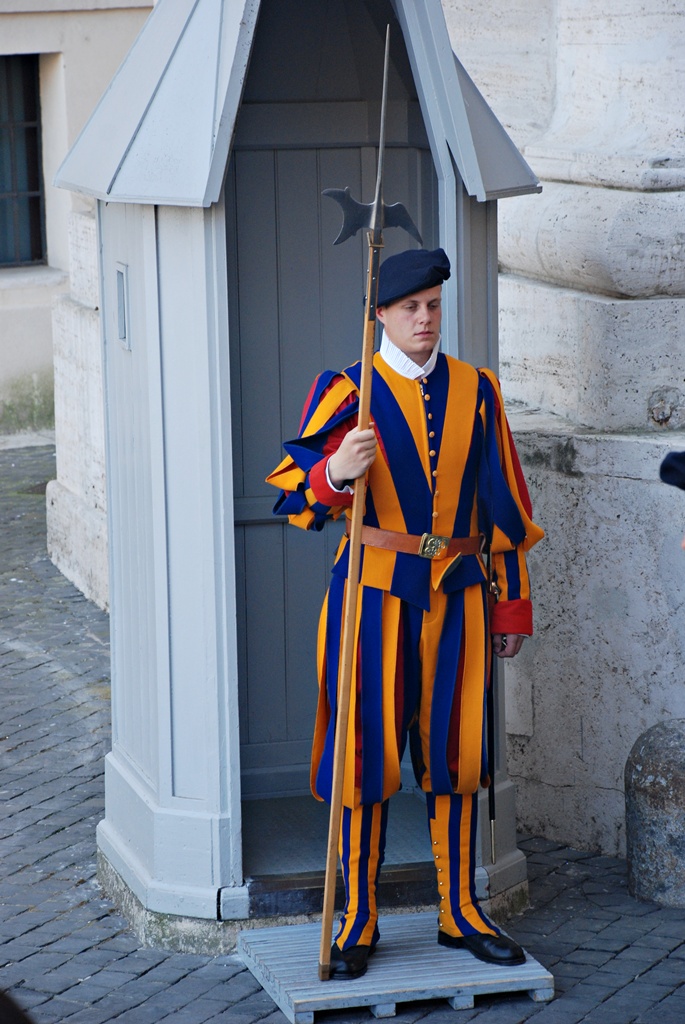
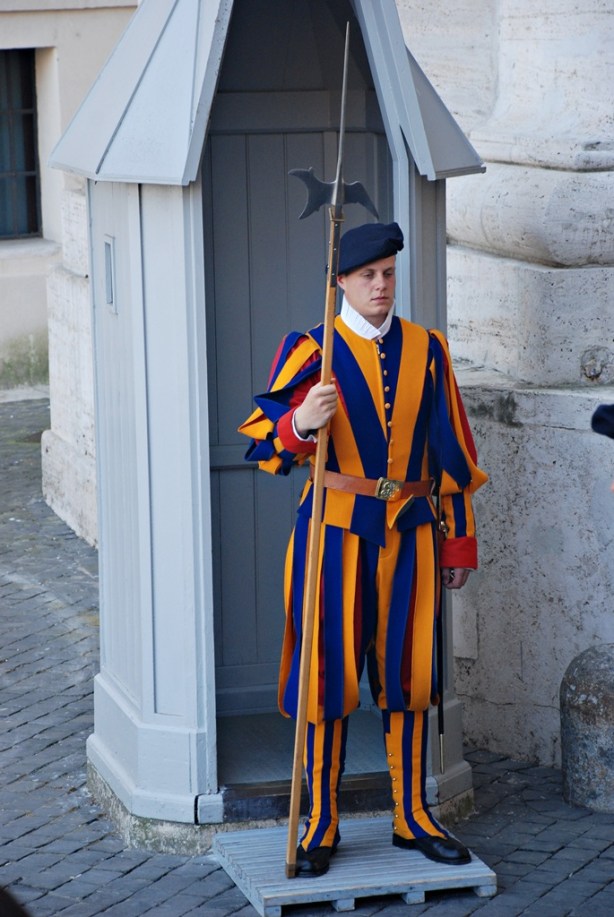
As we were leaving Vatican, we came close to the famous Swiss Guard of Vatican. They are practicing Catholics from Switzerland and act as the body guards of the Pope. They have been guarding the Pope and the Vatican from the 16th century. Their uniform is very colourful and does not convey the traditional formal message that army uniforms tend to.
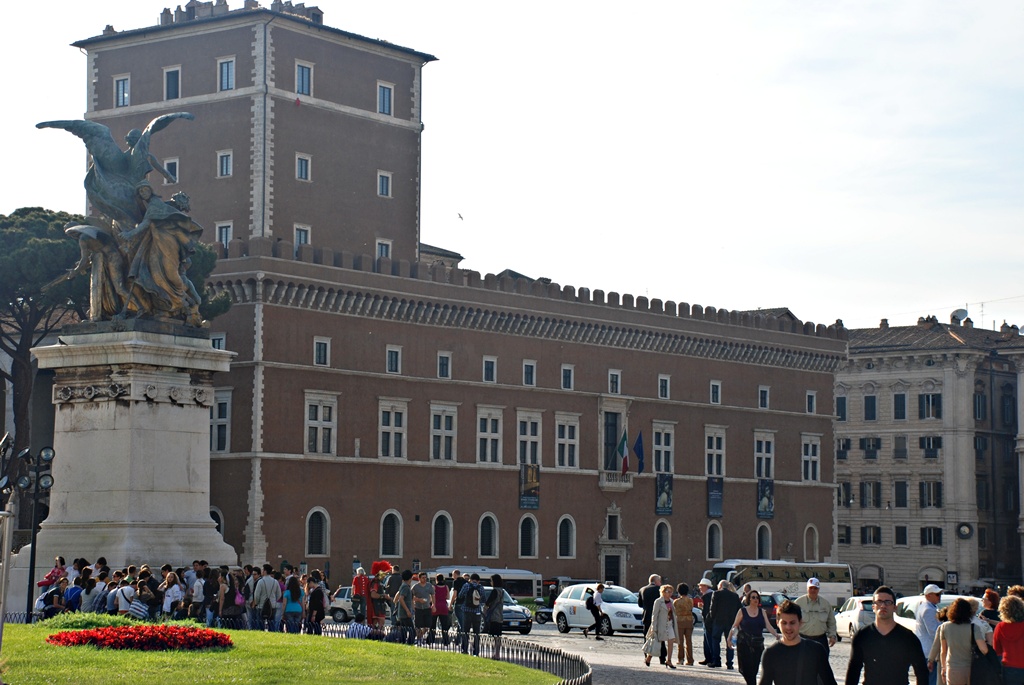
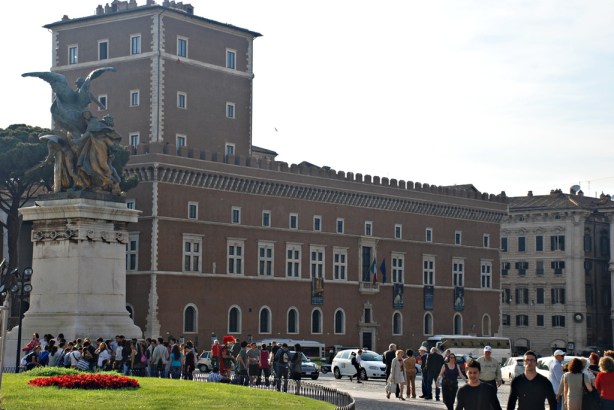
Vatican consumed almost all of the day and we spent the evening at Piazza Venezia, which was very close to the hotel. Mussolini’s residence, Palazzo Venezia, is in Piazza Venezia and a picture is given below. He used to address crowds from the balcony that can be seen in the picture.
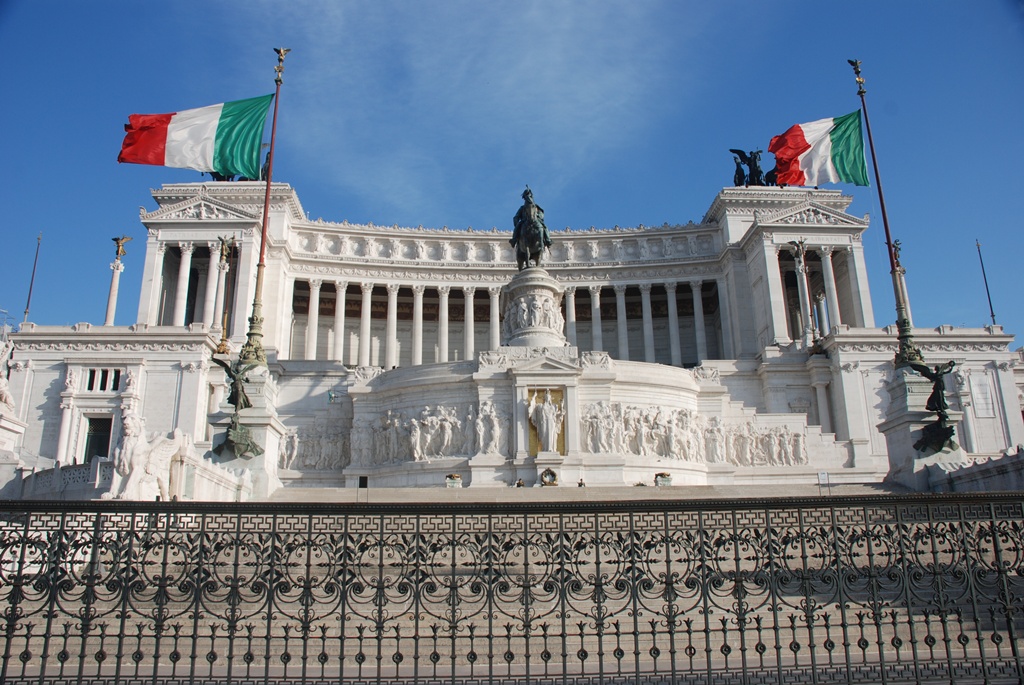
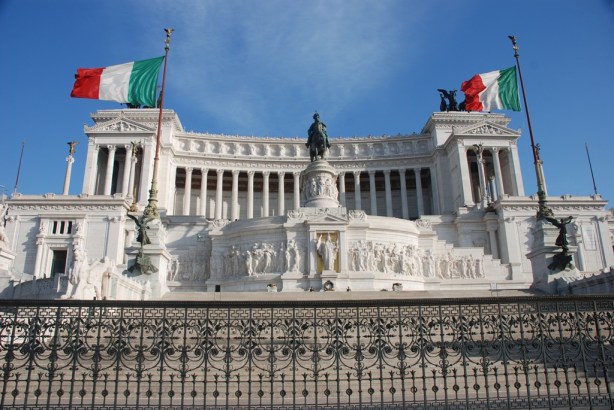
Another salient feature of the Piazza Venezia is “Vittoriano” a monument in the memory of unification of Italy and the first king – Vittorio Emanuele II. Vittorio himself is shown as seated on a horse. The monument also houses the Tomb of the Unknown Soldier.


21 April 2011

With the meetings at Melbourne finishing the day before Good Friday, I had the option of spending the week end at Bangalore or somewhere off Melbourne. Since Sandhya and Bharath were not at Bangalore, I decided to spend two days taking in some sights in Victoria. Earlier, I had been to the South-West of Melbourne, along the Great Ocean Road and then going to Ballarat. So, this time I decided to head North-East and chose a town called Wangaratta, which is at the starting point of the Great Alpine Road – the road that traverses through several towns in Australian Alps. This road is supposed to be Australia’s highest sealed road accessible throughout the year and despite the fact that I had no warm clothing, I wanted to give it a try. The point that there is a wine region called Rutherglen near Wangaratta sealed the deal and so I hired a car from Melbourne and set off by mid-morning on 21st.

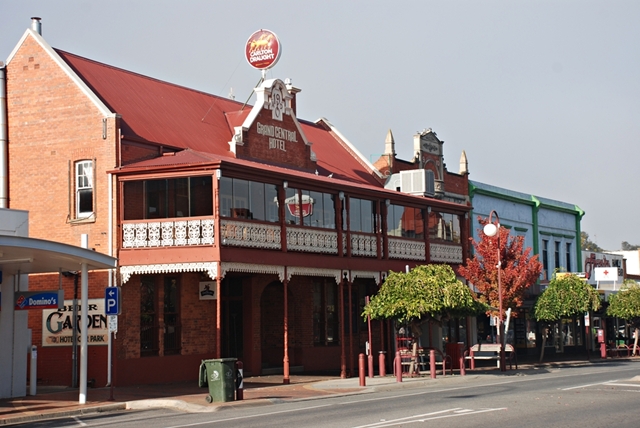
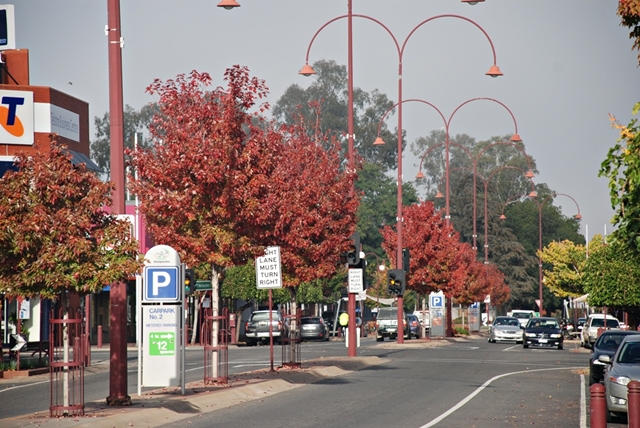
Thanks to the GPS and wonderful roads, I arrived at Wangaratta in reasonable time and checked into my motel. There are no real hotels in this town and I had great difficulty finding accommodation because of the long week end. Hence, I gladly took the Miller’s Cottage Motel without any complaint. Wangaratta turned out to be a one street town with a population of about 18,000.

Rutherglen is a short distance away from Wangaratta and I set off to Rutherglen town along the back roads. The day was okay even if a bit cloudy and the scenery along the road was beautiful. The main occupation of people in this region seems to be farming – cattle, sheep, grapes etc. Great meadows lined the road with large trees appearing here and there. Soon, I came up on a winery called Campbell’s and went in to have a look.

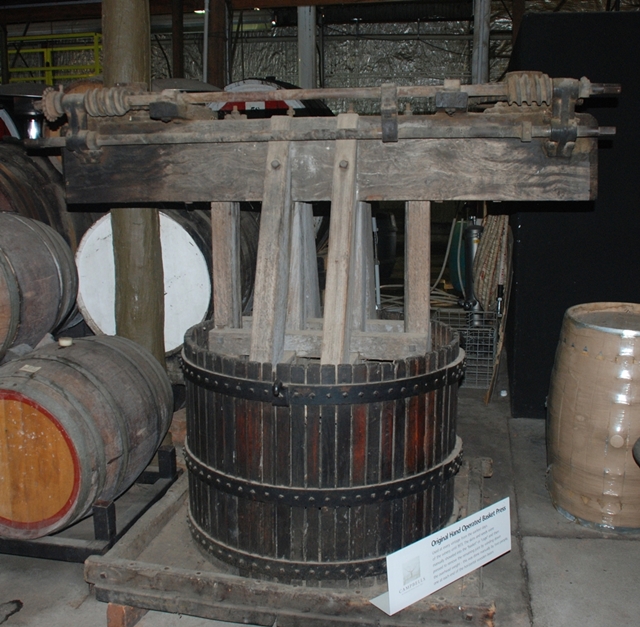
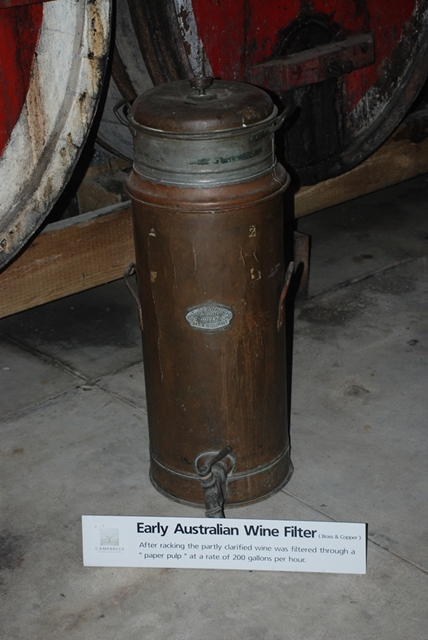
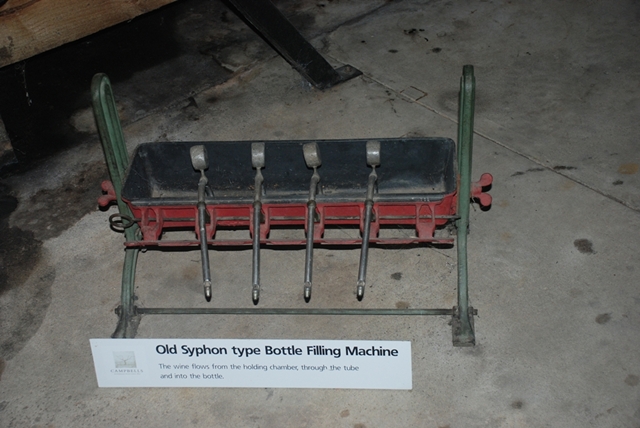
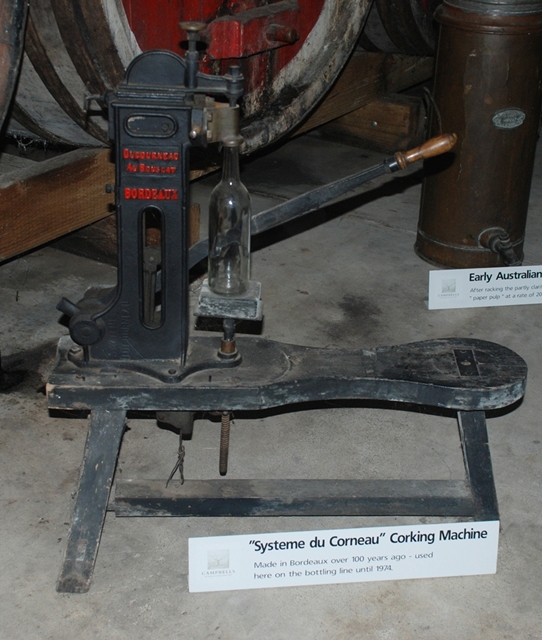
They had an interesting display of equipment used in the early days of wine making.

Hand operated basket press

Wine filter

Bottle filling machine

Corking machine

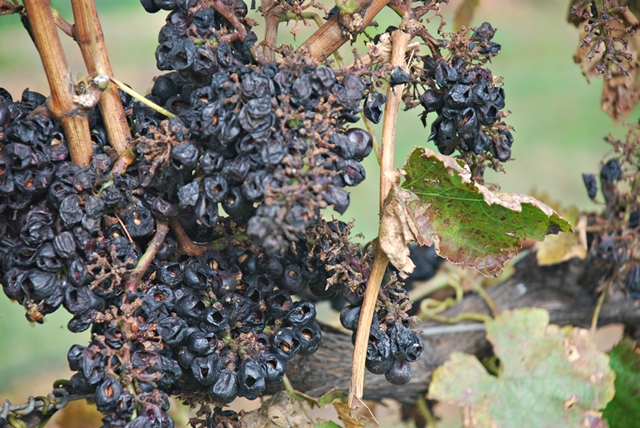
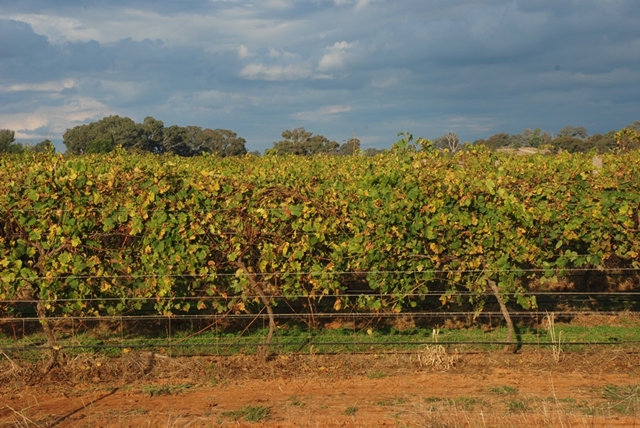
The vineyard was looking very attractive with the vines stretching on and on. The bushes were almost four feet tall and I found that the grapes had dried on the vines. It seems wine in this region is produced mostly from dried grapes and they leave it on the vine to dry. I had always thought that the grapes were plucked when they were ripe.

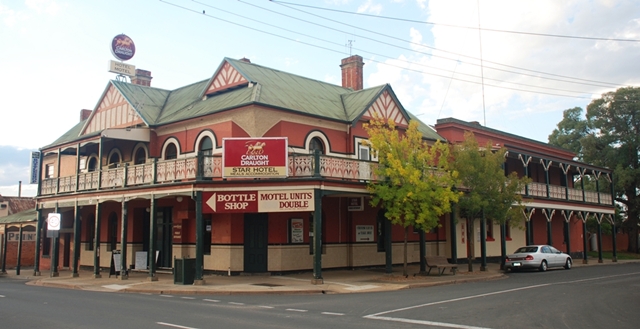
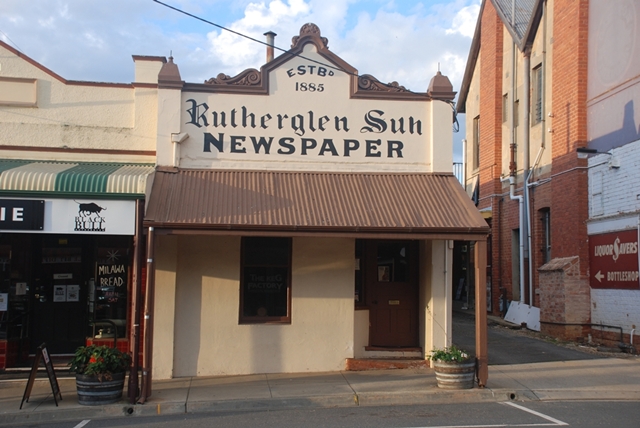
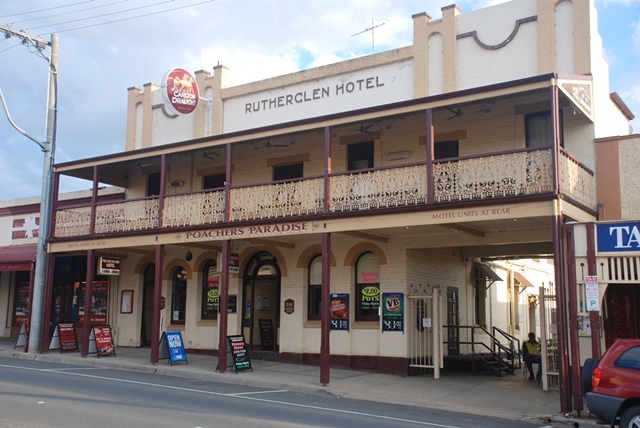
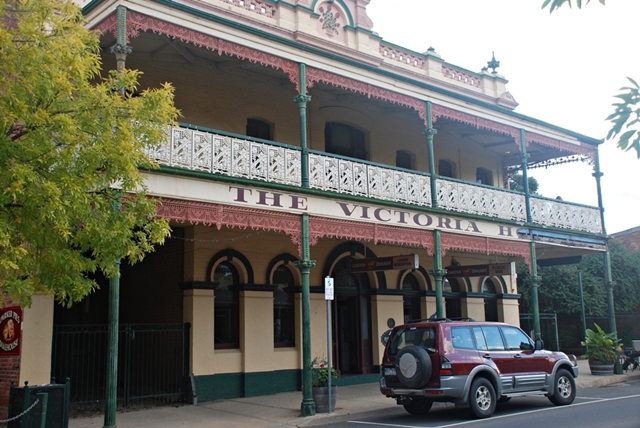
I soon arrived at the town of Rutherglen. This is the centre of Australia’s oldest wine growing region and is considered “historic” as it dates back to 1836. Gold was discovered here in 1860 and that is when Rutherglen got its name and shot into prominence. The first commercial establishment was the “Star Hotel”, which is still working even today.

As was the case with many small towns in those days, Rutherglen had its own newspaper as well. I saw one newspaper building – probably the original one. I have seen that there are many such local newspapers in the US as well and their towns also had the same approach of having their own newspapers. Local news seems to have been most important to the patrons and may be that is why the newspapers in the US give more prominence to local news than international stories, even today.

The town itself has been preserved rather well and the storefronts have an old-world look. Once again I was reminded of what a bad job we do in India in preserving our history.

I drove back to Wangaratta and went to the town for a quiet dinner and a glass of wine. All along the road, I saw many trees that had no leaves at all – may be because it is the Fall season now. I wonder whether these trees will grow leaves again in Spring or will they die off? I caught an image of a tree against the darkening sky and it was a picture of gloom!

22 April 2011

As usual, all plans of getting up early came to nought and the day was reasonably on by the time I drove out of my motel parking. Wangaratta town was deserted because of Good Friday and I could not even find an open coffee shop. My plan for the day was to explore the Great Alpine Road, taking in the towns of Beechworth, Bright etc. Beechworth is another “historic” town and is a short, scenic drive away from Wangaratta. The town was founded in 1850 or so and this one also became a boom town with the discovery of gold in 1852. They have also a done a good job of maintaining the old historic buildings and it has a nice, period look to it.

Of particular interest is the section where the old Town Hall, Courthouse and Telegraph Station stand. These buildings are all from the 1850s and the Telegraph Station has a working Telegraph line with an operator tapping away in Morse code, using the same old equipment, even now. I went in and sent a telegram to my cousin in Sydney and chatted with the operator. He was kind enough to pose for a photo of him sending the wire. He told me that his brother-in-law is an Indian and that he is currently getting some grief on cricket!

Next stop was the Courthouse. This is a big draw for tourists because a bushranger (basically a robber), called Ned Kelly, was tried in this Courthouse. Supposedly, he was the last of the old style desperadoes and seems to appeal a lot to the local population. The Courthouse was built in 1858 and was in use till 1989. The attendant at the Courthouse was in traditional attire and posed gladly for a picture.

He told me that Ned Kelly’s mother (Ellen) was also a colourful character. She migrated from Ireland when she was nine and married Ned’s father (John Kelly) in 1850 and had eight children with him before John’s death in 1866. She then had another child by a man named Bill Frost and when he refused to acknowledge the child, she sued him in court and won support costs for the baby. In celebration, she rode her horse around a nearby town call Benalla and was arrested for “furious riding in a reckless manner”. A few years later, she hit a police constable over his head with a shovel when he abused her daughter and was sentenced to three years in prison for attempted murder. She was held in the Courthouse at Beechworth for two months till the Circuit Judge could arrive to conduct her trial. It was while she was in prison that her son, Ned, was sentenced to death. She visited him in gaol before the night of his hanging and told him to “die like a Kelly, son”. Ellen lived to the ripe old age of 91 and died in 1923.
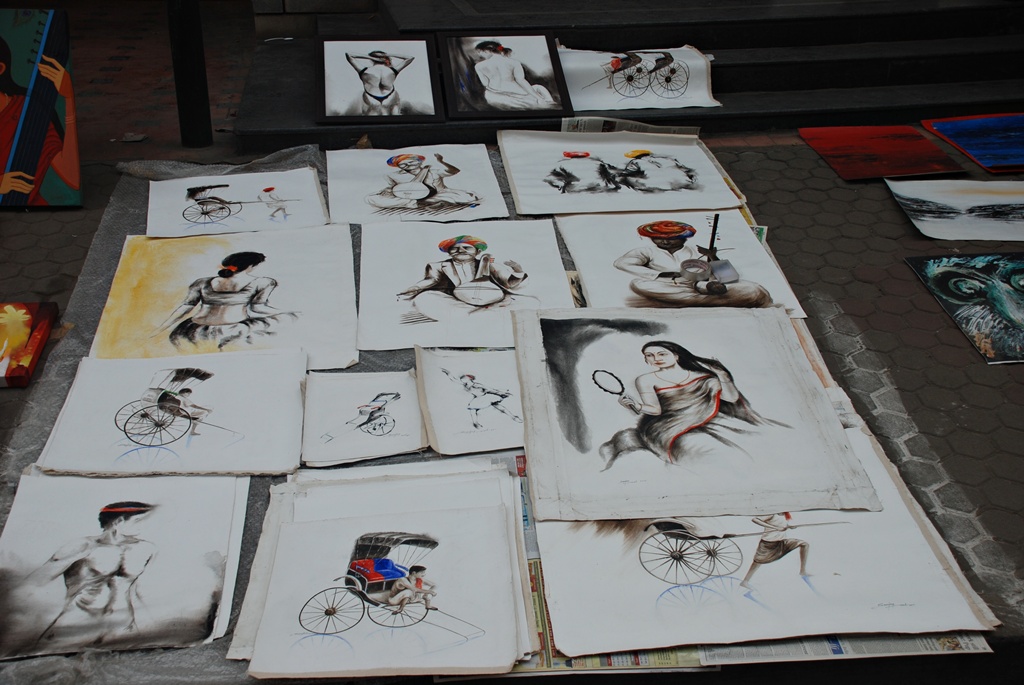
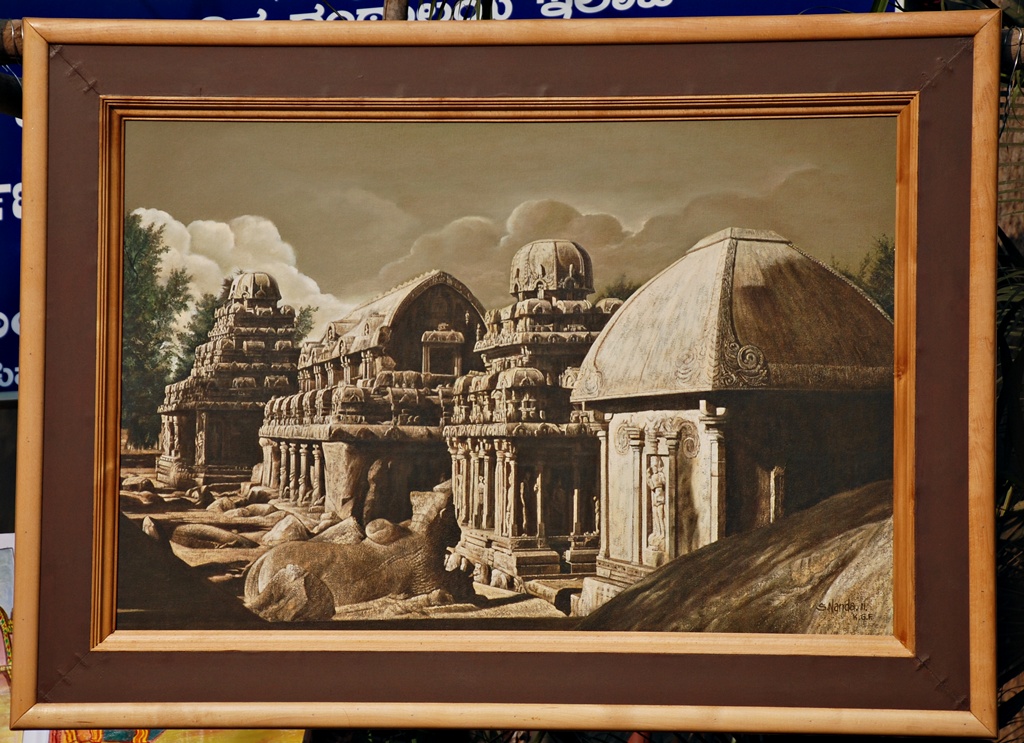
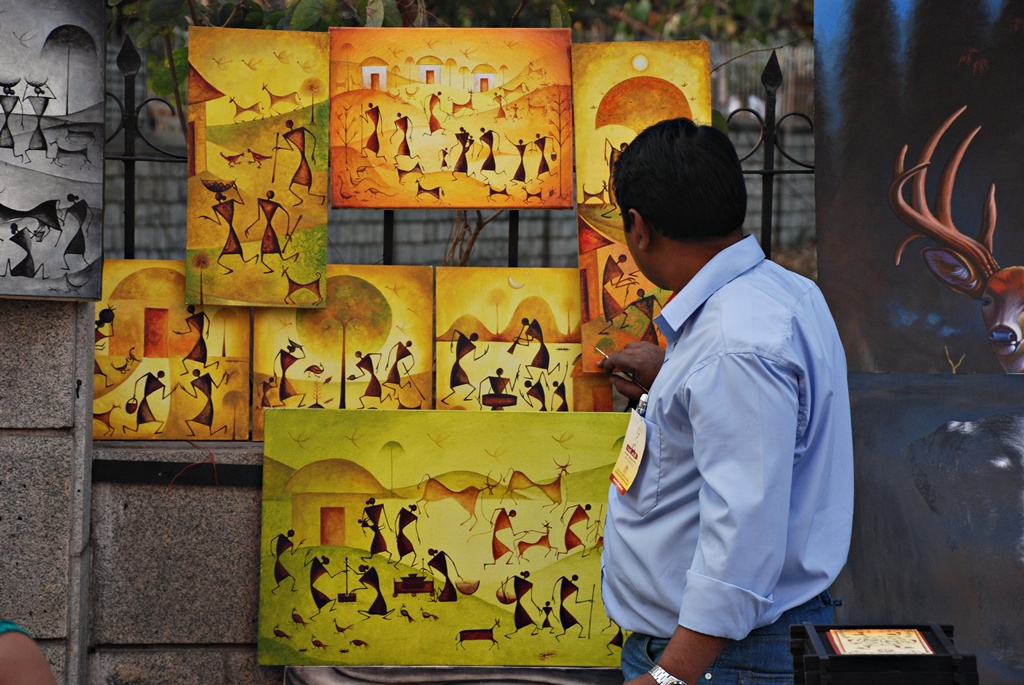
It was her story that attracted me more than her son’s – though all tourism web sites are filled with Ned Kelly and his exploits. He seemed to represent the resistance to the colonial power and looks like the whole Kelly family was treated a bit unfairly. Australia must have been a rough, frontier country in those days and life must have been hard for the common people. Those that survived were spirited folks that fought their way through and had little time for the “gentle, prim and proper” behaviour that so characterised Europe at that time. Ellen Kelly would have been like many others at her time. I am sure similar stories can be found in the US also. These two countries have some similarities in that they are both relatively young and were populated and developed by settlers. You can also find similarities in their treatment of the indigenous people, which was ruthless, to say the least.

Edward (Ned) Kelly was born in 1855 and led a gang of around four. They were bushrangers and Ned had a fantastic plan of setting up a Republic of North Eastern Victoria. His plan was to have the four members lead an army of supporters and he came up with an idea of having protective armour for these four important people. A replica of the armour is displayed in the Courthouse and it looks rather crude and unwieldy. In any case, all these plans came to an end with the capture and subsequent execution of Ned Kelly in 1880.
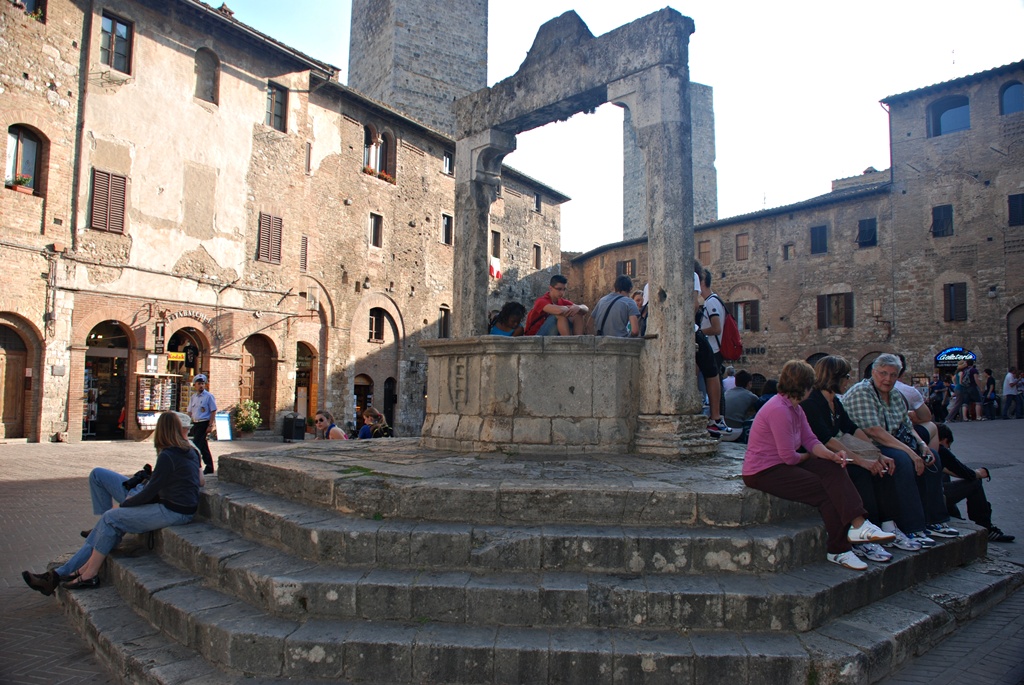
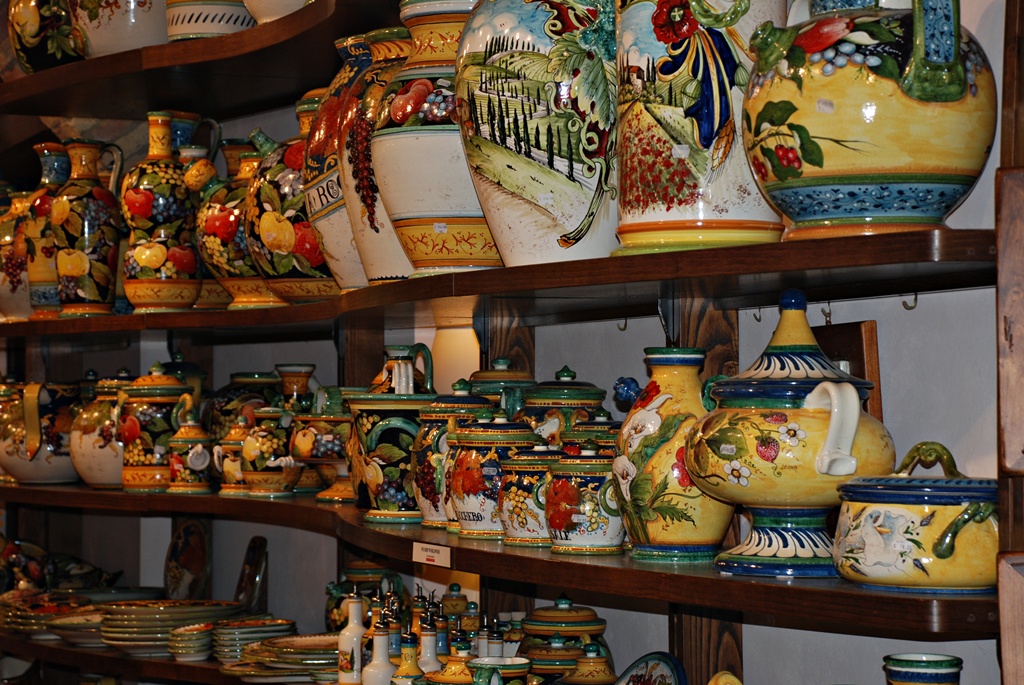
From Beechworth, I left for the town of Bright. A great part of driving around in Fall, in regions like these, are the wonderful colours that you get to see as leaves change colour. There was a whole variety from dark green to bright red on display along the roads. These leaves will all fall off by winter and the leafless trees are a desolate sight.

Bright turned out to be another small town, much like Beechworth, Rutherglen etc. En route, I stopped at a winery and had a taste of some red wine. It was quite full bodied and I liked it. About an hour’s drive from Bright, on the Great Alpine Road itself, comes the ski village of Mount Hotham. This village is at an altitude of 1862m and the route up to Hotham is quite steep with many sharp curves. The mountain seemed to be mostly jagged rock with very little vegetation. The soil layer is rather thin and it is pretty obvious that large trees will not be able to grow here. I could see many small bushes that had shed all leaves and had turned dry and white. From afar, it looked as if the mountains had grey hair!

The temperature dipped by about 10 degrees as I went up the mountain and it was quite chilly. There were some breath taking views but I could not stop at most places as the road was quite narrow. The mountains looked jagged and once could see many deep ravines. There are some footpaths, which one could explore but I could not do it as I was not dressed right and it was quite chilly and cloudy. It was almost dark by the time I got down from the mountain and I was quite tired as well by then, having driven about 250km.

I had a quiet meal once again in Wangaratta with the thought that I had to leave early next day morning to catch my flight back from Melbourne. Overall, I was happy that I had taken the time to visit this area, even if it is not very rich in history, like Europe. The views were literally breathtaking and the two days were a visual treat.